Pages

Showing posts with label drives. Show all posts

Nov 19, 2012

Hands-on: intelliPaper redefines the disposable world of USB drives

Do you own more than two USB flash drives? What do you do with extra sticks you'll never touch again? With intelliPaper, promotional USB sticks can be recycled, reused, and mailed without the bulk of physical plastic drives.

Last I counted, there are at least 15 USB flash drives scattered across my desk. We get them when public relations companies send over review units, at press events, or as swag at industry parties. If USB flash drives became currency one day, technology journalists would be the richest people in the world.

But they’re not. Flash drives are a way for PR companies to consolidate information into a compact package so we can pay attention as we try a new product, instead of taking spec notes. Unfortunately, after the article is said and done, the USB drive goes back into a drawer where many of its cousins reside, never to be touched again. It’s a waste of plastic and perfectly good technology.

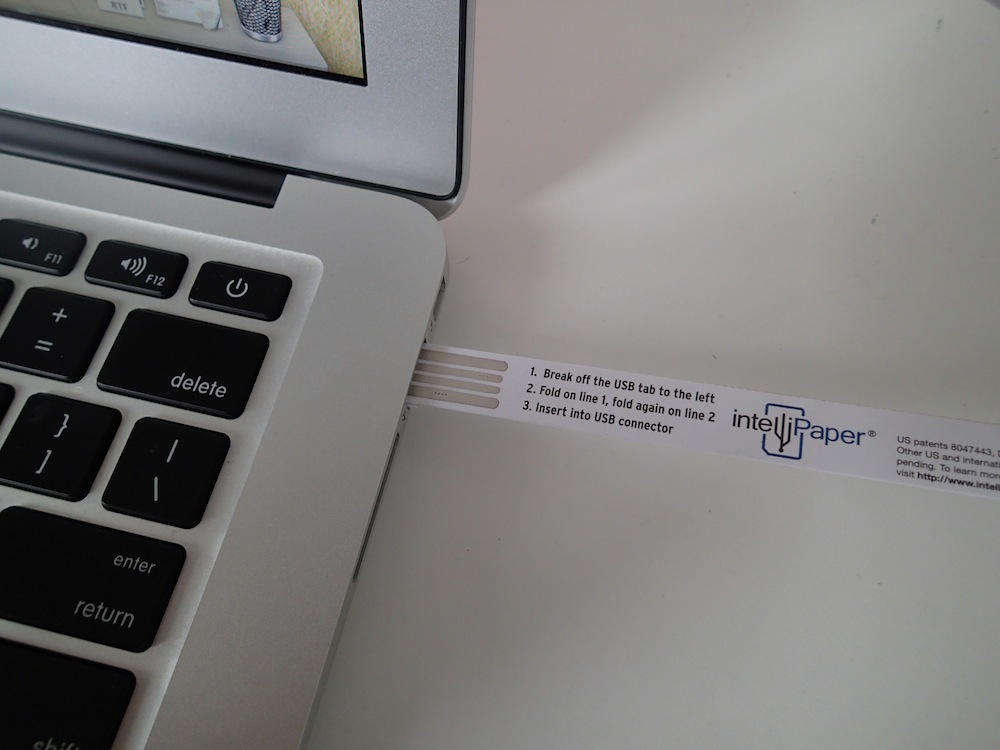
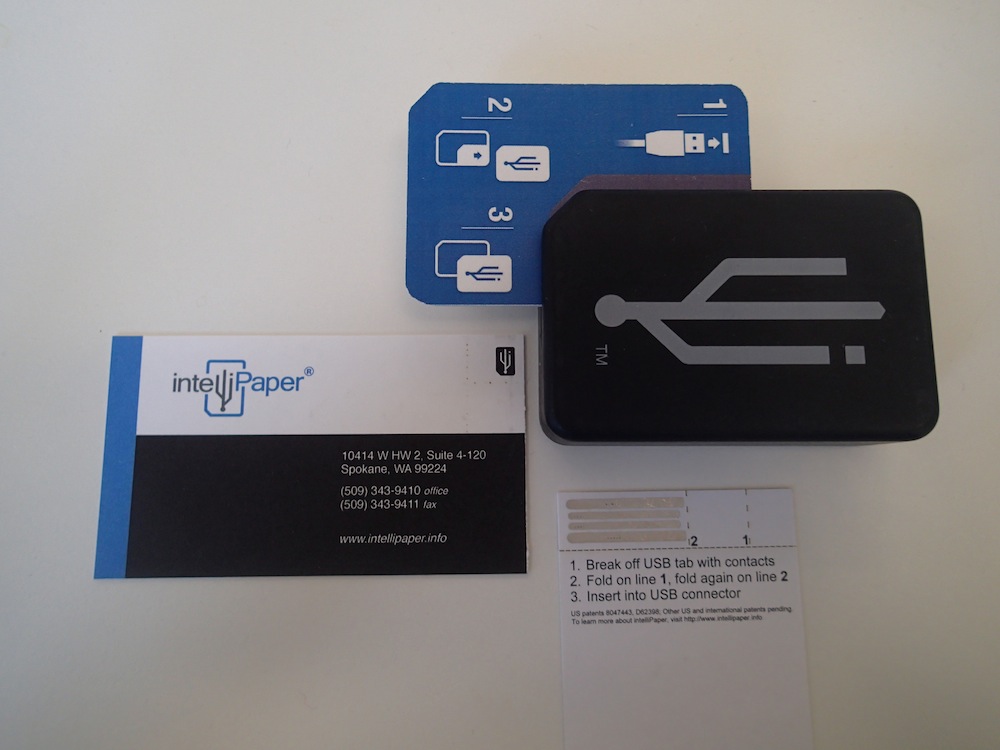
To combat this uneconomical practice, Andrew DePaula and team have invented the intelliPaper. At first glance, it looks like your average cardboard paper with silver prints at the end. But tear this perforated edge out and stick it into your computer’s USB slot and you have a functioning, flash drive. It’s an ingenius response to the increasing use of USB technology in a recyclable, disposable way. And in turn, we no longer have to feel guilty for hoarding little plastic drives.
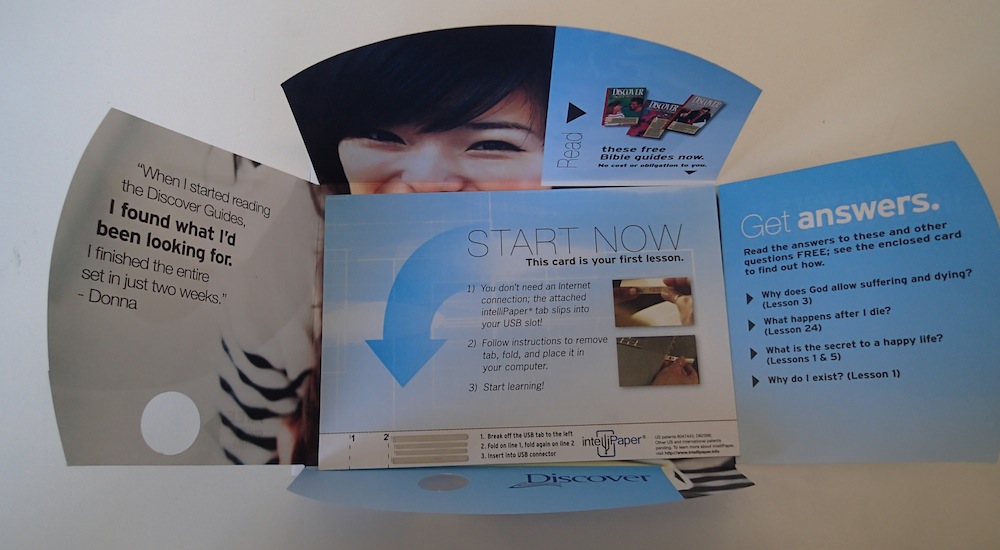
The intelliPaper team sent over a press kit to visualize how practical paper USBs can be. In it, we find a university pamphlet with a detachable intelliPaper strip at the bottom for more information, a postcard, and a few business cards. There’s also a stone-shaped reader that connects to your computer via mini USB cord if you’re uncomfortable with jamming a cardboard strip into your drive. These sample applications allow companies to provide additional information without the bulk and waste of plastic, and customize them in a practical and effective manner.
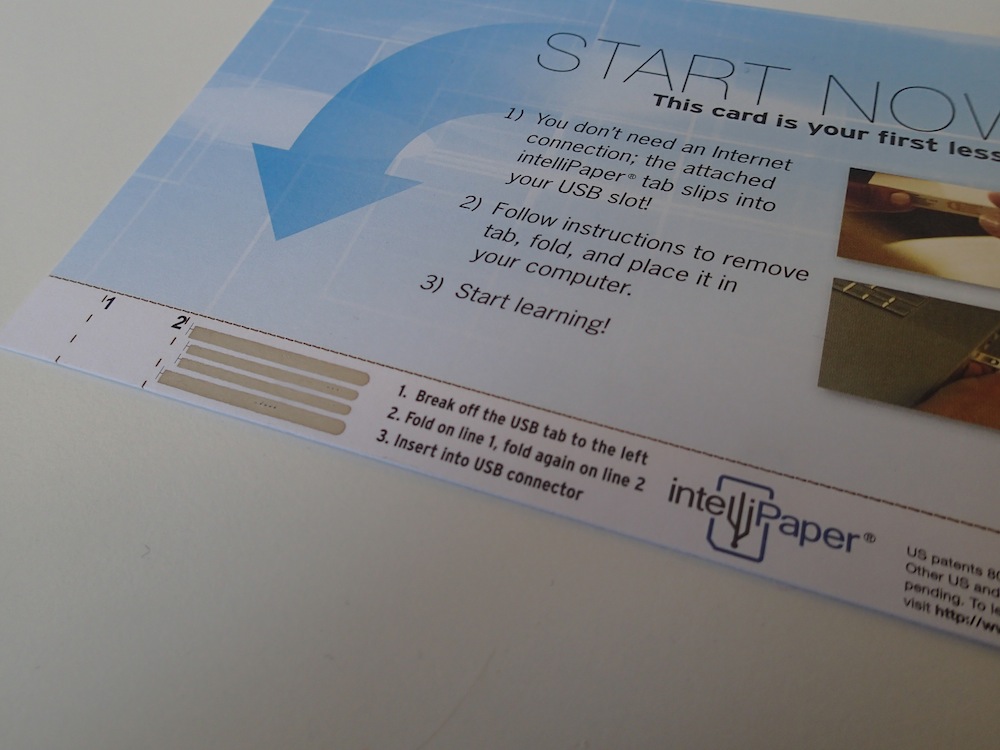
“We’ve been selling the product to a handful of companies since April. These are real projects that companies paid us to do,” DePaula tells us. “Right now, the samples are read-only, but there’s no reason anyone like yourself can’t get them and do whatever you want.”

With his Indiegogo project freshly launched, he aims to create a version where people can write their own files to the drives and print them on pamphlets or business cards of their choice.
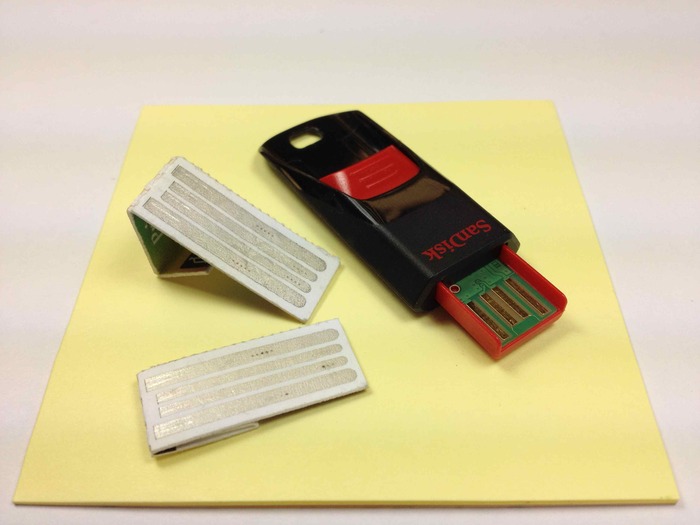
The secret to intelliPaper’s design is to strip a traditional USB drive to its core. DePaula did away with the bulky plastic housing and embedded the same silicon flash memory in the paper, thus creating a paper-thin USB drive.

In our initial use, we found intelliPaper quite intuitive. For disposable, one-time-use purposes, intelliPaper is an excellent way to curb manufacturing costs on drives. Not that there is a mobility issue with USB drives, but flattening it to the thinness of paper also makes it mailable in a regular envelope. Why is this important? Let’s be frank: People are curious. Even if you don’t care about the info kit that was sent to your house, if it comes with a paper USB, you’d at least want to stick it in your computer and see what’s up.
That’s not to say intelliPaper doesn’t have some problems left to resolve. In rare instances, intelliPaper managed to instantly boot me off my computer upon USB insertion – a problem DePaula guesstimates to be my MacBook’s older version of Mountain Lion. He also notes that my case is the first he’s ever heard of intelliPaper’s bugs, and the team is working hard to resolve any possible glitches. “There’s some [Mac] update that makes our product not work. It just doesn’t show up on your screen even though the system hardware shows it recognizes the flash drive,” he says. “We’ve made some changes to keep the product up to date, though why it didn’t work in the first place is still a mystery.”

One could argue that all this could be resolved if we just resorted to Web addresses. But the truth of the matter is, USB drives – outside of their storage utility – have become a way for companies to advertise and reach new audiences. Although the drives are still somewhat expensive at the Indiegogo funding of $100 for ten 8-32MB drives, like any new product, the price should go down with scale. The possibilities seem infinite. When those days come, the only plastic USB drives I’ll own are the ones I actually want, use, and need.


Source : digitaltrends[dot]com

Nov 14, 2012

Samsung SSD commercial featuring Overly Attached Girlfriend gets over 1 million views

Making solid-state drives sound interesting is an advertiser's Everest. However, Samsung's latest ad for its SSD 840 series made us chuckle thanks to Internet star Laina Walker, the Overly Attached Girlfriend.

Solid-state drives (SSD): they’re tough, fast, silent … and inherently difficult to advertise. While you’d want them in your computer, they’re not exactly the feature-rich eye candy you’d want to ogle over on your screen. So when Samsung launched its SSD 840 line, the company decided the best way to drum up publicity for a boring product is to release a hilariously creepy viral video starring Laina Walker, otherwise known as Overly Attached Girlfriend. And lo and behold, the ad has over 1 million views on YouTube.

“Hey, it’s me your computer,” the ditty begins, as Walker’s large, Stepford-Wife-like eyes hold you captive with their unblinking stare. Walker, known for the funny yet slightly unsettling Overly Attached Girlfriend Internet meme, takes on the role of a wayward computer, threatening you to get her a Samsung SSD if you don’t want to lose your files or have sensitive data leaked. “There’s tons I stopped from getting out: passwords, credit cards, bank account. These days, I’m so clumsy, I need your love to calm me,” she sings in part of lyrics.

But all creepiness aside, the Samsung SSD 840 Pro series is designed for use by IT professionals, heavy computer users, and serious gamers. They’re slightly more expensive than the regular SSD 840 products, which are meant for everyone else who just wants an SSD. Both the Pro and regular options feature super-fast load and read speeds – the Pro more so than the regular variant. The Samsung SSD 840 Pro series is available in 128GB, 256GB, and 512GB configurations, with prices starting at $189.99. The regular SSD 840 series is available in 120GB, 250GB, and 500GB configurations, with prices starting at $139.99. 

Check out the video below and let us know what you think. 


Source : digitaltrends[dot]com

Aug 23, 2012

Is digital hoarding dragging you down?

old computer parts monitors

Cheap hard drives and cloud storage have made it possible never to delete a file ever again. But should we stop selecting what we save just because we can?

I used to hoard a little bit. I’m not talking about floor-to-ceiling newspapers and envelopes of toenail clippings here, just some assorted tech junk. When I had children, we needed more room and so the junk had to go. I’m sure many of you are familiar with the need to keep old consoles and games you don’t play anymore, bits of old computers that still work perfectly well, a big bag of assorted wires and adapters, you know, just in case. My wife made me go through it and applied a ruthless rule: If it hasn’t been touched for over a year, or I don’t know what it’s for, then it has to go.

There were boxes that had been packed up two moves ago and never re-opened; old remote controls for DVD players and computers that I don’t even own anymore; US power cables still in their packaging because some devices shipped with both (I live in the UK); two broken PCs that I was planning to one day assimilate into what would be an antiquated and useless computer. Many things I couldn’t even identify. In the end I threw everything away or gave it away.

It felt great. It was a cathartic experience. I felt unburdened. Free of the pressure that I would one day organize and find a useful purpose for all of this stuff. Real world hoarding gets plenty of press nowadays, and we know it’s bad for us, but what about the junk we collect in the virtual world?

Infinite space, infinite clutter

We need to throw off the shackles of digital hoarding before it weighs us down. Hard drives are cheap and they are capable of storing tons of useless files. Almost everyone can afford the digital equivalent of a many-roomed mansion. So what if a few rooms are piled high with boxes we never open? We don’t need that space anyway.

The ease with which we can store digital files encourages us to stick them in a folder and forget about them rather than ask whether we need to keep them at all. My hard drive looks much like my wardrobes used to. I have folders that have been transferred from computer to computer and never opened. I think my first PC had a 10GB hard drive. This one has a terabyte. A quick look reveals a vast repository of junk, the detritus of past jobs, long-forgotten conversations, every holiday ever taken, and an awful lot of random stuff that was never deleted because there was no need to delete it. Is all of this accumulated baggage from life actually weighing us down?

Most of us have thousands of photos now and camera technology is vastly improved, yet we also yearn for the nostalgic experience of leafing through old photo albums. We use apps to give our shiny new perfect images faded tinges. Do we really want our memories to be perfect? Do we want to see things exactly as they were?

Putting memories on autopilot

Viktor Mayer-Schönberger, Director of the Information Policy Research Center, National University of Singapore, makes some excellent points in an interview with Big Think. He points out that the default used to be forgetting and it took some effort to remember things. That has been reversed now. Remembering has become the default and it actually takes effort to forget.

He’s right. Think about the selection process for a photo album or a memory box. It involves you curating your own life experience. You want to cherry pick the best bits and let go of the rest. As Mayer-Schönberger points out, people who can’t forget actually generally hate it because they’re stuck with a lot of useless information and a perfect memory of every mistake they ever made. Forgetting things and letting go of the past can be good for our mental health.

old tech in trash cables keyboard cd mouseAnother scary development is the idea that this is all being taken out of our hands. Social media and the cloud create a situation where large portions of our memory are now stored remotely. We may even lose control over those photos and files. Think carefully about what you are backing up.

Dr. Stanton D. Sloane provides another motivating angle for cutting out digital hoarding. He points out in Forbes that all those files in the cloud are being stored in power-hungry server farms. Your digital hoarding potentially has a big carbon footprint.

Salvation through automation… and willpower

So what’s the answer? If you’re organized or determined enough, then perhaps that long-promised “sorting things out” day will arrive and you’ll go through all those files and apply the same rules as you would to physical junk. If it hasn’t been touched for over a year or you don’t know what it’s for, then throw it away. Let’s be realistic though: That day is never going to come for most of us. I’ve started on that process a few times and been instantly distracted. Because the need to throw it away doesn’t seem pressing, the drive to do it isn’t strong enough.

When I first read Mayer-Schönberger’s solution I was horrified. He suggests that digital files should have an expiration date. The more I think about it, the more I like the idea. This changes things back so that you have to expend some effort to keep the things you really want to keep. The things you don’t care about, or need, can be allowed to float gently off into the digital void. The default would be forgetting and remembering would require some effort again.

How much of the stuff that’s clogging up your hard drive is actually useful? It can reach the point where searching for something on your hard drive actually takes longer than just searching for it online and downloading it again. There’s no point in keeping old emails or photos that are mediocre or even flat out rubbish. Do you really need that TV series that you already watched?

We need to get into the habit of deleting things immediately, because whatever sneaks past that initial hurdle can end up being carried around with you for the next few years, maybe even until you die, when some relative has to wade through it. Imagine reaching your eighties and having to go through 30 plus terabytes of files. You’ll never make it. You could die searching for that elusive photo or that awesome article you wrote in university. Sometimes finding it is worse because it can never live up to the memory in your head anyway.

I’m off now to take my own advice and purge my hard drive, wish me luck.

[Photo credit: Old computer - Shebeko/Shutterstock; Trash can - Sharon Day/Shutterstock]


Source : digitaltrends[dot]com