Pages

Showing posts with label cabin. Show all posts

Oct 19, 2012

2013 Lexus LS 460 first drive

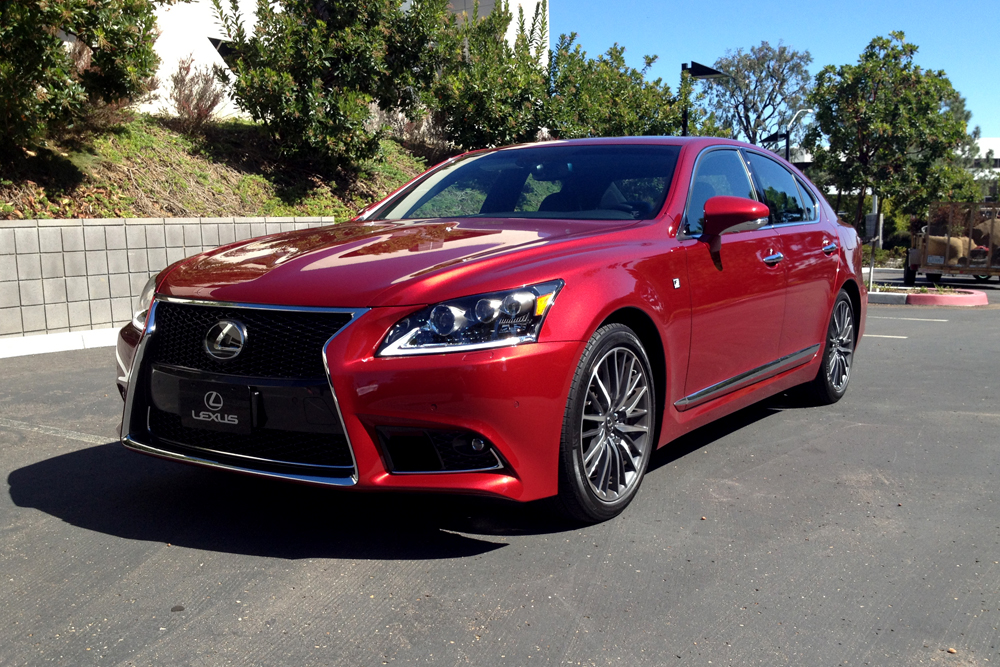
2013 Lexus LS 460 F Sport front angle first drive

Lexus unveils the latest version of its flagship sedan, featuring a dramatic styling overhaul and a robust list of tech features throughout its cabin.

Up until recently, Lexus had been swimming in dangerous waters. The Japanese luxury brand had become stagnant with its design philosophy, offering up little aesthetic excitement in comparison to some of its rivals, most notably BMW, Audi, and Mercedes. To draw a sports analogy, it seemed Lexus was merely content with becoming the automotive world’s equivalent of former Utah Jazz point guard and NBA Hall of Famer John Stockton: an industrious, hardworking, and unassuming player who was big on performing, but offered little flair or excitement to his approach to the game. While Stockton is regarded as one of the greatest point guards of all time, he was never exactly lighting up the highlight reels.

The same could be said for Lexus, although thankfully things are looking much brighter — and more exciting — at camp Lexus these days. It all starts with the company’s new “spindle grille,” which has finally made its way to the flagship LS sedan after having graced the new GS and ES models. But unlike the recent GS and ES models, the new LS lineup, which includes the LS 460, the all-new LS 460 F Sport, and the Earth-friendly hybrid LS 600h L, is more of a refresh of its 2012 predecessors than an entirely new offering. Thankfully, though, this update provides more than enough substance.

We recently had the opportunity to drive the 2013 LS 460 F Sport through the streets of sunny San Diego, California. Here is what we walked, or rather, drove away with.

More powerful than polite

The old maxim states that you should put your best foot forward; in this instance, however, Lexus has opted to put its best face forward, and it all centers on the company’s new grille. Gone is the sterile and sleepy trapezoidal front end adorning previous model years. Instead, Lexus has wisely opted to bring in a degree of uniformity to its models – and it works. BMW has the iconic kidneys, Audi has its dazzling LEDs, and now Lexus has provided itself with an aggressive aesthetic: a bolder, wider front end with a gaping maw that commands attention. The same look has been implemented across the line.
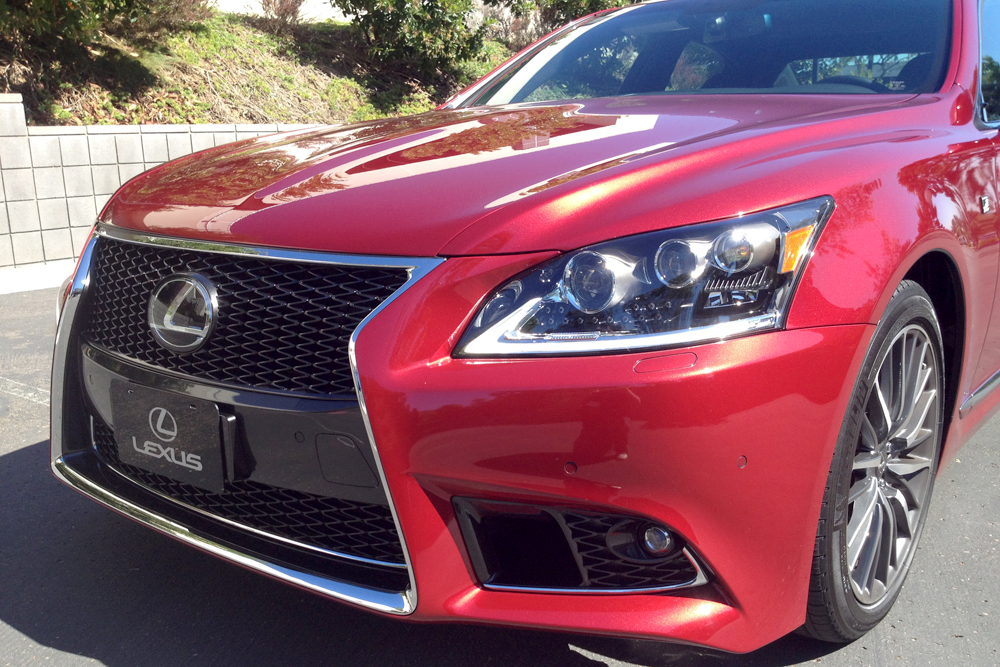
2013 Lexus LS 460 F Sport front left angle 2For the 2013 LS, Lexus also tweaked the front LED headlamps. Gone are the numerous sequential LEDs, replaced by a three-lamp configuration that provides a solid, continuous glow during both day and nighttime driving. It’s a small change, but one that provides just enough significance and visual cadence to Lexus’ flagship sedan.

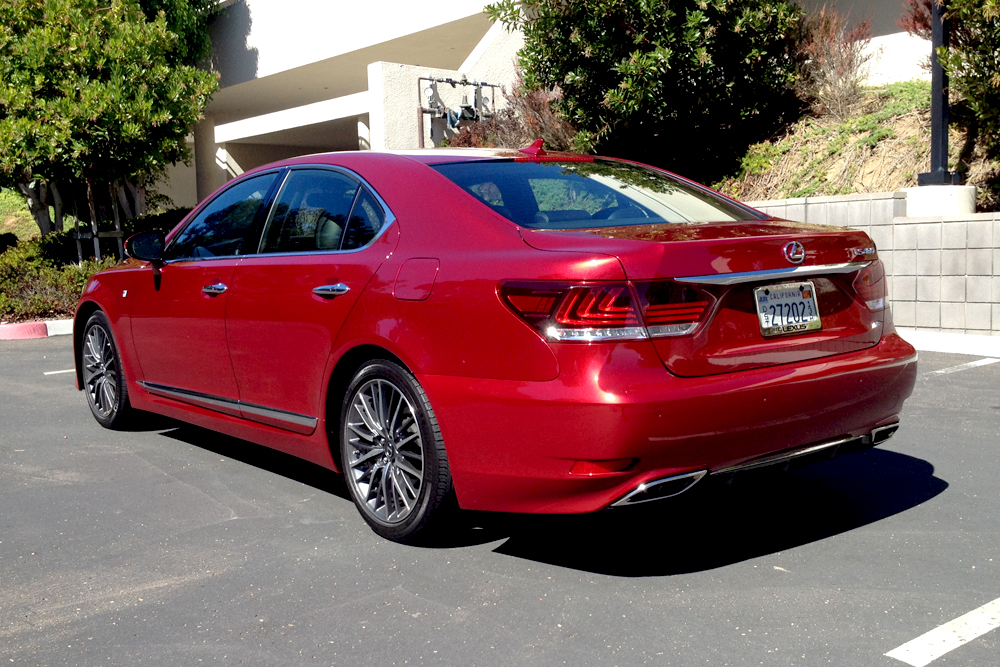
2013 Lexus LS 460 F Sport back right angleEven so, while the majority of 2013 LS’ touch ups are more readily witnessed up front, the tail of the car has received some love and attention from Lexus’ engineers. In keeping with the wider, more aggressive theme, the rear of the vehicle compliments the front’s athletic stance with sleeker LED taillamps and more sharply blended pillars.

It’s the little things

As you can imagine from a premium nameplate like Lexus, the LS 460 doesn’t skimp on luxury. For the 2013 model year, the LS 460 demonstrates its quality with a host of features and appointments that seamlessly blend Japanese craftsmanship with 21st century design. According to Lexus, a great deal of effort went into creating a cabin that was both spacious and luxurious. With our time in the LS 460 we see that this is very much the case. Of course, it’s the little things that add up, like genuine spun aluminum used throughout the cabin, and the gorgeous Shimamoku wood trim found on the steering wheel. Simply put, those looking for well-appointed, full-size luxury sedan would do well to cross shop against a comparable Audi, BMW, or Mercedes-Benz.

The technology of luxury

While we could drone on about bolstered seats and a host of other comfort details, what really had us most excited is the available cabin and safety tech integrated into the 2013 LS. We’ll start with the convenience aspect, though.

New for 2013 is a 12.3-inch LCD screen located centrally along the dashboard. In addition to displaying the navigation system, the LCD screen displays both phone and stereo interfaces. Its generous real-estate can be partitioned into three separate displays allowing for simultaneous viewing. For example, if you’re in the midst of using the navigation system, you can also see what track is playing on the stereo, or place a phone calls without having to close out one function over the other. This allows for a greater degree of utility and functionality. While bigger isn’t always better, it’s nice to see Lexus make use of the larger screen size in a smarter way.

2013 Lexus LS 460 F Sport GPS test driveSimilar to the interface we encountered in our 2013 Lexus GS 350 review, the 2013 LS utilizes the same mouse-like knob for controlling and navigating the vivid LCD screen, which itself is located on the center console. While touchscreens may be more intuitive, we’re proponents of a more tactile like this, and BMW’s iDrive controller. The responsiveness and ease of dial system over the current crop of touchscreens cannot be ignored.

Also available in the 2013 Lexus LS is an HDD navigation system with 80GB hard drive. In addition to downloading, updating, and transferring map data via a DVD or USB thumb drive, a few new features have made their way into the system. Automatic zooming, true 3D map viewing with city model and landmark graphics, as well as relayed speed limit information are all new for 2013. Lexus also tells us that the voice guidance system has been beefed up for the new model year, including active rerouting guidance as well as dynamic traffic guidance on roads without sufficient information.
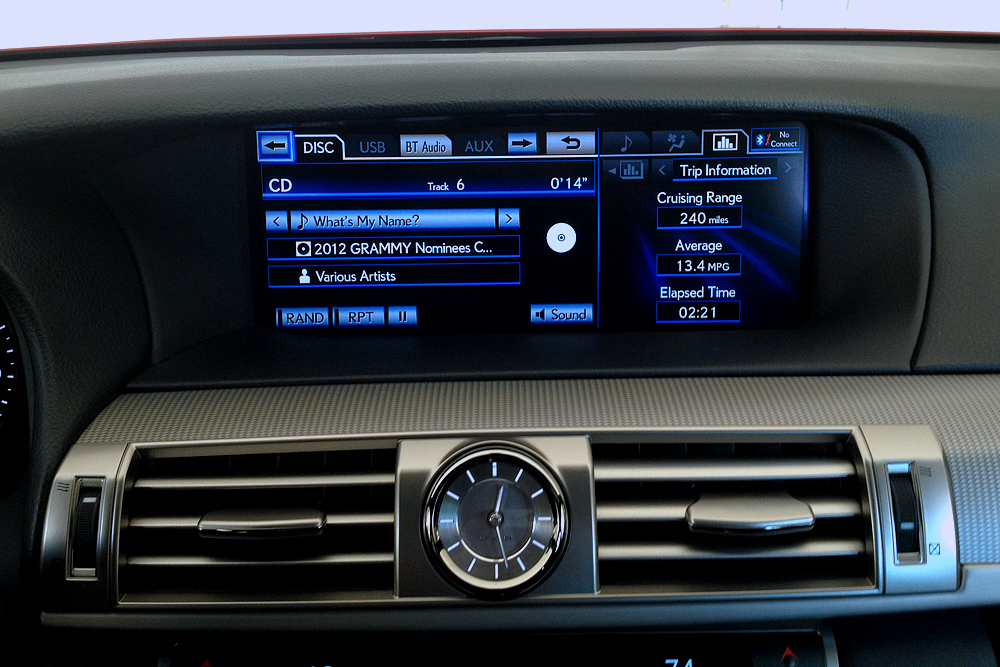
2013 Lexus LS 460 F Sport dash musicIntegrating into the navigation system is Lexus’ Enform telematics suite. Here, drivers have the ability to download the corresponding Enform smartphone app and gain access to supported apps via voice commands and Bluetooth. Currently, Enform supports various functions such as internet searches via its Bing app, as well as other applications such as iHeartRadio, Pandora, and OpenTable, among others. We weren’t able to test these functions during our brief drive, but we’ll have a more comprehensive rundown once we fully review the vehicle.

But much more than simply offering superfluous tech features, the 2013 Lexus LS packs three impressive safety technologies drivers are sure to appreciate. First up is Blind Spot Monitoring (BSM). While driving, this tech will alert you tif a vehicle is operating within your blind spot zone. It uses two radars, which are located at both the left and right rear quarters of the vehicle. If you try to shift lanes when they detect a vehicle present, it will will illuminate a mirror indicator to notify you of the potential hazard. If you happen to not being paying attention to the initial warning, BSM takes it a step further by emitting a flashing indicator on the side mirror when engaging your turn signal while a car is drifting in your blind spot.

The 2013 LS also features what Lexus calls its Rear Cross-Traffic Alert (RCTA). While the LS is equipped with a rear backup camera that allows you to see what is directly behind you, RCTA makes use of small microwaves to detect approaching vehicles to either side of you while parked.

Finally, perhaps the most impressive safety tech implementation, and one we are more than happy to have but hope to never have to use, is Lexus’ Advanced Pre-Collision System (A-PCS). Working in conjunction with millimeter-wave radar, front-facing near infrared projectors, and a front-mounted stereo camera, the A-PCS is designed to detect both vehicles and pedestrians and, you guessed it, avoid colliding into them. A-PCS works in conjunction with the vehicle’s advanced obstacle detection system and provides an innovative way of avoiding low-speed collisions, the key word here being low-speed. At speeds of less than 24 miles per hour, and in the event of a potential collision, A-PCS will assess the probability of a collision. If the system anticipates that a collision is indeed imminent, it will seek to warn the driver by emitting both a visual and audible warning. At the same time, A-PCS will automatically engage a number of safety measures, including emergency steering assist, giving the steering a greater response to the driver’s input; stiffening up the air suspension system for greater evasion controls. Last but not least, the A-PCS will apply a Pre-Collision Brake Assist system (PBA) to aid in emergency breaking force.

If all else fails, you fail to take the appropriate counter measures, and if you are traveling 24 mph or less, the A-PCS will automatically engage its breaking system, providing approximately 1G of stopping power. Lexus tells us the system will still kick into effect even when traveling at greater speeds, in order to mitigate potential harm and damage.

Rounding out the safety tech in the 2013 Lexus LS is a Dynamic Radar Cruse Control system, as well as an active lane departure system.

Powertrain: Same, but different

Powertrain options across the 2013 LS remain relatively simple as not much has changed from last year’s models. That means we see the same 4.6-liter V8 — only this year, Lexus has manage to squeeze out six more horsepower, bringing the total to 386 hp and sending 367 pound-feet of torque to the rear wheels via an eight speed automatic transmission. We see those numbers dip in the all-wheel-drive model due to a different exhaust setup, where the 2013 LS produces 359 horsepower and 347 lb-ft of torque.

For drivers just as concerned with style and luxury as they are with helping the environment, Lexus continues to offer its LS 600h L for 2013 model year. Its hybrid drivetrain features a 5.0-liter V8, two electric motors, and a nickel-metal hydride battery pack.

As far as engine efficiency is concerned, the 2WD LS should net 16 mpg in the city, 24 mpg on the highway, and 19 mpg combined, while the AWD LS is estimate to achieve 16/23/19. (Both figures based on using premium fuel.) This is by no means stellar, but not the worst fuel economy numbers we have seen in this class.
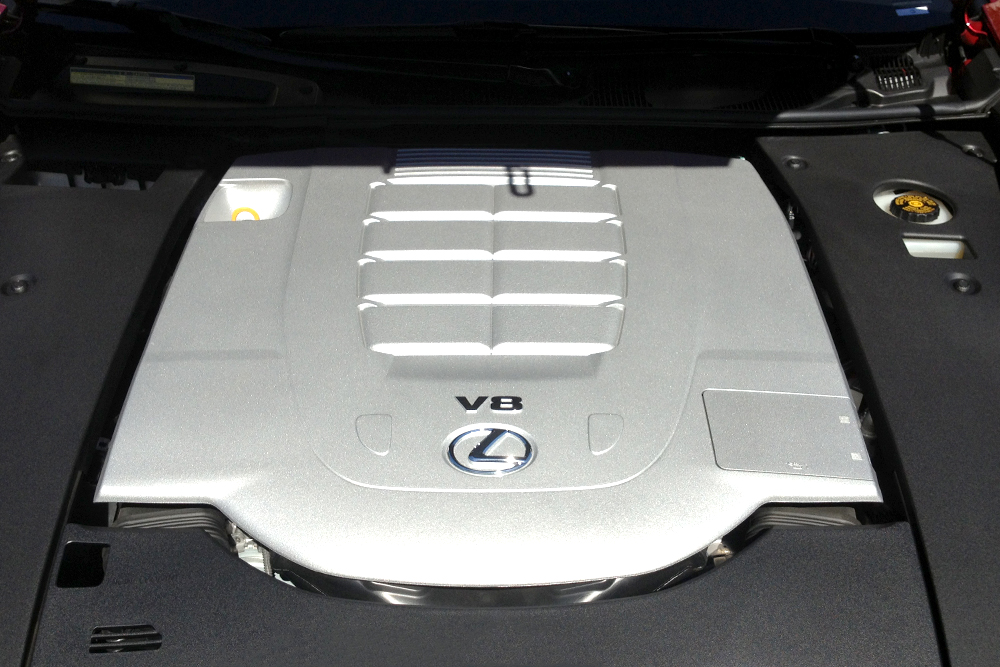
2013 Lexus LS 460 F Sport engineWhen it comes to performance, Lexus is looking to kick the LS into high gear. Lexus claims the 2013 LS can dash from 0-60 mph in just 5.4 second with an electronically limited top speed of 130 mph. While we were unable to generate a proper 0-60 time during our ride and drive, it’s clear the latest LS lineup possesses added energy under the hood.

Of course, for those looking for an even livelier experience, Lexus has included the LS F Sport to its 2013 LS lineup. Much like the GS F Sport, this go-fast version of the LS is gifted a veritable amount of tweaks and enhancements such as a Torsen limited-slip differential, Brembo front-brake calipers, 19-inch alloy wheels, and a 10 millimeter lowered adjustable air suspension, among others.
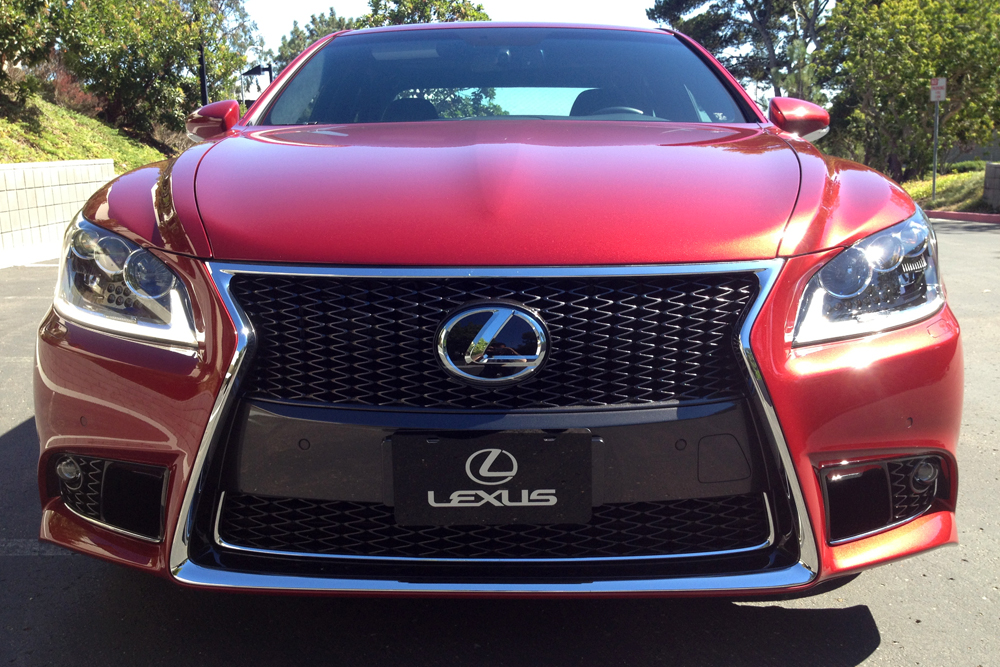
2013 Lexus LS 460 F Sport frontOverall, we really enjoyed our time with the AWD version of the F sport. The tightened air suspension felt comfortable and poised throughout our drive, and the added handling dynamics the F Sport package provides delivered some truly solid road manners. Even though the LS features several driving settings to choose from (Eco, Comfort, Normal, Sport, and Sport+) we never felt much of a difference outside of Eco and Comfort. That’s not to say the LS wasn’t fast or fun, but it never felt as confident or enthralling as we hoped. Still, if you prefer poise over power, the LS delivers without any fuss.

With the LS 460 starting at $71,990, and our LS F Sport north of that figure at $89,310, Lexus’ flagship lineup isn’t exactly cheap. But when compared to full-size luxury sedans from rivals BMW, Mercedes-Benz, and Audi, which can easily run upwards of $100,000, it almost seems a bargain… almost.

The pursuit of perfection continues

If you haven’t already gathered, there is a lot to like about the 2013 LS. The 2013 LS F Sport package we spent time in promising evidence that Lexus is capable of doing away with – if even just partially — its stiff persona and injecting a little more life and personality into its vehicles. We would still like to see Lexus approach the LS in a more radical way, but from a design perspective, the new spindle grill is a fine start. Likewise, techies as well as gearheads will appreciate the robust amount of advanced technology this lux sedan is carrying.

We’d still like to see a little more dynamism under the hood, but for now we’re willing to settle for what the LS has to offer: a buttery smooth ride with a competent, if not a tiny bit underwhelming drivetrain.


Source : digitaltrends[dot]com

Oct 3, 2012

2013 Mazda CX-5 review

2013 Mazda CX 5 Review exterior front left angle

The 2013 Mazda CX-5 rolls off the assembly line boasting impressive tech features to its cabin and under the hood, but does its new SkyActiv Technology prove more caustic than class-leading?

For automakers, bringing a new model to the market can be an exciting, albeit stressful, occasion. Some of the time they are heralded with the sort of pomp and circumstance befitting a royal procession; other times they just mosey on in with little more than a whisper. The 2013 Mazda CX-5 manages neither — but it does enter the market with a decent amount of hype and a whole lot of tech inside and under the hood.

You see, the CX-5 is on a mission, and that mission is simple: Replace the poorly aging (and discontinued) Mazda Tribute with a sporty, smallish crossover utility vehicle (CUV) that could duke it out with segment heavyweights such as the Honda CR-V, Ford Escape, and the Toyota RAV4.

Its weapons: An array of tech features that do more than simply guide you to the nearest Starbucks (although it does that too, courtesy of its new navigation system power by TomTom), but provide some of the most impressive — if not the most impressive — fuel economy we have yet to see in the small crossover segment, which comes courtesy of Mazda’s ultra-fuel-efficient SkyActiv Technology and lightweight construction techniques.

So how does the 2013 Mazda CX-5′s entire package stack up? Let’s climb inside and find out.

Function over flash

Without question, technology forms the nucleus of the 2013 CX-5. But it’s never overbearing, and perhaps more importantly, never overwhelming. Depending on your take this can be either good or bad. If you’re looking for a flashier tech-wonderland full of illuminated instrument clusters, LED lighting, and more buttons than Ramblin’ Rod (look him up), you’ll be largely disappointed. If, however, you yearn for a more subdued aesthetic, the 2013 CX-5 will more than suffice.

2013 Mazda CX 5 Review exterior right side angle low

2013 Mazda CX 5 Review exterior front   2013 Mazda CX 5 Review exterior right side   2013 Mazda CX 5 Review exterior back   2013 Mazda CX 5 Review exterior headlamp   2013 Mazda CX 5 Review exterior badge closeup

That’s because, on the inside, the CX-5 courts substance over style, functionality over flash. Our top end Grand Touring trim review unit sported some nice visual touches throughout the cabin, like metallic detailing along the dash, steering wheel, and below the climate controls. But apart from that, there isn’t much vibrancy, save some sporty cluster gauges to go along with the TomTom-powered navigation system and its 5.8-inch MID touchscreen.

Of course, that doesn’t mean the CX-5 isn’t bringing the tech heat — quite the contrary. The 2013 Mazda CX-5 is available in three different trim levels: Sport, Touring, and Grand Touring. Standard tech and comfort features include keyless entry, tilt and telescoping steering wheel, cruise control, USB/iPod interface with AUX jack for MP3 players, and a CD player. Mazda also offers a Bluetooth package that adds phone and audio connectivity, as well as an HD radio option and color monitor.

Moving up the ladder, the Touring trim adds a six-way power driver seat, as well as a blind spot warning system, which we found worked really well. The car will monitor your blind spot for you, beeping aloud and flashing a warning icon on the driver’s and passenger’s side mirror when some mindless nit is hiding out in the pocket. It might not be the most revolutionary feature, but it is a welcome safety tech addition that will surely please drivers (and possibly save lives).


At the front of the lineup sits the Grand Touring trim, which adds 19-inch alloy wheels (as opposed to the standard 17-inch variety), automatic headlamps, heated mirrors and front seats, eight-way power driver seat, as well as dual-zone comfort control and leather upholstery. The Grand Touring trim also includes satellite radio and a nine-speaker Bose system, which we found adequate, if not a little disappointing. Mazda also offers a Technology package ($1,325) that adds the aforementioned TomTom sourced nav system, adaptive xenon headlamps, and keyless ignition.

2013 Mazda CX 5 Review interior bose speakersIt might not be glitzy, but our time with Mazda’s tech features was pleasant enough. Pairing our smartphone was easy, although it can only be undertaken when the vehicle is stopped. Once paired, you’re given the option of downloading your contacts and call history. This is important because you won’t be able to use the hands-free calling by simply saying the name of your contact without going through this step first. Thankfully, downloading is super quick; and once completed, making calls is as easy as pressing the voice-recognition button located on the left side of the steering wheel.

While the voice recognition manages to work well when placing calls, the same cannot be said when searching for directions — which is strange considering it’s the same voice-recognition technology being utilized. Here, we constantly had trouble getting the system to understand where we wanted to go, and placing an address took multiple attempts before being recognized. Strangely, saying aloud the address in a faster, more natural manner seemed to gather better results than slowing our speech down and speaking more consciously.

2013 Mazda CX 5 Review interior front seats

2013 Mazda CX 5 Review interior bluetooth   2013 Mazda CX 5 Review interior steering wheel 2   2013 Mazda CX 5 Review interior back seats horizontal   2013 Mazda CX 5 Review interior navigation   2013 Mazda CX 5 Review interior ports

However, once we did get it working, the turn-by-turn navigation was excellent. On top of giving detailed directions aloud and on the screen, the CX-5’s navigation system shows your current speed and the posted speed along with easy-to-recognize point of interest icons. The navigation system also displays maps in 3D, although it’s not as detailed or vivid as some of the other nav systems we’ve encountered. In addition to route options and directions, the system provides live traffic reports courtesy of TomTom’s HD traffic service. Drivers with any degree of familiarity with standalone TomTom navigation systems will feel right at home thanks to large screen icons and an intuitive interface.

For the audio controls, we felt the 5.8-inch display worked excellently. The capacitive controls are tight and responsive. Screen glare was never an issue. And we found it just as easy to navigate using the touchscreen as it was with the buttons mounted on the steering wheel — which is a rare occurrence indeed. For those planning to use Bluetooth audio or hook up their MP3 player, the Mazda CX-5’s straightforward nature is a welcome change to the convoluted systems we continuously come across. Again, the CX-5 isn’t the flashiest, most elegant system, but it gets the job with little to no fuss. Indeed, there is a striking beauty to its simple nature.

Of course the CX-5 is a car, not a computer — though it’s getting hard to tell the two apart these days. Nevertheless, this competent crossover provides a great deal of comfort and utility for its front and backseat passengers. We have to point out though that space does tend to feel a little cramped in the rear quarters at times, especially for taller folks, but it never breaches levels of unacceptability. For a compact crossover, there is also a great deal of cargo space, with the rear hold able to swallow up 34 cubic feet of luggage on its own, and a massive 65 cubic feet with the rear seats folded forward.

Kudos for Kodo

Stepping outside the vehicle we’re treated to an attractive, high-riding CUV that does more than just indulge our stylistic desires. The first thing you’ll notice — we sure did — is how stylish the CX-5 is. Whereas many CUVs opt for a cute and often contrived aesthetic, the CX-5 eschews a handsome, self-confident vibe. It’s the first production vehicle to feature the Japanese automaker’s new Kodo “Soul in Motion” design language, which will eventually make its way across the entire model lineup. Mazda has wisely done away with smiley-face Nagare design seen on existing models — a change that makes us downright giddy. While we’re not exactly disgusted the by the current crop, we’re much more excited to see the new design language make its way into the fold.

SkyActiv’s the limit

Truthfully, we’re just as excited about the tech under the hood as we are with the car’s bold design and cabin features. That’s because 2013 Mazda CX-5 is the first vehicle to come fully equipped with the Japanese automaker’s Skyactiv Technology, which is aimed at delivering the greatest possible fuel economy. And so far, it seems to be working.

2013 Mazda CX 5 Review exterior skyactiv technologyAccording to the EPA, fuel economy for the front-wheel drive version is rated at 25 mpg in the city, 35 mpg on the highway and 29 combined when mated to a six-speed manual. Opting for the automatic sees those numbers dip slightly to 26/32/29, while the all-wheel-drive version nets an impressive 25/31/28. During our week-long road tests, which included a roughly equal amount of highway and city driving, our AWD Grand Touring review unit averaged an extraordinary 33 mpg.

Don’t be fooled into thinking all the magic is in the engine though. While it’s true the CX-5 sports a 2.0-liter inline-four available in either a six-speed manual or automatic transmissions, and is capable of producing 155 horsepower ad 150 pound-feet of torque, SkyActiv is much more than just a fancy new powertrain.

On top of the improved, low-displacement mill, a large chunk of the efficiency initiative is centered on designing every component of the CX-5 to be as lightweight as possible — including the new unibody SkyActiv chassis. Factor in the CX-5’s low curb weight (which ranges between 3208 and 3400 pounds) and impressive compression ratio of 13:1 — which Mazda has eagerly pointed out is higher than a Ferrari 458 Italia (12.5:1) – and it’s easy to understand what Mazda is aiming to achieve. With such a ratio, and because the exhaust manifold has been essentially designed from the ground up, with the utmost efficiency in mind, the CX-5 doesn’t need to rely on turbocharging or a hybrid powertrain to squeeze out its impressive fuel economy numbers.

2013 Mazda CX 5 Review exterior engineWhile the SkyActiv Technology is undoubtedly impressive, with Mazda duly deserving credit for its engineering prowess, the reality is many will be turned off by its sluggish, underpowered performance. We’ll be the first to champion its unapologetic fuel-sipping ways — but in certain scenarios, driving the CX-5 requires more work on the driver’s part than it normally would. Climbing a hill, merging onto an uphill freeway onramp, or passing another car isn’t the mechanical task relegated to muscle memory like it is in so many other cars. The CX-5’s humble horsepower and timid torque requires you plant your foot down with conviction as it takes some time for the car to muster its strength.

Strong character, lack of motivation

Peppiness aside, the 2013 Mazda CX-5 conducts itself on the road with a self-assuredness rarely afforded cars of its class. Suspension tweaks, paired with an unusually responsive electric steering system give it a unique and engaging drive character, and one that ultimately distracts from the powertrain’s shortcomings.

You see, while the CX-5 grips the road and navigates the most arduous of turns, the low-end torque sullies the experience to a degree, requiring a concentrated effort to mine the most out of its efficient, yet oh-so-stubborn SkyActiv powerplant. On the highway this isn’t as much an issue, but during tight uphill corners, squeezing out an adequate amount of power can be taxing on your foot and the engine.

Still, rarely have we been so impressed with the handling character of a compact SUV and it’s clear Mazda has put in a great deal of effort to provide a compelling and stiff ride that rarely loses its composure on the road.

Finish Line

Like so many other CUVs, the 2013 Mazda CX-5 requires you make some serious decisions about which features are most important, but ultimately asks you to sacrifice much less. Here, you won’t find a syrupy-sweet design, sterile drive mechanics, or a fuel-guzzling powertrain. Instead, the CX-5 delivers class-leading fuel economy and fun-to-drive mechanics wrapped in a sexy-sleek shell. Throw in a healthy-helping of cabin tech, and a very competitive price point (base price starts at just $20,695, while a fully-loaded Grand Touring Trim like ours will set you back just north of $30,000), some spacious quarters, and there isn’t much to complain about the Mazda’s “Soul in Motion” inspired CUV.

There are times where you’d almost be forgiven for thinking the CX-5 descended from the automotive heavens, but sadly its origins are far less celestial. And with that reality comes some harsh truths. While there is certainly a lot to admire about the CX-5, those of you seriously considering one will need to ask whether or not you can live with a car that aims to provide the greatest fuel-efficiency and handling character – with a good deal of comfort sprinkled in — over anything that possesses proficiency in power.

Highs

  • Truly impressive fuel technology
  • Tech features are (mostly) easy to navigate
  • Sleek and stylish design

Lows

  • SkyActiv engine, while ultra-efficient, is woefully sluggish
  • Engine has a tendency to get noisy when accelerating
  • Interior is a little bland

Source : digitaltrends[dot]com