Pages

Showing posts with label origins. Show all posts

Oct 15, 2012

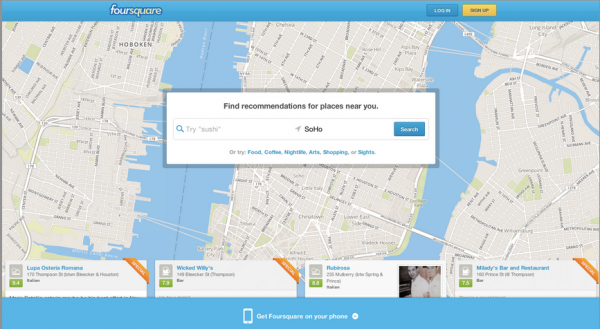
Foursquare homepage gets a search bar as the platform competes with Yelp’s local search status

foursquare search

Foursquare is taking more aggressive measures to compete with Yelp by launching a redesigned homepage that focuses on search.

Foursquare continues to pivot from its location-based, check-in origins and tiptoe in on Yelp’s business model with its increasing focus on local business search. Later today, as SearchEngineLand first reported, PC users will notice a significant user experience update to Foursquare’s landing page in the form of a search box.

Right now, Foursquare has a search element but it’s rather hidden, sitting on the top right hand corner of your screen next to the “Log In” button. Clicking on this expands the search bar, where you can input local restaurants, theaters, or other things to do, but it’s hardly a point of focus for the platform. When Foursquare redesigned its site and mobile app back in early June, the company was more concerned about educating existing and new users about the refreshed user experience that focused on deals, recommendations, and social updates. But with the “probationary period” over for users to get adjusted to the new Foursquare, the company is hitting the message home that it’s a local search tool, too.

To see the new homepage when the redesign is rolled out, you’ll have to be logged out of your account. SearchEngineLand got a firsthand look at the new design, and notes that the rest of the site’s features will remain unchanged. However there will soon be a few added features that non-members would be able to access without being required to sign up or sign in.
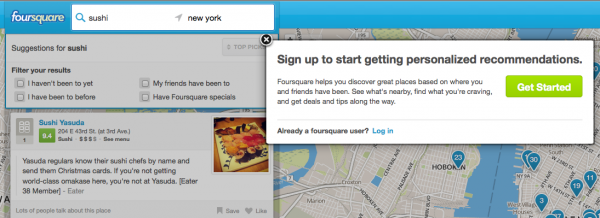
foursquare sushi search

Non-members, of course, won’t have access to everything Foursquare has to offer, but the search feature and some of what it offers will be available without an account. When you search for an establishment on Foursquare, the results will be ordered by a score based on user feedback, and you’ll have filters available to refine your search. According to SearchEngineLand, the one filter that will be made available to non-members is a “Foursquare special.” More robust filters that use user and friend-sourced data will of course require a user to register with the site.

The prominently featured search bar is an inevitable and a much-needed part of Foursquare’s recent branding efforts, and it should encourage new use since visitors aren’t required to sign up to access it. But this is just one step by Foursquare to establish itself as a location-based local establishment search engine that has access to our data and friend’s data — which could give it a leg up on Yelp. Yelp has established itself with its community-driven reviews and ratings and become the de facto guide for business search, but Foursquare obviously has the social lead. Refining search could help it compete with the legacy Yelp has created.


Source : digitaltrends[dot]com

Sep 7, 2012

Philip Roth unable to correct Wikipedia entry about his own novel

Celebrated novelist Philip Roth has a problem: Even though he knows the true origins of his book "The Human Stain," Wikipedia refuses to correct its version of events on his say-so alone.

As almost everyone on the Internet is no doubt already aware, Wikipedia is an impressive tool and treasure trove of information, put together in such a way that makes crowdsourcing an encyclopedia seem like not such a bad idea after all. After all, who can fault the idea of requiring secondary sources to back up every important fact inserted into a specific entry? Well, Philip Roth, as it turns out; the award-winning author has found out that he can’t correct a misconception about one of his novels due to the way Wikipedia works, and has taken to the Internet to explain his case.

Roth posted an open letter to Wikipedia on the New Yorker’s website after reading the Wiki entry about his novel The Human Strain, and finding it to be incorrect. Unfortunately, because of the need for multiple sources when it comes to correcting information on a particular entry – especially when said information has itself been cited by multiple sources – he found that it wasn’t as easy as contacting the site, saying “Actually, that’s my book, so I am kind of the last word on this kind of thing” and then watching as the entry gets corrected.

“Yet when, through an official interlocutor, I recently petitioned Wikipedia to delete [the incorrect assertion] along with two others,” Roth explains in the letter, “my interlocutor was told by the ‘English Wikipedia Administrator’—in a letter dated August 25th and addressed to my interlocutor—that I, Roth, was not a credible source: ‘I understand your point that the author is the greatest authority on their own work,’ writes the Wikipedia Administrator—’but we require secondary sources.’”

The problematic statement in the Wikipedia entry revolves around the origins of The Human Strain. According to Wikipedia, the book was “allegedly inspired by the life of the writer Anatole Broyard,” something that Roth denies, pointing out instead that the novel “inspired, rather, by an unhappy event in the life of my late friend Melvin Tumin, professor of sociology at Princeton for some thirty years.” Going on to point out the similarities between Tumin and Coleman Silk, the novel’s protagonist, Roth continues his letter by pointing out the many ways in which Silk could not have been inspired by Broyard. “To be inspired to write an entire book about a man’s life,” Roth explains, “you must have considerable interest in the man’s life, and, to put it candidly, though I particularly admired the story ‘What the Cystoscope Said’ when it appeared in 1954, and I told the author as much, over the years I otherwise had no particular interest in Anatole Broyard.”

At time of writing, the Wikipedia entry for The Human Stain still maintains that Broyard was the inspiration for the book, although it notes that “Roth has repeatedly said these opinions are false,” and even cites the New Yorker open letter as proof of this. Clearly, he needs to write a second open letter, and claim that one as his secondary source.


Source : digitaltrends[dot]com