Pages

Showing posts with label researchers. Show all posts

Oct 18, 2012

NASA’s Curiosity Rover Finds More Shiny Objects on Mars

ht nasa mars rover Shiny object part2 thg 121018 wblog NASAs Curiosity Rover Finds More Shiny Objects on Mars

                                          (NASA/JPL-Caltech/MSSS)

When NASA’s Curiosity rover found a shiny object on Mars last week, researchers believed it was just part of the rover. But now, the rover has found more bright objects in Mars’ soil, leading NASA officials to believe it is something native to the planet.

NASA sent commands to Curiosity Monday to take a third sample of soil from Mars to learn more about the shiny objects.

“Confidence for going ahead with the third scooping was based on new assessment that other bright particles in the area are native Martian material,” NASA said in a statement. “One factor in that consideration is seeing some bright particles embedded in clods of Martian soil.”

SEE MORE: CURIOSITY’S FINDINGS ON MARS

The first sample taken on Oct. 7 found a shiny object that they determined was a piece of the rover. During the second scooping on Oct. 12, more bright objects were found in a hole made by the scooping, leading researchers to believe this is something native to mars.

“At that point when they first saw the bright particles in the hole created by the second scoop they weren’t sure what they were,” NASA spokesman, Guy Webster, told ABCNews.com.


Source : abcnews[dot]go[dot]com

Oct 15, 2012

The robotic wheelchair that can take on steps

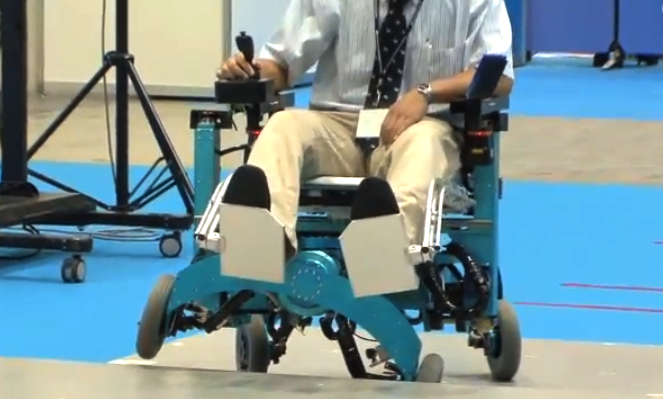
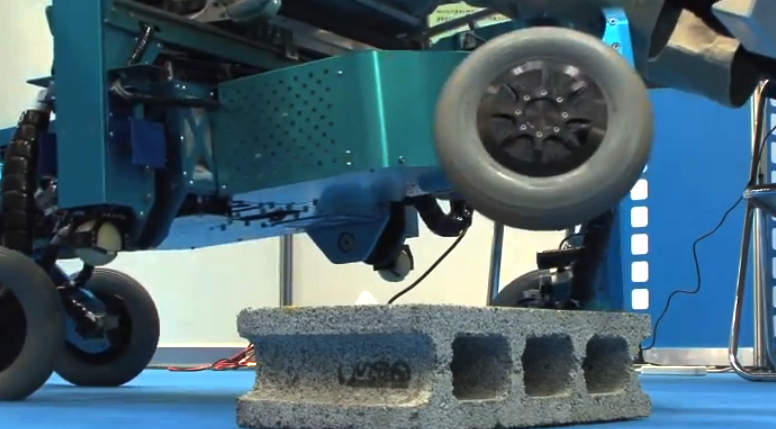
Researchers in Japan have designed a robotic wheelchair that can walk up steps and turn a perfect circle.

While the urban landscapes of many towns and cities cater much better to wheelchair users these days in terms of accessibility, some public spaces still throw up obstacles when least expected, with steps surely the bane of every wheelchair-bound person. If there’s no ramp nearby, they’re left to look for another way to their destination, an inconvenient, time-wasting and doubtless frustrating experience every time it happens.

The issue has inspired Japanese researchers at the Chiba Institute of Technology (CIT) near Tokyo to come up with a specially-designed robotic wheelchair that can climb steps.

The four-wheel drive, five-axis wheelchair is controlled using a joystick and moves along on its wheels until it comes to an obstacle. Sensors on the wheelchair then assess the surroundings before the vehicle cleverly hoists itself up and over the obstacle.

A particularly neat feature is that its mechanics ensure the seat stays parallel with the ground, helping the wheelchair and its occupant to maintain perfect balance and avoid any tipping feeling – great not just for going up and down steps but also for when navigating steep ramps.

“[The wheelchair] has various sensors and it uses them in combination to assess how big a step is,” Shuro Nakajima, associate professor at CIT and the person leading the team behind the wheelchair’s development, told DigInfo TV.

The vehicle also is also capable of lining up its wheels, helping it to turn a perfect circle in a tight space.

Though currently a concept design, Nakajima is pleased with his team’s progress, explaining that the robotic wheelchair’s motion is pretty much worked out, with the next stage of development involving getting a variety of people to try it out in the real world to fine tune the user experience.

The neat design would certainly be a boon to wheelchair users for whom even one step in an unexpected place can prove a challenge to navigate, though it may be a while before it becomes commonly available. You can check out the vehicle in action below.


Source : digitaltrends[dot]com

Oct 10, 2012

Researchers modify refrigerator to stay locked unless you smile

Happiness counter

Definitely a terrible idea when unhappy about a growling stomach, Japanese researchers want a smile before opening your refrigerator.

Developed by a group of researchers at the University of Tokyo, the team developed a device called the “Happiness Counter” that utilizes smile recognition to trigger specific actions. In order to test the device, the researchers attached the “Happiness Counter” to the front of a refrigerator and asked participants to smile each time they wanted to open up the fridge to grab something to eat or drink. Over a period of ten days, the researchers noticed that the participants shifted from a fake smile to a genuine smile in order to access food within the refrigerator. 

happiness counter cameraIn order to build the ”Happiness Counter” for the test, researchers enclosed a Sony CyberShot point and shoot digital camera within a black plastic compartment. Like many other digital camera brands, Sony includes a smile recognition function that will automatically take a picture when the people in the shot are smiling.

Nearly covering the LCD screen of the Sony CyberShot camera, the researchers attached a light sensor. When the camera automatically detects a smile and takes a picture, the light sensor picks up the flash of light and relays information that turns on the LED lights on the front of the device in the shape of a happy face. When the system detects someone that’s standing in front of the camera and isn’t smiling, the LED lights will create a frowning face in red.

Regarding real-world implementations, the researchers foresee workplaces could add the device to the door to a conference room and require employees to flash a smile in order to gain access to a meeting. Hypothetically, the researchers believe that this could influence the mood of the people attending the meeting and ultimately increase productivity. A spokesperson for the ”Happiness Counter” device specifically stated “We feel that the happiness counter will naturally encourage the act of smiling in the multitude of daily frustrations, thus enhancing a positive mood and the communication of people.“


Source : digitaltrends[dot]com

Sep 13, 2012

Earthquake First Responders: Cockroaches

ht cockroach cyborg ll 120913 wblog Earthquake First Responders: Cockroaches

                                                                                                                 (Image Credit: iBionicS)

Move over search-and-rescue dogs. First-responding cockroaches might be the next big thing in disaster response.

Researchers at North Carolina State University in Raleigh hope the unsightly pests can be put to good use, saving lives in disasters like earthquakes, fires and chemical attacks.

“Our research is basically to turn insects into beasts of burden as we did with larger animals: horses and camels,” Alper Bozkurt, an assistant professor at N.C. State’s Electrical and Computer Engineering Department, told ABC News.

The bugs carry “backpacks” equipped with sensors that could potentially carry microphones to transmit audio or low-grade video cameras for video from their environment.

They are steered around in tight crevices and rubble – say from an earthquake – using their antennas that interpret low-grade electrical pulses as an obstacle the bug needs to avoid.

A video released at the iEEE Engineering in Medicine & Biology Society conference in San Diego last month shows the cockroaches successfully being steered along a curved line drawn by researchers.

“We are interested in finding people after the earthquakes, under the building,” Bozkurt said. “The first sensor one can envision could be tiny microphones to listen to the help calls.”

The advantage of using the tiny creatures lies in both their size – they are smaller than humans and dogs – and their strength.

Bozkurt’s research uses the Madagascar hissing cockroach, one of the largest species of cockroach, small enough to slip into small cracks between rocks, but large enough to carry their potentially lifesaving loads. It can grow up to 3 inches long.

“Insects are self powered,” he said. “It’s like riding a horse, as long as you feed the insect it will keep going.”

The radio that sends a signal back to rescuers waiting outside will be powered by tiny batteries.

Researchers are continuing to perfect the technology, looking for more ways to make tiny circuits even smaller, exert more precise control over the insect and move them around in a 3-D environment.

But Bozkurt expects that their work could make a huge difference after disasters in densely populated urban areas.

“It’s a huge mess and somewhere in the middle your kid is crying, asking for help and you want to help them as soon as possible,” Bozkurt said. “So the only help would come from huge machines which dig through the rubble and it’s not very efficient.

“So we’re trying to make this process more efficient.”


Source : abcnews[dot]go[dot]com

Sep 3, 2012

Chinese researchers develop FlyingBuddy2, a mind-controlled drone

Flying Buddy 2 drone

Researchers at Zhejian University have developed a mind-controlled drone to aid the disabled by offering them a second vantage point.

We can control television with our minds, so why not control a drone? In a new video, researchers at Zhejian University show off the technology that allows users to control a quadcopter, called “FlyingBuddy2,” with their mind using a headset that tracks for EEG signals.

The Chinese scientists developed the technology and drone to offer disabled people an extra “eye” in the sky. The technology uses an electroencephalogram signal (EEG) headset that is commercially available and manufactured by Australia-based Emotiv. The device, coined the EEG neuroheadset, is worn over a user’s head. Using non-invasive measures, it tracks the electrical signals firing in the brain. There are 16 tendril-like sensors that enable the owner to program and track for up to 12 different movements. The headset can reportedly also detect emotions.

To demonstrate the FlyingBuddy2′s abilities, a wheelchair-bound person wearing the Emotiv headset accomplished feats that would otherwise be impossible for disabled individuals, including viewing a flower located in an unreachable location. The drone was outfitted with a camera that constantly streams a life feed onto a laptop for its user’s viewing purposes. Bluetooth connects the EEG headset to a laptop, which then connects to the drone via Wi-Fi.

According to the video, a user can control the drone’s movements in three dimensional spaces — but the controls are a bit odd. Thinking “left hard” will signal the craft to lift off from the ground. To fly the drone downward, a user has to clench his or her teeth. Thinking about flying the craft “right” will fly the craft forward. To rotate the drone counter clockwise, the user has to think about turning “left.” To control the ascent of the drone, the users has to think about “pushing” the craft. A user can also capture pictures with the drone’s camera just by blinking.

Flying the drone, as you’ve noticed already, requires a series of mind bending commands that goes against the user’s habitual inclinations. But as with mastering anything, maneuvering the craft takes practice.

In addition to offering users a second set of eyes, the video claims that controlling the drone gives users makes the mind more nimble and precise.

Mind controlled devices are a reality and may one day rid of remote controls altogether. The FlyingBuddy2, set to be presented at the Ubiquitous Computing Conference in Pittsburgh, Pennsylvania, is just one step closer to an improvement in the well being of disabled users.

If you’re looking to get your hands on one, the device can be purchased for $500.

Check out the video of the drone below.


Source : digitaltrends[dot]com