Pages

Showing posts with label cities. Show all posts

Nov 2, 2012

Microsoft bricks up the door to freedom with the Windows Store’s ‘walled garden’

Microsoft bricks up the door to freedom with the Windows Store’s ‘walled garden’

As Microsoft migrates from an open platform to a walled garden with Windows 8, freedom falls by the wayside.

For me, Windows 8 is a tale of two cities: There’s an abundance of cool new features that I love, balanced out by an abundance of design changes that I absolutely hate. I accept all of that. Major changes bring major transitions. But as a card-carrying, freedom-loving geek, there’s one thing about Windows 8 I simply cannot accept, a “feature” that seems shiny and new and nice, but hides dark and dangerous possibilities that could devastate computing as we know it and leave us all shackled in Modern-styled chains. Even worse, that ticking time bomb beats as the heart of the new Live Tile interface, a malign tumor threatening to eventually rot the PC’s open core.

The Windows Store. The harbinger. Microsoft’s closed-off answer to Apple’s vaunted walled garden.

Skin-deep beauty

Don’t get me wrong; I have no problem with the usability of the Windows Store itself. No matter what type of device you’re using, the Windows Store is slick, polished and easy to browse, especially with the help of Windows 8′s new “type to search” feature. Its interface sits heads and shoulders above the Apple and Android alternatives.

No, my issue lies with the philosophical underpinnings beneath the attractive veneer.

The only way to get Windows 8 apps is through the Windows Store, some enterprise and developer exceptions aside. And the only way to get into the Windows Store is to go through Microsoft; developers need to pay for a license, submit their apps for approval from on high, and pray to get in.

Windows 8 store microsoftThe new walled garden approach holds a number of advantages for casual and neophyte computer users. Since Microsoft approves the content, Windows 8 apps are sure to be functional at a base level and free of malware. That security comes at the price of freedom, however.

The only way to get Windows 8 apps is to go through the Windows Store, and Microsoft’s app guidelines contain a laundry list of rules that tell developers what types of apps will be approved. Microsoft, like Apple, plans to actively screen the editorial content of apps to avoid offending delicate sensibilities.

A poisoned Apple

Just search Google for “Apple censors apps” and similar phrases to get a feel for what happens when an entire ecosystem’s content flows through a single source that considers itself a moral authority. Apple has censored iOS apps from satirical Pulitzer Prize winners, apps from religious groups, apps with political motivations, Google Voice, apps with Dropbox hooks, any app that overlaps the functionality provided by the core iOS experience, and a whole lot more.

Microsoft allows apps with competing functionality into the Windows Store, but it controls editorial content with an iron fist. Here are the content guidelines for Windows 8 apps:

  • Your app must not contain adult content
  • Your app must not contain content that advocates discrimination, hatred, or violence based on membership in a particular racial, ethnic, national, linguistic, religious, or other social group, or based on a person’s gender, age, or sexual orientation
  • Your app must not contain content or functionality that encourages, facilitates or glamorizes illegal activity
  • Your app must not contain or display content that a reasonable person would consider to be obscene
  • Your app must not contain content that is defamatory, libelous or slanderous, or threatening
  • Your app must not contain content that encourages, facilitates or glamorizes excessive or irresponsible use of alcohol or tobacco products, drugs or weapons
  • Your app must not contain content that encourages, facilitates or glamorizes extreme or gratuitous violence, human rights violations, or the creation or use of weapons against a person or animal in the real world
  • Your app must not contain excessive or gratuitous profanity

In other words, Windows 8 apps are so many bricks in the wall(ed garden), thought-controlled and scrubbed squeaky clean to Microsoft’s new Leave It To Beaver-esque standards.

A Dark Age ahead

Microsoft’s a private company, of course, and it can impose whichever arbitrary and heavy-handed rules it wants. However, a large part of Windows’ past success lied in the relatively open nature of the operating system. (Cool it, Linux lovers.) If you wanted to create a new piece of software, you just whipped it up and slapped it on the Internet — no costly developer license, jumping through censorship hoops, or 30 percent cuts of revenue to Microsoft required. There is a reason that Windows shined while Mac stuttered and iOS users strived to jailbreak their locked-down phones.

Microsoft is gutting its legacy, sacrificing its past on the altar of the tablet gods.

I’m not the only one who thinks so. When Microsoft asked Minecraft’s developer Notch to certify the game for Windows 8, he told them to “Stop trying to ruin the PC as an open platform.” He didn’t stop there. “I’d rather have Minecraft not run on Win 8 at all than to play along,” he tweeted.

windows rt tablets windows 8 storeMinecraft can, of course, still run on Windows 8 thanks to the Desktop mode, which plays classic-style Windows programs just fine. Windows RT tablets don’t have the same privilege; they’re stuck running those squeaky-clean, Microsoft-approved Windows 8 apps alone.

The focus is firmly on the new apps and interface, however. Windows 8 takes great pains to shove the Desktop and its legacy programs into a dusty, dark corner. The entire Modern-style Start screen revolves around glittery, transforming Live Tiles generated by Windows 8 apps, while the entire Desktop functions as a single app in Windows 8′s Switcher, no matter how many classic-style programs you have open. Microsoft doesn’t even allow users to boot to the Desktop directly from start up — you must go through the Modern Start screen.

Unless even users complain and Windows 8 fails miserably, I expect the non-enterprise versions of Windows 9 to be the final bricks in the walled garden, ditching the Desktop completely and leaving users with no choice but to look at the world through glasses colored whichever hue Microsoft decides to approve.

A happy medium

It doesn’t have to be like this. The newbie-friendly benefits provided by a walled garden are huge, and I can understand Microsoft wanting to hand-approve apps that sink deep hooks into Windows 8′s core.

I’m a big boy, though, and I want choice. Grand Theft Auto IV wouldn’t have been anywhere near as fun if Packie didn’t swear like a sailor and Niko laid down his automatic weapons and alcoholic beverages. Fortunately, there’s already an example Microsoft can follow that would dispel all my negativity and doubt: Android and Apple’s own OS X desktop operating system.

Both of those platforms restrict users to central, approved download sources out of the box, which provides casual users with the same level of security and ease-of-use currently offered by the Windows Store. More crucially, they also provide a way around that barrier for power users. Sideloading apps on Android is as simple as switching out a system setting, while disabling Gatekeeper on a Mac is just as straightforward.

Adding a sideloading option for everyone — not just devs and IT admins — would allow Microsoft to have its cake and eat it too. Casual users could stay safe and secure, while power users could bask in the open freedom and continue to use their computers as they see fit.

Sideloaded apps wouldn’t be subject to Microsoft’s 30-percent Windows Store fee, of course. That shouldn’t make too much of a dent in company revenues; as I said, Android allows sideloading, and I don’t hear Google complaining that hordes of users are snagging apps from third-party sources. However, allowing sideloading would let developers distribute Windows 8 apps that are too edgy, mature, political or religious for Microsoft’s squeaky-clean enforced tastes, while maintaining the open tradition the operating system is known for.

Will Microsoft grant this boon after already tossing out the Start button, the desktop and the company’s reluctance to make its own hardware, or will it continue down the ham-fisted (yet profitable) path blazed by the dictators at Apple? That remains to be seen. But if the company doesn’t change its ways, the Windows Store will be the death — not the evolution — of computing as we know it.

Keep on keeping on with that Steam for Linux endeavor, Valve. You might just be sowing the seeds of rebirth that keeps hope alive after a computing apocalypse.


Source : digitaltrends[dot]com

Oct 15, 2012

The robotic wheelchair that can take on steps

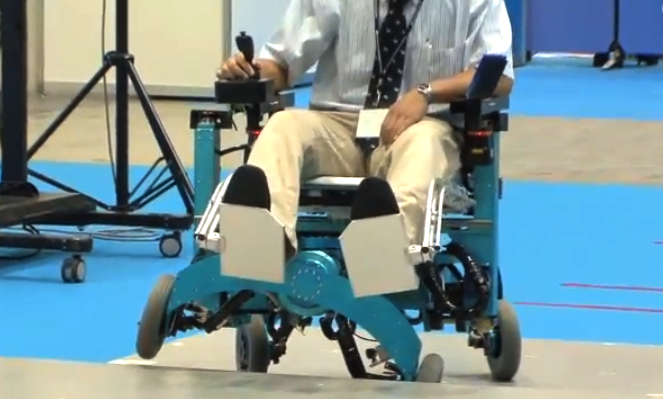
Researchers in Japan have designed a robotic wheelchair that can walk up steps and turn a perfect circle.

While the urban landscapes of many towns and cities cater much better to wheelchair users these days in terms of accessibility, some public spaces still throw up obstacles when least expected, with steps surely the bane of every wheelchair-bound person. If there’s no ramp nearby, they’re left to look for another way to their destination, an inconvenient, time-wasting and doubtless frustrating experience every time it happens.

The issue has inspired Japanese researchers at the Chiba Institute of Technology (CIT) near Tokyo to come up with a specially-designed robotic wheelchair that can climb steps.

The four-wheel drive, five-axis wheelchair is controlled using a joystick and moves along on its wheels until it comes to an obstacle. Sensors on the wheelchair then assess the surroundings before the vehicle cleverly hoists itself up and over the obstacle.

A particularly neat feature is that its mechanics ensure the seat stays parallel with the ground, helping the wheelchair and its occupant to maintain perfect balance and avoid any tipping feeling – great not just for going up and down steps but also for when navigating steep ramps.

“[The wheelchair] has various sensors and it uses them in combination to assess how big a step is,” Shuro Nakajima, associate professor at CIT and the person leading the team behind the wheelchair’s development, told DigInfo TV.

The vehicle also is also capable of lining up its wheels, helping it to turn a perfect circle in a tight space.

Though currently a concept design, Nakajima is pleased with his team’s progress, explaining that the robotic wheelchair’s motion is pretty much worked out, with the next stage of development involving getting a variety of people to try it out in the real world to fine tune the user experience.

The neat design would certainly be a boon to wheelchair users for whom even one step in an unexpected place can prove a challenge to navigate, though it may be a while before it becomes commonly available. You can check out the vehicle in action below.


Source : digitaltrends[dot]com

Sep 29, 2012

Google Maps updates with higher resolution images and adds 45 degree view as well

Google has updated their maps platform to include higher-detailed satellite imagery, as well as a new 45° view as well.

They’ve started with 51 cities initially, including the Leaning Tower of Pisa in Italy, and the State Capitol building in Austin, Texas.

Of the 51 cities, 37 of them are scattered across the US, so be sure to check out some great American landmarks.

While 45° view is not a novelty for online maps (Bing Maps have had Bird’s Eye mode for quite a while), it seems that Google is trying to get in a few punches against the competition, in light of Apple’s recent maps debacle.

The cities which Google lists as having higher resolution satellite maps available are far too numerous to list here, but you can get a find a full list by following our source link.

Let us know if your area is among those updated.


Source : blog[dot]gsmarena[dot]com

Sep 14, 2012

iPhone Thefts: ‘Apple Picking’ on the Rise

gty apple ipod touch ll 120914 wblog iPhone Thefts: Apple Picking on the Rise

                                                                                 Credit: Justin Sullivan/Getty Images

Cities across the country are on alert as officials warn of an uptick in stolen Apple products, dubbed “Apple picking.”

According to the Federal Communications Commission, 30-40 percent of robberies in several major cities involve cell phones, including 38 percent in Washington, D.C. and 40 percent in New York City.

Las Vegas police broke up two rings of cell phone thieves on September 6.

“What this started with, we had a normal report of a theft. Somebody stole someone’s cell phone,” said Bill Cassell of the Las Vegas Metropolitan Police Dept. “Our officers started investigating and realized there were a lot of other similar instances.”

The LVMPD connected these robberies because they all seemed to target similar victims.

“They were all targeting people in fast food restaurants, coffee shops, people walking on street,” Cassell said. “The victims all had a similar profile too. They were all focused on their cells phones, inattentive of their surroundings and looked like they wouldn’t put up a fight.”

The thieves, many of them juveniles, would either ask to borrow the victim’s cell phone and run off with it or simply grab it from their unsuspecting victims.

“We tracked down some of the individuals involved and in doing this, realized there were two groups of people doing the same crime the same way. But they weren’t associated,” said Cassell.

One of the groups was charged with 14 cell phone thefts. The other has been charged with seven thefts, but according to Officer Cassell, the investigation of  20-30 thefts is still on-going.

The recent increase in cell phone thefts has prompted action from both the government and major wireless carriers.

In April, FCC Chairman Julius Genachowski, along with  Washington, D.C. Mayor Vincent Gray  and U.S. Sen. Chuck Schumer, D-N.Y., announced new initiatives to combat the thefts.

Genachowski announced the creation and implementation of a database to prevent the use of stolen smartphones. With this new system, which is expected to launch in the coming months, a cell phone user can report their device stolen and their carrier will block the device from being used.

Officials believe that the registry will cut cell phone thefts.  Even more dangerous is the threat of stolen personal information stored on smartphones.

“That’s what we’re most worried about, the tremendous amount of information these people are stealing,” Cassell said.

Beyond monetary consequences, many people are injured or even killed during robberies.

Hwangbum Yang, 26, a chef at a restaurant in Manhattan’s Museum of Modern Art, was shot and killed during a cell phone robbery on his way home from work in April.

In 2011, 17-year-old Prince Watson was charged with the murder of Sally Katona-King, 68, when he shoved her down the stairs in an attempt to steal her iPhone, according to ABC Chicago affiliate WLS.

And device thefts are not limited to the street or coffee shops.

Last week, a California man was accused of driving his SUV through an Apple store in Temecula and stealing thousands of dollars worth of display items. The investigation is still on-going.


Source : abcnews[dot]go[dot]com

Aug 20, 2012

Halo LED belt increases cyclist visibility at night

Make commuting at night safer with the Halo LED belt and be visible on the road without running the risk of getting your bike lights stolen.

In many cities, cyclists are required to have rear lights outfitted to their bikes in order to ride safely on the streets, especially during sundown. So why not take safety a step further into fashion by making it cool to promote good behavior? The Halo LED belt achieves both by allowing wearers to wear LED light as a belt, increasing his or her visibility on the road. 

So you may ask: why not just get bike lights? According to city laws around the world, light lumen limits vary — which make it difficult to have the same light be legal across all borders. Bike lights are also the subject of a thief’s desire. By wearing the safety light on you, you’re always visible and never run the risk of someone stealing your lights… unless, of course, you’re just entirely robbed out of your outfit. 

The Halo LED belt is also great for other types of land commuters, such as skateboarders or joggers, to be seen on the streets at night. The belt is a battery-powered gear that runs on two CR2025′s and lasts up to 20 hours of consecutive use, or 75 hours non-consecutive. Users also have the option of switching between three light modes: strobe, solid, or flash. The product started out as a Kickstarter project which asked for a rather measly $5,000… and ended up crowdfunding more than $53,000.

Designed for universal use, the belt can fit anywhere from a women’s size 0 to men’s size 38 waist. Even if you’re not a cyclist, the belt looks cool enough to wander the streets in or catch some attention inside a dark bar. Some of the promotional photos also show basketball players wearing the belt in the dark, which can help you classify teammates if you play in the park at night. You can even wear it around your shoulders if you want extra visibility — whether on the road or just roaming the streets.

You can purchase the Halo LED belt now in a choice of four colors — red, blue, green, and yellow — for $85.


Source : digitaltrends[dot]com