Pages

Showing posts with label adaptation. Show all posts

Nov 20, 2012

The Walking Dead Episode 5 review: A fitting end for the best story of the year

Telltale's episodic adaptation of Robert Kirkman's The Walking Dead has finally arrived, and it's as emotionally jarring as you'd expect.

Just before Telltale’s episodic video game adaptation of Robert Kirkman’s comic book series The Walking Dead first debuted in April, fans of the property had a laundry list of concerns. Would a video game be able to capture the oppressive atmosphere that has made Kirkman’s books such a macabre joy? Would Telltale have the courage to push their game intto the shockingly dark territory that The Walking Dead books usually plumb for their most emotionally resonant moments? Do people still want to play a classic adventure game in an era where gaming is defined by endless first-person shooters and bombastic explosions?

Then Telltale released Episode 1 of The Walking Dead and all doubts were immediately cast away, replaced instead by a sense of awe at how well-crafted and engaging Telltale’s game was. Of course, fans then expected the worst and assumed that the developer wouldn’t be able to match the quality of the first Episode in its sequel. Telltale proved doubters wrong there as well. Over the course of four increasingly violent, increasingly frightening, and increasingly depressing episodes, Telltale has repeatedly topped itself to the astonishment of fans and gleeful critics alike (now would be a good time to have a look at our reviews of Episode 1, Episode 2, Episode 3, and Episode 4).

And now comes the final chapter, Episode 5 of The Walking Dead, the appropriately titled No Time Left. If you were expecting Telltale to finally drop the ball, we’ve got bad news for you: The Walking Dead Episode 5 is not just a fantastic end to this first season of the game, it’s also the best Walking Dead Episode to date.

This Is The End

If you know only one thing about The Walking Dead, it’s that the property centers on zombies. However, if you know two things, you know that in truth the game, comics, and television series are not so much stories about the zombie apocalypse as they are stories of disparate groups of survivors attempting to remain sane and alive amidst the apparent end of days. A strong focus on that second aspect has been the backbone of all of Telltale’s Episodes so far, and in that regard Episode 5 does not disappoint. It may not be the most violent episode, but what it lacks in straight-up gore, it more than makes up for in shock value. Not in the “cheap jump scares” sense that plagues so many modern survival horror games, but instead by building a complex, multi-layered world that constantly kicks players when they’re down. There is no happy ending once the credits roll on Episode 5 (but if you’ve been expecting that, you likely haven’t been paying very close attention).

The Walking Dead Episode 5

The other key theme of The Walking Dead has always been that no one is safe. No matter how much you like protagonist Lee or the adorable Clementine, either one of them could be torn apart by zombies or shot by another survivor at the drop of a hat. It would be easy for this concept to wear thin on players very quickly as too many deaths would simply desensitize them to the plight of the characters in the game. Too few deaths however, and you lose a sense of tension. To solve this problem, Telltale’s writers have spent five episodes crafting some of the most complex, nuanced human characters we’ve ever seen in a game. Each person, though obviously not an actual human, seems to have his or her own motivations, fears, and hopes for this bleak new reality. By building The Walking Dead on a classic adventure game template, Telltale made it easy to connect with each individual, which only makes it that much more harrowing when a character you’ve come to know and love is killed. Most games can’t even form a connection between a single protagonist and a player, so it’s very impressive that Telltale is able to create connections so effortlessly, even if it then twists these connections to heighten the game’s horror atmosphere.

If you thought this would be the point where I drop the bombshell that both Lee and Clem are killed off in horrific fashion during Episode 5, sorry, but that would be revealing too much of the plot. Though it does make the game more difficult to review, if you take nothing else away from this, trust that you are better off experiencing The Walking Dead’s expertly-crafted plot for yourselves, as Telltale intended. Ideally, in a dark room, with few distractions and maybe a stiff drink to take the edge off when your nerves become a bit too frayed.

That said, those of you who were hoping that Telltale would continue to ramp up the dark tone of The Walking Dead should be very pleased by Episode 5. It’s not quite as blunt as Episodes 3 or 4, but the incidents you experience are as emotionally resonant and actively moving as anything in the series to date. Once the credits have started rolling (by the way, you should definitely sit through the credits; trust me on this one too) you should be sitting there, mouth agape at what you’ve just experienced and how thoroughly Telltale is able to draw players into a relatively traditional survival-horror story purely by virtue of amazing writing and realistically complex character building.

The Walking Dead Episode 5

Sadly, The Walking Dead’s story is so good that it casts a stark relief on the rest of the games industry. After playing The Walking Dead, it’s difficult to return to other, more traditional blockbuster titles, as the majority of developers are either unable or unwilling to match the quality of the writing seen in Telltale’s game. On the other hand, this episodic adaptation of The Walking Dead has been selling quite well for Telltale, so maybe this is an indication that players, if given the choice, would readily gravitate toward good writing and well-crafted characters, instead of the rote run ‘n gun action we see so often.

If It Looks Like A Zombie And Sounds Like A Zombie

In our reviews of The Walking Dead to date, we haven’t spent much time discussing the game’s technical aspects. Not because we dislike what Telltale has done with this game’s aesthetics and sound, but because they’re so good that you simply don’t notice them. Yes, it’s impressive that Telltale’s artists were able to nearly replicate the Walking Dead art of Charlie Adlard for the video game. Yes, it’s impressive that Telltale assembled such an excellent cast of vocal talent and that the game’s ambient sounds are perfectly capable of terrifying players by themselves. However, it’s far more impressive that by the time Episode 5 was ending, we’d completely stopped paying attention to how the game looks and sounds, in favor of focusing entirely on the story. Ideally, graphics and audio should exist to serve the story, and it’s almost depressing that The Walking Dead stands out specifically because it’s one of the few games that manages to get this concept right.

It should also be pointed out though, that with Episode 5 it seems that Telltale has finally mastered the engine it created for The Walking Dead. Though we adored the past four episodes of The Walking Dead, each had a few minor glitches and scripting errors that, while far from game-breaking, did serve to momentarily disrupt a player’s suspension of disbelief. It’s difficult to stay engaged when a character disappears from a scene at random or certain lines become unsynced from a character’s lip movements. It’s never been a huge issue for the series, but it’s nice to see that Episode 5 appears to have sloughed off these minor flaws. Even with the issues which inevitably crop up when reviewing a game prior to its official release, I didn’t once notice any oddly aberrant behavior, or glaring moments that were obviously mistakes.

There is one bit of novel technology in The Walking Dead that we can’t help but mention: The game’s decision making system. As with previous episodes, Episode 5 allows players to make various dialogue choices during gameplay that can have surprisingly dramatic effects on the game. We interviewed Gary Whitta, writer of Episode 4, shortly after its debut, and he told us that while all the divergent story lines eventually get to the same key points by the end of the game, it’s very easy to have a drastically different experience than your friends did merely because you happen to be a bit more kind-hearted. The end result is a game that plays out like a personality test, with no real “rewards,” just different scenarios to experience based on your choices. Episode 5, being the final episode of the first season, is where most of these story threads merge back together, and it’s really great to see a decision you made months ago in one of the earlier episodes finally pay off in a big (or not so big) way. Again, no spoilers, but I predict that a lot of you are going to be kicking yourselves over choices you made in the past.

The Walking Dead Episode 5

If I have one qualm about The Walking Dead Episode 5 though, it’s that it marks the end of this adventure. We’ll eventually be playing through a second season of The Walking Dead, but it may be asking too much to hope that anything you’ve done here will carry over to Season Two in any really meaningful fashion. From a design standpoint I understand why Telltale wouldn’t want to push a bunch of loose plot cords to the next season, but at the same time there’s an undeniable sense of finality once Episode 5 has come to a close. This, it seems, is the danger with episodic entertainment: You get used to playing new adventures every month, and then when a company runs out of stories to tell, you’re stuck waiting anxiously for something to fill that entertainment void. Hopefully Telltale doesn’t make us wait too long for Season Two.

Conclusion

It should be apparent by now that we adore The Walking Dead, but more important than how we feel about it, is why we feel so strongly that each of you should rush out and buy each episode. Here is a game, released in the same time span as big-budget blockbuster games like Halo 4 and Assassin’s Creed III, that trumps both of those multi-million-selling titles purely because it’s such a fundamentally sound gaming experience. Instead of relying on flashy graphics or ambient sound designed to push $5,000 surround sound systems to the brink, Telltale Games has created an adventure that succeeds on the strength of its writing, and thus should be enjoyable not just for hardcore gamers or people who get off on killing zombies, but also for anyone who likes the idea of being sucked into a witty, dark, emotionally intense tale for twenty-plus hours of their lives.

Though Telltale’s game doesn’t really do anything terribly original, the elements in this game are so well-crafted that they serve to create a whole that is far more than the sum of its albeit impressive parts. No hyperbole: The Walking Dead is the perfect modern adventure game, and given its necessarily tight pacing and the length of its individual episodes, it may even trump Kirkman’s own Walking Dead comics as the best rendition of this universe to date. 

Then again, even if it isn’t better than its comic book source material, The Walking Dead is still an utterly perfect distillation of everything that makes Kirkman’s writing so great: Realistic human characters, oppressive atmosphere and an unending drive to emotionally torture players by destroying the lives of a small group of desperate survivors. Top that with intuitive, surprisingly diverse gameplay options, and a game engine that delivers great graphics and audio, and it’s easy to see why The Walking Dead has attracted such a vast, rabid fanbase. Hopefully this kind of support ensures that Telltale will keep creating new Walking Dead Episodes until all of the world’s shambling corpses are reduced to dried up skeletons choking the streets of Savannah.

(This review was written using a digital copy of The Walking Dead: Episode 5 provided by Telltale Games.)


Source : digitaltrends[dot]com

Oct 26, 2012

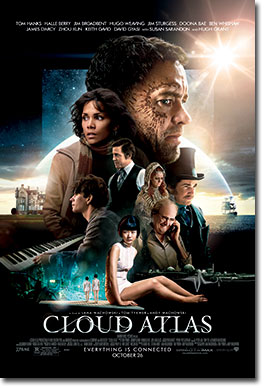
Cloud Atlas review: Six on one hand, a millennia on the other

Cloud Atlas review

The Wachowskis and Tom Tykwer present an adaptation of a novel set in six time periods spanning a millennia that most thought would never be able to translate to the big screen. Those critics have been proven wrong.

There are going to be those that don’t like Cloud Atlas. They may rage against the very concept and decry it as a failed attempt at bringing ADD theater to life. They may find fault with the initially disjointed narrative that focuses on six moments in time that don’t obviously lend themselves to one another. They may even pick at the often amazing but occasionally off-putting makeup featured heavily throughout the film. To those, I salute you and wish you well as you move along.

I understand the criticisms of Cloud Atlas. This is certainly not a film for everyone. But for those that find merit in each of the six settings, and those that are willing to stretch their appreciation to accept a more esoteric theme, they will be rewarded with one of the better and more original films of the year.

The story of Cloud Atlas is actually stories, six in total, all taken from the 2004 novel by David Mitchell. The six stories are told concurrently, with the film jumping back and forth as the narrative in each – although inherently unique – eventually finds a common thread to unite them. The stories are also connected in unlikely ways, as the central character of each new setting in some way stumbles upon a manuscript, a book, series of letters, or video of the chronologically previous character.

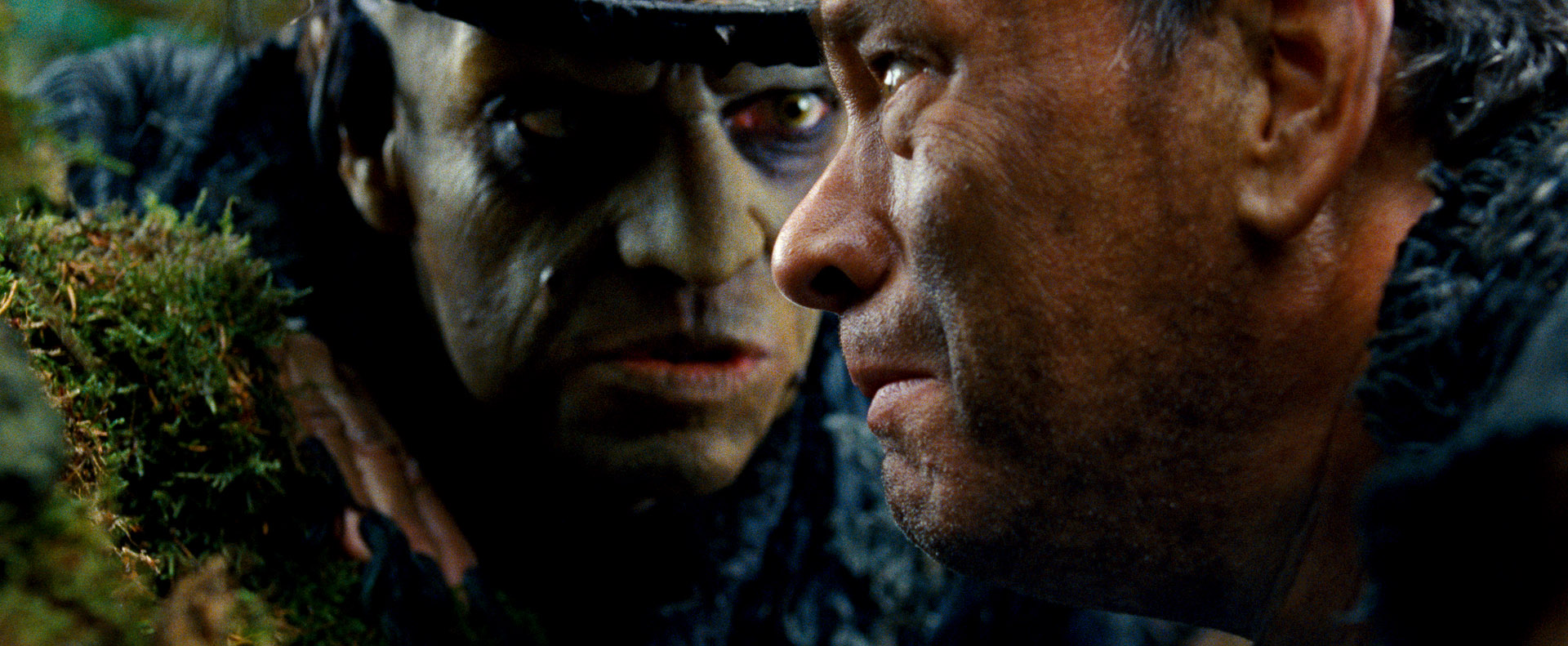
Cloud Atlas -- Hugo Weaving and Tom HanksThe themes that tie these narratives together are not fully revealed until the end, and the influence one has upon the other is subtle, and not always obvious. It is there though. But regardless of the overall impact, each of the individual narratives offers a complete story.

The film begins with an aged and tattooed Tom Hanks speaking a bizarre dialect that could only exist in the future, but chronologically the film begins in the South Pacific in 1849, with the story of an American notary named Thomas Ewing (Jim Sturgess) who is subjected to the horrors of slavery before beginning the journey home while racked with a debilitating illness. The next tale begins in the 1930s and focuses Robert Frobisher (Ben Whishaw), a young, gay musician who takes a job working with a marginalized, but brilliant composer.

The next era highlighted is 1975, and focuses on a journalist (Halle Berry) who becomes involved in a deadly conspiracy after a chance encounter. From there the plot jumps to the present day plight of Timothy Cavendish (Jim Broadbent), a beleaguered publisher that finds himself running from one bizarre situation into a much weirder one. That leads to Neo Seoul and a dystopian future where a genetically engineered servant named Sonmi-451 (Bae Doona) is shown the truth about her society with violent results. The final tale takes place in a nearly unrecognizable Hawaii in the far future after an event alluded to only as The Fall reverts most of humanity back thousands of years. When a member of the last technological society on Earth comes to the island, she (Halle Berry) must put her trust in the hands of Zachary (Tom Hanks), an emotionally scarred tribesman.

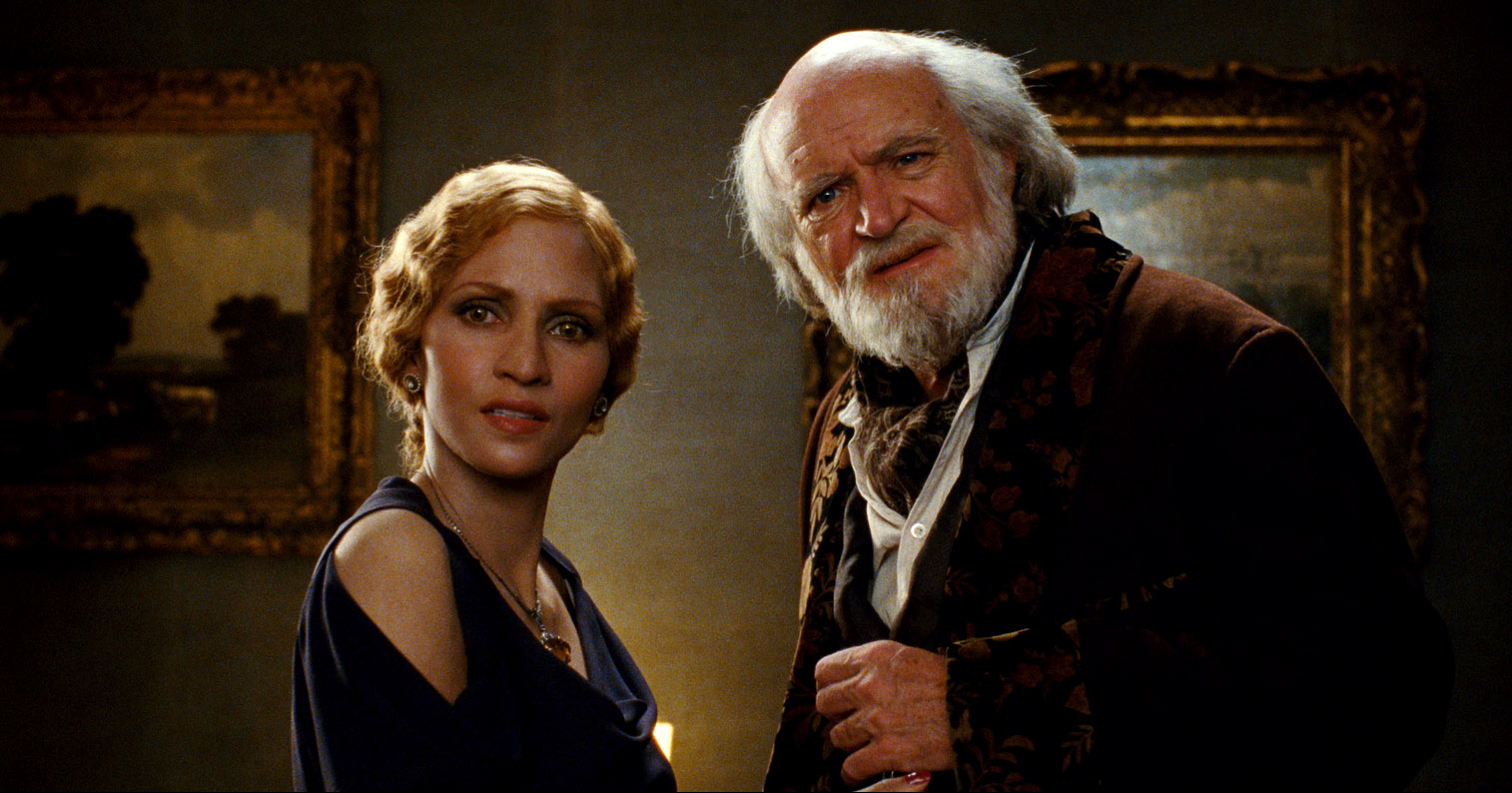
Cloud Atlas -- Halle Berry and Jim BroadbentThe gamble with Cloud Atlas is obvious. Each of those narratives is different in theme and tone, and each is an essential moving piece in a larger machine. If one fails, the whole is diminished. There may be enough to overcome a dislike of one or even two of the narratives, but even that seriously impacts the overall package. So all six pieces need to fit together and keep you entertained, otherwise the pacing will be severely affected.

Thankfully, each of the stories is engaging and engrossing. The shift in tones – from the humor in Cavendish’s situation to the action of Neo Seoul to the detective yarn of the 70s – all fit together well, and the three directors, Lana and Andy Wachowski (the Matrix Trilogy, Speed Racer) and Tom Tykwer (Run Lola Run, The International) do a masterful job of knowing when to cut between times to maximize the emotional impact of each story. You are generally left wanting more, which is good, but you also build on the feeling the previous setting generated and let it influence your interpretation of the next period.

This is well handled throughout, but nowhere more so than at the end when each of the six stories reaches its individual climax. The cuts between eras become fast and furious, and you are constantly left with mini-cliffhangers as the narrative picks up. Every one of the six then concludes with a surprisingly impactful ending, sometimes funny, sometimes tragic, but always relevant to the overall narrative. There are some that are stronger than others, and there is an order and a ranking to the power of each conclusion, but that will come down to the individual audience members tastes as much as anything.

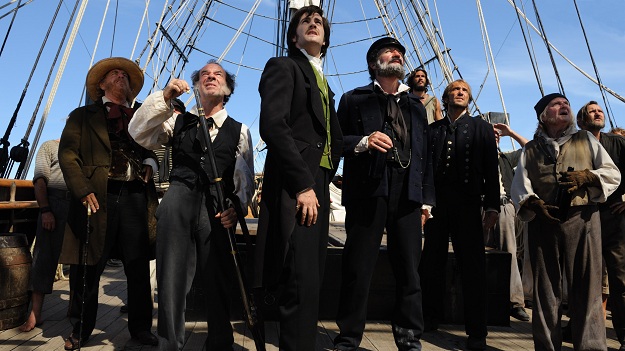
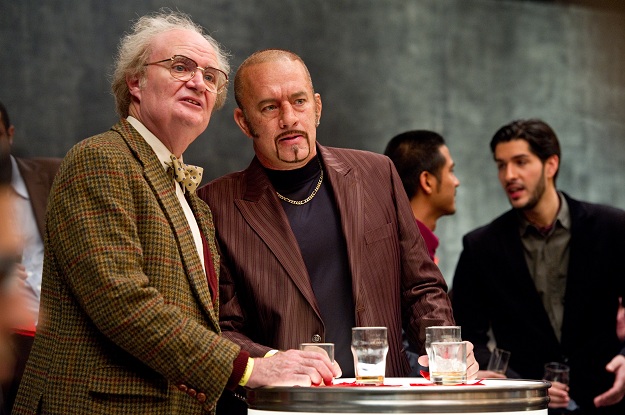
Cloud Atlas -- Tom Hanks, Jim Sturgess, and Jim BroadbentOf course, not all stories are created equal. Some certainly drag more than others, but there is a quality feel to each of them, and if you aren’t enjoying a particular section of one story just wait a few minutes.

While the narratives began in radically different places, they are often held together by the cast that dons multiple hats. Most of the characters play more than one role, and a few are in four or more. Hugo Weaving leads the pack with six roles, although Halle Berry and Jim Sturgess are the only actors with two roles that can both be considered as starring characters in their respective eras, with Berry leading the story in the 70s and costarring in the distant future, and Sturgess as the focal point of the 1849 piece and also co-starring in Neo Seoul.

Some of the actors, Hanks and Broadbent especially, seem to gleefully embrace the chance to try out the different skins they wear, while others consume their new characters with a degree of intensity that impresses. Of all the stars in the film, Sturgess is perhaps the standout. In each of the roles he plays, he transforms into that character. His mannerisms change, his vocal patterns mutate, and he approaches each role from a different viewpoint. Perhaps he is favored by the story of the two major parts he plays, as both are motivated by love, but he embraces the story powerfully.

Cloud AtlasHanks is in top form as well, and whether cackling as the 19th century Dr. Goose, or battling inner demons in the future as Zachary, he brings a fire to the role. Berry by comparison also does a good job, but her roles are somewhat hampered in comparison, as they are far more traditional even as she plays a member of a scientifically advanced branch of humanity.

Broadbent, however, may have the most endearing role in the film as Cavendish, a lovable loser with the timing of an oblivious Englishman, but it is Whishaw that has perhaps the most emotionally charged role. Between this and his turn as Q in the upcoming Bond film Skyfall, Whishaw may be bound for stardom.

The actors are free to indulge in playing multiple roles thanks in part to the makeup and effects used. For the most part, they are exceptional. In crowded theaters, the end credits will become a game of sorts as audiences are shown the various roles each actor played. If you correctly guessed them all, you will be in the minority. Hugh Grant in particular is almost like an Easter Egg in this film thanks to his time in the makeup chair. There are a few moments where the makeup becomes disconcerting and obviously fake, but these moments are typically brief.

Cloud Atlas -- Jim Broadbent and Tom HanksThe effects, although used sparingly, make this film possible. Moments like the first time you see Neo Seoul or the juxtaposed technology in the primitive future meld well with the generally remarkable look of the period pieces.

Despite the $100 million budget, Cloud Atlas is an indie film that just happens to star several major Hollywood talents. And like an indie movie, it stretches itself out and plays with the convention of film in order to try something new.

Conclusion

On paper, it shouldn’t work. You have six different stories with one emotional thread that the audience is left to recognize and accept on their own. And yet somehow it all manages to come together. The pacing is spot on and the cuts between time periods are handled in such a way that they help to lead you into the next narrative even though it may be completely different in tone. There is no way this should work. And yet it does.

For those willing to accept the odd nature of the film, for those that can appreciate that a story can have depth even if there isn’t a lot of time to fully flesh out the characters, and for those looking for something that is fresh and original, Cloud Atlas comes highly recommended.


Source : digitaltrends[dot]com

Aug 24, 2012

Sony taps National Treasure writers to script Uncharted movie

Uncharted

The Uncharted movie adaptation has found a pair of writers, Marianne and Cormac Wibberley.

When you think of Naughty Dog’s Uncharted series of action-adventure games, what comes to mind? Treasure hunting? Riddles obscured by legendary figures? Nicholas Cage mugging into the camera every few moments while John Voight silently wonders where his acclaimed career went wrong? Alright, forget that last one. Otherwise that’s a pretty solid descriptor for Uncharted, isn’t it? As it turns out, that’s also a great synopsis for the National Treasure movie franchise.

What’s the point, you ask? Well, it seems that Sony Pictures has noticed the similarities between the two media properties and took the totally logical initiative to hire the people responsible for writing the two National Treasure films to create a screenplay for the studio’s upcoming film adaptation of the Uncharted games. Variety reports:

Scribes Marianne and Cormac Wibberley, who were the architects of Disney’s “National Treasure” franchise, have been tapped to rewrite “Uncharted: Drake’s Fortune” for Sony Pictures, Atlas Entertainment and Arad Prods.

Unfortunately, in that same report Variety also reveals that Neil Burger is no longer attached to the film as director. Though far from a household name, Burger is a competent director and seemed like a solid candidate for the position, and losing him must be seen as a set back for the project. 

Additionally, Burger’s departure points out why we’re totally apathetic about the news that the Wibberleys have been tasked with writing the script for Uncharted: It makes little difference who writes this film as long as it has a good director and/or stars. If you’ve played the Uncharted games you already know how cinematic they are. Naughty Dog built these games to replicate Indiana Jones-style adventure movies and few would claim that it failed. Writing a script for an Uncharted film should be as simple as following the tropes established by the Uncharted games, dropping in ample amounts of fan service, and making sure that the historical figures referenced in the flick have been dead long enough to seem spooky and mysterious to today’s uneducated populace.

The director and actors however, have to both provide a believable portrayal of events that occasionally veer toward the silly and offer a suitable aesthetic replacement for the locales and characters seen in the game. Discounting Nathan Fillion — too obvious — can you think of any male actors who could play the lovably roguish Nathan Drake? We can think of a few to play his older pal Sully, but now that Ernest Borgnine is dead we’ve lost our first choice. Likewise worrying, the film’s producers have to find a director capable of aping a game series that is itself effectively an homage to Indiana Jones — a movie directed by Stephen Spielberg. Granted, that’s a whole lot easier than trying to directly one-up Mr. Spielberg, but there’s still only a short list of people we’d trust to competently helm this movie and most of them are likely far outside Sony’s price range.

Then again this project is very early in development, so a lot could change before it hits theaters. Hopefully the next blurb of info we get on the Uncharted film is a bit more reassuring.


Source : digitaltrends[dot]com