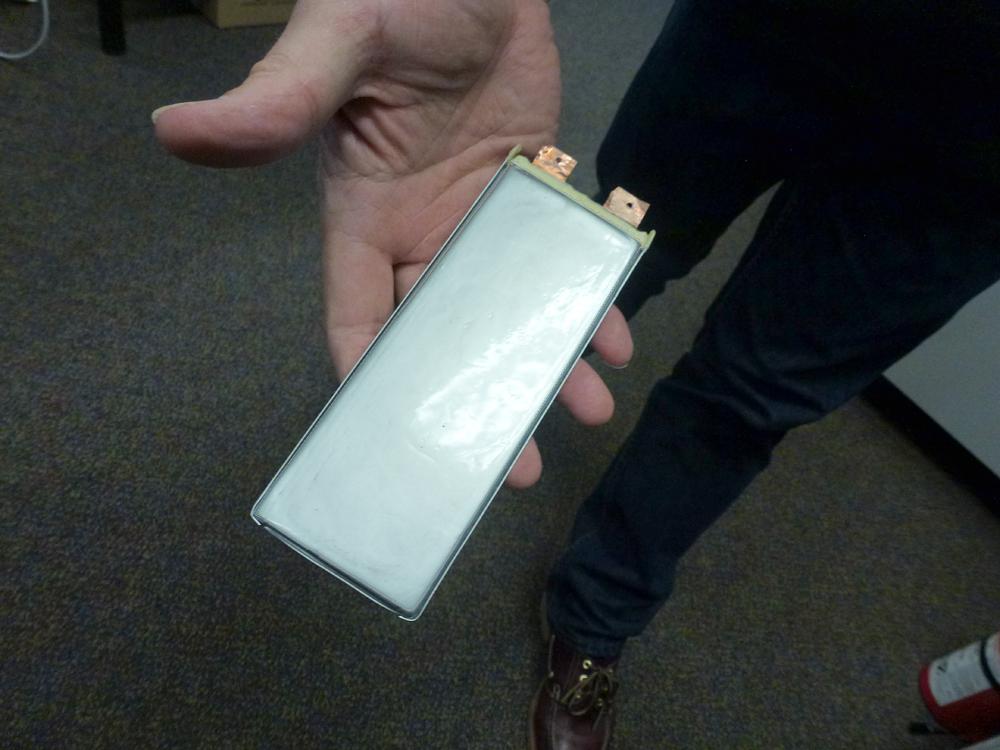
Several of the biggest makers of lithium-ion batteries have been accused of price fixing in a number of class action suits, which could have major implications for the future of electric cars.
As key components in everything from laptops and cell phones to electric vehicles, lithium-ion batteries have never been cheap, but it may have been more than just insatiable demand that has kept them that way over the years. According to the New Jersey Law Journal, at least 10 class actions have been brought against manufacturers of lithium-ion batteries alleging price fixing. Firms named include Panasonic, LG, Sony, Samsung, Sanyo and Hitachi, along with their American subsidiaries in California and New Jersey. The plaintiffs allege that these companies have engaged in price fixing to keep lithium-ion battery prices artificially high since 2000, and that they have controlled at times between 60 and 90 percent of global lithium-ion battery production.
The suit follows in the footsteps of others filed over price fixing of electronic components, such as LCD screens and RAM, and in some cases, the companies involved are the same. The plaintiffs allege that the situation the battery situation mirrors those previous cases in some ways, such as a highly concentrated market, rapid commoditization of new technology, and pricing that seems to defy the effects of fierce competition.
According to court filings, li-ion battery prices fell dramatically between 2000 and 2002 as Korean manufacturers entered the market and competition increased. But in the period following this, prices have risen consistently without even a hiccup during the 2008 economic downturn, evidence, plaintiffs claim, of price fixing.
Breaking up a potential price-fixing racket in lithium-ion batteries could be a significant development for EVs, where prohibitively expensive battery packs have served as an insurmountable stumbling block preventing mass EV implementation. Government programs have helped somewhat in reducing the cost for the consumer, but this spending is controversial, and skeptics see any consumer technology that needs to be propped up with legislation as being impractical in the long run. Prices have been predicted to fall for lithium-ion EV batteries over the next decade, but with sales of EVs falling well short of the high expectations of just two years ago and automakers rethinking their EV strategies, a decade from now might already be too late to save the EV. Should these suits trigger a worldwide drop in lithium-ion battery prices, the potential is there for an EV market which is competitive with standard gasoline-powered cars.
America's favorite action hero turned governor turned action hero Arnold Schwarzenegger has signed on to star in The Legend Of Conan.
When you think of Arnold Schwarzenegger a myriad of images likely flashes through your mind. There’s Schwarzenegger in a dapper suit addressing his constituents as governor of California. There’s Schwarzenegger riding a Harley while firing a sawed-off shotgun with one hand in Terminator 2. There’s Schwarzenegger swinging a gigantic sword in some dusty desert landscape, accompanied by a stirring Basil Poledouris score in Conan The Barbarian.
While that last one might have partially been pushed out of your memory banks by the recent reboot of the Conan series starring Jason Momoa, now would be a very good time to pull Schwarzenegger’s turn as Robert E. Howard’s most famous half-naked warrior to the forefront of your mind. According to a new Deadline report, Schwarzenegger has signed an agreement with Universal Pictures to return to his iconic role in The Legend Of Conan.
Though Deadline’s piece offers scant few details on what this film will be about, we are told that like 1982′s Conan The Barbarian, Legend will be an adaptation of Howard’s Conan tales. Given that there is no Robert E. Howard story called The Legend Of Conan however, we imagine that Universal plans to cherry-pick interesting moments from Howard’s stories to create something of a hybrid Conan adventure.
Intriguingly, it’s being reported that Legend will ignore both the 2011 Conan The Barbarian as well as 1984′s Conan The Destroyer. While not necessarily a direct sequel in name, Legend will create its fiction based on the events of Schwarzenegger’s first Conan film. “The original ended with Arnold on the throne as a seasoned warrior, and this is the take of the film we will make,” said producer Fredrik Malmberg. “It’s that Nordic Viking mythic guy who has played the role of king, warrior, soldier and mercenary, and who has bedded more women than anyone, nearing the last cycle of his life. He knows he’ll be going to Valhalla, and wants to go out with a good battle.”
Corroborating Malmberg’s words is producer Chris Morgan who explains why the original Conan film was the peak of the franchise and the only logical entry on which to build this new film. “Robert E. Howard’s mythology and some great philosophy from Nietzsche to Atilla the Hun was layered in the original film,” Morgan states. “People say, he didn’t speak for the first 20 minutes of the film, but that was calculated in depicting this man who takes control of life with his own hand. This movie picks up Conan where Arnold is now in his life, and we will be able to use the fact that he has aged in this story. I love the property of Conan so much that I wouldn’t touch it unless we came up with something worthy. We think this is a worthy successor to the original film. Think of this as Conan’s Unforgiven.
That seems like an intriguing premise and an excellent way to gloss over Schwarzenegger’s age. 1982 was three decades ago, and while the 65-year-old actor is still likely in far better shape than the vast majority of us common folk, he’s not exactly the same sculpted statue of masculinity that captured the world’s heart during the Reagan administration. That said, the man has a seemingly endless font of charisma, so assuming the script is well-written we’d be very excited to see Schwarzenegger tackle a more complex, older version of the sword-swinging barbarian character he made famous in his earlier days.
As this deal just came to light a few moments ago, we’re not likely to see The Legend Of Conan in theaters any time soon. Given the rigors of production and the number of other projects Schwarzenegger has lined up since leaving the world of politics, we’d expect at least a year to pass before Legend makes it theatrical debut. Deadline offers no word on when this film might enter production nor even an estimate on when it might see theaters, so please temper any giddy excitement you’re currently experiencing at this news.
Remember the Multi-Window feature that debuted on the Galaxy Note II? As it turns out the Galaxy S III owners might get a chance to join the multitasking action with the upcoming Android 4.1.2 update.
According to SamMobile, the update is coming in December and in addition to the Multi-Window functionality will also bring bug fixes and stability improvements.
For those unfamiliar with the feature, it allows you to have two applications open on the screen at any one time and operate both at the same time. It works great on the 5.5-inch Galaxy Note II, but we’ll see how well it’ll work on the Galaxy S III once the update hits the device.
Liam Neeson and his jeopardy-friendly family are back for another go-round on the kidnap merry-go-round in Taken 2.
Have you ever watched an action movie and thought to yourself, “you know, I like the action, but what it really needs is about 20 times more camera angles so I’m not entirely certain what I just saw — that would be great.” If so, then you are in luck! If, however, like the vast majority of functioning humans, you actually like to see the things you are looking at, Taken 2 might not be the film for you.
Taken 2 is a shallow, kinetic mess of visual trickery that never, ever stops, even when it should. Like a twitchy kid with ADD and an alarming coffee addiction, Director Olivier Megaton can’t seem to keep his hands off a single shot.
At several points in the film I actually began to count to see how long before the movie cut to a different shot. The longest I made it to was five seconds. Even in what should be the slow shots, innocuous moments, like when characters are walking into a hotel lobby, it’s almost as if the film is vibrating, and simply cannot slow down. Long shots, close-ups, side views, overhead shots – there are no lack of camera angles in this movie. It is filmmaking trickery, and it can work to make things feel more frantic, but only in moderation. And if there is one thing Megaton seems unable to grasp, it is moderation.
You can’t really blame him though. With a badass name like Megaton, you really don’t have many options as a director other than action movies. And with a filmography that includes The Transporter 3, Colombiana, and Hitman, it would seem he agrees.
When this style works, it is fine. In a foot chase, using the unrelenting cuts actually makes it feel a bit more frantic. In a fist fight or a car chase though, it feels like you are missing some of the movie.
There is never a second where you can just enjoy the action. Some of the best action moments are actually lost in a strobe light-like series of cuts. To give you a better example, at one point during a fist fight a character pulls a knife, but the camera never cuts back far enough, or lingers long enough, to identify who it is holding the knife. A long shot eventually reveals it, but that is just muddy filmmaking.
All of the sins of the quick cuts can be forgotten – or at least tolerated – if the story is good. Shame that Taken 2 barely has one.
The sequel is a direct continuation of the original Taken, as opposed to another adventure in the life of Bryan Mills (Neeson). A few years have passed since Mills murdered his way through Paris in order to rescue his daughter Kim (Maggie Grace), who was taken by an Albanian human trafficking gang and sold as a sex slave.
Mills is still at it, but following the breakup of his ex-wife Lenore (Famke Janssen) and her husband, he invites his family to join him in Istanbul for a getaway. Unbeknownst to them, Murad Hoxha (played by Rade Šerbedžija), the father of the Albanian gangster that took Kim and was subsequently killed in a fairly brutal fashion, awaits them for a round of revenge.
To its credit, Taken 2 avoids the tired, clichéd sequel staples of having an extraordinary person thrust into an unbelievable situation yet again, and instead tailors the script to be based on the consequences of Mills’ actions. It makes sense in the narrative, and it allows the film to massively simplify the entire plot.
This isn’t a bad tactic for action movies. Most adrenaline fueled films aren’t well served by getting lost in heavy drama, but the risk is that you need to do a very good job with developing the minimalist script or it feels hollow. You don’t need a massive backstory on the villain, but you do need to care at least a little, otherwise the resolution is anti-climactic. And that is a problem with this film.
The antagonist is just sort of there. Šerbedžija is given nothing to build a memorable character around, beyond the idea that he apparently loved his son, a guy that was so despicable he sold young girls into a life of perpetual rape. You are just supposed to sort of buy his justification, and beyond his identity as a father, you never learn a single thing about this character to make him stand out. There is nothing interesting about him, and the possible complexity the character could offer is totally absent.
The same is mostly true of Mills’ family as well. Smith and Janssen both do well with what they are given, but neither are working with much to begin with. Of all the characters, the one with the most potential to be explored is Kim. But instead of wasting time on silly little things like story, the movie flies by the emotional toll of the last film, the traumatic effects reliving it would have, and instead she is swept up in the events and becomes a narrative tool rather than a character.
That is endemic of the film as a whole, and highlights the problems with Taken 2: it is just an action movie, and a fairly lazy and generic one at that. There is even a point in the final act where the comes together so quickly, and through such an unlikely series of events that it feels like the film has long since given up on a narrative.
The original Taken had a story to tell and a unique way to do it. The shocking and gritty world of human trafficking was juxtaposed against the beauty and light of Paris, and the story was able to ratchet up the tension as an unpredictable protagonist quickly went from hero to antihero, yet managed to retain the sympathy of a father desperately seeking his daughter. None of that depth is present in Taken 2 on any level.
Conclusion
Taken 2 is an exceedingly generic film with no real meat to it, and it is badly shot on top of that. The three main stars, Neeson, Janssen, and Smith are all fine in their roles, but they are given next to nothing to work with. That puts the burden on the action, which Megaton takes in a bizarre direction that feels like you are watching a movie made of caffeine.
With even a tiny bit more attention to the character development, and a few Valiums for Megaton, Taken 2 might have been worthy successor to the original. Instead it comes off as a pale impersonation.
Legal action between the Academy of Motion Picture Arts and Sciences and GoDaddy is looking increasingly likely to spill over and engulf Google, despite a waiver that should keep the company free of any such implication... A waiver that one of the two parties involves is denying it ever agreed to.
For two years, the Academy of Motion Picture Arts and Sciences – the organization responsible for the Oscars each and every year – has been engaged in an ongoing and seemingly increasingly complicated legal battle with GoDaddy, the web domain registration and hosting service, and for two years, the legal battle has continued to get more and more complicated, instead of less. Which makes the news that the never-ending fight has now drawn Google into the tussle both surprising – because, why is an entirely separate company being sucked in? – and entirely believable. What else could go wrong?
The conflict between the AMPAS and GoDaddy centers around the question of whether or not the latter company is facilitating trademark infringement by allowing outside parties purchase and then “park” pages on Oscars-related URLs such as “oscarsliveblogging.com” or “oscarshotels.com.” Such cyber-squatting not only hurts the Oscars’ credibility, says the AMPAS case, but it also allows the squatters to benefit from any advertising revenue generated from accidental visits as a result of a pay-per-click advertising model. The argument over the case has been stalled out for some time at the pre-trial discovery phase, and that stalling is in large part responsible for the increasing possibility of Google involvement in the whole thing.
In the past month, reports the Hollywood Reporter, both GoDaddy and the AMPAS have appealed to the judge in charge of their case to compel Google to hand over documents and issue subpoenas to have Google executives deposed as part of the proceedings. The reason for this is that GoDaddy is arguing that the only reason users are landing on the cybersquatted URLs and know they exist in the first place is because people are discovering them via Google searches, and anyway, the advertising pay-per-click program that makes money for the quatters…? That’s also the work of Google.
So far, Google is dissembling in its response to such requests. The company has already handed over somewhere in the region of 4,600 documents to assist in the trial, but seems uncomfortable becoming any more involved, citing that there is a written agreement between Google and GoDaddy prohibiting any discovery towards Google in this trial. That waiver comes from 18 months ago, and relates to the fact that GoDaddy’s legal firm in this case is also Google’s legal firm in certain matters. Weirdly enough, GoDaddy rejects the idea that it actually agreed to any such waiver, something that points to either an untruth or staggering lack of organization on their side while preparing for this case to come to trial.
Waiver or not, everything could change as early next week. A hearing on whether or not Google will be legally compelled to get further involved with the case will be held next Tuesday in San Jose.
Vin Diesel's next role may see the muscular action star slaying witches.
According to a report over at The Wrap, Vin Diesel (pictured above; you’re welcome ladies) is currently in talks with the Lionsgate Entertainment/Summit Entertainment conglomeration to assume the lead role for the studio’s upcoming The Last Witch Hunter. As the name suggests, the film revolves around a man with a knack for bumping off witches, or, as The Wrap puts it, The Last Witch Hunter “follows the last remaining witch hunter who must stop a witch uprising in modern day manhattan.”
Neat concept, right? Apparently Hollywood thinks so too, as the script for this thing, written by Cory Goodman (whose only prior writing credit was on 2011′s Priest), found its way on to the 2010 edition of the Black List. For those of you currently scratching your heads, the Black List is a short roster of the best scripts in Hollywood that have yet to be made into films. Former Black List scripts that eventually spawned movies include Aaron Sorkin’s The Social Network (it made the list in 2009) and Joe Penhall’s adaptation of Cormac McCarthy’s The Road (which is featured on the 2007 list.) If you’d like to learn more about the List or read through the entire collection of Black Lists dating back to its inception in 2005, have a look at the List’s official site.
Anyway, back on topic: Vin Diesel as mankind’s last hope against the apparently terrifying menace of witchcraft. As much as we’d like to have something cynical to say about this idea, we can’t really come up with anything. We like the premise, we like the idea of Diesel as an action movie star, and we like everything we’ve heard about the script. The only possible problem we can see with this project is that the concept of witches doesn’t seem to generate much excitement among prospective viewers.
Remember 2011′s Season Of The Witch? Of course not, you didn’t see it. Very few people did. The movie, which starred Nicolas Cage as a world-weary knight devoted to routing demonic evil, pulled in a little less than $25 million here in the US, and nearly earned $67 million worldwide. On a production budget of $40 million, those figures leave a lot to be desired and may indicate that contemporary audiences just don’t care about angry women who can vomit pestilence and spin their heads all the way around.
Then again, Season Of The Witch may have been stymied by its lack of long-term, pre-release advertising, or the overexposure of its male lead. Vin Diesel, by comparison, is far more suited to being an action star than the 48-year-old Nicolas Cage. Likewise, he hasn’t been headlining three movies a year for the past decade. Maybe audiences will more readily accept Diesel as a hunter of the wolfsbane and eye of newt set.
Whatever happens, it’s going to be a while before we see how this project turns out. Diesel has yet to sign an official agreement to star in The Last Witch Hunter, and even once that’s completed the film will likely need at least a year of production prior to its theatrical debut. Fingers crossed that this project can avoid any unforeseen roadblocks.
After years of paying his dues, inarguably awesome action movie star Michael Jai White has been given his own franchise.
Officially speaking, we write these stories about the movie business to impart important news. All those stories we’ve written over the past few months about Joss Whedon’s blockbuster hit The Avengers were driven purely by your collective interest in that film. The movie pulled in nearly $1.5 billion worldwide, so it seems a pretty safe bet that our readers have some interest in hearing news related to the film and its possible future implications.
That said, we also have a bit of an ulterior motive in mind when we sit down to write one of these things. Ideally we’d like you to walk away from our work having learned something, or with a newfound desire to seek out entertainment that perhaps you had never heard of before.
Why the above disclaimer? Well, it’s great news for fans of Michael Jai White that the man will finally be given the sort of full-featured action movie franchise he has so obviously deserved for years, but it’s also an opportunity to expose White’s work to a larger audience. Many of you have likely never heard of the man, and that’s a shame given that he’s the closest living, youthful analogue we currently have to the larger-than-life badass action heroes of the late 1980s and early ’90s. Imagine a more athletic, martial arts-focused Sylvester Stallone, who can actually act quite well, and you’ve got a decent idea of what Michael Jai White brings to the table.
Alright, proselytizing is momentarily over. Let’s get right to the news. Courtesy Indiewire:
White has signed on to star in what is expected to be an action movie franchise from Moonstone Entertainment, titled Codename: Falcon. The franchise will revolve around a former marine named John ”Falcon” Chapman, described as a “dark anti-hero driven by guilt, who will destroy himself unless given something else to destroy,” making him “a useful weapon-of-last-resort for the foreign ministry.”
The first film in the franchise, titled Favela, is currently in pre-production.
As for the plot behind Favela, Moonstone Entertainment offers the following, PR-approved synopsis blurb:
… Favela sees Chapman traveling to Brazil to hunt down his sister’s killers, in the process discovering an underground world of drugs, prostitution, and police corruption ruled by the Japanese mafia.
That sounds like a pretty standard action movie plot. Something like a hybrid of Commando and any number of John Woo’s Hong Kong classics. Normally that wouldn’t reach out and grab our attention, but again, we’re big fans of Michael Jai White’s work, and his being given a franchise to lead is long overdue.
Listen, we don’t have all day to impress upon you the idea that Michael Jai White should be standing alongside Tony Jaa in your mental roster of our modern world’s most entertaining celluloid heroes, so instead we’ll do this the quick way. When you next fire up Netflix, stream the film Blood And Bone. Many will claim that Michael Jai White’s best work was in the 2009 blaxploitation spoof Black Dynamite, and they’d be absolutely correct, but Blood And Bone is a perfect depiction of the man’s acting talents alongside his inarguable skill at making on-screen violence look both spectacular and horrifically visceral. Blood And Bone fits neatly into the B-movie subgenre, but it’s amazing how many modern big-budget action movies are annihilated by comparison to this flick. If nothing else, it should offer ample evidence that Michael Jai White is a fellow to keep your eyes on.
Bruce Willis may be contemplating legal action against Apple over the ownership of his digital music collection.
At first, this appears to be a slightly ridiculous story that exists only because it features a movie star and the world’s most talked-about technology company, Apple. However, there is a little more to it than that, but first here’s the tabloid-friendly story:
Bruce Willis, star of many an action film including most recently, The Expendables 2, is said to be gathering a legal team to potentially fight Apple in court, over the ownership of his digital music collection.
This doesn’t refer to his own discography from the 80s and 90s, but to songs he has purchased through iTunes. Willis wants to pass on the presumably extensive collection — which according to The Sun contains songs by the Beatles and Led Zeppelin — to his children, Scout, Tallulah and Rumer after he dies.
Except Bruce has done what many of us haven’t — he has read the iTunes terms and conditions, which under the “nontransferable license” section clearly says that “licensed applications” (in this case, songs), cannot be used on any Apple device you do not own or control. You aren’t really purchasing the music through iTunes, but the rights to listen to it, which can’t be passed on to others.
His legal team is in the process of setting up a trust to hold his music collection, but if the report is accurate, he’s also readying them to go to court over the situation.
Save us, Bruce Willis!
For those not in the know, The Sun is one of the best-known tabloid newspapers in the UK, and as such a degree of sensationalism in its stories should be expected; but Bruce’s frustration will be felt by a great many others too.
Attempting to bequeath digital media isn’t as easy as it is with a physical collection of music, books or films. An estate attorney for a New Jersey law firm told the Wall Street Journal that despite digital collections being recognized as “an asset and something of value, the law is light years away from catching up.”
This won’t help Bruce Willis, who has the added problem of agreeing to the terms and conditions when he signed up with iTunes. It’s hard to argue about something when you’ve already accepted the consequences.
Setting up a trust is a way to circumvent the troublesome ownership issue, which according to the blurb on one such site advertising such a service, “manages your digital assets and allows those who you preselect to access them without violation of the license terms and without potential liability.”
While this is probably the route Willis will end up taking, one must wonder what would happen if a media personality with clout stood up in court with the intention of changing the rules concerning digital content ownership. Could Willis, who has said “I think I could save the world five or six more times” before retiring, be that person?
The Uncharted movie adaptation has found a pair of writers, Marianne and Cormac Wibberley.
When you think of Naughty Dog’s Uncharted series of action-adventure games, what comes to mind? Treasure hunting? Riddles obscured by legendary figures? Nicholas Cage mugging into the camera every few moments while John Voight silently wonders where his acclaimed career went wrong? Alright, forget that last one. Otherwise that’s a pretty solid descriptor for Uncharted, isn’t it? As it turns out, that’s also a great synopsis for the National Treasure movie franchise.
What’s the point, you ask? Well, it seems that Sony Pictures has noticed the similarities between the two media properties and took the totally logical initiative to hire the people responsible for writing the two National Treasure films to create a screenplay for the studio’s upcoming film adaptation of the Uncharted games. Variety reports:
Scribes Marianne and Cormac Wibberley, who were the architects of Disney’s “National Treasure” franchise, have been tapped to rewrite “Uncharted: Drake’s Fortune” for Sony Pictures, Atlas Entertainment and Arad Prods.
Unfortunately, in that same report Variety also reveals that Neil Burger is no longer attached to the film as director. Though far from a household name, Burger is a competent director and seemed like a solid candidate for the position, and losing him must be seen as a set back for the project.
Additionally, Burger’s departure points out why we’re totally apathetic about the news that the Wibberleys have been tasked with writing the script for Uncharted: It makes little difference who writes this film as long as it has a good director and/or stars. If you’ve played the Uncharted games you already know how cinematic they are. Naughty Dog built these games to replicate Indiana Jones-style adventure movies and few would claim that it failed. Writing a script for an Uncharted film should be as simple as following the tropes established by the Uncharted games, dropping in ample amounts of fan service, and making sure that the historical figures referenced in the flick have been dead long enough to seem spooky and mysterious to today’s uneducated populace.
The director and actors however, have to both provide a believable portrayal of events that occasionally veer toward the silly and offer a suitable aesthetic replacement for the locales and characters seen in the game. Discounting Nathan Fillion — too obvious — can you think of any male actors who could play the lovably roguish Nathan Drake? We can think of a few to play his older pal Sully, but now that Ernest Borgnine is dead we’ve lost our first choice. Likewise worrying, the film’s producers have to find a director capable of aping a game series that is itself effectively an homage to Indiana Jones — a movie directed by Stephen Spielberg. Granted, that’s a whole lot easier than trying to directly one-up Mr. Spielberg, but there’s still only a short list of people we’d trust to competently helm this movie and most of them are likely far outside Sony’s price range.
Then again this project is very early in development, so a lot could change before it hits theaters. Hopefully the next blurb of info we get on the Uncharted film is a bit more reassuring.
The US Federal Trade Commission announced on Wednesday it had finished its investigation into Facebook's acquisition of Instagram and would not be taking any further action, paving the way for the deal to be sealed.
Facebook’s acquisition of photo-sharing app maker Instagram came another step closer on Wednesday when the US Federal Trade Commission (FTC) announced it had completed its antitrust investigation and would not be taking any further action.
Facebook said in a statement that it was “pleased” with the FTC’s decision though it gave no indication as to when the deal might be completed.
Back in April, a month before the social networking giant floated on the stock exchange, Facebook CEO Mark Zuckerberg said it intended to buy Instagram for $1 billion. The deal struck between the two companies meant Instagram would receive $300 million in cash and just under 23 million shares.
Of course, Instagram CEO Kevin Systrom had been hoping to see the value of Facebook shares hit the roof after the company went public in May. However, it’s gone the other way, with shares in the social networking company currently worth just half of their original $38 IPO price. This means the Facebook-Instagram deal is currently valued at just over $747 million.
The news in April of Facebook striking a deal with Instagram came as a surprise to many, not least the Facebook board. Co-founder Mark Zuckerberg reportedly sorted the deal all by himself, meeting Systrom at his Palo Alto home over three days, whittling the Instagram boss down to $1 billion from his original asking price of $2 billion. It’s thought Zuckerberg wanted to act fast in order to stop another company getting in first, with Facebook keen to find ways to increase its presence in the mobile space.
Instagram is a hugely popular free photo-sharing app that allows users to make fast and stylish edits to their snaps before sharing them on the Web. It currently has 80 million users, a figure impressive by any standards, but even more so when you consider it launched less than two years ago.