Pages

Showing posts with label brazil. Show all posts

Oct 23, 2012

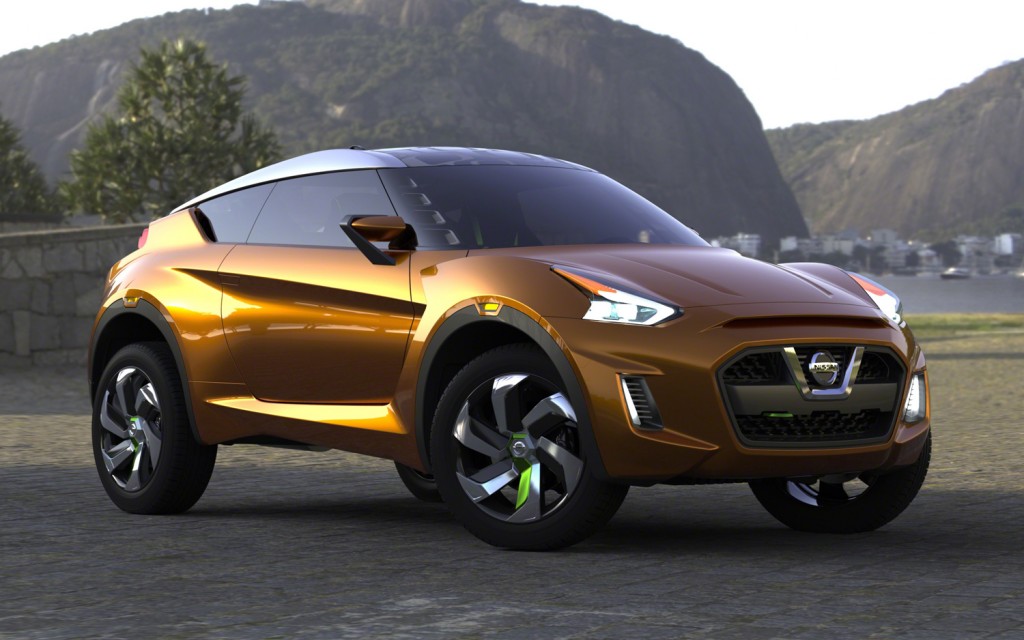
Nissan Extrem concept: Brazil gets its own Juke

Nissan Extrem concept front three quarter view

The Nissan Extrem may have been designed specifically for Brazil, but it borrows a lot, including a turbocharged engine and all-wheel drive, from Nissan's other crossover coupe.

What if you like the Nissan Juke, but don’t like the styling? Nissan may have a solution. The company unveiled a new concept car, the Extrem, at this week’s São Paulo Motor Show. Like the Juke, it’s a sporty runabout that combines elements of a coupe and crossover, but it looks completely different.

Make that different and smaller: the Extrem is 151.6 inches long, making it significantly shorter than the Juke, which measures 162.4 inches. Nonetheless, the Extrem shares the Juke’s 1.6-liter, turbocharged four-cylinder engine, along with a choice of front-wheel drive or torque-vectoring all-wheel drive.

Nissan says the Extrem is a 2+2, meaning the back seats are only fit for short trips or kid duty. Given the Juke’s relatively cramped quarters, and the fact that the Extrem is shorter, that seems about right. It might be better to think of the Extrem as a two-seater with some storage space behind the seats.

What really sets the concept Extrem apart from the production Juke is styling. The Juke has always been a polarizing car, and without a grinning face and cartoonish headlights, the Extrem looks oddly normal in comparison.

Normal is a relative term, of course. The Extrem’s 19-inch wheels look gigantic on such a small car, and the position of the taillights and resulting tiny backlight is, well, extreme. The roof rails look like they belong on a Mini Paceman, though.

The bottom line is that, for cars that are essentially the same mechanically, the Extrem and Juke couldn’t look more different. Where the Juke is bulbous and curvy, the Extrem is sharp and edgy. It is up to buyers to decide which approach is better.Nissan Extrem concept rear three quarter view

The Extrem was designed specifically for Brazil, but Nissan says it will appeal to the same types of people the Juke does in other markets.

“It was created to appeal to the country’s growing band of city-based young professionals who are passionate about design and want to make a personal statement. The lightweight two-door 2+2, has a dynamic stance, fresh surfacing, and a clear rugged ability to tackle the urban jungle everyday,” Nissan senior vice president and chief creative officer Shiro Nakamura said in a statement.

Despite having a production-ready engine and Nissan’s V platform (which also underpins the Cube and Leaf), the Extrem probably won’t see production. Like most concept cars, its mission is to set a precedent for future models with its outspoken styling.


Source : digitaltrends[dot]com

Aug 8, 2012

Realtime lands $100M in funding to actually make the Web real-time

realtime logo

The Brazil-based startup will continue its growth and help the real-time Web evolution speed things up.

As the Web has evolved, so has its speed. We want instant results, we live on autocomplete, we refresh our news streams. And real-time functionality has brought us as close to a constant flux of information as possible.

However a real-time information feed is hardly a site standard yet, and aptly named startup Realtime wants to speed the adoption up. Today, the Brazil-based company announced its U.S. launch as well as a new round of fundraising to the tune of $100 million. The startup has developed a proprietary technology that it says will take us from the real-time Web to the live Web.

Founder André Parreira tells me that the team founded Realtime after seeing that the Internet as we currently know it is working with a rather old infrastructure. “Near real-time solutions such as AJAX, Comet, and other can become costly and don’t actually offer real-time,” he tells me. “Also, with the rapid expansion of mobile devices that are connecting to the Internet and constantly sending and receiving data, it’s clear that a solution to use less bandwidth and dispatch information faster and more efficiently is a true need that Realtime can surely answer to.”

That all sounds well and good, but how is Realtime doing this exactly? To be more specific, the startup has developed a set of tools and a new programming frameworks (called xRTML and ORTC) which can be integrated to create a cloud-based — you guessed it — real-time messaging system. Better yet, it’s with one simple line of code. Realtime is free up to a certain point, or pay as you go if your traffic is particularly high. 

“We feel like the new Web is a live Web, and this new Web needs a new approach that we provide,” Parreira says. Still not entirely certain what this actually looks like? Check out this demo video showing one example of what the Realtime infrastructure can do for a client site.

What Realtime is doing right now is very much an enterprise-facing platform, we’re not looking at a new Twitter competitor trying to take advantage of the service’s recent, small fall from grace. Instead it’s targeting the likes of publishers, advertisers, and media agencies that want to implement a way to connect with their customers and site visitors. Parreira tells me the company will soon announce several high profile clients and partners Realtime is already working with.

The $100 million is going to go into research and development, which Parreira says is “part of our DNA,” human resources, and to further building Realtime’s global business and brand while readying for its commercial debut.

As previously mentioned, Realtime is making a beeline for Twitter’s business in lieu of its recent distancing from developers. But when asked whether it could be a part of alternative solution, Parreira says “We definitely could [be], hands down.”

“Our technology will provide real-time experience — and for that, Twitter will be only one application — because Realtime is providing a really democratic online experience,” he says. “Which is creating not a product, but really an industry.”


Source : digitaltrends[dot]com