Pages

Showing posts with label results. Show all posts

Nov 8, 2012

Tablet survey: Apple products top holiday wish lists

Apple iPad Mini review iPad comparison iOS tablet

Hoping to find an Apple tablet in your Christmas stocking? According to the results of a new survey, you're not alone.

For the second year running, a survey by online shopping site PriceGrabber shows Apple products at the top of consumer wish lists this holiday season.

A refreshed iPad (in fact, you could call it double-refreshed) since last Christmas, together with the introduction of the smaller 7.9-inch iPad Mini, have evidently enabled the Cupertino company to maintain strong consumer interest, with 63 percent of respondents hoping to receive a tablet this holiday season wishing for an iPad 3 or 4. Twenty-four percent said they’d like to receive an iPad Mini.

It was neither a Kindle Fire nor the Nexus 7 that placed third, with 22 percent saying they’d like to receive Samsung’s latest 5.5-inch Galaxy Note device instead. Amazon’s Kindle Fire HD was the preferred choice for 20 percent of respondents, while 13 percent went for the Surface.

PriceGrabber’s survey, which allowed respondents to select as many tablets as they liked, involved 1,475 US-based online shoppers interviewed between October 24 and November 1, 2012.

Of course, the tablet market has changed greatly in the last 12 months, with big hitters like Amazon introducing its new range of Kindle Fire tablets. Google also entered the tablet arena this year with its Asus-made Android-powered Nexus 7 and Nexus 10 devices. The Nexus 10 doesn’t appear in the survey results, presumably because it was announced at the tail end of the period during which the research was conducted.

Lower-priced category

In the lower-priced tablet category – a category that’s expected to generate a lot of revenue for tech companies this holiday season – PriceGrabber asked consumers not which tablet they’d like to receive but instead which one they’re most likely to buy as a gift.

The iPad Mini was chosen by 45 percent of consumers, while 27 percent went for the Kindle Fire HD. The Nexus 7 and non-HD Kindle Fire tablet tied for third spot, each receiving 19 percent. Six percent selected one of Barnes & Noble’s tablet offerings.

PriceGrabber’s Rojeh Avanesian commented on the results in a release, saying, “Tablets continue to grow in popularity as a top holiday gift, especially with the emergence of lower priced tablets in the $200 to $300 price range targeting budget-conscience consumers.”

Does it surprise you to see the Galaxy Note in third spot among consumer preferences – placing higher than the Fire HD and Nexus 7 – or, considering its feature set and portability, does it make perfect sense? 


Source : digitaltrends[dot]com

Nov 6, 2012

Google updates search engine results page

Google has done some minor modifications to their SERP (search engine results page). The new design mostly involves rearranging the navigation controls around.

As you can see from the screenshot above, the navigation controls, which previously could be found on the side, have now been moved up top. This works fine for usual web search but poses new problems for image search.

Earlier when you made an image search on Google, you would see options for image size, image type, etc. on the sidebar and you could quickly click them. In the new layout, these additional options are hidden inside a drop down menu called Search tools. Opening it reveals other options, such as Any time, Any size, Any color, etc., so you then have to click on those to access the submenus. So essentially your one click process has now turned into a three click process.

Moving the navigation controls up top has freed up space on the side. The image view fills it with image results, so you now have images spanning the entire width of your browser window. Web searches, however, just show blank white space on the side, which looks remarkably like Bing now.


Source : blog[dot]gsmarena[dot]com

The problem with your socially-sourced election predictions

social media and election predictions

As the 2012 presidential election comes to a close, our interest is being held captive by early results sourced by the likes of Twitter and Facebook. But for all of the infographics created from this data, is there really enough here to offer election predictions?

Finally, November 6 is here. Election Day has come and that means the campaigns we’ve watched unfold over what feels like a lifetime are coming to an end. And this has been an election season the likes of which we’ve never seen: It’s infiltrated every last pore of our existence thanks to the deluge of social media outreach and coverage.

And it’s not over yet. While the votes have yet to be counted, we apparently already have an outcome: Obama will be our president for another four years.

How do we know this? Social media. Statistically, candidates who have more Facebook Likes and Twitter followers tend to win. Three recent gubernatorial races went to the candidate with largest Twitter follower counts.

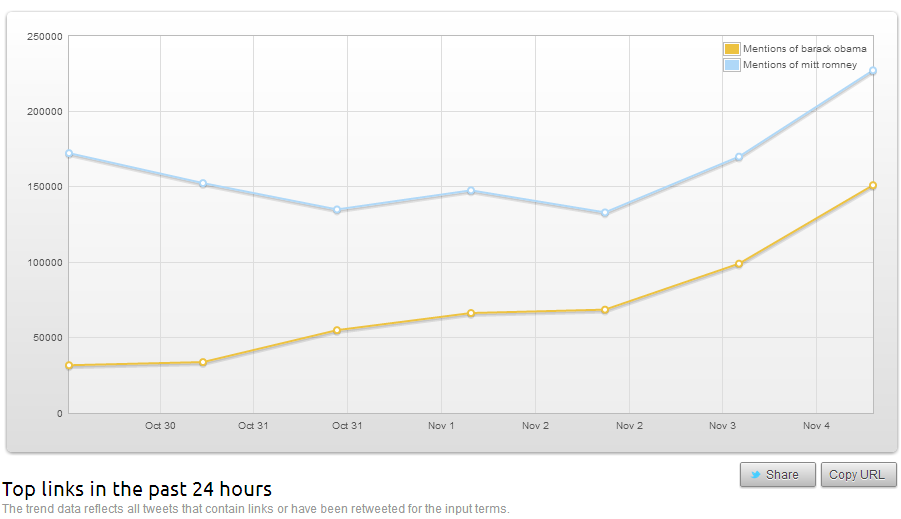
But wait – there’s also an argument that @mentions indicate who our winner is going to be. The candidate everyone’s talking about will be the next president. In that case, Mitt Romney takes the lead.

topsy election

And if you think Web buzz in general is going to predict our next president, then once again it’s Romney for the win.

google trends election

Social network-sourced election predictions are everywhere, but whether they mean anything is unclear. There’s no shortage of infographics using eye-catching visuals to colorfully chart out how we’re using Facebook, Twitter, and Instagram to talk about our candidates, but not enough analysis about whether this content is signal or noise.

What we do know is this:

  • People increasingly use social networks; as of May, eight percent of online adults were using Twitter on a typical day.
  • People increasingly get their news from social media and digital outlets; according to a Pew Research Center Report, “the percentage of Americans saying they saw news or news headlines on a social networking site [from the day before] has doubled from nine percent to 19 percent – since 2010.”
  • 88 percent of social media users are registered voters.

election infographicsThe big picture take-away from this is that social media and elections matters; politicians should be creating content here, because constituents react to it. But the data raises more questions than it answers. What about sarcasm, mood, and sentiment? Or spam accounts? Or malicious posts meant to manipulate a social network? We just saw how completely faked information can take over a platform as well as the news cycle, so what’s to keep us safe from similar effects with election predictions?

For all the revealing bite-sized data we can squeeze out of Facebook posts and followers and Twitter mentions and hashtags, there are plenty of glaring inaccuracies as well. According to Twitter, Ron Paul should have been the Republican nominee, and the Iowa primary would have ended quite differently.

For every insightful social media analysis, there are 10 terribly shallow ones. Countless news outlets launch tools or republish infographics that count “buzz” – and if that’s all we we’re looking for, Herman Cain would probably be our next president.

What’s missing, of course, is context. So many of the endlessly-circulated infographics and charts we’ve seen this year are heavy on data and pie charts and graphs and lack anything to put those numbers into perspective.

As a rule, these prediction tools aren’t able to determine if tweets or Facebook posts are coming from people who are even eligible to vote. According to a recent study, 73.7 percent of Twitter users are between the ages of 15 and 25, so there’s plenty of opportunity here for users who can’t vote to be sharing their opinions. To further complicate things, only 0.45 percent of Twitter users disclose their ages. 46 percent of Facebook users are 45 or older, but given how large Facebook is, this number is sort of insignificant; it means that there are plenty of under-aged users on the site who could very well be endorsing candidates they can’t vote for.

Demographics in general are rather ignored – the most notable of them being that the people who use social networks to talk about politics are already politically motivated. This means that those who keep their political ideals to themselves or don’t have strong enough beliefs to broadcast them – but will still vote – aren’t being counted. In traditional prediction methods, pollsters specifically reached out to this subset in order to create more accurate views of the elections, but since the data being pulled from social networks is all self-motivated, these data simply get left out.

German researchers recently looked at Twitter’s predictive abilities, saying: “While we find evidence of a lively political debate on Twitter, this discussion is still dominated by a small number of users: Only four percent of all users accounted for more than 40 percent of the messages.” This was back in 2009, but surely the scale still speaks to a notable discrepancy.

“So long as you understand the data and the demographics of social users, you can measure sentiment in perspective and target relevant messages to those groups,” says 140Proof founder and CTO John Manoogian III says. “The problem comes when pundits and analysts mistakenly assume that social media aggregates the tastes and preferences of all voters — it does not. Sites like Facebook and Twitter have political leanings. But social media does pretty strongly indicate what young, educated, and/or professional voters are saying.”

A much bigger factor is the failure of sentiment and mood analysis. The mechanisms we use to measure social media talk aren’t sophisticated enough to know if you’re slamming Obama or endorsing him. Some people can barely read sarcasm, so don’t expect applications pulling in tweets and posts to consistently do so. If you write “Oh sure, I totally believe Romney has women’s interests at heart,” in a Facebook post, it will likely be interpreted as a pro-Mitt statement.  

There’s also the fact that we want this to work; we want to be able to use social media to tell us how we all really feel. “This is the so-called file-drawer effect: researchers do not publish negative results, hence, only positive results are known and it seems that something is possible most of the time when it could be due to pure chance,” says researcher Daniel Gayo-Avello. “A paper [I wrote with] Eni Mustafaraj and Takis Metaxas showed that, in fact, results could be guessed roughly half of the time; that is not an impressive predictive ability, isn’t it?”

“Thus, by not knowing (because they are seldom published) about negative results, everybody assumes that simple methods simply work; and, indeed, they ‘work’ but half of the time, akin to a broken watch which ‘works’ twice a day.”

This doesn’t mean all this information isn’t valuable – it absolutely is, and interesting to boot. There’s no argument that politicians shouldn’t be using social networks, and this type of outreach is only going to become more common and more sophisticated.

The big lesson is social networking can be used as an indicator of opinion, but not necessarily decision. There are just too many loose ends involved, and until they can be tied up, you’re just going to have to learn who will win our elections the old fashioned way: by waiting up all night for some guy or gal on TV to announce it. 


Source : digitaltrends[dot]com

Nov 1, 2012

Finally, you can now search the Facebook App Center

Facebook Gifts charity

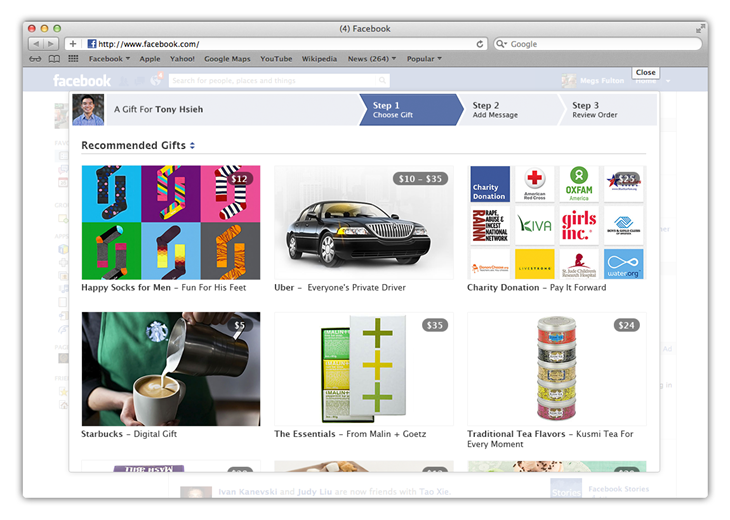
Facebook added a few updates today: The social network has added search and sponsored results to its App Center, and announced 11 partners to its Facebook Gifts program.

Among other announcements today, Facebook finally introduced a search function to its App Center to aid in discovering new Facebook apps. Sponsored Results will also now start showing up when you search the Facebook App Center. Lastly, with the Facebook Gifts event in New York City having been canceled altogether due to Hurricane Sandy, Facebook made the intended announcement anyway to reveal that 11 new charity partners have been added to its Facebook Gifts program. Facebook users can now make charitable contributions on Facebook Gifts to these select charities. Let’s take a closer look at the three announcements. 

Facebook App Center search 

Just as its important for developers to get their apps visible real estate in the Apple App Store and for SEO marketers to get their sites to the top of Google’s search engine, it’s vital for developers to climb to the top of Facebook’s App Center — search and discovery for new apps is incredibly important to their success. Facebook announced today on its developer blog that the social network is finally rolling out a keyword search engine to help with the discovery of published apps within Facebook’s App Center.

“All listed app detail pages will be included in our search index, and no changes are necessary for developers,” Zhen Fang a manager at Facebook, writes in the blog post. Developers won’t be required to make any updates to apps for Facebook to start indexing them. It should help developers get their apps discovered amid the sea of apps offered to attract some of the 220 million monthly users that visit the App Center.

Of course, it also means it will be easier for user to find apps in the first place. At the moment, the only way to view official Timeline Apps is to sort through this page. And if you want to see all the available apps, you’re left to scroll endlessly. This is a much-needed, update to make the App Center a legitimate platform. 

Sponsored Results available in App Center

Facebook made a brief splash with Sponsored Results, which the social network introduced in August. The new advertising product promoted search results in its search engine based on targeted keywords. It enabled third party related apps to be listed, for instance, when you searched Instagram. Today, Facebook announced that Sponsored Results would be coming to the App Center. Developers can, beginning today, promote their apps in the App Center by “targeting Facebook entities, including Facebook Pages, Places, Apps and subscribe-enabled users.” One thing to note about this feature is that it only works on Facebook’s desktop app, and not on its mobile apps.

Gifting charities on Facebook

facebook list of charities for gifts

Facebook’s Gift announcement set to take place at FAO Schwarz in New York City today was canceled due to Hurricane Sandy. It was rumored that Facebook was simply announcing more partners to its program, and for the most part that hunch was correct. Conicidentally enough, the announcement set weeks in advance comes in the aftermath of a devastating hurricane, which Facebook has taken note of:

“We are especially pleased to be launching this test now – when so many people are looking for new ways to help the victims of Hurricane Sandy, or assist those most in need around the holidays,” Facebook product design engineer, Jared Morgenstern, writes in a blog post.

Now you can make charitable contributions using Facebook Gifts to 11 charity partners that Facebook unveiled today. It’s the first expansion of its Gifting platform that now can be used not only for sending gifts for your friend’s special occasions, whether it’s a birthday or an anniversary, but for donations as well. 

Some of you may yet have Facebook Gifts, but don’t fret. Facebook is rolling out the feature gradually and Morgenstern assures us that it’s “coming to you very soon.”

You can check out the list of charity launch partners below:

  • American Red Cross
  • Blue Star Families
  • Boys & Girls Clubs of America
  • DonorsChoose.org
  • Girls Inc.
  • Kiva
  • LIVESTRONG
  • Oxfam America
  • RAINN
  • St. Jude’s Children’s Research Hospital
  • Water.org

Source : digitaltrends[dot]com

Oct 18, 2012

Do you remember Facebook political ads? If not, you’re not alone

The penetration rate of political advertising on Facebook isn't the kind of thing that is likely to impact the results of any electorial race, according to a new study that claims that voters just don't remember the ads that they've seen.

If you’re someone who finds the constant barrage of political advertising on social media in the weeks running up to this year’s US Presidential Election to be more than a little distracting – if not entirely offputting – then there’s some good news for the future: You’re likely to see a lot less of it… Or, at least, a lot less of the kind that you’ve become all too familiar with.

The reason for that is that a new study entitled Can Facebook Advertisements Increase Political Candidates’ Name Recognition and Favorability? Evidence from a Randomized Field Experiment - conducted by University of California Department of Political Science graduate student David Broockman and Columbia University Professor of Political Science, Donald Green – has revealed that… Well, Facebook ads don’t actually seem to make any real impression on those that see them.

As the study reveals, although previous studies have demonstrated that other forms of media and advertising have detectable effects on undecided voters’ choices and behavior when it came to choosing a candidate – or even simply forming early opinions about a candidate – that wasn’t the case when it came to Facebook ads. “We found that voters randomly assigned to view a candidate’s online ads a number of times did not have significantly differing opinions of him and indeed did not recall seeing his ads at all,” the study reports.

“Speaking for myself I thought the results were surprising,” Broockman explained to the Talking Points Memo website. “Like most Americans I use Facebook every day and think it’s a great product. However, on reflection, I can’t remember any Facebook ads I’ve seen in the last week — and it appears most Americans are the same.”

Unsurprisingly, those who work in digital marketing aren’t exactly in agreement with the study’s results, pointing to flaws in the methodology. “This was just one one state legislative race [used in the study],” complained Rebolution Messaging’s Keegan Goudiss, adding, “You would think that they would at least compare several races at whatever level — legislative or above.”

It’s not all bad news for advertisers, though; as Broockman admits, the experiment’s results aren’t 100% bulletproof. “The experiment estimates the effect at zero, but it cannot say that it is exactly zero,” Broockman admitted. “It is possible that a very small number of people remembered the ads. But just like one undecided voter changing their mind from one day to the next wouldn’t itself register in a national poll, effects of the ads of such small sizes wouldn’t be able to be picked up in our study. We can be confident enough — that is, using the language of polls, the margin of error is small enough — to rule out the kind of effects that could have a meaningful impact on candidates’ campaigns.”


Source : digitaltrends[dot]com

Sep 29, 2012

Google adds movie trailers to search results

google movie trailers

Definitely a helpful addition to a search results page, Google is making it easier to find trailers for movies currently in theaters.

Detailed on Google’s official Google+ account this week, the search company has added links to movie trailers when a user searches for information regarding showtimes at local theaters. In order to bring up these listings, the user uses a search term like “showtimes zip code” or “showtimes city name” and Google displays all the current movies playing at nearby theaters. As of this week, a new gray button that says “Trailer” appears to the right of each movie listing. When the button is clicked, a pop-up window is launched overlaying the search results page. The trailers are being streamed from a “Googlemovietrailers” YouTube account, but Google doesn’t allow users to browse videos on the account. Users need a direct link to play the trailer on the YouTube page.

movie search results pageDepending on the screen size, the overlay window will size itself accordingly and automatically choose the highest quality version of the video. Google also overlays a dark gray color on the remaining white portion of the screen to improve viewing quality.

At the top of the overlay window, the user will see the name of the movie trailer on the left and a Google+ Recommend button on the right. However, there’s no rating system included on the overlay for negative feedback. Underneath the embedded YouTube video, Google has included the name of the director, several names of the top actors and actresses in the film and a detailed description of the plot.

It’s likely that the inclusion of movie trailers on search result pages will reduce the amount of people that visit sites like Apple, Yahoo, IMDB and Rotten Tomatoes to view a movie trailer. As of right now, the addition of the movie trailers button has been rolled out in the United States as well as other English-speaking countries including the United Kingdom, Australia and Canada. However, Google plans to roll out the new movie trailers button globally as well.


Source : digitaltrends[dot]com

Aug 29, 2012

How the video game Defiance could change movies and TV for the better

SyFy and Trion present Defiance

Early next year the results of a unique collaboration between the SyFy Channel and the developer Trion will be released. The TV show Defiance will debut along with the game of the same name, and it could point the way to how future gaming projects will be developed.

In entertainment, few groups are as desperate and downtrodden as fans of films and TV shows adapted from video games. They are a loyal and passionate bunch who have continually been disappointed, and yet still retain a joyfully naïve optimism based on the recent success of similar source materials, like comic books, as well as the rich and immersive content from the video games themselves that the films are taken from. Perhaps it is the movie industry that doesn’t fully understand video games, or perhaps games themselves are just inherently difficult to adapt. Whatever the excuse for films like Alone in the Dark and Double Dragon is, it seems like a new approach is in order. If nothing else, NBC and Trion’s upcoming game and companion TV show, Defiance, is unique.

There is still a stigma associated with many video game movies (and, by extension, the handful of TV shows also based on games) and it is one that is well deserved. There have been a few that could be considered decent, but from the epically bad Super Mario Bros. movie that ended the career of Rocky Morton (one of the film’s two directors) and did its absolute best to do the same for the entire cast, to the entire library of Uwe Boll’s impressively awful gaming flicks, fans have been burned so often that they are understandably wary of properties adapted from games. And yet again and again, the majority of the fanbase keeps hoping that the next film, the next adapted property, will be the one that gets it right.

But perhaps it isn’t fair to group Defiance in with other adapted video game properties. The definition of an adaptation is changing one thing to make it suitable for something else, and that is not the case with the upcoming Defiance – it is something original.

Defiance TV show

Defiance is the first of its kind, a hybrid property being developed concurrently by both Trion Games and NBC Universal’s SyFy Channel. When it is released in April of 2013, it will be two properties: an MMO third-person shooter for PC, PS3, and Xbox 360, as well as an original, ongoing TV series on the SyFy channel. The two will exist together concurrently in the same universe and attempt to create a larger story.

One of the most important things in creating a good live action adaptation from any source material is simply to make the film with the same level of respect and care that the developers of the original property had while creating it. That was the same problem comics used to face, as filmmakers would create “comic book movies” as opposed to movies that just happened to be sourced from comics. It was an important distinction that has made the difference between films like Christopher Nolan’s The Dark Knight and Joel Schumacher’s Batman and Robin. That is not a problem Defiance will face, and the people behind both the show and the game will approach the property from a uniquely cooperative angle.

“It’s something we’re excited about,” Bill Trost, creative lead for Trion said. “It’s something that hasn’t really been done in that way before.”

Trost is one of several big names in their respective fields to be brought on board. A longtime gaming industry veteran, Trost was instrumental in creating the social gaming juggernaut EverQuest. That level of experience will be vital to the success of Defiance, a game that will need the interaction of fans in order to truly thrive.

To compliment Trost and others, on the TV side the SyFy Channel is bringing in well-known and familiar faces. The show will star Grant Bowler (True Blood, Liz & Dick), who will be joined by Julie Benz (Angel, Dexter), Tony Curran (Doctor Who, The League of Extraordinary Gentlemen), Mia Kershner (The L Word, 24), Oscar-nominated actor Graham Greene (Dances With Wolves, Twilight: New Moon), and many other recognizable actors.

To helm the show, SyFy tapped Rockne S. O’Bannon, a name much beloved among sci-fi aficionados thanks to his work in the genre, most notably with the recent remake of V and the modern cult classic, Farscape. O’Bannon will serve as Executive Producer and also scripted the pilot. SyFy even went so far as to enlist the talents of Bear McCreary (Battlestar Galactica, The Walking Dead) to serve as music supervisor. Defiance will be, to date, the most ambitious and expensive show produced on the SyFy channel.

Defiance is the biggest show that SyFy has ever done in their 20 years of existence. They are investing more on Defiance than they have on anything, and it’s going to be a big show, and a big event,” said Trost.

defianceDefiance takes place in the near future following a lengthy war that quite literally changed the Earth forever. When an alien race known as the Voltans arrive on Earth and request sanctuary after their own solar system was destroyed, years of negotiations prove fruitless. The refugees become invaders and begin to try to terraform the planet, beginning a catastrophic war. After unimaginable losses on both sides, a ceasefire began, and the two races are forced to live together on a radically altered Earth. 

The development process has been one of a kind, and part of the reason for that is simply that there aren’t many companies with the power to launch both a TV show and publish a game at the same time. It takes reach and money; and beyond that it requires a company that can see the potential of winning over gaming fans to the big and small screens, something that is easier said than done.

From the start NBC Universal (who owns SyFy and is an investor in Trion) wanted something that would be built from the ground up as a collaborative effort. The gaming and TV sides were then brought together to discuss what they wanted to create and what options they had, including an examination of the NBC library, most of which was available to them.

“Very early on we started thinking about what we could do together and whether it was [to] take one of their licensed properties or create something new,” Trost said. “And the option that we all got excited about was creating something new with SyFy.”

From the start both the TV show — which will air as a 13-hour series broken into 12 episodes with a two hour pilot — and the MMO that will feature numerous missions set in a third-person shooter world, were created hand in hand. Due to the time needed to create a game versus the time needed to produce a TV show, the developers at Trion went to work first, but did so with the conceptual help of those who would eventually break off to create the TV series.

Grant Bowler as Jeb Nolan

“A lot of the initial work was done here at Trion before SyFy was really ramped up, but we had a lot of initial discussion to set the boundaries of what they were looking for as far as what would make compelling television, and we laid on the table what we thought would make a good AAA MMO,” Trost said. “So we’ve been guiding the development of the IP of what Defiance is, to those two goals.”

Jeb Nolan in the gameIt is a difficult — and expensive — proposition for all involved. An exact price tag hasn’t been mentioned, but it is clearly a massive undertaking for both SyFy and Trion. And once the game is released and the show is airing in spring of next year, the work is still just beginning.

“It’s totally ongoing, that’s the plan, that’s the whole idea behind Defiance is that its these two things that are constantly playing off of each other and developed together, and react to each other,” Trost told us. “Around here, and within our talks with SyFy, we all know that it all really starts once April 2013 hits. That’s when the job really starts.”

To further that idea of integration, when the game is released, it will start with a mission featuring the character Jeb Nolan, the star of the TV show played by Bowler. Once the mission is complete, the character will then leave behind the game’s digital setting of the Bay Area and head east towards the remains of St. Louis where his story will continue on TV. You could therefore justifiably claim that the mission in question is a prequel to the TV show, but that understates the integration between the two.

Defiance's take on the Bay Area

Make no mistake, Defiance is a risky proposition. The more moving parts something has, the more potential for disaster. The TV show and the game both need to capture fans, a goal that is difficult for any game or TV show to achieve under the best of circumstances. And even if it is a success, that doesn’t guarantee that the formula is going to work for other properties.

“It’s challenging, turning games into movies, because movies are so different,” director and producer Bryan Singer recently told us. “A game is all about playing, and a movie is all about being played. One has to find the essence of the game and the essence of the character in the game, and then create a journey and a story that caters to a movie and a controlled, defined experience.”

Regardless of whether or not Defiance is a success, there is a definite move to transform video game material into quality live action adaptations. The highest profile property at the moment is the announced Assassin’s Creed film, which has attracted Michael Fassbender to both star and produce. Closely behind that is the Uncharted film, which has experienced some issues and already lost two writer/directors after both Oscar winner David O. Russell and then Neil Burger dropped out. Despite the delay, the film seems to still be a priority for Sony.

In both cases, the properties are being handled by groups that have an invested interested in seeing them succeed — beyond just the obvious commercial reasons. Assassin’s Creed is being developed by Ubisoft itself, who recently created its own film division to adapt some of its properties after it was unhappy with Disney’s commercially successful, but critically panned, adaptation of Ubisoft’s Prince of Persia: The Sands of Time. Likewise, the Uncharted game was developed by Sony’s SCEA division, and will be produced by Sony’s film department. Both properties are being developed into film by the companies that helped create them, which should give hope to fans waiting to see their favorite games turned to films.

But before either of those films hits the screen, Defiance will be available to play and to watch. It is a bold experiment, and one that is being created by people that know both industries and are hoping to break new ground. If it works, it may be the first in a salvo of upcoming game related films and TV shows that are developed with respect for the source material.

All it will take is one property to show others that gaming can be a profitable and reliable source of material for film and TV developers constantly on the lookout for the next big trend. Maybe that property will arrive in April 2013 when Defiance is released on PC, PS3, and Xbox 360, and hits SyFy Chanel at the same time.


Source : digitaltrends[dot]com

Aug 8, 2012

Realtime lands $100M in funding to actually make the Web real-time

realtime logo

The Brazil-based startup will continue its growth and help the real-time Web evolution speed things up.

As the Web has evolved, so has its speed. We want instant results, we live on autocomplete, we refresh our news streams. And real-time functionality has brought us as close to a constant flux of information as possible.

However a real-time information feed is hardly a site standard yet, and aptly named startup Realtime wants to speed the adoption up. Today, the Brazil-based company announced its U.S. launch as well as a new round of fundraising to the tune of $100 million. The startup has developed a proprietary technology that it says will take us from the real-time Web to the live Web.

Founder André Parreira tells me that the team founded Realtime after seeing that the Internet as we currently know it is working with a rather old infrastructure. “Near real-time solutions such as AJAX, Comet, and other can become costly and don’t actually offer real-time,” he tells me. “Also, with the rapid expansion of mobile devices that are connecting to the Internet and constantly sending and receiving data, it’s clear that a solution to use less bandwidth and dispatch information faster and more efficiently is a true need that Realtime can surely answer to.”

That all sounds well and good, but how is Realtime doing this exactly? To be more specific, the startup has developed a set of tools and a new programming frameworks (called xRTML and ORTC) which can be integrated to create a cloud-based — you guessed it — real-time messaging system. Better yet, it’s with one simple line of code. Realtime is free up to a certain point, or pay as you go if your traffic is particularly high. 

“We feel like the new Web is a live Web, and this new Web needs a new approach that we provide,” Parreira says. Still not entirely certain what this actually looks like? Check out this demo video showing one example of what the Realtime infrastructure can do for a client site.

What Realtime is doing right now is very much an enterprise-facing platform, we’re not looking at a new Twitter competitor trying to take advantage of the service’s recent, small fall from grace. Instead it’s targeting the likes of publishers, advertisers, and media agencies that want to implement a way to connect with their customers and site visitors. Parreira tells me the company will soon announce several high profile clients and partners Realtime is already working with.

The $100 million is going to go into research and development, which Parreira says is “part of our DNA,” human resources, and to further building Realtime’s global business and brand while readying for its commercial debut.

As previously mentioned, Realtime is making a beeline for Twitter’s business in lieu of its recent distancing from developers. But when asked whether it could be a part of alternative solution, Parreira says “We definitely could [be], hands down.”

“Our technology will provide real-time experience — and for that, Twitter will be only one application — because Realtime is providing a really democratic online experience,” he says. “Which is creating not a product, but really an industry.”


Source : digitaltrends[dot]com