Pages

Showing posts with label startup. Show all posts

Oct 19, 2012

Startup Six3 hits the video market with a new take on the messaging app

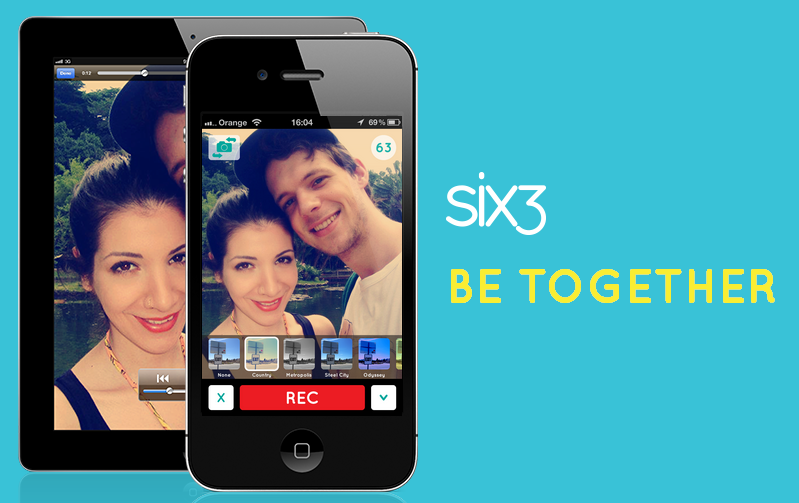
six3 be together

Telefonica-backed startup Six3 wants to bring video messaging to the masses with its new app -- which lies somewhere between Skype and Viddy.

UK-based, 14-month-old startup Six3 wants to shake up the messaging platform by adding video the mix, and with a backer like Telefonica, the largest telecommunications companies in the world, it might just be able to. There isn’t a direct competitor with any existing mobile app out there, so Six3 describes itself as a hybrid between Whatsapp and Viddy and hopes to be a game changer that opens up a market of users communicating strictly through short video messages.

There are undoubtedly countless messaging and video sharing apps out there, which Six3’s CEO and co-founder Tim Grimsditch categorizes into three buckets. First there are one-to-one video chatting services, but Grimsditch says that the growth for those companies is slow since users “tend to stick to very tight circles using that service.”

In bucket two are the Instagram-for-video apps. The most well known in this market are services like Viddy or Mobli. Those apps, however, are about producing quality content. Six3 is about bite-sized messages and quick communication.

The third bucket is filled by the all-in-one communication services like Whatsapp and Skype. These apps tend to “focus all of their energy behind a piece of their service that they’re famous for,” says Grimsditch. The video part of a messaging service like Whatsapp, he explains, is weak. “We’re a tiny team with small resources, yet our video messages are twice as fast as Whatsapp.”

Internationally, particularly in Asia, there’s been a lot of experimentation with new types of chat apps — a popular one being WeChat. Its users are so accustomed to its unique voice messaging feature that I was told few WeChat users in China even send text messages anymore. Six3 wants to do something similar by targeting an untapped niche. “[We're] a platform to communicate with video messages in a way that’s easy, mobile, lets people decide on private or public messaging, and lets people use it within their existing network,” says Grimsditch.

Using the app is as simple. You can select a colored filter, record your video for a maximum of 63 seconds (which is where Six3’s name comes from), select the video’s recipients (via email, address book contacts, Twitter, Facebook, or other Six3 users), and press “Send.”
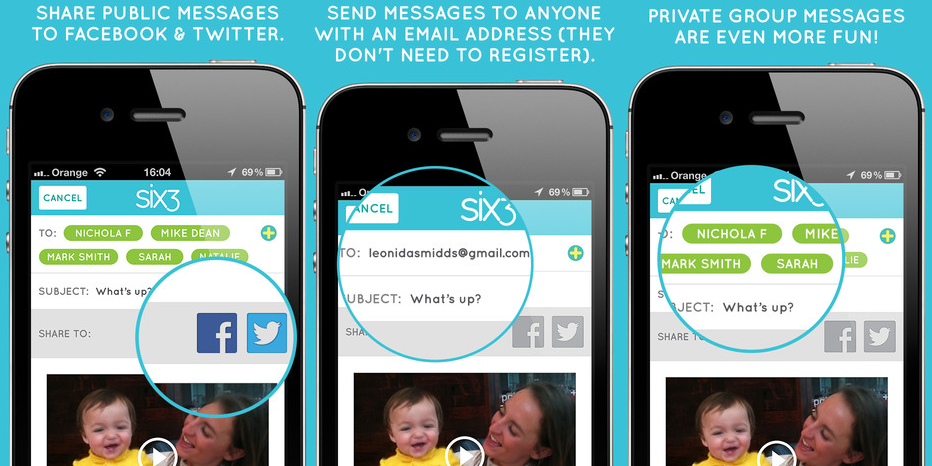
six3 messaging to

To take social a step further, Six3 announced a deeper Facebook integration yesterday at the Dublin Web Summit’s START conference, where the company was recognized as one of the “world’s 100 most promising early stage startups.” The update adds the ability for users to send private Six3 video messages to individual Facebook friends or share them publicly to your Facebook Timeline, while offering a faster and more seamless user experience. “It makes it incredibly easy to create good looking 63 second long video, share it through Six3, Twitter or Facebook, and respond to the video,” explains Grimditch.

The app will remain free for as long as it exists and you can find it in the App Store (the Android version is in the works), but Six3 will be experimenting with a few revenue models. The ones that Grimsditch was comfortable describing include charging users to archive messages for those important clips that you might have an emotional attachment to as well as the possibility of creating sell premium options like color filters or other visual effects as in-app purchases.

To many developers’ benefit, smartphone owners aren’t particularly app-loyal. Grimsditch is well aware of this and hopes to jostle competitors and become not jut a trend, but a staple app in the sea of 700 million smartphones. “The reality is that we’re just getting started and the dust isn’t going to settle in this market for years and years. So I think you’re going to see many years of explosive innovation, and we’re absolutely planning to be at the forefront of that.”


Source : digitaltrends[dot]com

Oct 18, 2012

Apple rumored to be dipping into its savings to acquire Color Labs

color app

After Color Labs was rumored to be closing its doors, the photo-sharing app startup refuted the allegation by saying it was doing no such thing. Now, a new rumor suggests it's be acquired by none other than Apple.

One minute Color Labs, creator of the photo-sharing social app Color, is closing down, then the next it’s not, and now there’s a rumor it’s about to be purchased by Apple. No matter which one is true, it has certainly put then app-the-world-forgot back in the news.

Today’s rumor comes from TheNextWeb.com, where “trusted sources” say Apple is about to hand over a figure in the high tens of millions for company, and perhaps more importantly, its patent portfolio. The patents up for grabs include those related to GPS, battery saving, group content sharing and HD video recording.

Forbes.com points out that Color has a trademark on its name, and an acquisition would also nab the desirable color.com URL. It also says that Google offered to purchase Color before it launched, and suggests that Apple wants to keep the patents out of Google’s hands.

The report says that Color founder Bill Nguyen has thrashed out a deal with Apple thanks in part to an existing relationship with Eddy Cue, Apple’s VP of Internet Software and Services. Apple also purchased Lala, an online music startup and another Nguyen project, back in 2009. It’s said the Color deal is complete, and only needs a few signatures before it’s final.

If the acquisition rumor is true, it clarifies Color’s statement that “Color is not shutting down,” which under the acquisition scenario, it’s not.

An acquisition would also net Apple some more talent, of which there should be plenty inside the company. Just before Color launched, a report in The Wall Street Journal from March 2011 told the story of how Sequoia Capital got involved with the project. They apparently told Nguyen — after a 45-minute demonstration — that the concept was “transformative” and “not since Google have we seen this.”

Throwing $25 million at the company was supposed to accelerate five years of development into one, which would be achieved by hiring the “best-of-the-best engineers who will rapidly iterate and advance this terrific product.”

Apple rarely talks about its acquisitions, but Color may spill the beans, should there be any truth to this new rumor.


Source : digitaltrends[dot]com

Oct 4, 2012

Let’s go MeeGo: open-source OS is on track for its comeback

Jolla MeeGo

Jolla, the company resurrecting the MeeGo mobile OS, has announced $260 million in funding and plans to reveal its first phone soon.

In July, ambitious Finnish startup Jolla announced it had adopted the abandoned — by Nokia, at least — operating system MeeGo, and would be designing and developing new smartphones based around it.

Jolla’s seriousness was proven by the members of its team, the majority of whom worked on MeeGo with Nokia, and therefore were both personally and professionally attached to the project from the start. MeeGo has plenty of fans around the world too, thanks primarily to the Nokia N9, the one and so-far only MeeGo smartphone to be released.

That could all change very soon though, as Jolla has announced that it has raised 200 million euros/$260 million in funding, and that its first smartphone is almost ready for its public debut.

Details on the funding are sketchy, with Jolla saying only that it has formed an alliance with “leading players in the industry,” and that a data center to host the OS’s cloud services and infrastructure will be setup through Cyberport in Hong Kong. This is an important point, as Jolla plans to aggressively target the Asian and Chinese market, calling China a “game changer in the technology industry,” adding how it wants to create the “third smartphone ecosystem in China,” after Android and iOS.

Jolla’s MeeGo OS has a codename too, Sailfish, and it will make its first appearance very soon. Jussi Hurmola, Jolla’s CEO, called the OS “more open than Google Android regarding apps and service development,” and said in a tweet that now the ecosystem support system is in place, the company “is very close to announce the date for the device launch.” Speaking to Lightreading.com, Hurmola said that the launch dates for the hardware would be decided later this week.

International availability promised

International fans of MeeGo shouldn’t despair at this apparent focus on Asia, as a tweet from Jolla’s official Twitter account stated that Sailfish is “definitely not for China only.”

As for the first phone, if Jolla listens to those who voted in its poll to find out the preferred form factor for the debut device, it’ll be a touchscreen QWERTY slider. Of the just over 3,000 people who voted, 47-percent chose it, despite — or perhaps because of — the design having fallen from mainstream grace over the past few years. The phone announced is almost certainly going to be a pre-release device though, as Sailboat isn’t going to be available for licensing until early 2013.

Speculating on whether Jolla has a meaningful future ahead of it is almost impossible at this stage, particularly without a look at the Sailboat OS and the phone on which it will first appear. Concentrating on rapidly developing markets — in this case China — is a solid tactic, and something which other companies looking to re-invent themselves are also doing.

Competition is fierce though, with ZTE already adopting Mozilla’s Firefox OS, and the Alibaba Group pledging to invest $200 million per month into its Aliyun mobile OS. Jolla has certainly got some hard work ahead if it wants that coveted third position in the market.


Source : digitaltrends[dot]com

Sep 28, 2012

Moo introduces NFC-enabled business cards, making real world connections more digital

UK-based startup Moo.com announces NFC business cards so you can digitalize the way you meet new professionals.

In this ever-evolving world of technology, it’s still nice to know that when strangers meet in a professional setting, physical business cards are still something people invest time and creativity into making. United Kingdom-based startup Moo.com is now further digitalizing the business card by adding an option for a Near Field Communication (NFC) microchip to be embedded into your cards so you don’t even need to hand over a card if you’re running low.

Moo NFC business card Samsung Galaxy S3With an NFC chip incorporated into your card, you can told tap it against an NFC-enabled phone and the phone can perform the command you selectively programmed into your card. This can range anywhere from downloading your resume PDF from your website, opening up your portfolio web page, adding yourself as a contact, checking into your Foursquare office location, locating your office on a map, or linking to your Facebook or Twitter profile. It’s a quick and new way to break the ice with business cards, and you can rewrite the NFC chip with different functionalities to keep things updated. 

“We’ve always aimed to upset the existing order within print – to do new things, think in exciting ways, and to go where no man has gone before,” Moo writes in its announcement blog post. “With the roll-out of our NFC cards, and our recent acquisition of Flavors.me, a design-led personal identity site, we are showing our commitment to expanding online personal and professional identity creation.”

For a limited time, Moo is offering 150,000 free NFC-enabled cards with your next order so you can sample the new technology. The company is also planning to release an accompanying Android app to help you program your NFC business cards.

For those who want to get in on the socially interactive NFC action but don’t particularly need it in a business card capacity, you can always check out the Samsung TecTiles, which essentially do the same thing but you can apply the NFC stickers anywhere you want: tabletops, cashier counters, wallets … whatever surface retains stickiness.

Check out the video below to learn more about Moo NFC-enabled business cards.

NFC Business Cards from MOO from MOO.COM on Vimeo.


Source : digitaltrends[dot]com

Sep 11, 2012

WeHostels takes on the space between CouchSurfing and Airbnb

wehostels travel app

Travel app WeHostels has all the app finesse of Airbnb without the high prices. The startup officially launches to target the last-minute backpacking crowd.

Today WeHostels is announcing its public launch, pivoting from its beginnings as Inbed.me. The currently mobile-only app is targeting the space between CouchSurfing and Airbnb — the world of cheap hotel and hostel bookings. The startup is still riding its $1.2 million raised this past spring, and silently added 30,000 downloads in the past three weeks.

wehostels screenshotBefore the WeHostels mobile app, the service existed as Web client Inbed.me – but surprise, we users all have our minds in the gutter and interpreted the name in the most inappropriate way possible. Though there’s been a name change, the concept more or less remains the same: Connect to Facebook and find last-minute affordable last-minute accommodations on-the-go. It’s not all utility, however, and the social link gives you options to connect with other guests so you can, as WeHostels puts it, make friends en route before you even get to your destination.

Of course, the other big switch-up would be that fact that WeHostels is entirely ditching the desktop in favor of a mobile-approach. According to the team, it was a pure logistics decision when they saw traffic from smartphones growing 10 times faster than their Web app.

“We decided to focus only in mobile because it’s a fascinating new arena that requires a very unique set of skills in terms of product design and distribution,” says co-founder Diego Saez-Gil. “By focusing only in mobile, we’re forcing ourselves to become experts on it, and therefore we can outperform any team in any big company working on it.”

Despite that focus, WeHostels sees beyond the smartphone. “In the future we plan to develop solutions for all devices and platforms – we will need to be ubiquitous,” Saez-Gil tells me. “But we prefer to start on the one platform where the new ways of interacting with the Web are happening.”

wehostels screenshot searchThe fast and quiet growth that WeHostels experiencd over the last few weeks saw the userbase grow largely in the United States, with Europe coming in second, and from there travelers in South America and Australia getting on board with the network. The current version of WeHostels has 80 cities available, but new partnerships with Hostelworld and Expedia will hugely increase those options worldwide.

“We will keep growing in terms of cities and accommodations, and we will develop for other devices,” says Saez-Gil, who mentions that iPad and Android are up next. “In the longer future we consider expanding to other verticals in the travel space and becoming the one-stop-shop where young travelers plan and book their trips from mobile devices.” 


Source : digitaltrends[dot]com

Sep 4, 2012

West coast, best coast: The startup scene hits the Northwest this week for Portland Digital eXperience

mfnw portland digital experience

This week, Portland debuts its startup festival, Portland Digital eXperience, to showcase local innovation and offer a platform for industry discussion.

SXSW has come to epitomized startup culture. For all its faults – which generally run along the lines of launch overhype and an overwhelming amount of events and parties (to be filed under “First World Problems”) – the Austin-based festival has firmly made its name as the place where the worlds of digital, social, and startups collide.

Now, Portland, Oregon, is ready to give the similarly-spirited Austin a run for its money. This week marks the opening of Portland Digital eXperience, a startup and social festival that will run alongside MusicfestNW.

Though smaller and admittedly wetter than Austin (with the exception of this past SXSW, which I can vouch for being engulfed in a nearly permanent torrential downpour), Portland has become synonymous with innovation, creative talent, and ingenuity – and yes, hipsters and PBR. But don’t forget that this is where legacy names like Intel, Nike, and Wieden + Kennedy are headquartered. And a slew of new and notable startups have begun to follow in those prestigious footsteps: Urban Airship, Geoloqi, Lensbaby, Trapit, Vizify, and Grove all call Portland home.

And thus, Portland Digital eXperience is rising out of the short-lived North by Northwest festival’s ashes to focus in on the growing energy in the city. There will be speakers from Flipboard, Tumblr, Spotify, as well as more local names from outlets including Chirpify, Grove, and Cloudability, all on hand to cover both the intensely unique Portland spirit as well as larger industry trends. Events include a Startup Crawl through Portland’s Pearl District and Old Town neighborhoods, as well as a music hackathon to round out the festival.

The mix of big names with promising startups harkens back to some of SXSW’s earlier days, before mass chaos made attending more than a handful of events a near impossibility – a pain point many of us are more than willing to tolerate for what the show has to offer. That said, spreading this wealth can only mean more exposure for startups and more access for the rest of us.

Portland Digital eXperience starts tomorrow, September 5, and runs through September 8. You can still pick up passes here, which are also good for access to MusicfestNW shows. We’ll be attending Portland Digital eXperience and bringing you startup, social, music news, and everything that’s sure to fall in between this week. 


Source : digitaltrends[dot]com

Aug 23, 2012

Oh, the irony: Startup launching Bitcoin debit cards in two months

Bitcoin is about to enter the physical real world now that startup BitInstant aims to create a debit card system based on the BTC currency.

You may remember hearing about the P2P puesdo-currency Bitcoin: a virtual monetary system that allows users to pay anonymously, bypass bank regulations, and avoid transfer and withdrawal fees. Last year, Bitcoin experienced quite a crash and security breach that made the currency nearly worthless – dropping from the exchange rate of $17 to merely a few pennies. Bitcoin has surprisingly got itself back together in the past months, and now a New York City-based startup wants to normalize its use again by introducing a Bitcoin debit card system.

Known as BitInstant, this Bitcoin debit card would act like your average prepaid card that you can use to make every day purchases, withdraw money, or transfer amounts to friends and merchants. The card hold a maximum of $1,000 in Bitcoin credit (BTC) limit, and would contain QR codes in the front that are scannable by a BitInstant app to link users directly to their accounts. 

bitcoin“You’re at dinner with a friend? Forget PayPal, just scan his or your card with your Bitcoin app,” BitInstant CEO Charlie Shrem explains to Ars Technica. This process bypasses transfer fees if friends do not bank with the same company though users are allowed to keep each money transfer as BTU or convert them into US dollars, in which case a conversion fee would be charged.

So why would anyone use a Bitcoin debit card in place of actual prepaid cards in the first place? For one, BitInstant would attract those who’ve actually had successes at mining Bitcoin. Since the e-currency is in its own entire realm, advanced Bitcoiners can run complex softwares to generate BTC and BitInstant would allow these users to spend their hard-earned Bitcoins in real life, anywhere they want. The transfer would also be as instant as handing someone cash, meaning transactions can take place between any two users in the world without waiting for third-party middlemen to process the transfer.

Still, the entire concept of BitInstant cards seem ironic, to say the least. The point of Bitcoin is to provide anonymity and leave banks out of the money transfer equation, yet introducing a bank-issued Bitcoin card would bring both issues back to the forefront. We can’t imagine that a bank would issue a BitInstant card without so much as providing a trackable feature on the card, ruining the whole anonymous transaction feature Bitcoin had going for it. Even if BitInstant and the banks that issued the cards cannot publicly release transfer history made on the card, we’re pretty sure one can get a hold of that information if a user can acquire a police warrant to make banks give them that data.

But hey, if the whole futuristic e-currency idea seems fancy to you, by all means, preorder your Bitcoin debit card with BitInstant and its public Google Doc signup sheet.

(Photo mockup of Bitcoin debit card by Ars Technica.)


Source : digitaltrends[dot]com

Aug 20, 2012

Post-Microsoft acquisition, Yammer CEO questions the state of the startup ecosystem

david sacks post

After the Microsoft acquisition, Yammer's chief has some less than glowing projections about the tech startup scene.

Back in June, Microsoft announced it had acquired enterprise social networking system Yammer for $1.2 billion. The deal spurred discussion about the new wave of business-focused social applications and their significance and proposed worth.

“When we started Yammer four years ago, we set out to do something big,” Yammer CEO David Sacks said at the time of the acquisition. “We had a vision for how social networking could change the way we work. Joining Microsoft will accelerate that vision and give us access to the technologies, expertise and resources we’ll need to scale and innovate.”

Apparently Sacks has more critical ideas about the startup life cycle than that, though. TechCrunch first spotted a post to his personal Facebook page (which you can see in its entirely after the break), Sacks spoke about the unending circle of acquisitions that small tech businesses are stuck in. “I think silicon valley as we know it may be coming to an end. In order to create a successful new company, you have to find an idea that (1) has escaped the attention of the major Internet companies, which are better run than ever before; (2) is capable of being launched and proven out for  ~$5M, the typical seed plus series A investment; and (3) is protectable from the onslaught of those big companies once they figure out what you’re onto. How many ideas like that are left?”

The post has inspired a who’s-who debate among some of the Valley’s tech scene elite, including investor Marc Andreesen, Founders Den co-founder Jonathon Abrams, and former TechCrunch editor Erick Schonfeld, among others – and it goes on and on and on. Clearly, a chord has been struck here and questions about the current state of the startup ecosystem resonate loudly for those closest to it.

The art of the acquisition has become a promise and a threat for young startups; it can sign those long-awaited paychecks while also effectively shutting down that planned product roadmap. There’s plenty of discussion about big companies that have turned into startup killers, Twitter, Facebook, and Google usually ended up on the other end of this finger pointing. The argument that Sacks’ opponents take in his post is that this is how the market works – it will always work in favor of the establishing veterans, and disruption will always be challenging.

Sacks could be feeling the effects of his small but powerful startup’s acquisition by the venerable Microsoft (a company not exactly known for its out-of-the-gate innovation), but his analysis isn’t without merit. Also worth nothing is that this is just one of several recent gripe-sessions from tech startup founders who are frustrated with their narrowing options in this market. So are we stuck in an unbreakable system of startup scoops by big tech companies? Maybe, maybe not – regardless, the bleak scene it’s painting for potential founders could be enough to hinder new development and growth. 

david sacks facebook


Source : digitaltrends[dot]com

Aug 8, 2012

Realtime lands $100M in funding to actually make the Web real-time

realtime logo

The Brazil-based startup will continue its growth and help the real-time Web evolution speed things up.

As the Web has evolved, so has its speed. We want instant results, we live on autocomplete, we refresh our news streams. And real-time functionality has brought us as close to a constant flux of information as possible.

However a real-time information feed is hardly a site standard yet, and aptly named startup Realtime wants to speed the adoption up. Today, the Brazil-based company announced its U.S. launch as well as a new round of fundraising to the tune of $100 million. The startup has developed a proprietary technology that it says will take us from the real-time Web to the live Web.

Founder André Parreira tells me that the team founded Realtime after seeing that the Internet as we currently know it is working with a rather old infrastructure. “Near real-time solutions such as AJAX, Comet, and other can become costly and don’t actually offer real-time,” he tells me. “Also, with the rapid expansion of mobile devices that are connecting to the Internet and constantly sending and receiving data, it’s clear that a solution to use less bandwidth and dispatch information faster and more efficiently is a true need that Realtime can surely answer to.”

That all sounds well and good, but how is Realtime doing this exactly? To be more specific, the startup has developed a set of tools and a new programming frameworks (called xRTML and ORTC) which can be integrated to create a cloud-based — you guessed it — real-time messaging system. Better yet, it’s with one simple line of code. Realtime is free up to a certain point, or pay as you go if your traffic is particularly high. 

“We feel like the new Web is a live Web, and this new Web needs a new approach that we provide,” Parreira says. Still not entirely certain what this actually looks like? Check out this demo video showing one example of what the Realtime infrastructure can do for a client site.

What Realtime is doing right now is very much an enterprise-facing platform, we’re not looking at a new Twitter competitor trying to take advantage of the service’s recent, small fall from grace. Instead it’s targeting the likes of publishers, advertisers, and media agencies that want to implement a way to connect with their customers and site visitors. Parreira tells me the company will soon announce several high profile clients and partners Realtime is already working with.

The $100 million is going to go into research and development, which Parreira says is “part of our DNA,” human resources, and to further building Realtime’s global business and brand while readying for its commercial debut.

As previously mentioned, Realtime is making a beeline for Twitter’s business in lieu of its recent distancing from developers. But when asked whether it could be a part of alternative solution, Parreira says “We definitely could [be], hands down.”

“Our technology will provide real-time experience — and for that, Twitter will be only one application — because Realtime is providing a really democratic online experience,” he says. “Which is creating not a product, but really an industry.”


Source : digitaltrends[dot]com