Pages

Showing posts with label drive. Show all posts

Nov 2, 2012

Amazon released Cloud Drive Photos app for Android with 5GB of free storage

Amazon has just launched the Cloud Drive Photos app in the Google Play Store. It’s free and can be installed on any device running Android 2.3.3 Gingerbread or higher.

With this app you can easily upload photos from your Android devices and computers to the Amazon cloud. You can also easily share those photos to various social services, via email, etc.

Amazon gives you 5GB of free storage for your photos.

Unfortunately, the app doesn’t offer automatic camera upload along the lines of Dropbox. Hopefully a future update will see to it.

You can get the app right here.


Source : blog[dot]gsmarena[dot]com

Hands On: Amazon wants you to trust it with your photos

Amazon's cloud storage service for photos isn't just for Kindle HD users anymore. The company made its Cloud Drive Photos app available for most Android devices today. Signing in with your Amazon account will net you 5GB of free space for your pictures.

Android phone and tablet users have yet another option for cloud-based storage, though this time it’s specifically for photos. Amazon has made its Cloud Drive Photos app, which is already integrated into the Kindle Fire HD, available on most Android devices. This app looks like a service that will serve constant photo-snappers quite well.

The app initially asks for users to sign in using an Amazon account. You’re going to want to sign up for an account if you don’t already have one, because this app is completely useless if you don’t. The point of a cloud drive service is to save space, not take it up. Once you’re signed in, you’ll be greeted with the app’s home screen, or the “Cloud” tab. This simply explains to you how to access your drive online and add content from your computer that can then be viewed on your phone or tablet.

There is a second tab atop the display in this app called “Photos.” This is where you will actually be able to see the photo content that is currently saved on your device. Your camera roll, screen captures, Draw Something drawings, Instagram images, and all other photographic data is displayed. These are displayed by category, which can then be explored to see what each album holds. Pressing and holding on an album or an individual picture will allow you to manage the selection, prompting you to either remove it from the device or upload it to the cloud. These are very contrary choices, so make sure you select the one you want. The app also doesn’t appear to automatically sync and there is no option to do so in the settings, so you’ll have to manually update your sync after every snapshot, making this app annoyingly out of date compared to options from Google+ and others. 

All users of Amazon’s Cloud Drive Photos get 5GB of free storage. That can be upgraded to 20GB of space for $10 a year. Everything you upload is accessible right from your Amazon account, making it easy to manage from your phone or your computer. The app isn’t exactly feature rich, but it does the job it claims. An auto-sync feature would be nice, but it looks like we’ll have to wait until the next update to see if it’s there.


Source : digitaltrends[dot]com

Oct 23, 2012

Nissan Extrem concept: Brazil gets its own Juke

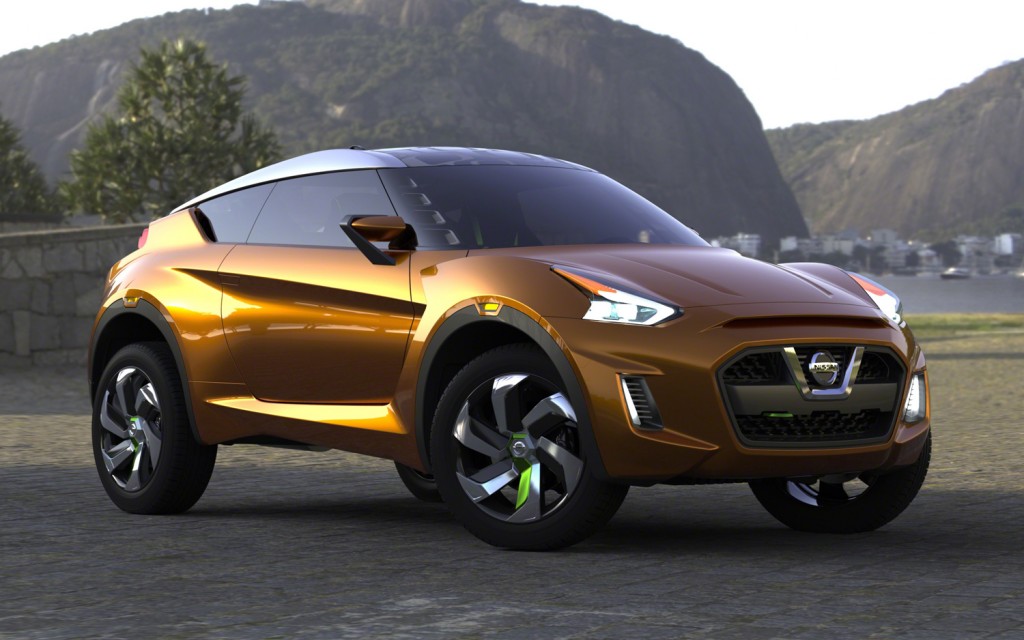
Nissan Extrem concept front three quarter view

The Nissan Extrem may have been designed specifically for Brazil, but it borrows a lot, including a turbocharged engine and all-wheel drive, from Nissan's other crossover coupe.

What if you like the Nissan Juke, but don’t like the styling? Nissan may have a solution. The company unveiled a new concept car, the Extrem, at this week’s São Paulo Motor Show. Like the Juke, it’s a sporty runabout that combines elements of a coupe and crossover, but it looks completely different.

Make that different and smaller: the Extrem is 151.6 inches long, making it significantly shorter than the Juke, which measures 162.4 inches. Nonetheless, the Extrem shares the Juke’s 1.6-liter, turbocharged four-cylinder engine, along with a choice of front-wheel drive or torque-vectoring all-wheel drive.

Nissan says the Extrem is a 2+2, meaning the back seats are only fit for short trips or kid duty. Given the Juke’s relatively cramped quarters, and the fact that the Extrem is shorter, that seems about right. It might be better to think of the Extrem as a two-seater with some storage space behind the seats.

What really sets the concept Extrem apart from the production Juke is styling. The Juke has always been a polarizing car, and without a grinning face and cartoonish headlights, the Extrem looks oddly normal in comparison.

Normal is a relative term, of course. The Extrem’s 19-inch wheels look gigantic on such a small car, and the position of the taillights and resulting tiny backlight is, well, extreme. The roof rails look like they belong on a Mini Paceman, though.

The bottom line is that, for cars that are essentially the same mechanically, the Extrem and Juke couldn’t look more different. Where the Juke is bulbous and curvy, the Extrem is sharp and edgy. It is up to buyers to decide which approach is better.Nissan Extrem concept rear three quarter view

The Extrem was designed specifically for Brazil, but Nissan says it will appeal to the same types of people the Juke does in other markets.

“It was created to appeal to the country’s growing band of city-based young professionals who are passionate about design and want to make a personal statement. The lightweight two-door 2+2, has a dynamic stance, fresh surfacing, and a clear rugged ability to tackle the urban jungle everyday,” Nissan senior vice president and chief creative officer Shiro Nakamura said in a statement.

Despite having a production-ready engine and Nissan’s V platform (which also underpins the Cube and Leaf), the Extrem probably won’t see production. Like most concept cars, its mission is to set a precedent for future models with its outspoken styling.


Source : digitaltrends[dot]com

13-inch Macbook Pro with Retina display unveiled

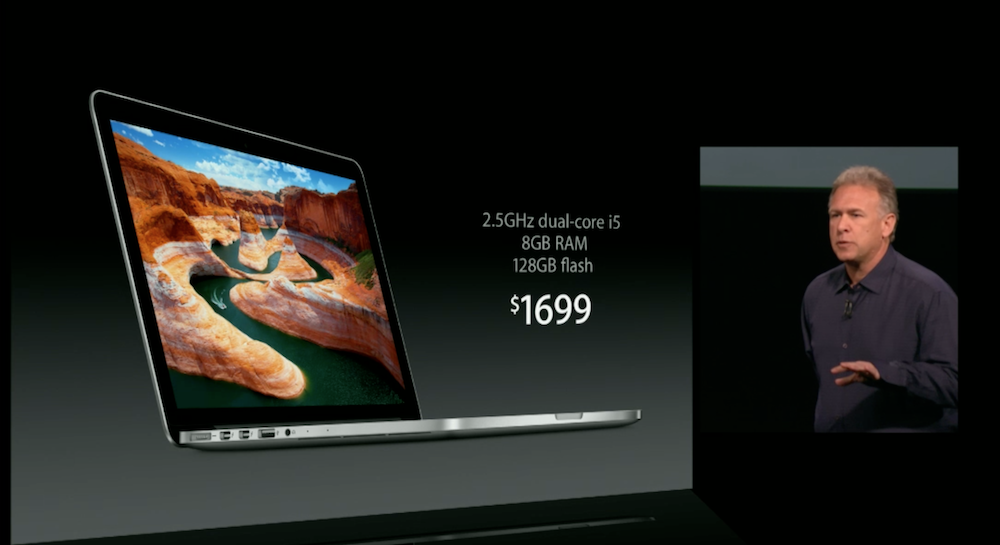
Apple has given it's Macbook Pro a refresh with a Retina display. The new computer is smaller and more powerful then previous Macbooks, with increased RAM, an optical drive, and the highly touted Retina display.

As expected, Apple announced a new addition to the MacBook family. Starting today, a 13-inch Macbook Pro equipped with the Retina display will be available to consumers. The newest installment of Apple laptops got a full refresh from past Macbook model. In standard Apple fashion, it did it’s best to fit more in less.

The first noticeable change comes in size. The Macbook Pro with Retina display measures in with a  .75-inch thickness, making it 1/5th thinner than the older model. This new thin look translates to the weight as well. Apple says this is its lightest Macbook ever, weighing in at 3.5 pounds.

The changes continue inside the new Macbook Pro. A new standard of 8GB of RAM comes loaded in to the laptop, along with an optical drive. The processor will be a Core i5 or i7 and the system will be powered by asymmetric lithium-ion batteries. Hard drives are available with up to 768GB of storage, which will a be solid state drive. The computer will feature stereo speakers, pushing sound out from each side, and dual microphone plugins. A new HD camera will broadcast your FaceTime sessions.

Of course, the main attraction here is the Retina display. Apple has always been proud of it display, and this one is no exception. Phil Schiller showed off the display, bragging of its 4,096,000 pixel display. By comparison, he said that is almost double the pixels of an HDTV. The numbers delivered were impressive, including a 29 percent higher contrast ratio, 75 percent reduced reflection, and IPS panel that gives a 178 degree viewing angle.

The standard model of the Mackbook Pro with Retina display will come with 8GB of RAM and 128GB of flash storage for $1700. Other models are also available, all starting today. Expect to see ads for the computer run during the holiday season about as often as political ads are running now.


Source : digitaltrends[dot]com

Sep 28, 2012

Mercedes-Benz SLS AMG Electric Drive: Mercedes-AMG’s most powerful car runs on batteries

Mercedes-Benz SLS AMG Electric Drive front three-quarter motion view

With 740 hp, the SLS AMG Electric Drive outmuscles its gasoline-powered sibling, but it also costs more than twice as much.

Mercedes-Benz unveiled a production version of its SLS AMG E-Cell electric sports car at the Paris Motor Show. Called the SLS AMG Electric Drive, it’s the most powerful car Mercedes-Benz AMG has ever built.

Replacing the SLS AMG’s 6.2-liter V8 are four electric motors, connected to an “axially-arranged” transmission and a 60-kWh lithium ion battery pack. The transmission, which Mercedes calls AMG Torque Dynamics, makes the electric SLS all-wheel drive and can power or brake wheels individually depending on conditions.

Combined, the four motors produce 740 horsepower and 738 pound-feet of torque. That’s much more than the gasoline-powered 2013 SLS AMG GT, which produces 583 hp and 489 lb-ft. It also makes the SLS AMG Electric Drive is more powerful than a Lamborghini Aventador.

With so much power on tap, it’s not surprising that Mercedes is claiming the SLS AMG Electric Drive as the world’s fastest production electric vehicle. The company says its gull-winged creation will do 0 to 62 mph (o-100 kph) in 3.9 seconds, and reach a limited top speed of 155 mph. That makes the electric SLS much slower than the SLS GT, despite the extra power. The SLS AMG GT will do 0 to 60 mph in 3.6 seconds and reach a top speed of 197 mph.

So far, the only serious competition for the SLS AMG Electric Drive is the Audi R8 e-tron. The Audi’s top speed is limited to 125 mph, although a test car’s was raised to 155 mph for a record-setting Nürburgring lap.

The liquid-cooled battery pack consists of 864 individual cells in 12 modules, and was developed by the same people who made the Kinetic Energy Recovery System (KERS) regenerative braking for Mercedes’ Formula 1 cars.

A full charge from a standard European household outlet takes 20 hours, but Mercedes will offer a 22 kW quick charger that cuts charge time down to three hours. The SLS AMG Electric Drive has a 155-mile range, although it probably won’t get that far if driven enthusiastically.Mercedes-Benz SLS AMG Electric Drive rear three-quarter view

If the car does run out of juice on the highway, that bright blue paint (an Electric Drive exclusive) should alert passers by to the driver’s plight. Besides the paint, there is little to distinguish the Electric Drive from a regular SLS AMG coupe. The electric SLS get a carbon fiber front splitter, a rear diffuser, and a grille with “bionic honeycomb-shaped” vents.

However, under the skin, there are more significant modifications. The body is a carbon fiber monocoque bonded to the stock SLS’ aluminum chassis. To accommodate the electric drivetrain, the regular SLS’ double-wishbone suspension was replaced with a multi-link setup.

The AMG engineers also needed to recreate an important aspect of the V8 SLS: sound. Electric motors are very quiet, and that is a problem for both pedestrians (who won’t hear it coming) and drivers (who will miss out on the aural experience). AMG designed different sounds for startup, wide-open throttle, and cruising, which play through the car’s speakers.

The SLS AMG Electric Drive goes on sale in Europe next year for roughly $536,000, or more than 2.5 times the cost of a regular SLS. Green speed is possible, but it doesn’t come cheap.


Source : digitaltrends[dot]com

Sep 22, 2012

XCOM Enemy Unknown console version hands-on preview: We are most definitely not alone

We give the campaign and multiplayer modes in Firaxis Games' XCOM: Enemy Unknown a hands-on test drive.

XCOM: Enemy Unknown shouldn’t exist. It’s an enhanced remake of an almost 20 year old PC strategy game, spruced up by Civilization architects Firaxis Games, and releasing for consoles (and Windows as well) during a crowded holiday 2012 season. It’ll sell for a “budget” price of $49.99 when it hits stores on October 9, 2012, but arriving as it does amidst a flurry of big-name releases like Resident Evil 6Dishonored, and Medal of Honor: Warfighter, the odds would seem to be stacked against it.  And they sort of are.

Fortunately for 2K Games, Enemy Unknown isn’t competing with the blockbuster shooters and other standard-fare action games that tend to punctuate holiday lineups. It offers something different, the rarest gem of all in fact: a strategy game that is actually fun to play on a console, using console-style gamepad controls. The PC faithful will no doubt quickly rise to defend the PC release of Enemy Unknown, and more power to them. But after spending an hour-plus with my hands wrapped around an Xbox 360 controller for some campaign and multiplayer action, I’m happy to report that this console-based strategy game is no unicorn, it’s the real deal.

Those of you who are familiar with UFO: Enemy Unknown won’t be in for too many surprises. The game that you remember from 1994 is largely intact here, though it’s looking a whole lot better in 2012. The story opens with extraterrestrial activity on Earth prompting an investigation by a crack squad of specially trained soldiers. This scouting operation plays out as a largely scripted tutorial mission that teaches you the basics of movement, combat, ability use, cover, and — as your four-strong squad is whittled down to just one — permadeath.

The controls are surprisingly simple to get a handle on, with players guiding a command reticule around the map for each squad member’s turn. A border painted around the selected troop indicates the maximum movement range for the first half of their turn. Push the reticule outside that boundary and a more distant border appears, showing the max distance you can move when dashing, which consumes both halves of that unit’s two-action turn. 

Combat actions and unit skills can be triggered by going into tactical mode with a press of the right trigger. The camera zooms into an over-the-shoulder perspective and a new list of icons appears at the bottom of the screen, an indicator of which abilities you can call on. From this perspective you can see which targets are in view and what your chances to hit it are. It’s a surprisingly light flow of data, but in the act of playing you quickly realize that it’s all the information you need.

Over the course of three missions (two if you don’t count the tutorial), I was able to get a sense of Enemy Unknown‘s tactical flavor. Again, UFO fans won’t feel lost here at all. The controls offer all the flexibility you might need for advancing through each environment while maintaining tactical control of the battlefield. The alien aggressors enter the fray in scripted, and sometimes unexpected, locations, but the game doesn’t feel cheap. The few times my attackers got the drop on me, it quickly became clear that it was my own tactical planning that was at fault.

Wrapping tightly around the turn-based action is a larger meta-game focused on building up your alien-fighting arsenal. All of this plays out from your underground mission control, rendered in the game as a cross-section view of various facilities. Between missions, you can visit the barracks to assign skill points you’ve earned among your finite number of troops and mess with their loadouts. You can also visit the research or engineering departments, directing their respective teams to focus their efforts in one direction or another. Alien materials picked up at the end of each mission fuel your research team’s efforts, and their discoveries can then be produced as actual gear to outfit your troops with by engineering.

There’s also a situation room where you’re able to monitor the general state of the world as aliens descend. The panic level of each nation determines whether or not it’s helping you in your fight against the invaders. Let one nation’s panic level get too high, and you’ll lose any associated support from there. Throughout the game, players are presented with decisions to make. Even the location of your starting base is accompanied by a choice, since the different regions of the world offer different benefits, such as reduced prices and build/research time.

In terms of missions, you might be presented with a pair of reported E.T. sightings that need to be investigated, with the caveat that the panic level will rise in whichever of the locations you choose to not visit. There are also some missions that you’re simply locked into. One early task, for example, was assigned to me by the shadowy Council charged with waging war against the alien invaders. There was no choice to be made in that case; the Council handed down orders and I, faithful soldier that I am, responded.

The meta-game disappears completely in Enemy Unknown‘s 1v1 multiplayer matches. Instead, each player has a budget of points to work with and the ability to spend those points on forming a squad of up to six units, pulling from either/both the human and alien factions. The size of the budget varies according to the match settings, but the general idea is that both players are limited by the same resource constraints to come up with the most effective team that they can. There are a lot of variables at play, to the point that even just building your multiplayer match team can take quite a bit of time, but the game thankfully allows players to save lineups that they’re particularly fond of.

The flow of a multiplayer match is much faster than that of a campaign battle, largely because there’s a time limit on each player’s turn. The default right now is set at 90 seconds per side, which means you’ve got 90 seconds to issue orders to all six of your units. In practical terms, that window felt just a bit too short at the beginning of the match, though the time-per-turn is fortunately one of the many pre-match variables that players can adjust.

Beyond the 90 seconds, I blame part of the rushed feeling on a clunky interface. The actual controls are well-designed, but the preview build’s command reticle wasn’t as sticky as it could have been with cover points, which resulted in me sometimes moving a unit to an out-of-cover position. The D-pad-controls for cycling through the various combat options in tactical view wasn’t as responsive as it could have been either, to the point that I’d sometimes have to press left or right multiple times for the command to register. These issues were present in the campaign missions I played as well, though there are no time constraints to rush you along there, making the clunkiness much more manageable. This is all based on playing with a preview build of the game, of course, but it’ll be something to watch for in the final release.

Overall, XCOM: Enemy Unknown seems to deliver on its promise of re-creating a classic PC game from 1994 for modern audiences. The basics of what made the original worth revisiting with a remake are still very much intact, and the console-specific control scheme works shockingly well. The overall presentation, particularly with the cutscenes, voice acting, and so forth, definitely speaks to the budget price tag, but the actual play — at least in the handful of early missions and one multiplayer match that I sampled — promises all of the tactical flexibility that fans of the original will go in expecting to find.


Source : digitaltrends[dot]com

Sep 14, 2012

Concept Active Tourer heralds front-wheel drive future for BMW

BMW Concept Active Tourer

BMW will show the Concept Active Tourer at the Paris Motor Show, and it's the basis for a future range of front wheel drive cars.

This is BMW’s Concept Active Tourer, which will make its official debut at the Paris Motor Show, and it’s a very important vehicle for the German manufacturer. Why? Primarily because the platform on which it’s built will go on to form the basis of the next-generation Mini, and a new range of entry-level BMWs in 2014.

Also, it’s the first car to showoff BMW’s new, super-frugal, three-cylinder, 1.5-liter turbocharged motor; plus the concept is a plug-in hybrid that uses the same system seen in the gorgeous BMW i8.

However, there’s another reason too, not that BMW will shout about it. The Concept Active Tourer is front-wheel drive. Yes, the three-cylinder engine powers the front wheels, and it paves the way for the first production front-wheel drive BMWs.

In fairness, BMW is easing us in gently, as the electric motor drives the rear-wheels, making the Concept Active Tourer four-wheel drive; except with 134 horsepower through the front wheels and only 67 through the rears, the bias is the opposite of the aforementioned i8.

BMW Concept Active Tourer Rear

Back to that petrol engine for a moment though. It’s mounted transversely rather than longitudinally, and is essentially the same as that in the i8; except here, the 1.5 turbo will produce 134 horsepower for a 0-60 time of less than 8-seconds and a top speed of around 120 miles-per-hour.

Economy is the order of the day, and when the petrol and electric motor — which has a standalone range of 19 miles — work together, BMW estimates a minimum of 113 miles-per-gallon while producing less than 60g/km of CO2. Cleverly, the hybrid motor talks to the satellite navigation, deciding between them which will be the most efficient way of driving on upcoming roads.

Features on the concept car include a “Cool Shade” panoramic roof, which has an active particle layer that goes from opaque to clear at the touch of a button, 20-inch rims, a color heads-up display and a 10-inch touchscreen control panel.

Aficionados may balk at the thought of a front-wheel drive BMW, raise their eyebrows at a transversely-mounted engine, and fondly recall a time when the company only used front-wheel drive in ads to mock its rivals. The move is a sign of the times though, as production costs will fall and BMW will be able to produce more small cars.

As for the Concept Active Tourer, it’ll eventually become a Mercedes B-Class competitor, and is almost certainly our first proper look at the previously rumored 1-Series GT.


Source : digitaltrends[dot]com

Sep 11, 2012

Latest Google Drive update for iOS lets you create and edit documents

When Google released the Google Drive application on iOS, it was a mere shadow of the application available on Android. The most you could do in that application is view all your files and documents uploaded on Drive but the lack of editing made the application fairly useless.

Well, that’s taken care of with the latest update, which brings with it several new features, the big one being able to edit all your documents. You can now tap on your documents and enter a view-only mode but with the tap of the Edit button you can start writing and also get basic formatting options. The documents are collaborated so any changes made elsewhere reflect immediately on your device. Unfortunately, editing is only available for documents and not for spreadsheets or presentations.

You can also create documents now but there is no option to create spreadsheets or presentations. The Android version at least lets you create spreadsheets.

Other changes in the new version include the ability to create folders and move items between them, ability to upload photos and videos and take pictures from the camera, ability to delete files, richer Google presentations with animations and speaker notes and support for over 30 languages.

The Android version also got an update and brings with it ability to create folder and move to folder, option to auto-sync pinned content while on 3G, richer Google Presentations viewing experience, basic table support in Documents Editor, create, reply and resolve comments in Documents Editor, view and change fonts in Documents Editor, pinch to zoom in Documents Editor, print files using Google Cloud Print and option to resume interrupted uploads.


Source : blog[dot]gsmarena[dot]com

Sep 6, 2012

Western Digital announces its thinnest external drive with USB 3.0

My Passport Edge for Mac

Excellent for anyone that hates to travel with a laptop bag, Western Digital has announced a new hard drive that can slip into a pocket.

Explained in detail within a Western Digital press release today, the popular hard drive manufacturer has announced a new 500GB My Passport Edge drive for both PC and Mac computers. The PC drive is just 0.5 inches thick and the Mac drive, encased in an all-metal housing, is even smaller at 0.4 inches thick. Comparing that thickness to a popular smartphone, the Mac drive is barely thicker than Apple’s iPhone 4S. In addition to the slim body style, the drives are fairly light and don’t weigh significantly more than a standard smartphone. Either drive could easily be slipped into a pants pocket for transport and include shock tolerance features for rougher handling. In addition, both drives come equipped with a USB 3.0 interface for speedy file transfers compared to the older USB 2.0 standard.

My Passport Edge versus laptop sizeThe PC version of the My Passport Edge drive has a slightly different design with a light gray color on top along with a familiar pattern of dark gray circles around the logo. The PC version of the drive also ships with Western Digital’s SmartWare software that allows the user to setup automated backups in order to recover data in case of a hard drive crash in the user’s main desktop or laptop PC.

The drive has been formatted in NTFS for use with the Windows operating system. The 500GB version of the drive includes a three-year warranty from Western Digital and is currently priced at a MSRP of $109.99. 

The Mac version of the My Passport Edge drive was designed to blend into Apple’s lineup of Macbooks and offers a solid black top with a brushed aluminum finish around the edges. According to Western Digital, the drive is compatible with Apple’s Time Machine for data backup and have been formatted in HFS+. While My Passport Edge for Mac also comes with a three-year warranty, the drive is priced at a higher MSRP of $119.99. However, both drives can be purchased at a discounted rate when using the “Where to Buy” feature on the Western Digital site.


Source : digitaltrends[dot]com