Pages

Showing posts with label disclosure. Show all posts

Nov 6, 2012

State of the Web: We gotta fight! For our right! … to Instagram our ballots

state of the web ballots election voting 2012

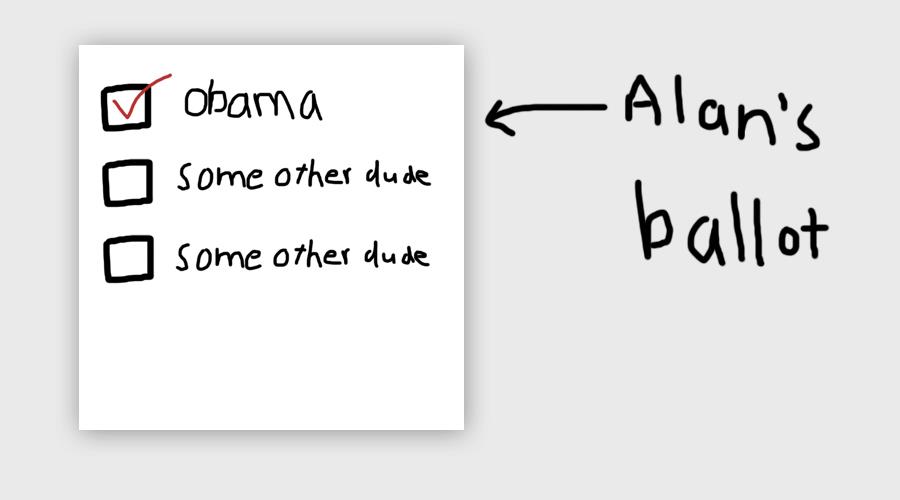
If you photographed your completed ballot this election day and shared it with the world, beware: You may have broken your state laws against ballot disclosure. For this week's State of the Web, Harvard University's Andy Sellars explains the ins, outs, and total confusion surrounding the anti-Instagram laws.

Did you know that you could be arrested, fined, kicked out of your polling place, or have your vote tossed in the trash for sharing a photo of your marked ballot on the Web?

This is the reality for most states in the U.S. Florida, Georgia, Kentucky, Nevada, North Carolina, Texas, and West Virginia all have laws on the books that explicitly forbid photography or video recording in polling places. Some states forbid the use of cellphones – which more often than not double as cameras. A majority of states have laws against the “public display” of a marked ballot – which means that Instagram photo you just posted to the Web may have broken state law. And other states just don’t make the rules clear, meaning you’d have to ask an already over-worked polling place volunteer first before snapping a pic or shooting video – and they might not know the answer.

Despite this, citizens are flooding the Web with photos of their ballots. A quick search for the #vote hashtag on Instagram at the time of this writing brings up nearly 600,000 photos, many of which likely violated the law – though many probably didn’t know they were doing so. On top of that, YouTube is pushing voters to record their voting experience, another potential no-no in the eyes of state laws.

In short, we might have a legal mess on our hands. So, how did we get in this muck? And, more importantly, can we get out?

To get a better sense of the issues at hand, I reached out to Andy Sellars, a First Amendment Fellow at Harvard University’s Berkman Center for Internet & Society and a staff attorney for its Digital Media Law Project, which has become the preeminent authority on laws governing the photographing and recording of ballots.

Protecting the vote

First, it’s important to remember that these laws are in place to protect citizens’ right to vote and the integrity of the voting process at large.

“The reason to have laws like this largely go to issues of voter intimidation and voter fraud,” says Sellars. “The concerns with voter intimidation would be you showing your ballot around the polling place, trying to use your vote as a way of influencing other voters how to vote, which obviously we [Americans] are pretty repugnant toward.”

In terms of voter fraud, Sellars says these laws are often in place to prevent vote-purchasing schemes, which could become more prevalent if voters are able to take a photo of their completed ballot as proof that they voted a particular way. “By preventing the disclosure of ballots, you’re preventing that from being able to happen,” says Sellars. “It reinforces the privacy of the vote … It also helps make sure that people aren’t interrupting other voters, or interfering with other voters, while in the polling place.”

Despite the protection anti-ballot-disclosure laws provide, Sellars notes that much of this legislation was concocted in an age before smartphones and social media.

“It’s important to keep in mind that these laws were probably written before we all walked around with cameras in our pockets,” says Sellars. “So the laws contemplate sort of a traditional era of voting, where you’d mark your ballot, you’d deposit your ballot, then you’d walk out, and there would be no physical record of that ballot traveling [outside the polling place].”

A dangerous culture of disclosure

Another argument for the presence of laws against ballot disclosure is that, by allowing everyone to photograph and share their ballots, it could create a so-called culture of disclosure, wherein people who do not wish to share their ballot with anyone feel pressure to do so. Sellars, however, doesn’t see this becoming too widespread a problem.

“There haven’t been that many elections where we have social media like we have today, so this election could be setting a new standard here,” says Sellars. “But, in general, we haven’t seen all that many people doing this. We see it happen for sure. And Instagram, I’m sure, will have many examples of this today. But I think that this idea of privacy around your vote isn’t escaping the next generation of youth that are voting for the first time today.”

“For the same reasons that you might be careful about photos you post on Facebook from a party this weekend, you might be careful about posting [your ballot],” Sellars adds. “It could jump back to bite you later.”
Ballot photo

Shackled free speech

Of course, it is difficult not to notice the irony in laws that are meant to protect the most sacred form of free speech – your vote – which in turn prevent people from engaging in speech. Sellars says that “these sorts of disclosure laws face some serious Constitutional issues under the First Amendment,” but that the issues are most pertinent “in circumstances where [states are] prohibiting the disclosure of a ballot after the election has concluded.”

Furthermore, these laws do not prevent all forms of disclosure. As Jeff Hermes, director of the Digital Media Law Project, writes in a blog post on the First Amendment issues, “ballot disclosure laws are not complete bars to disclosure of a voter’s choice; voters are free to discuss their votes, albeit without proof in photographic form.”

Limited usefulness

Hermes goes on to argue that taking a picture of your marked ballot, or recording video at a polling location, only adds further protection against voter fraud and errors which seem to have become increasingly commonplace given the prevalence of e-voting machines.

“Voting is the fundamental method by which American citizens exercise their rights of self-governance, and it is essential to combat corruption of the process,” writes Hermes. “However, the extraordinary importance of voting also requires that we be free as citizens to discuss our experiences at the polls, including the people for whom we voted if we so wish. Otherwise, we begin to lose the protection against corruption and error that the First Amendment itself provides.”

The ability to record in your ballot has already proven its usefulness in this election, with a Reddit user capturing an e-voting machine switching his vote from Obama to Romney.

Sellars says that recording the conditions around your polling location may provide “very helpful evidence” as to whether the election is being conducted legally (as the video above proves); however, he says it’s not entirely clear that photographing your ballot is a particularly useful way to make elections more transparent.

“You’d have to have so many people disclosing their ballots in order to show a bad count in their precinct,” says Sellars. “You could come up with a circumstance where, you know, a precinct says, ‘We had 100 percent of respondents say this.’ And then you say, ‘No, here’s me voting the other way.’ But statistically, that’s very unlikely.”

Times a-changin’ – but not yet

In other words, there is a great debate to be had over whether or not disclosure laws are a positive or negative force on our democracy. Still, some states, like Maine, have already begun to update their disclosure laws. And Sellars says others may follow suit. Until then, however, your best bet is to “contact your precinct first,” says Sellars, before you snap an Instagram pic of your ballot. This is especially important due to the fact that many of these laws are so vague.

“Just because a state law doesn’t expressly prohibit [photographing and sharing your ballot], doesn’t necessarily mean it’s OK,” says Sellars. “Virtually every state empowers the secretary of state or the attorney general of the state, as well as local election officials, to take action to prevent activity which would disrupt a polling place”

So snap cautiously, people. Who knows what could happen if you don’t.


Source : digitaltrends[dot]com

Aug 31, 2012

Smooth Moves: Fable: The Journey preview

fable kinect

A demo session with a feature complete version of Fable: The Journey shows that there's great potential in the Kinect adventure.

I’ll give you the same disclosure I gave Fable: The Journey creative director Gary Carr: I have never played a full Kinect game. I messed around with the early Project Natal demos back in 2009, but an actual, finished Kinect game? Never done it. I tell you this so you know that I went into my demo of Fable: The Journey last week with no expectations whatsoever.

Was I skeptical that an adventure game like Fable was suited to hands-free motion control and guided levels rather than free-roaming exploration? Definitely. Am I still skeptical? Sure. Is The Journey entertaining even in just a quick demo? Absolutely.

To catch you up, The Journey picks up 50 years after Fable III. Despite your revolutionary efforts in that game, Albion looks just as medieval and goblin-infested (or hob-infested as the case may be). This time around you play as Gabriel, one of the Dwellers, Albion’s fantasy version of the Romani people. Since he’s a fantasy gypsy, Gabriel doesn’t have the inherent magical skills that the fated heroes of past Fable games do. After getting separated from his family and swept up in immortal sorceress Theresa’s goings on, Gabriel receives a pair of magic gloves that let him toss all kinds of magic.

A swift tutorial through an ice and crystal covered cave introduces you to Gabe’s powers. It works like this: Raising your right hand and pushing forward will toss an energy ball. If you flick your right hand after throwing it, the ball will automatically whiplash and hit the nearest enemy. If you hold your right hand in place waving it back and forth, your energy ball becomes a much stronger fireball. Holding your right hand at your shoulder still will conjure an even more powerful spear to throw.

Raising your left hand and pushing will let you Obi Wan Kenobi it up and force push bad guys away. Holding your left arm out connects a magical tether to enemies letting you toss them around. This brings some nuance into fights. When you’re fighting against a bunch of skeleton warriors, the quickest route to victory is tethering them and popping off their limbs one by one. You can also block by holding your left arm up in front of you, natural as a shield. Dodging is just a matter of leaning right and left.

If that sounds like a lot to remember, it is, especially when a large group of enemies is bearing down on you. The Journey is best described as a cross between an old-fashioned lightgun game like Virtua Cop and a fighting game like Street Fighter. You have to pay attention to the environment directly in front of you while assessing what of your limited moves will best help you overcome your enemies. Both those styles of games require precision and quick decision making though.

Lionshead’s game impressively allows for both. When the moves didn’t work in the game it was almost always because I was rushing and not being specific with my motions. The Journey also allows for decent improvisation. The second level I played through was a mine where an enormous rock monster boss was waiting at the end. As you fought him, deflecting back giant rocks and tossing fire, skeletons would pop and advance. What do you do? Should I dodge to the far right and focus on the boss, or can I move fast enough to dismember these undead goons while also tossing boulders back at the boss? This sort of blend of physical challenge with classic video game problem solving delivers on that early promise of the Kinect.

At least in this sliver of the game. Carr told me during our demo that the game is 10 to 15 hours long. I played for a mere 20 minutes. The on-rails lightgun shooters and fighting games I compared The Journey to are brief games, played in short burst sessions, but Lionhead wants this to be a lengthy, deep adventure. It’s impossible to say how it stacks up in that regard based on this sample.

Is it funny like Fable? Couldn’t tell you. How’s the art? All I saw was a mine and a magic ice cavern. Throw in a forest and it would be every fantasy game ever. Does the action continue evolving or is it just a game of push and pull for 20 hours? Carr promised exploration areas but none were demoed.

Fable: The Journey was an impressive first experience with a complete Kinect game, but it has many questions to answer before it releases in October.


Source : digitaltrends[dot]com

You really should be watching PBS’ Idea Channel

Idea Channel -- William Gibson

As long as you're going to waste time on YouTube anyway, why not watch something genuinely good? Something like PBS' Idea Channel.

In the interest of full disclosure, we will cop to the fact that today is a very slow news day. Normally that would make the remainder of the afternoon intensely boring, but instead of struggling to convince you readers that an otherwise inconsequential story is actually crucial information, we’re opting to instead introduce you to something cool that you may not be aware of.

Specifically, today’s focus is on a relatively recently launched YouTube channel from America’s Public Broadcasting Service dubbed the “Idea Channel.” Instead of regurgitating PBS’ oft-stuffy televisual content onto the ‘net or periodically posting kittens in vaguely science-related situations, the Idea Channel contains numerous vignettes that explore deceptively simple topics in a way that is both thought-provoking and cleverly crafted to appeal to the modern sensibilities and waning attention spans of today’s always-connected ‘net denizens.

To wit: At the bottom of this post we’ve embedded the Idea Channel’s latest offering, a video that asks the question “Is William Gibson a modern day oracle?” Gibson’s fans should already know where this is going: In the course of his literary career William Gibson has predicted, in great detail, an amazing number of technologies that we see as relatively commonplace today. Second Life, the modern Internet, reality TV, that hologram Tupac that performed at Coachella; you can find eerily prescient references to each of these ideas in Gibson’s work — and even more impressively Gibson has regularly managed to dream up these technologies more than a decade before flesh and blood humans can even think of making them a reality.

On the other hand, maybe seminal cyberpunk authors aren’t really up your alley. Maybe you’re more interested in video games. In that case have a look at the Idea Channel’s debut video which posits the idea that “Super Mario Bros. is the world’s greatest piece of surrealist art.” Or, say your interests run toward Internet culture itself. In that case, we’d highly recommend this clip which explores the possibility that modern, online memetic humor might be creating a “cultural singularity.”

The bottom line is that PBS’ Idea Channel is not just another diversion dropped into a sea of momentarily interesting Internet offerings all designed to help a person kill time. Instead, it provides simple, yet profound ideas that should inspire further thought and discussion amongst its viewers. Even more impressively however, is how well PBS has adapted this content to its prospective audience. While watching these clips keep in mind that this footage comes from the same group that is best known for highbrow, culturally significant TV shows like Downton Abbey. The contrast between these clips and the aforementioned BBC drama is undeniable, but it should be seen as a endorsement of the clever people working behind the scenes at PBS that the broadcaster is able to seamlessly switch gears between historical melodrama and a video that wonders if LOLcats are an important modern artform. Propers to PBS for demonstrating such range, and most crucially, for keeping us all entertained on a dull Friday afternoon.


Source : digitaltrends[dot]com