Apple's new iMacs are mighty impressive, but we're still left wondering why the company doesn't just give us its next big thing: an iTV.
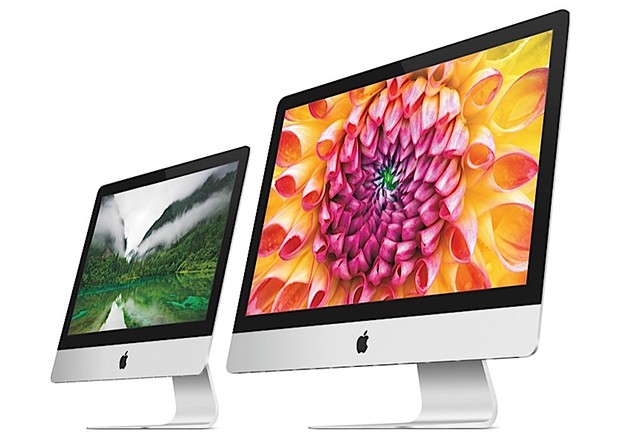
Running his hand along the slender 5-millimeter-thick edge, Apple’s Phil Schiller, senior vice president of worldwide marketing, debuted the company’s newest iMac. “It’s hard to believe there’s even a display in there,” Schiller said, highlighting how outlandishly thin it is.
Though Schiller said the new iMac “epitomizes something Apple does so well, to create an innovative, breakthrough product,” the last time an iMac was a breakthrough product was when it was introduced in 1998. Yes, everything on display at the October 23 launch featured top-of-the-line specs and dazzling improvements, but nothing felt truly new. Where are the disruptive technologies of launches past? The one area that many of us have prayed Apple would dive into is the HDTV market. So where is the iTV?
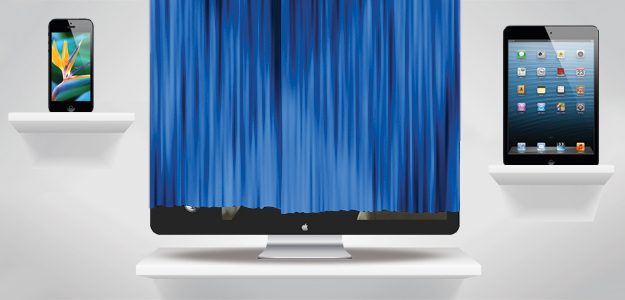
There’s a market for computers large enough and thin enough to double as televisions, and Apple has all the key ingredients to build one. Creating an Apple-branded flat-screen HDTV that doubles as a powerful computer would surely make an impact on the television market. And though it’s a good start, Apple has only inched into the arena with its current Apple TV set-top box.
Computers are far more versatile than TVs. Not only can people watch televised content through a myriad of sources, including Hulu, Netflix, YouTube, HBO Go, and iTunes, but they can also enjoy full Internet browsing and productive capabilities native to a computer. That being said, today’s Smart TVs are already doing a pretty good job at blurring the lines between computer and TV. Most Smart TVs offer streaming from the above sources, and many of them offer Internet browsers with support for Flash; what they don’t offer is the kind of clean, simple user interface that Apple has leveraged through the years to turn customers into obsessives.
As TV manufacturers struggle to integrate the increasing functionality of their products, Apple could easily leapfrog ahead of them. But don’t take our word for it. Walter Isaacson, Steve Jobs’ authorized biographer, quotes the late Apple founder on the subject in Steve Jobs: The Exclusive Biography:
“‘I’d like to create an integrated television set that is completely easy to use,’ he told me. ‘It would be seamlessly synced with all of your devices and with iCloud.’ No longer would users have to fiddle with complex remotes for DVD players and cable channels. ‘It will have the simplest user interface you could imagine. I finally cracked it.’”
Although we know Apple can do it, the company has not yet made large displays with competitive pixel resolution. The new iMacs lack Retina Display, but come packing a 1920-by-1080-pixel resolution on the 21.5-inch model, and a 2560-by-1440-pixel resolution on the 27-inch model. Coupled with the laminated screen and 300-nit brightness, it is almost ready to wrangle with some of the HDTVs already on the market. No, it’s not Plasma or LCD/ LED technology, but it’s very good, and it leaves us with no doubt that Apple’s talented staff could (and perhaps do) already have a prototype capable of making current purveyors like Sony tremble.
Perhaps more important than the hardware, though, is the need for a content ecosystem robust enough to convince the average consumer to cut their cable cords. The Apple TV is a good start, since it marries iTunes, Netflix, Vimeo, and other streaming services, but Apple would have to up its ante to compete with traditional cable companies.
Jobs knew this, as evidenced by his efforts to reach out to content partners in a possible attempt to create a streaming media service. Reported back in March by Engadget, CBS CEO Leslie Moonves disclosed Jobs’ advances towards establishing a partnership. Moonves chose to decline the partnership due to concerns about the impact it would have on existing revenue streams.
One way of working around the challenges of quickly establishing a content system as comprehensive as those of cable companies is to shift the emphasis away from the convenience of browsing channels over to the convenience of having a mounted computer. As more television networks have recognized the importance of streaming content, more shows have become available online. In an ideal world, the TV industry would have the future of computers built into TVs, but we think the future of TV is actually on computers. Because of that, it makes sense that an iTV would do more to blur the lines between computers and TVs than any other product so far. It also makes sense for Apple to stop trying to fit the outmoded concept of network time slots into its usually forward-thinking vision, and champion streaming.
What Jobs claimed to have “cracked” remains out of his company’s reach for the time being. Apple’s recent launch introduced some attractive devices, but none of them shifted paradigms in the same way as the iPod, iPhone, or iPad have done in the past. And though the company isn’t quite there yet, it won’t have another watershed moment until it introduces something as legitimately game-changing as an iTV – or something equally novel.