Pages

Showing posts with label kickstarter. Show all posts

Oct 16, 2012

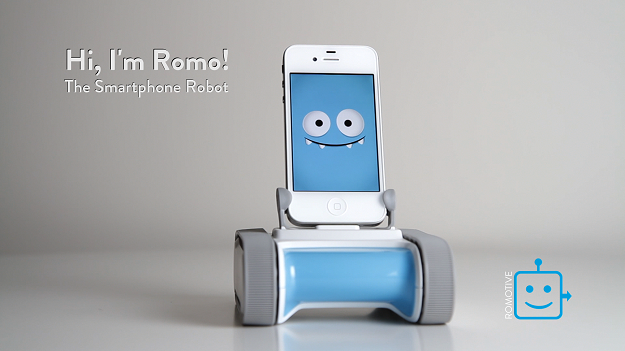
Romotive returns to Kickstarter with a faster, stronger, smarter Romo

Romo, the smart personal robot by Romotive, is returning to get Romo 2.0 into the hands of the creatives and hackers of Kickstarter.

Romotive is one of the many hardware startups that have embraced Kickstarter and been a part of as well as enjoyed the platform’s overnight success. The first version of the robot was hand-assembled, or sent in disassembled kits and shipped from the team’s apartment in Las Vegas. Romo 1.0 was just thirty pieces, sported a transparent base, a protruding audio cord, and assembled like a puzzle. Still, it was an innovative product and raised $114,769, more than 3.5 times the pledge goal of $32,000. Having learned from its first Kickstarter project, the team is returning and setting out to win the support of Kickstarter again with a smarter and improved Romo, this time with a project goal of $100,000.

The new Romo is better in just about every aspect. It’s compatible with iPhone 4, 4s, as well as the fourth and fifth Gen iPod TouchThis means to drive Romo, you can use just about any iOS device, or even a computer supporting Chrome, Safari, Firefox, or any Mac computer running OS 10.6 or later (it deserves to be mentioned that the iPhone 5 won’t work with the gadget). While Romo 1.0 supported Android, Keller Rinaudo, CEO and co-founder of Romotive told me that the majority of the issues that the team faced with the first project were entirely from Android users. The team isn’t looking to make that same mistake this time around and strictly supports iOS devices for now. An Android-based Romo 2.0 is in the works, but it won’t be arriving for awhile.

Design-wise, you can’t help but notice Romo’s new, much easier-on-the-eyes You can plug in your iOS device into the 30-pin dock, and unlike its previous version, all you have to do to install the Romotive app is to physically connect your phone to Romo, and then the app will automatically download.

Under the hood, the latest Romo has been rebuilt from scratch. The circuit board is more complex , enabling your phone to download the Romotive app automatically. And the app itself has a new, robust suite of features that enables remote two-way video feeds, facial recognition, and autonomous navigation.

Romotive is looking to “build the world’s first affordable personal robots,” says Rinaudo, but the team also wants to foster an ecosystem where developers unfamiliar with robotics can use Romotive’s open SDK to create new functions – for instance, taking a photograph using Romo and uploading that it to a social network — based on the  foundation Romotive has created.

This platform focus will also include the ability for Romo owners to personalize their robot with custom features. For example, non-developers will be able to select their robot’s personality through its graphical programming interface, while programmers can hack together new apps or features using Romo’s SDK. The latest version is “ten times better” Rinaudo assures me. For instance, Rinaudo told us the new iteration of Romo has the ability  to navigate to its own charging station.

Given all the new features, the new Romo will cost double that of the first generation device. It’ll cost $150 to back the project, while Romo 1.0 was half that at$75, but the team undervalued the cost of manufacturing the parts and ended up with a net loss. Luckily Romotive was funded shortly thereafter by seed investors.

In addition to the Romo 2.0, Romotive is also announcing a $5 million round of Series A funding. Backing the company are esteemed tech investors including Sequoia Capital, Crunchfund, SV Angel, and Felicis Ventures. Neimen Marcus will also be adding Romotive to its holiday catalog for those who don’t want to take a gamble on Kickstarter.

Given all this, you might wonder why Romotive has decided to return to Kickstarter. Rinuado’s reasoning is simple:It’s the Kickstarter community of creatives, hackers, hardware, and robot enthusiasts that you can’t find anywhere else. These are the types of people, Rinuado explains, that Romotive wants to give first access to.

In fact, the latest Romo is already coming off the assembly lines in China and the team is ready to ship the product. Between 4,000 and 8,000 are being manufactured per week to meet the demands of Kickstarter backers, large (unannounced retailers), and those individuals purchasing multiple Romo robots from Romotive.com. If you’re planning on backing the project, Rinuado told us exclusively, you’ll receive a Romo before the January 2012 ship date that the team had listed on its Kickstarter page, soyou’ll likely have a Romo in your hands by December.


Source : digitaltrends[dot]com

Sep 22, 2012

This week in Kickstarter: Our 5 favorite projects

kickstarter weekly best

We've rounded up a list of five of our favorite and trending Kickstarter projects that we thought you should keep on your radar.

Kickstarter is the home to the Internet’s innovative, brilliant, and bizarre sides, and for all the crowdfunding criticisms out there, there’s plenty of ingenuity to be found. We’ve rounded up five of our favorite and trending Kickstarter projects that we thought you should keep on your radar. And keep an eye on them for the upcoming holiday shopping season — should they get that all-so-important funding.  

TouchTime

touch time watches

With just days left in its Kickstarter campaign, Phosphor has broken the $250,000 mark with its line touch screen watches it calls Touch Time. A variety of Kickstarter watch projects have risen to infamy and met their funding markets, including the fan-favorite Pebble. But Touch Time fancies the beauty of minimalism, designed with the guidance of Nike+ designer Stefan Andren, while offering a cornucopia of interchangeable strap colors or the choice between metal and silicone. It ports basic apps that you’ll find in a smartphone, including a calendar, stopwatch, and calculator, into a 144 x 168 LCD capacitative touch screen.

iControlPad 2

icontrolpad2

We’ve seen a number of controllers that have specifically been designed for the purpose of fitting an iPhone — but what if that controller could be applied to a number of different hubs including a Raspberry Pi, robots, your computer, set-top boxes, or just about anything that can be connected to a controller supporting a Bluetooth connection? The iControlPad2is an all-in-one hackable open-source controller, and means you can fit an Xbox controller and gaming keyboard in a package that’s no larger than an iPhone 4S. “We were motivated to create this as we realized for all these ‘open’ systems there was no actual open controls which could, in theory, be made to work with anything,” co-founder of the iControlPad2, Craig Rothwell, told Digital Trends. “It would certainly save having to have a controller for every console, computer, and tablet.”

Impossible Instant Lab

impossible instant lab

Polaroid stopped manufacturing instant cameras and accompanying film in 2007, a sad day to the nostalgic among us. Today’s generation can effortlessly capture moments and instantly filter them through our smartphones, but in retrospect photography in its physical form is now a dying breed. With this in mind, Impossible Instant Project’s Impossible Instant Lab is worth recognizing. Preserving the love for instant photography in a form factor that’s reminiscent of a traditional Polaroid camera, Impossible Instant Lab can transform photos stored digitally on your smartphone into the classic analog instant photos that were hip even before Instagram existed. The printing process is a bit complicated, as you’ll notice from the video, but we’re willing to overlook that detail when considering the quality of the results.

SmartThings

SmartThings Hub

We’ve covered SmartThings before, but since it has broken $1 million goal and has garnered rave reviews for its innovate concept, this project is one that’s worth a second mention. SmartThings is really like IFTTT, the app recipe mix-master, but for your real life. Using the SmartThings hub, you can connect tools and gadgets from the physical world to its complimentary smartphone app. In one scenario you can set up your day by activating or scheduling your coffee maker to turn on at a certain hour and change the temperature of your home in time for your early morning shower, or it could double as a notification tool for instance to alert you that a door has been opened. On a creative note, SmartThings suggests that you can combine the Internet and the real world by brightening or dimming the lights when you get another fan or follower on a social network.

Goldie Blox

goldie blox

Goldie Blox is, considering our list, something of an outlier but it’s a project that nonetheless caught our eye. In a toy that’s specifically designed for girls from the ages of 5 to 9, former Stanford Engineer Debbie Sterling realized that men dominated her career field, and consequently developed Goldie Blox in an effort to make engineering appeal to girls. “When I was a little girl, I thought the word, ‘engineering’ was nerdy and intimidating and just for boys. I’ve since learned I was so wrong.” The toy itself is a child-friendly construction toy that encourages girls to build gears and other features while following a storyline written by Sterling. The project is the result of one year of research and testing with over 100 girls. 


Source : digitaltrends[dot]com

Sep 7, 2012

Kickstarter: 2012 is the year of the game

Of 11 projects that have passed the $1 million mark on Kickstarter, seven have been from the game category.

If you’re an indie game developer, you should probably try your luck on Kickstarter. The crowdfunding platform has hosted 11 campaigns that have passed the $1 million mark, and among those 11, seven of them have been game related.

This year, Kickstarter declared, is the year of the game. The platform has had the most dollars pledged to the game category this year, with $50 million, and has been bumped up from being the eighth-most funded category in the history of Kickstarter, to the second-most funded category.kickstater game stats 2012

Kickstarter released some data that displays just how much money the gaming category is bringing in for campaign owners and Kickstarter. In 2009, just over $48,190 was pledged to game-related campaigns. By 2010, $519,885 was pledged, and that amount jumped to $3,615,841 by 2011. With the data from 2012 tallied up for the first eight months of the year (through August 31), 2012 saw a nearly 1,400 percent jump. Kickstarter revealed that of 36 projects that have raised over $500,000 in 2012, 20 of them have been games. And yes, there is still another four more months left in this year.

Kickstarter explains that the growth was spurred by the indie game project Double Fine Adventure, which ended up raising a total of $3,336,372 — over eight times its goal of $400,000. In just the first hour alone, the project raised $1 million.

“The gaming world hasn’t looked at Kickstarter the same way since. Double Fine signaled to game developers that they could use Kickstarter to do something that previously seemed impossible: make the game they wanted without outside interference,” Yancey Strickler, co-founder of Kickstarter, and Fred Benenson, an engineer, wrote in Kickstarter’s blog post.

Since then, game projects like OYUA, and the latest, Reaper Miniature Bones, and Planetary Annihilation, have breezed past the $1 million mark. A project like Reaper Miniature Bones, you may not realize, falls under the subcategory of board games, despite the fact that much of the attention on Kickstarter games has been focused on video games. But with the increasing profile of successful Kickstarter game projects, board games have tagged along for the ride to the extent that the amount of money pledged to board games has doubled, with 47 percent of board games successfully reaching their funding goals. Just 23 percent of video games, on the other hand, have been successfully funded, with an average of $96,000 pledged to video game projects.

Kickstarter notes that game backers tend to be the most frequent supporters of campaigns, but as more and more indie developers take to mediums like Kickstarter to raise awareness and funding, the competition for the backers’ attention will intensify. And hopefully the hype doesn’t lead to fatigue. 


Source : digitaltrends[dot]com

Sep 6, 2012

‘Homestuck’ heads towards new Kickstarter record

A Kickstarter campaign to translate a webcomic into an adventure game looks set to break the record for the most money raised for a comic-related project on the crowdsourcing campaign. What is so appealing about 'Homestuck'?

Even as you read these words, it’s possible that crowdfunding history is being made.

Specifically, Kickstarter history for the most money raised on the crowdfunding site for a comic-related project. Previously, that record belonged to Rich Burlew’s The Order of The Stick, which managed to raise $1,254,120 in order to publish a number of out-of-print comics in February of this year, describing the success of his funding drive as something that revealed “this huge geeky safety net out there that I didn’t know about this whole time.” Now, however, it’s looking as if another webcomic-related project is about to take the crown, as Andrew Hussie’s Homestuck continues to rack up pledges as a truly startling rate.

Only three days into its Kickstarter drive, the Homestuck campaign has already met its $700,000 goal to develop a videogame based on the long-running webseries that started as a parody of adventure games, and is en route to demolish Burlew’s record without breaking a sweat. For those unfamiliar with Hussie’sHomestruck, the creator describes it as “an illustrated, semi-animated story on the internet [that] was specifically designed to exist there, to explore the potential of the medium, and evolve through reader participation.” The story revolves around four friends who agree to play an adventure game online together with, as Hussie puts it, “major consequences.”

“Saying anything more about the plot here would probably be getting in too deep,” he says in an in-depth description of the multiple-formatted series. “It gets fairly complicated. One of the goals was to begin with extremely simple, mundane circumstances, and allow reader participation combined with some preplanned elements to grow the story quickly and spontaneously, into something much bigger, more dynamic, and more intricate as a natural result of this approach.”

Another result of the level of reader participation is, apparently, the sense of ownership and involvement that readers feel when it comes to the idea of continuing the Homestuck experience past its initial serialization. Understandably for a series based in part on gaming culture, parts of Homestuck have already been translated into short-form games, but Hussie’s plan was to extend the universe of his series into a stand-alone game that goes far beyond its original incarnation. “It’ll be a little more like a spinoff than an adaptation,” he wrote. “Something that draws from the elements already established in the vast Homestuck universe, applied more selectively to a shorter, self-contained story. Homestuck’s structure is very open, which suits a highly exploratory piece of freeform media with a huge cast and many silly tangents.”

The idea has already struck a chord with the Internet, obviously, with close to 9,000 backers funding the project at time of writing and 28 days remaining on the campaign’s clock. Whether it’s the concept of translating narrative into a free-form immersive game that’s so appealing, or the adventure game comic genre (Order of The Stick was also a comic that dealt with adventure game tropes, interestingly enough), it’s clear that there’s a sweet spot somewhere in Homestuck‘s DNA. Personally, I suspect it’s this video:


Source : digitaltrends[dot]com