Pages

Showing posts with label robot. Show all posts

Oct 16, 2012

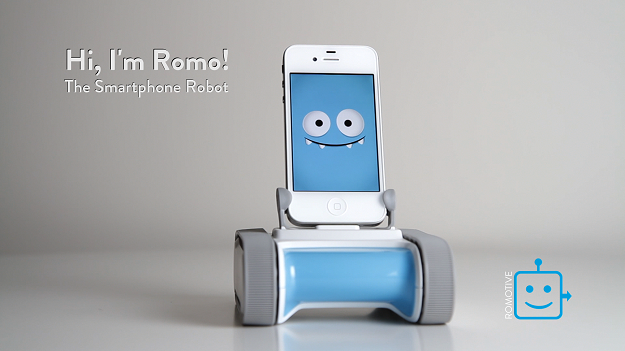
Romotive returns to Kickstarter with a faster, stronger, smarter Romo

Romo, the smart personal robot by Romotive, is returning to get Romo 2.0 into the hands of the creatives and hackers of Kickstarter.

Romotive is one of the many hardware startups that have embraced Kickstarter and been a part of as well as enjoyed the platform’s overnight success. The first version of the robot was hand-assembled, or sent in disassembled kits and shipped from the team’s apartment in Las Vegas. Romo 1.0 was just thirty pieces, sported a transparent base, a protruding audio cord, and assembled like a puzzle. Still, it was an innovative product and raised $114,769, more than 3.5 times the pledge goal of $32,000. Having learned from its first Kickstarter project, the team is returning and setting out to win the support of Kickstarter again with a smarter and improved Romo, this time with a project goal of $100,000.

The new Romo is better in just about every aspect. It’s compatible with iPhone 4, 4s, as well as the fourth and fifth Gen iPod TouchThis means to drive Romo, you can use just about any iOS device, or even a computer supporting Chrome, Safari, Firefox, or any Mac computer running OS 10.6 or later (it deserves to be mentioned that the iPhone 5 won’t work with the gadget). While Romo 1.0 supported Android, Keller Rinaudo, CEO and co-founder of Romotive told me that the majority of the issues that the team faced with the first project were entirely from Android users. The team isn’t looking to make that same mistake this time around and strictly supports iOS devices for now. An Android-based Romo 2.0 is in the works, but it won’t be arriving for awhile.

Design-wise, you can’t help but notice Romo’s new, much easier-on-the-eyes You can plug in your iOS device into the 30-pin dock, and unlike its previous version, all you have to do to install the Romotive app is to physically connect your phone to Romo, and then the app will automatically download.

Under the hood, the latest Romo has been rebuilt from scratch. The circuit board is more complex , enabling your phone to download the Romotive app automatically. And the app itself has a new, robust suite of features that enables remote two-way video feeds, facial recognition, and autonomous navigation.

Romotive is looking to “build the world’s first affordable personal robots,” says Rinaudo, but the team also wants to foster an ecosystem where developers unfamiliar with robotics can use Romotive’s open SDK to create new functions – for instance, taking a photograph using Romo and uploading that it to a social network — based on the  foundation Romotive has created.

This platform focus will also include the ability for Romo owners to personalize their robot with custom features. For example, non-developers will be able to select their robot’s personality through its graphical programming interface, while programmers can hack together new apps or features using Romo’s SDK. The latest version is “ten times better” Rinaudo assures me. For instance, Rinaudo told us the new iteration of Romo has the ability  to navigate to its own charging station.

Given all the new features, the new Romo will cost double that of the first generation device. It’ll cost $150 to back the project, while Romo 1.0 was half that at$75, but the team undervalued the cost of manufacturing the parts and ended up with a net loss. Luckily Romotive was funded shortly thereafter by seed investors.

In addition to the Romo 2.0, Romotive is also announcing a $5 million round of Series A funding. Backing the company are esteemed tech investors including Sequoia Capital, Crunchfund, SV Angel, and Felicis Ventures. Neimen Marcus will also be adding Romotive to its holiday catalog for those who don’t want to take a gamble on Kickstarter.

Given all this, you might wonder why Romotive has decided to return to Kickstarter. Rinuado’s reasoning is simple:It’s the Kickstarter community of creatives, hackers, hardware, and robot enthusiasts that you can’t find anywhere else. These are the types of people, Rinuado explains, that Romotive wants to give first access to.

In fact, the latest Romo is already coming off the assembly lines in China and the team is ready to ship the product. Between 4,000 and 8,000 are being manufactured per week to meet the demands of Kickstarter backers, large (unannounced retailers), and those individuals purchasing multiple Romo robots from Romotive.com. If you’re planning on backing the project, Rinuado told us exclusively, you’ll receive a Romo before the January 2012 ship date that the team had listed on its Kickstarter page, soyou’ll likely have a Romo in your hands by December.


Source : digitaltrends[dot]com

Oct 10, 2012

Hop the hands-free suitcase follows you around like an obedient pet

Hop robot suitcase

Travel through the airport with ease with the Hop, a hands-free robot luggage designed to follow you wherever you go.

Ever since most major airlines imposed the fee on first checked baggage, people everywhere have been looking for ways to stuff the most items into their carry-on luggage and one personal item (usually a backpack) to avoid the excess charge. While most of us have mastered the weight limit restriction, the trouble is no longer about stuffing your life into a carry-on but dragging all your things through the airport — especially because you always seem to get assigned the gate at the far end of the terminal. Wouldn’t it be nice if your luggage just followed you around so you can use your hands for more important things, like… finding the time to eat before your flight?

Hop robot suitcase remote controlHop the suitcase aims to be such a solution. Billing itself as the “next generation of luggage,” Hop contains three receivers that can locate and track the user’s cellphone so it can follow the owner wherever he or she goes. If the signal becomes lost or interrupted, the suitcase locks itself so no one can access what’s inside, and alerts the user’s cell that the luggage has stopped following. You can program Hop, named after hotel bellhops, to be controlled by you or jointly with the staff that handles your luggage if you do decide to check it.

“If a suitcase can move by itself, besides facilitating the lives of a large number of travellers, families, disabled people, [it] could also spare all the elements that moves externally the baggage (conveyor belts, carts),” the official Hop website reads. While that’s a novel and hopeful idea, it’s definitely going to take a while for airport security to shift from its large system to a bunch of RC luggage bags — if the idea ever catches on. And if it does, you best make sure to not lose your phone either or else the thief not only gets a shiny new smartphone, he’ll swipe all your travel goodies too.

At this moment, Hop is only in its prototype stages, but we could always dream of a robot bellhop suitcase to make airports less of terrible place to travel through. Still, we can’t help the lack of great food offered in most terminals, though.


Source : digitaltrends[dot]com

Sep 26, 2012

Mobile developer Red Robot Labs snags industry vet John Davison

Mobile games developer Red Robot Labs welcomes their new Director of Content and Publishing John Davison. His history with the gaming industry bring a lot to the table for the start-up.

Mobile games developer Red Robot Labs focuses many of its games on location-specific elements, but with its latest hire, the company may be looking to relocate itself to the top of the gaming world. John Davison, a 20-year veteren of the video game industry, will call Red Robot Labs his new home as he settles into a role as the start-up’s Director and General Manager of Content and Publishing.

Davison’s most recent position prior to this announcement was Vice President of Programming for CBS Interactive Games, which left him as overseer of content for GameSpot and Metacritic. He had also served as editor for Ziff Davis’ network of tech and gaming sites. Essentially, if there is anyone that knows the gaming world, it’s John Davison. 

Red Robot Labs, the team behind the well-received Life is Crime and Forever Drive–both available on iOS and Android–are happy to welcome Davison in from the world of covering gaming and into the world of making them. In a press release from the company, CEO Mike Ouye stated, “As a video game industry veteran with a proven entrepreneurial track record, John is the perfect addition to Red Robot as we aim to disrupt and innovate the mobile space for gamers.”

Davison is already staking his claim for what he plans to bring to Red Robot Labs and the gaming landscape as a whole. “There is a huge opportunity to build new products around the ways that gamers interact and discover content, and the team at Red Robot understands this better than any group I’ve ever come across. We want to empower gamers with technology designed specifically for them.”

Considering both Red Robot Labs’ and John Davison’s track records of innovation, creativity, and community, there’s a lot of promise in this partnership. Gamers everywhere should be on the lookout for whatever may come next from this team.


Source : digitaltrends[dot]com

Sep 7, 2012

Quadrocopter swarm performs amazing light show [video]

50 quadrocopters perform light show in Austria

Austrian and German robot makers launch a record-breaking 50 quadrocopters to perform an incredible 3D light show in the sky.

When I think of quadrocopters — the miniature flying drones that can be programmed to fly in choreographed formations — the first thing that comes to mind is a nightmarish future where people are bombarded by these little robots, picked up off the ground, and flown to some secret CIA prison. But apparently not everyone is as paranoid and crazy as I am.

Like the clever folks at Austria’s Ars Electronica Futurelab and German firm Ascending Technologies GmbH, who recently used a swarm of 50 quadrocopters to create what can only be called 21st century performance art. Outfitted with programmable LED lights, the swarm of Hummingbird quadrocopters flickered and danced in the night sky on September 1, above Linz, Austria, for the 34th annual Klangwolke (Cloud of Sound) multi-media music festival, to create 2D and 3D images in the sky.

Dubbed “The Cloud in the Web,” the eight-part performance tells the story of “the networking of our world,” according to the press release (pdf). “Episode 0″ starts with the story of waterways like the Danube river (along which the performance took place), which first connected humanity with one another. From there, the story travels through the first harnessing of electricity, to the birth of telecommunication and radio, to the rise of the robots, and finally to the age of the Internet.

The performance set a world record for the number of synced quadrocopters flying in unison. But the team says that it’s not finished there. Better 2D and 3D images are in the works, as is long-range flight. But what the team really wants to do is “crank up the numbers” — say, somewhere in the neighborhood of 5,000 quadrocopters in the sky at once.

Now, if that doesn’t sound like something out of a nightmarish dystopia, I don’t know what does.

Watch a video of “The Cloud of Sound” below:


Source : digitaltrends[dot]com

Sep 4, 2012

Inebriator, the Arduino-powered cocktail robot, is your personal bartender

The Inebriator robot bartender arduino

With a lot of time and a few gadgets, some crafty creatives at home built a robot bartender powered by Arduino microcontroller.

Bartenders can be tricky to deal with. You always want to shop around to find ones that mixes a generous ratio of liquor, but it’s an added plus if he or she is also fun to talk. It’s even better if they throw you a free drink or two after a long night. While it can be hard to find all these qualities in one bartender, the Inebriator comes close. This Arduino microprocessor-powered robot can make you the perfect drink every time — and you don’t even have to tip or leave your home.

The setup is simple: rows of spirits lined up upside down, ready for pouring. When you order a drink, the robot moves the glass horizontally across the machine to obtain the calculated parts of a cocktail — making the drink with the exact same ratio each time. If you drink comes with a mixer, an external cooler attached to the machine spritz the final touches to complete your order. Did we mention a cool glow of lights changes colors each time a new drink component is thrown in?

The inebriator robot bartender backThis home project relies largely on the tiny Arduino board, an inexpensive processor similar to Raspberry Pi. While it doesn’t have the functionalities or capacities like Raspberry Pi, Arduino is relatively inexpensive and fun for programmers to experiment with in order to whip up something as creative as the Inebriator. From the looks from its website, putting the robot bartender together was no easy feat. Among the gadgets required, a Hitachi HD44780 compatible display, a stepper motor, RFID sensor, and LED lights were just some of the items used in the making.

The Inebriator creators are currently working on a second version which should hopefully hide the cords in the back of the machine and also heed to the recommendations from a recent Reddit forum. Some of the ideas discussed include a pressurized CO2 system to keep mixers carbonated as necessary. Our other suggestions are to figure out a way for the robot to grab a glass of ice itself, or adding a tumbler so the robot can shake and mix the cocktails to perfection.

No words on whether the Inebriator is meant to be made for commercial use or if the creators will release a tutorial for the curious programmers at home. While you ponder, here’s a video of the cocktail robot in action.


Source : digitaltrends[dot]com

Aug 21, 2012

Miimo: The robotic mower from Honda that loves your lawn

Meet Miimo, a new lawn-loving robot from Honda that mows the grass so you don't have to.

Chores, chores, chores. Sometimes life seems to be nothing but time-consuming chores. The folks at Honda appear to agree, for they’ve just unveiled Miimo, a robot-on-wheels that’ll take care of your lawn, leaving you to do more important things like read a book or drink a beer.

Miimo incorporates what Honda calls a “continuous cutting system”, trimming 2-3 mm of grass at a time, several times a week. That sounds pretty measly at first, but if Miimo starts off with a well-cut lawn (OK, I guess you’ll have to do that), then it should have little problem keeping on top of things from thereon in.

The small robot cuts in a random pattern, thereby creating “less stress” on the grass, though quite what stressed grass looks like, I’m not altogether sure.

Cuttings are not collected, but are apparently so small (ah yes, 2-3mm) that they’re comfortably “dispersed into the lawn root system, breaking down quickly to act as a natural fertilizer which improves the health and quality of the grass,” Honda’s says in a news release about its robotic mower.

Before you can send Miimo on its way, you first have to bury a special wire around the perimeter of your yard. Sensors built into Miimo will detect the wire, thereby preventing it from disappearing off down the street, never to be seen again. The sensors also stop Miimo from bashing into any large objects located around the yard.

Power comes in the form of a lithium-ion battery, but you needn’t worry about it running out – Miimo’s got it covered. When the juice starts to run low, this clever device will trundle over to its docking station for a power boost all by itself.

Miimo is Honda’s first commercial product for domestic use, and will go up against a number of other robotic mowers already on the market. The company hopes it’ll prove popular with those who have no time (or inclination) to mow their lawn. It could also be useful for the elderly, or for those with some physical impairment preventing them from taking on the task.

The Japanese car company has also gained attention in recent years for another robot, Asimo. The advanced astronaut-looking humanoid robot can run, walk across bumpy surfaces, hop, and even pour a coffee. It can’t, however, mow lawns.

Miimo is coming to the European market first, in early 2013. There’s no word on price yet, though machines of a similar type cost from around $1,600.

[Ubergizmo via engadget]


Source : digitaltrends[dot]com

Aug 19, 2012

Disney’s ‘Physical Face Cloning’ produces the ultimate photo-realistic robots

Disney Research found a way to replicate the human face onto a robot for a more realistic robot experience.

It seems, over time, our robots are becoming more and more human-like. They can walk like humans, talk like humans, and perform tasks like humans. The one thing they haven’t really been able to successfully do, though, is look like humans. They are metal and mechanical. Achieving the human look is difficult. There are so many complexities in the human form.

If you think about it, robots probably shouldn’t look like humans. A human-like robot would certainly freak everyone out. If robots looked like us, we would constantly feel like a robopocalypse is on our horizon.

But it would be fun if we kept these human-like robots to a minimum and used them for specific things. And that’s exactly what Disney is planning on doing.

Disney Research in Zurich, Switzerland, just developed a new process of robot making that enables a physical human face to be cloned onto a robot. The process is called “Physical Face Cloning,” and it involves the scanning of a human head. Once the human head is scanned, the coordinates and expressions are recorded onto a 3D program. It uses measurements of skin elasticity and skin thickness to create a realistic mold of the face with silicon.

The robot face looks eerily accurate. Even the wrinkles and fine lines are portrayed on the robot. The robot is also capable of accurately portraying emotions like sadness, happiness, and anger.

Disney is planning on using the robots in its theme parks to add “realism to the interactive characters.” With advances in artificial intelligence, perhaps we’ll be ask the robots questions and see the robot reply with human-like emotions and expressions, like mechanical versions of Siri.

There’s no word yet on when the robots will be released, but this video demonstrates the complicated process involved in making them:


Source : digitaltrends[dot]com

Aug 17, 2012

Double transforms your iPad into a $1999 telepresence robot

California-based Double Robotics has come up with a piece of kit, called Double, that turns your iPad into a telepresence robot. Cost? $1,999.

Imagine you’re at your company, seated at your desk, when this iPad perched on a kind of pared-down Segway rolls up beside you. On the screen is the face of one of your co-workers located in another country who today is poking about your office, getting to know the layout, meeting some new people, asking a few questions. After a brief chat, it rolls off to the other side of the office. You look up five minutes later and do a double-take as you notice two of these devices having a conversation with each other by the water cooler.

Thanks to Double Robotics’ iPad-on-wheels – otherwise known as ‘Double’ – such a scenario could one day become a reality.

Double, which its maker claims offers the “most elegant way to be somewhere else in the world without flying there,” comprises a pair of wheels, a battery-powered motor, an adjustable pole and an iPad holder.

The telepresence robot is controlled remotely by someone using Double’s app on another iPad. The app enables the operator to move Double around its location, with its minimalist design helping to ensure it doesn’t get in the way of ‘real’ on-site workers. The length of the pole can also be adjusted using the app, allowing its user to talk face-to-face with co-workers, or peer over partitions to see what others are up to when they think no one’s  looking.

Weighing a delicate 15 pounds (7 kg), there’s little chance of Double causing any damage to furniture, or humans for that matter, should its operator fail to see upcoming obstacles.

The California-based firm behind Double believes its creation offers a unique teleconferencing experience, allowing you to move around a location freely, meeting co-workers in any location, although presumably the bathroom will be off-limits.

Double Robotics suggest its robot could be used by companies who regularly communicate with remote workers, as well as school campuses, “enabling potential students to walk the halls and talk to professors.” Museums and galleries could also use Double, offering tours to those too far away to visit in person.

While some may consider Double to be an unnecessary luxury, the museum/gallery idea is certainly an appealing one, where anyone on the planet could work their way around such places using simply an iPad and an app.

Of course, there are already a number of telepresence robots like this in existence, but what makes this one stand out is its reasonable price – $2,499, or just $1,999 if pre-ordered – iPad not included. The firm is set to ship its first batch this December, with orders placed from this week going out early in 2013.

Take a look at the slick promo video below to see Double in action. Would you like to see one of these rolling about your workplace?


Source : digitaltrends[dot]com