Pages

Showing posts with label printing. Show all posts

Nov 9, 2012

NASA using 3D printing technology to build parts for Mars-bound rocket

NASA's getting in on the 3D printing scene with new selective laser melting technology which is being used to build parts for future space rockets.

When it comes to 3D printing, it’s almost as if there’s a game of one-upmanship going on as to what can be created using this emerging technology. We’ve seen an acoustic guitar (novel) knocked together using 3D printing technology, a titanium jaw (impressive), an electric racing car (it’s getting interesting now), a plane (amazing) and even ‘magic’ arms (interesting and amazing).

Evidently not wanting to be outdone, and mindful of having access to some of the most advanced technology in the world, NASA recently piped up to say it’s currently using a kind of 3D printing technology to help build parts for future rockets that could one day carry humans to Mars. Top that, 3D printing fanatics.

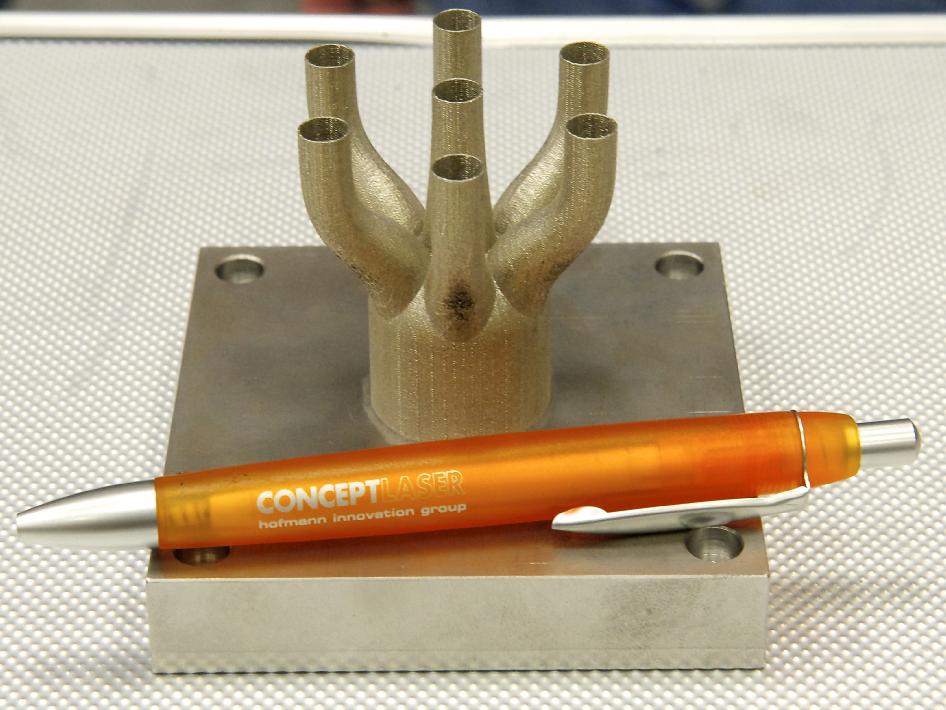
The method, called selective laser melting (SLM), can create intricate metal parts for future space rockets and could save the space agency millions of dollars in manufacturing costs, NASA said on its website recently.

Explaining SLM technology, Ken Cooper of NASA’s Space Flight Center in Alabama said, “Basically, this machine takes metal powder and uses a high-energy laser to melt it in a designed pattern.

“The laser will layer the melted dust to fuse whatever part we need from the ground up, creating intricate designs. The process produces parts with complex geometries and precise mechanical properties from a three-dimensional computer-aided design.”

According to Andy Hardin of NASA’s Engines Office, using the technology can cut manufacturing time drastically “from months to weeks or even days in some cases.”

He added that since engineers wouldn’t be welding parts together, the more complete parts created using SLM technology will be “structurally stronger and more reliable, which creates an overall safer vehicle.”

Saving money while improving reliability and safety means utilizing the technology is something of a no-brainer for the space agency, which is already dealing with major cuts to its budget.

Parts created using the technology will be tested on the ground later this year with NASA aiming to use them in a test flight in 2017. 

[Image: NASA/MSFC/Andy Hardin – shows the first test piece produced on one of NASA's SLM machines, with a pen included for scale.]

Image credit:


Source : digitaltrends[dot]com

Sep 26, 2012

Can you really just print your own working firearm with a 3D printer?

Just because 3D printing will make production more attainable by individuals, does that mean that everyone should be able to produce whatever they want? That hypothetical conundrum has a new reality to it with the announcement that Wiki Weapon, which aims to release plans to allow anyone to 3D print working firearms, has been fully funded.

The advent of 3D printing has been heralded by many as a revolution in mass production, especially with home versions of 3D printers now becoming available. With these devices and a little bit of technical know-how, the converts casually pronounce, anything is possible in the brave new world. That may be true, but it’s always worth remembering: “anything” doesn’t necessarily tend to limit itself to the good stuff.

Last week, Defense Distributed’s Wiki Weapon project reached its funding goal, meaning that – barring any unforeseen circumstances – it will be able to go ahead with its plan to create the world’s first fully-printable, working plastic gun, before going on to make the blueprints for said device available online, for free, for anyone to download and use to build their own firearm. As you might expect, that’s not an idea that thrills everyone.

The project is the creation of a University of Texas law student called Cody Wilson, who worked with a group of engineers, designers and programmers to develop the prototype device after discussing the idea with friends. Wilson is well-aware of ideological objections to make it possible for firearms to be created without license or guidelines, but he is firmly of the mindset that it’s better to live free than restrict an American’s right to bear arms. “People say you’re going to allow people to hurt people, well, that’s one of the sad realities of liberty. People abuse freedom,” he told the Guardian newspaper. “But that’s no excuse not to have these rights or to feel good about someone taking them away from you.”

Wilson is familiar with defending his idea. He initially tried to crowdsource Wiki Weapon on IndieGoGo, only for the website to freeze the project and refuse to share the $2,000 Wilson had already managed to raise beforehand (According to IndieGoGo, the project was frozen for violating company policy as it involved the sale of firearms, a charge that Wilson rejects as Wiki Weapon was never a for-profit project, nor planned to actually sell firearms, as such). Even after he went solo and managed to reach his crowdfunding goal, the problems haven’t ended; it turns out that actually fulfilling its aim may be illegal under US law (Specifically, it may run afoul of a 1988 law known as the Undetectable Firearms Act that prohibits entirely-plastic firearms).

Again, Wilson – who is, after all, a law student and therefore familiar with such legal challenges, is undeterred. “I haven’t felt any real heat yet, but I think it’s very possible the project might happen outside of America or the files might be hosted outside of America,” he’s on record as admitting. “The point of manufacture might also have to be outside of the United States.”

Even with full funding, it’s possible that Wiki Weapons will disappear without a trace like other crowdfunded projects. But it’s worth considering the project just a taste of what’s to come as 3D printing technology becomes more popular amongst the mainstream.


Source : digitaltrends[dot]com