An in-depth look at automatic license plate readers, the modern law enforcement tool that has civil liberty advocates up in arms.
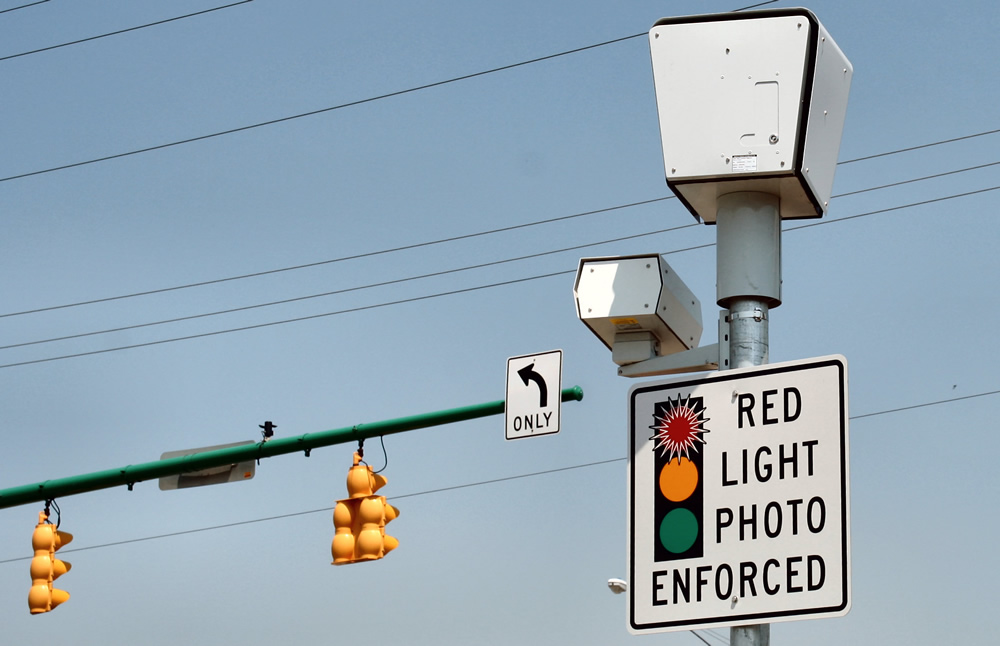
You’ve seen them strapped to the back of police cars, mounted on toll booths, and hanging anonymously on metal posts along the highway. They are automatic license plate readers (ALPRs or just LPRs), and they are quickly becoming a vital tool for fighting crime in the 21st century — one that critics say could potentially give law enforcement a map of all our travels. Let’s take a look at what LPRs are, what they do, and why they have privacy advocates worried.
What a LPR system is and how it works

Like something out of a dystopian cyberpunk novel, License plate readers are sophisticated cameras packed with Optical Character Recognition (OCR) software that allows them to rapidly identify license plates, snap photos of the plates, then convert the numbers and letters in the image into text. Each time a plate number is “read” by an LPR, the numbers are uploaded into a database. These images are most often time-stamped, and include geolocation data, which allows users of the data to know where a particular vehicle was at a particular time.
License plate readers come in three types— but only two are widely used: fixed and mobile. Fixed LRPs, which are mounted to the tops of posts along highways, at city intersections, and at toll booths, gather the largest number of plate numbers, have a high degree of accuracy, and run nonstop. Mobile LPR systems are slapped to the trunks and hoods of police cars, and often include two to four cameras.
New LPR systems can capture a staggering number of license plate images — hundreds every minute — and fully process the license plates into machine-readable text at a rate of about one a second. These advanced LPRs often include infrared technology to capture license plates at night, and are able to accurately read the plates of vehicles traveling 150 mph or greater.
When used by law enforcement (as they usually are), LPR systems automatically compare license plate numbers against a so-called “hot list,” which are made up of multiple databases that include stolen vehicles, vehicles used in crimes, vehicles owned by citizens with outstanding warrants, vehicles with unpaid taxes or out-of-date registration, and you-name-it. Mobile LPR systems will instantly alert an officer anytime a license plate number that appears on a “hot list” is identified.
While 2012 figures about the use of LPRs in the U.S. are difficult to come by, a 2010 study found that roughly one-third of all police departments in the U.S. use LPRs. According to the Wall Street Journal, the Department of Homeland Security has dolled out more than $50 million to local and state law enforcement agencies, for the sole purpose of buying LPRs, over the past five years.
As of April of last year, New York City had a total of 238 LPRs in use throughout the five boroughs, according to The New York Times. That includes 130 mobile systems, and 108 fixed systems. Washington D.C. had more than 250 LPRs installed as of November 2011, which equals out to approximately one LPR per square mile, reports the Washington Post. D.C.’s LPRs collectively capture roughly 1,800 images of license plates every minute.
Effectiveness of LPRs

Law enforcement agencies put stock in LPRs because they get results. An FBI report released in September 2011 indicated that the 82 local, state, and federal agencies operating under the FBI’s Criminal Justice Information Services (CJIS) LPR program reported “a total of 1,102 stolen vehicles recovered with a value of more than $6.5 million, as well as contraband recovered that included stolen license plates, stolen property, vehicles, drugs, weapons, larceny proceeds, suspended registrations, credit cards, and a police badge.” This in turn resulted in the location of “818 subjects listed in the Wanted Persons File and 19 listed in the Missing Persons File. Another 2,611 persons were apprehended.” According to The New York Times report mentioned above, LPRs were “directly responsible” for the recovery of approximately 3,600 vehicles in New York City, plus the citation of almost 35,000 unregistered vehicles.
Despite a real-world accuracy rate of about 80 to 85 percent, according to the National Law Enforcement and Corrections Technology Center (PDF), LPRs have their fair share of technical limitations. Accuracy can drop dramatically in colder regions, where snow and mud have a tendency to obscure plates, rendering them unreadable. Some LPR systems will also misread plates, mistaking a “Z” for a “7,” or a handicap symbol for the letter “G.” Some will even accidentally pick up “one way” signs, which have a reflective surface that “confuses” LPRs into “thinking” its a license plate. And because most LPRs are connected to state databases only, they can trigger alerts when they pick up out-of-state plates with the same number as ones flagged by local police.
What LPRs mean for your privacy
Of course, any technology as powerful as LPRs has a downside. According to groups like the American Civil Liberties Union (ACLU), that downside is a potential loss of our Constitutional rights.
As mentioned, LPR systems have the ability to gather and store thousands of license plate images every day, each of which indicates the time and location of each vehicle it captures. According to an officer from Long Beach, California, the local police department currently has “24 million plus reads” gathered by LPR. Combined, this data can paint a vivid picture of people’s lives, including the vast majority of us who are completely innocent.
“As license plate scanners are spreading, because the cost is falling and the government is providing a lot of grants to allow law enforcement agencies to get these things, you’re having places like lower Manhattan, or Washington D.C., or the borders — but also in small towns — where there are so many license plate scanners all over the place that people’s cars are being picked up all the time,” says Allie Bohm, a policy strategist for the ACLU. “And you can create a map of people’s travels.
“You’re getting not just the plates of somebody who committed a crime, or suspected of a vehicle violations,” she adds. “You’re also getting every innocent person that’s going by.”
In July, the ACLU filed Freedom of Information Act (FOIA) requests for the release of records from the Department of Justice, the Department of Homeland Security, and local and state agencies around the country to find out who is using LPRs, who’s funding the purchase of LPR systems, how long the data collected by LPRs is kept, and who has access the the LPR-collected data. While Bohm says her organization has already received thousands of documents, the ACLU filed suit against the federal agencies on September 25, in an attempt to force them to release their documents.
Bohm readily admits that LPRs “can be a legitimate tool” when they are used for “narrowly tailored law enforcement purposes, such as finding vehicles that are stolen, involved in a crime, or associated with fugitives.” What’s not legitimate, says Bohm, is when law enforcement agencies collect data on everyone, and store it indefinitely.
“In our society, it’s a core principle that the government doesn’t track people, or collect information about innocent people’s activities, just in case they do something wrong,” says Bohm. Unfortunately, LPRs allow governments to do just that, which limits people’s abilities to “freely travel on the open road, and engage in private activities, if they so choose,” she says.
Bohm recommends that law enforcement delete “innocent hit data” gathered by LPRs after a “reasonable amount of time.” At the moment, however, few states have enacted laws to regulate the use of LPRs and the data they collect. Maine requires that data collected through LPRs be deleted after 21 days, unless it’s being used for an investigation. New Jersey mandates that officers must have “specific and articulable facts” about possible criminal activity before using LPRs. New Hampsire bans their use entirely. No other state has yet enacted legislation to address the use of LPRs.
What do you think? Should police be allowed to use LPRs to fight crime? Do LPRs pose a threat to our individual privacy and civil liberties? What, if any, limits should be placed on their use? Let us know your thoughts in the comments.