Pages

Showing posts with label frame. Show all posts

Oct 15, 2012

noPhoto license plate frame foils speeding and red light cameras

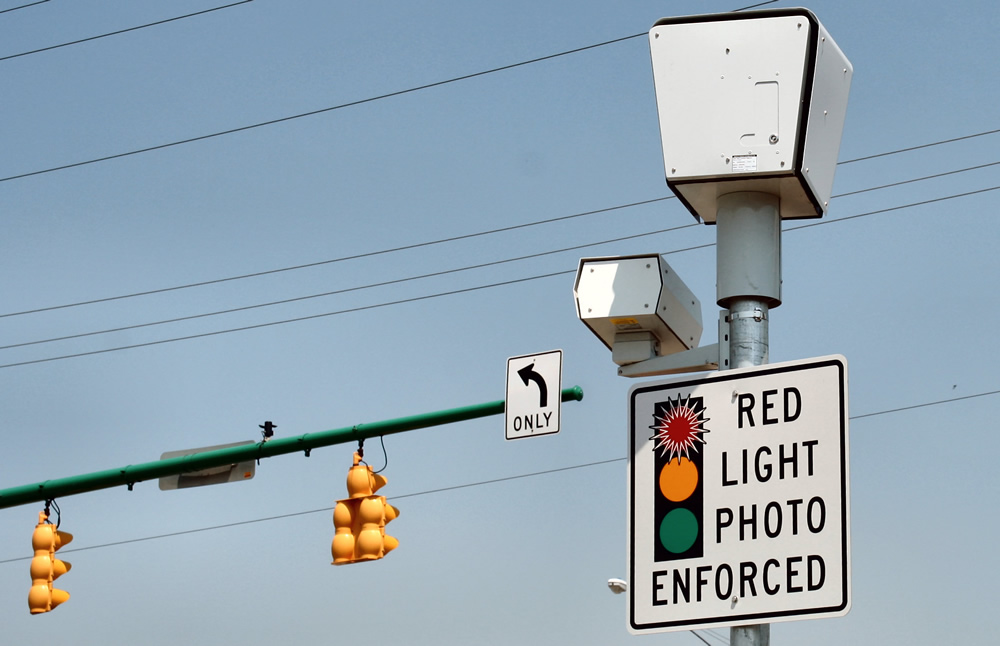
Red light camera

Attempting to limit the ability of law enforcement to deliver automated traffic tickets, the noPhoto frame lights up when you need it.

Detailed extensively on a current Indiegogo project, inventor Jonathan Dandrow has developed a smart license plate frame that has the ability to blanket the numbers and letters on your license plate in white light when being captured by a traffic camera. When a red light or speeding camera uses a high-powered flash to illuminate your vehicle, the sensor at the top of the noPhoto frame detects that flash. After quickly analyzing the incoming flash, the sensor triggers two flashes from the xenon lights on the left and right side of the frame. When the lights are active, it’s impossible to see any letters or numbers on the license plate and the driver of the car won’t receive a ticket in the mail based of the photo taken by the traffic camera.

nophoto frameThe noPhoto frame is basically designed to overexpose the area around the license plate with too much white light without breaking any current laws about license plates.

According to Dandrow, the noPhoto frame is legal because it doesn’t cover the state name on the plate or the actual identification number. In addition, Dandrow claims there are no laws specifically indicating how much light can cover a license plate at any given time.

If the noPhoto frame is used to successfully thwart a camera, a driver would avoid paying a fine for the ticket in addition to increased car insurance costs over the year. Beyond the obvious financial incentive to using the NoPhoto frame, Dandrow also indicates that there are privacy concerns to red light and speeding cameras. According to Dandrow, a company called Redflex located in Arizona makes the majority of the traffic cameras used in the United States. Each time a photo is taken by a Redflex camera, Dandrow claims a driver’s personal information is being stored in a database. Dandrow fears that information could be sold for marketing purposes at some point.

noPhoto OverExposedBeyond specifically using the noPhoto frame to drive recklessly, Dandrow also stresses that red light and speeding cameras can be prone to failure. Faulty equipment can send out tickets to people that didn’t actually break any traffic laws, thus the noPhoto frame would be useful for the law-abiding citizen.

Dandrow is also attempting to market the noPhoto frame to celebrities looking to avoid paparazzi, owners of exotic cars or basically anyone that prefers anonymity.

In order to fully fund the Indiegogo project, Dandrow is seeking $80,000 to get UL certification as well as kick off manufacturing of the noPhotos frames. Dandrow is currently offering the first one hundred noPhoto frames at a price of $199, but the standard price of the frame appears to be $350 according to the main site. The frame is designed to work in all types of weather since the circuity is sealed in plastic within the frame. Dandrow has included a test button on the noPhoto frame to see if the lights are still active. In addition, the firmware of the noPhoto frame can be updated assuming manufacturers of red light and speeding cameras attempt to modify photo timing in the future.


Source : digitaltrends[dot]com

Sep 17, 2012

Canon announces EOS 6D full-frame DSLR along with PowerShot G15, S110 and SX50 HS point and shoot cameras

Few days ago we saw Nikon announce their smallest and lightest entry level full-frame camera, the D600, at the $2100 price point. Now, Canon has announced a rival in the form of the EOS 6D, their own smallest and lightest entry-level full-frame DSLR selling for the exact same price.

The Canon 6D uses a 36 x 24mm CMOS sensor with a resolution of 20.2 megapixels. It’s lower than the 24.3 megapixels on the D600 sensor but since the sensors are of the same size, it should theoretically give the Canon an advantage in low light situations, as the individual pixels are larger and thus will collect more light.

The autofocus system on the 6D has 11 points, way lower than the 39 points on the D600. Having said that, Canon claims their AF system on the 6D offers the strongest low-light performance of any of their AF systems till date. Canon trumps the Nikon in the max ISO department, where it can go up to ISO 25,600 whereas the Nikon can only go up to 6,400. Both offer the option to go beyond that limit using software tricks, at which point the 6D goes up to ISO 102,400 and the D600 up to ISO 25,600. It remains to be seen how good the images actually are at those sensitivities, however.

Where the Canon really shines is in having GPS and Wi-Fi built into the camera, whereas on the Nikon you would need to buy separate accessories. It’s also the first Canon EOS to include these features. The 6D also has a slightly better 3.2-inch 1024k dot display, compared to the 3.2-inch 921k dot display. Neither displays, however, swivel or have touchscreen functionalities.

The Canon EOS 6D will sell for $2,099 body-only and for $2,899 with the 24-105mm F/4 L lens. Unlike the D600, though, that launches this week, you’ll have to wait until December to get your hands on the 6D.

The next one is PowerShot G15, part of Canon’s G-series of enthusiast point and shoot cameras that offer the settings and manual modes of a DSLR in a compact body. The G15 has a 12 megapixel, 1/1.7-inch CMOS sensor and a 28-140mm, f/1.8-2.8 lens. The 3.0-inch display has a higher resolution, 920k dot panel compared to the previous G12 but loses the swivel functionality. As before, it has a front dial and full manual control, along with RAW and HDR shooting modes. The G15 can also record 1080p videos.

The PowerShot G15 will go on sale in October for $499.

The PowerShot S110 is the successor to the S100, a point and shoot camera designed for those who don’t want a lot of control options but still expect high quality photos from their camera. The S110 has a slightly updated 12 megapixel sensor from the S100, along with the same 24-100mm, f2.0-5.9 lens and the GPS functionality. What’s new is Wi-Fi and a touchscreen functionality for the 3.0-inch, 461k dot display.

The PowerShot S110 will go on sale in October for $499 and will be sold in black and white.

Lastly, we have the PowerShot SX50 HS, a super zoom camera with a mind-boggling 50x optical zoom. The lens in question is a 24-1200mm equivalent with f3.4-6.5 aperture. Behind this lens sits a 1/2.3-inch, 12.1 megapixel BSI-CMOS sensor. The SX50 HS has a 4.5-stop optical image stabilizer, 1080p video recording with HDMI out, 2.8-inch, 461k dot LCD, as well as manual and RAW shooting modes.

The PowerShot SX50 HS will go on sale in October for $479.


Source : blog[dot]gsmarena[dot]com

Sep 13, 2012

Nikon unveils D600, its first budget full-frame DSLR

Here it is, folks. Nikon's long-awaited D600 DSLR, a camera that's sure to prove very tempting for Nikon shooters looking to make the leap to full-frame photography.

Nikon fans who’ve been wanting to get their hands on a full-frame DSLR, but found prices for the likes of the D800 and D4 to be prohibitive, will be taking a keen interest in the Japanese camera company’s latest addition to the market, the D600, which comes with a body-only price tag of $2,099.

Packed inside the weather-sealed magnesium alloy body of the new shooter is a 24.3-megapixel CMOS sensor and the same EXPEED 3 image-processing engine found in high-end Nikon DSLRs such as the D4 and D800.

The body is similar in size and weight to the D7000, making it the smallest and lightest of any of Nikon’s full-frame offerings.

Here’s a quick breakdown of the D600’s key features:

- 24.3-megapixel CMOS sensor

- 39-point autofocus system

- ISO range from 100 to 6400

- maximum of 5.5fps

- dual SD card slots

- 1080p HD video at 30, 25 or 24 fps

- 3.2-inch LED display

- 100 percent viewfinder coverage

- $2,099 (body only)

- $2,699 with the 24-85mm lens

The D600 is reportedly scheduled to start shipping next week.

Launching with the new camera will be the new $60 WU-1b Wireless Mobile Adapter that allows the quick and easy transfer of photos to mobile devices (most Android and iOS devices; free accompanying app required), and can also be used to fire the shutter remotely at a distance of up to 50 feet.

The D600’s price tag is at least $1,000 less than Nikon’s next-in-line D800, and may be tempting for some D800/D3/s/x/D4 owners in need of a back-up body.

At the other end, this camera is sure to appeal to DX shooters looking to make the leap to a full-frame format, considered to produce better high-ISO results and offering more creativity with depth of field. However, users of cameras such as the D7000 and D300s should keep in mind that any DX lenses they currently use may produce a vignette effect when used with an FX camera, which means forking out for a bunch of new lenses. DX users fond of shooting sports and wildlife might also miss the 1.5x crop factor they enjoy with their current camera.

For full information on the D600, check out its dedicated webpage here.


Source : digitaltrends[dot]com

Nikon announces the D600, the smallest and cheapest full-frame DSLR on the market

Looks like full-frame sensors are suddenly in vogue. Yesterday we saw a whole bunch of Sony cameras with full-frame sensors, including one camcorder. Now Nikon has announced the D600, which packs a full-frame sensor in what is the smallest, lightest and cheapest camera on the market right now.

The Nikon D600 uses a 24.3 megapixel 35.9 x 24mm full-frame CMOS sensor. The camera uses Nikon’s EXPEED 3 image processor and is capable of shooting at 5.5 fps.

Other features include ISO range of 100-6400 (expandable to IS 50-25,600), 39 point AF system, 0.13 second startup time, 1080p video recording in 30, 25 or 24 fps and 720p in 60, 50 or 30 fps, uncompressed video out via HDMI, dual SD card slots, HDR mode and a 3.2-inch, 921k dot LCD.

The Nikon D600 will go on sale on September 18 and will retail at $2,099 (body-only) or for $2,699 with the AF-S NIKKOR 24-85mm f/3.5-4.5G ED VR lens.


Source : blog[dot]gsmarena[dot]com

Sep 10, 2012

Sony RX1 spotted, allegedly packing a glorious full-frame sensor

After stuffing in a one-inch sensor inside the point and shoot RX100, it seems Sony is now going to put in a full-frame 35mm sensor inside an upcoming compact camera known as the RX1.

The RX1 looks like something that is barely larger than the RX100 but with a bigger lens to go with that ginormous sensor. The lens in question is a 35mm f/2.0 Carl Zeiss lens that looks like it’s removable but is fixed to the body. Despite being fixed the lens has manual focus and aperture adjustment dials just like on removable lenses so those used to DSLRs can feel at home.

Due to the fixed nature of the lens the RX1 is not going to be pocketable like the RX100 but it’s still looks way smaller than most DSLRs and not even close to those with a full-frame sensor inside.

Other noticeable features include a focus mode dial next to the lens, built-in flash on top with a hot shoe next to it for another one or a mic, mode adjustment dial, shutter release with a power ring and an exposure adjustment dial.

With a sensor that big inside, you can expect some amazing image quality from this camera. Unfortunately, it seems that it would come at a hefty price of around $2,799. Still, for someone who wants a high quality camera that isn’t the size of a handbag, this seems like a very good choice.


Source : blog[dot]gsmarena[dot]com

Aug 21, 2012

Instacube is a digital photo frame feeding real-time Instagram pictures

Instacube Instagram photo frame

Get real-time updates of your Instagram feed on this stylish digital photo frame which looks like a life-size Instagram logo.

Personally, I find that digital photo frames are a waste of electricity. Who wants to look at the same photos repeating itself over and over again, only to manually replace the memory card with new photos every so often? The introduction of Instacube addresses this issue: instead of adding photos to a digital frame yourself, Instacube will update your photos in real-time, reading off your Instagram feed based on the friends you follow, photos you’ve liked, or just your own pictures.

Instacube wireless digital photo frame for InstagramThe completely wireless digital photo frame looks similar to the Instagram logo itself, displaying pictures three times the size of what you might find on your mobile phones. The LCD touchscreen frame allows users to sift through photos as they’re fed to the frame in real-time, and connects to the Web via Wi-Fi. You can set Instacube to show photos of a certain hashtag so you can discover new photos in a faster pace of updates. To “like” a photo that you randomly come across on the giant display, there’s even a designated heart-shaped button at the top to give those photos some lovin’.

Instacube, currently a Kickstarter project, aims to not only market as a home decor item, it also wants companies to start embracing the technology in their businesses. For example, a clothing store could advertise a certain hashtag and for every photo a customer uploads with that keyword, their pictures would display in the store’s Instacube. These photos can be entered as part of a contest or campaign to promote brand visibility. This possibility of branding and interactivity makes Instacube not only your average digital frame, it might actually be fun to play with.

Instacube has 4GB of internal memory — should you want to display your own pictures — runs in 256GB of RAM, and has a 7.5-inch screen displaying 600 x 600 pixel resolution. It will run on rechargeable lithium ion battery so you can carry and move it around as you please. No word on how long the battery actually lasts before it needs a recharge.

To own an Instacube, should the Kickstarter succeed in one month’s time, you’ll have to fork up $99 of funding to receive your first edition of the wireless digital frame. These limited edition, discounted frames are quickly running out, and once they do the frames will begin to cost $149 apiece. The product aims to launch in the second quarter of 2013.

Watch the video below to learn more about Instacube.


Source : digitaltrends[dot]com