Pages

Showing posts with label health. Show all posts

Oct 17, 2012

App-enabled Beam Brush tracks habits, gamifies brushing your teeth

Beam Brush

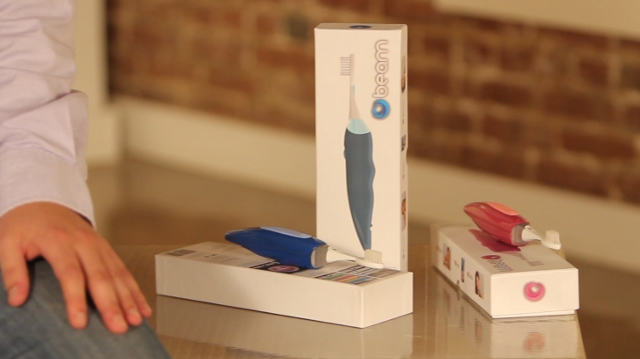
Possibly a fun way to get kids to brush their teeth more often, the Beam Brush utilizes your smartphone to encourage better oral hygiene.

Similar to health-related tracking devices like the Fitbit, a company called Beam Technologies has developed a toothbrush that syncs with your smartphone to track your oral health. Called the Beam Brush, the Bluetooth-enabled toothbrush is designed to increase the amount of time you spend brushing your teeth in addition to tracking overall consistency. Syncing to either an iPhone or Android phone, the Beam Brush includes a two minute timer and a quadrant indicator to help the user target specific sections of their mouth. In addition, the user can setup the application to play their favorite song in order to listen to something entertaining while brushing. 
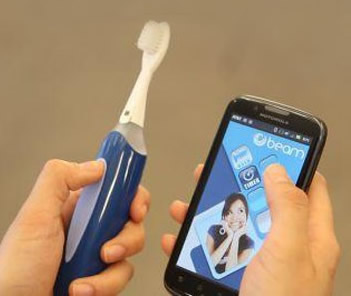
Beam Brush SyncThis product may be particularly helpful for parents trying to encourage their children to brush their teeth on a consistent basis. The app allows parents to sync multiple Beam Brushes to a single smartphone, so an entire family could track their progress. In addition to a set of standard goals within the app, parents could also setup custom goals that could lead to incentives for a child.

The application also outputs reports detailing each time a person brushes their teeth in addition to the length of time for each instance. Reports can be formatted for a single day, a full week or an entire month. These reports can be supplied to your dentist through email, thus helping the dentist evaluate a patient’s oral care more accurately. Rather than telling a patient to simply increase the amount of times they brush and floss their teeth each day, dentists will be able to offer more specific advice regarding future oral hygiene. 

According to data provided by Beam Technologies, the average person brushes their teeth for 46 seconds. By increasing the figure to 120 seconds, users will be able to reduce the potential for cavities or other problems that would require a trip to the dentist. People are also 50 percent more likely to brush for a full two minutes if using a timer. 
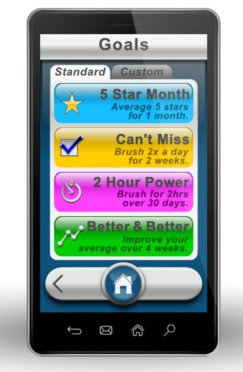
beam brush goalsAccording to Mashable, the company plans to monetize brushing goals for all Beam Brush users. This would include prizes such as discounts on specific merchandise or entertainment options like tickets to a local theater as well as video games for kids.

Hypothetically, the company could also work with dentists to provide incentives to patients that supply the Beam Brush tracking data prior to a checkup.

Beam Technologies plans to launch the Beam Brush during November 2012 for a price of $49.99, but is currently offering a preorder price of $34.99 on the company’s site. Available in blue and pink colors, the Beam Brush uses AA batteries that last approximately 90 days per charge. It also requires Android version 2.2+ or iOS 3.2+ on your Android phone or iPhone.

Replacement brush heads will be sold through the site for a price of $3.99. Beam Technologies recommends that the brush head be swapped out every three months and includes a feature within the app to track the last time the brush head was replaced. In order to raise consumer awareness about the Beam Brush, the company is also working with dentists on a resale program. If a dentist likes having access to the Beam Brush data, they could offer the brush to patients during a checkup.


Source : digitaltrends[dot]com

Aug 27, 2012

Health Risks of Mobile Phone Use: Fact v Fiction

It’s long been a concern of many that using mobile phones escalates certain health risks. Yes, using mobile devices while driving, for instance, escalates risk of accident and injury. However, the health risks discussed in this specific topic are not external. Some rumored conditions from use include degradation of hearing to brain tumors. Let us discuss each health risk some more commonly held in fear and the truth behind each.

 Brain Tumors

Too many people believe that mobile phones escalate risks of brain tumors forming from inherent radiation that mobiles generate. While it is certainly true that these devices do generate a small degree of radiation caused by the radio signal exchange, the amount of radiation exhibited by these devices is not significant enough to cause tumors to develop.

Children’s skin and organ tissues are more delicate and thin than those of an adult. If this particular fear is high enough, reduce the odds by prohibiting Bluetooth headsets. When a child holds the mobile phone to his ear instead of using the remote headset, the signal exchange ratio is reduce, thereby, reducing the radiation projected.

A series of extensive and comprehensive studies published in the Journal of the National Cancer Institute verified that moderate use of Bluetooth headsets and to-ear mobile phone use poses no real brain tumors or cancer risks. Corded headsets reduce fears and radiation exposure, however, if the fear continues.

These rules, by the way, hold for users of all ages. Constantly wearing a Bluetooth headset is never recommended for any age, for it can produce other side-effects than one of radiation: Our ears need airflow. If the ear canal is blocked from that air flow, built-up moisture condenses and can cause infections that can damage the ear drum and fragile bones.

 Hearing Loss

If the volume is high continuously, the threat of hearing loss, starting in the upper frequency ranges, is actually real, just as listening to loud music can threaten full-range hearing. Ensure the incoming volume is adequate for clarity but not overly loud for convenience.

This audibility rule holds for headsets of all types and for speakers as well, whether they’re on a television set, a stereo, an MP3 or MP4 player or a smartphone.

 Sterilization

Stemming from radiation fears, the location and negligible amount of radiation mobile device exude have absolutely no impact on male or female sterility.  No medical study has ever confirmed that fable regarding mobile phone use.

 Emotional Health

Health concerns for children and mobile phone use extend beyond the physical. Adolescence and teenaged years can be extremely difficult for kids. Cyberbullying, inappropriate content viewed while surfing the Internet or even engaging in photo sharing and chat room conversation lead parental concerns.

Using their smartphones when supposedly sleeping or doing homework or other tasks are also on the concern list. Sending a photograph to someone who shouldn’t have those photographs can risk emotional trauma and extreme distress.

Parents can monitor text messages and call histories to help lessen those concerns. Also, parents can download onto their children’s mobile devices a lock-out program that will prevent mobile phone use during sleep hours, for example, or text messages during inappropriate times.

Parents might opt to explain the prohibition parameters, however. A child might opt to toss the mobile if he thinks it’s not working, causing additional expense and exasperation.

Unfortunately, emotional health problems from Internet-based actions or viral text messages can impact users of any age.

Guest post by Jaye Ryan, a freelance author who likes to write about mobile technology facts and trends for MobilePhones.org.uk.


Source : techtalkafrica[dot]com