Pages

Showing posts with label visibility. Show all posts

Nov 9, 2012

Hands on: Halo Belt makes us believe in Kickstarter again

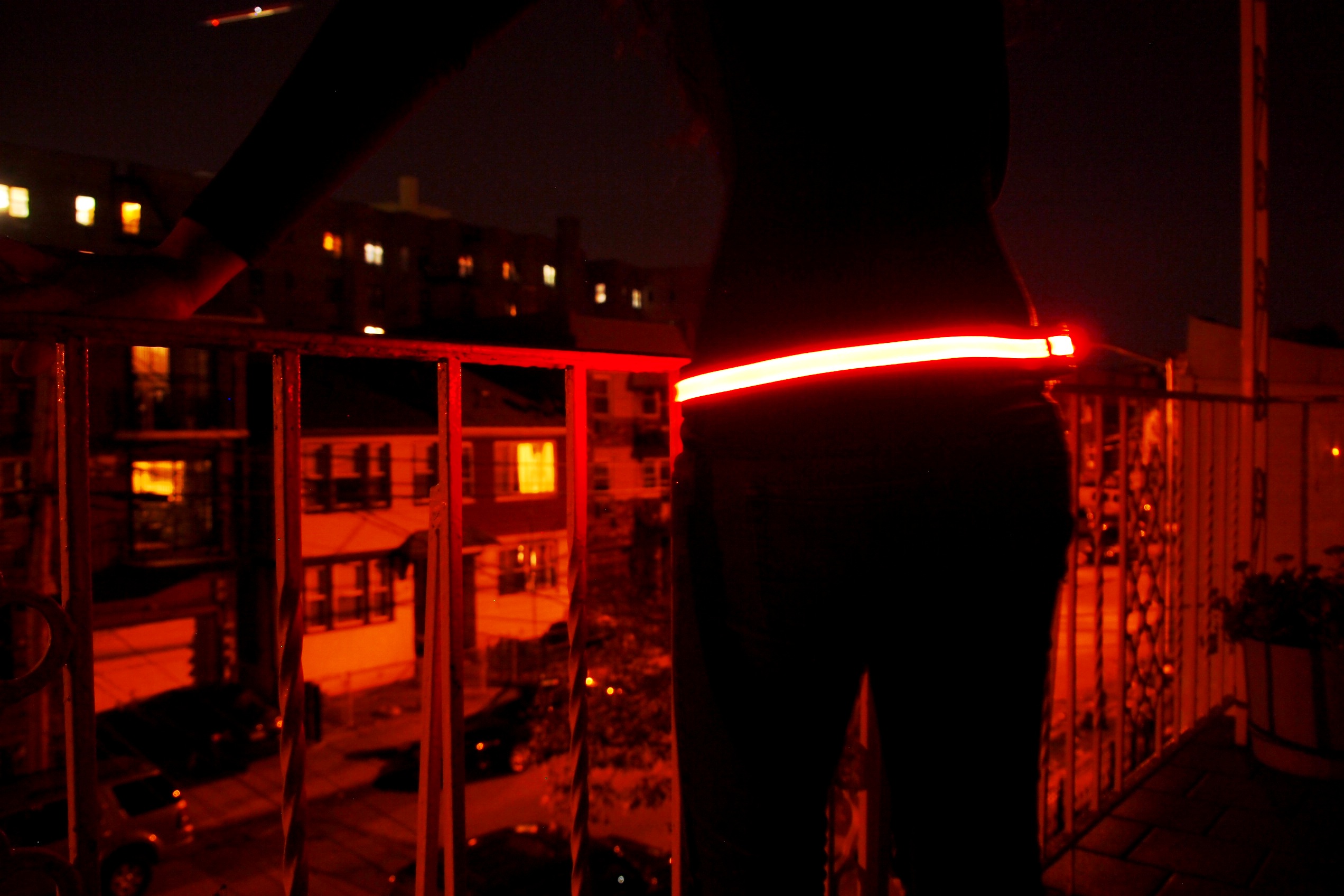
Tired of getting your bike lights stolen? Why not just wear the bike light? WIth Halo Belt, the Kickstarted project brings nighttime visibility directly to - and on - you so you can commute with ease.

In a sea of hidden failures and over-promised ideas, Halo Belt makes Kickstarter a worthy source for creative projects again. Over the summer, we caught a glimpse of the LED belt designed to increase land commuters’ visibility when traveling at night. By October’s end, the Kickstarted project shipped the final product to its loyal supporters, with an international launch due in January. Well, is Halo Belt worth the hype? 

Look and feel

Halo Belt comes packaged in a tube container, a clever design that’s sure to please retail showrooms with how portable yet presentable the product can be. Out of the tube, the belt is like your average fabric strap found on most backpacks. On the outer side of the belt is the flexible LED strip lining the majority of the belt length. The belt loops on the wearer with a plastic buckle, all designed to be weather proof during your commute. 
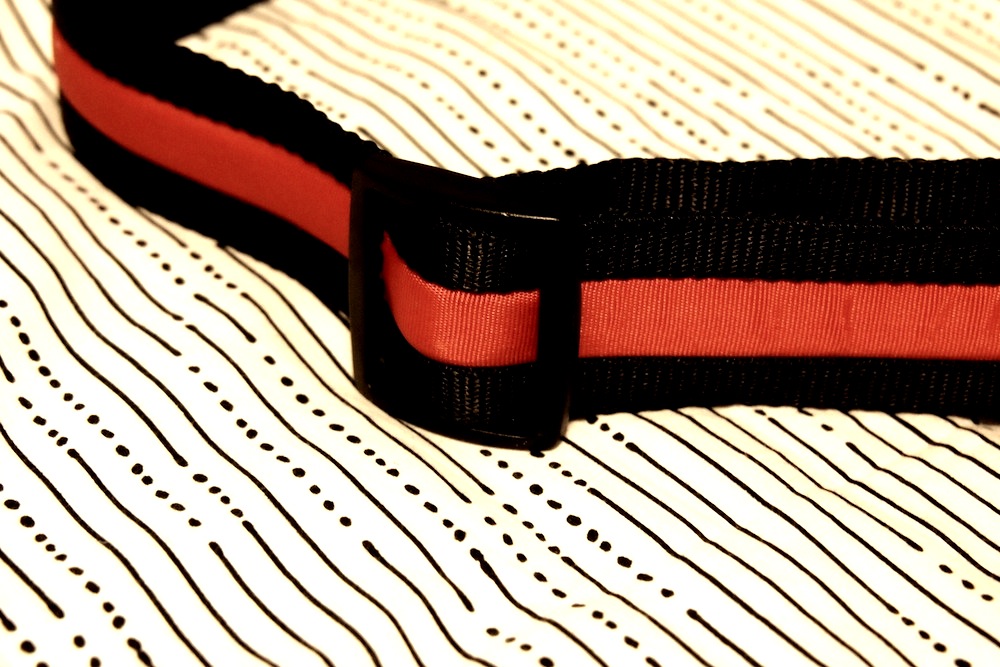
Halo Belt advises that it one size fits most, from a women’s 0 to men’s 38-inch waist. I’m wear a women’s 0 and found myself forcing parts of the LED through the adjustment loop for Halo Belt to fit loosely on my hip. It’s not a difficult fix, but I can’t imagine jamming the LED strip through the plastic slots is good for prolonged use, especially if you continually readjust the size. Fortunately for Halo Belt, I’m likely in the minority of being too thin for the product.

Once worn, the Halo Belt is noticeable without feeling noticeable. The strap is lightweight, looks cool while glowing in the dark, and the Power button is easily accessible next to the plastic buckle. One tap turns the belt on at a flashing mode, an extra push puts it on strobe, and one more keeps the LED light on solid. 

Utility 
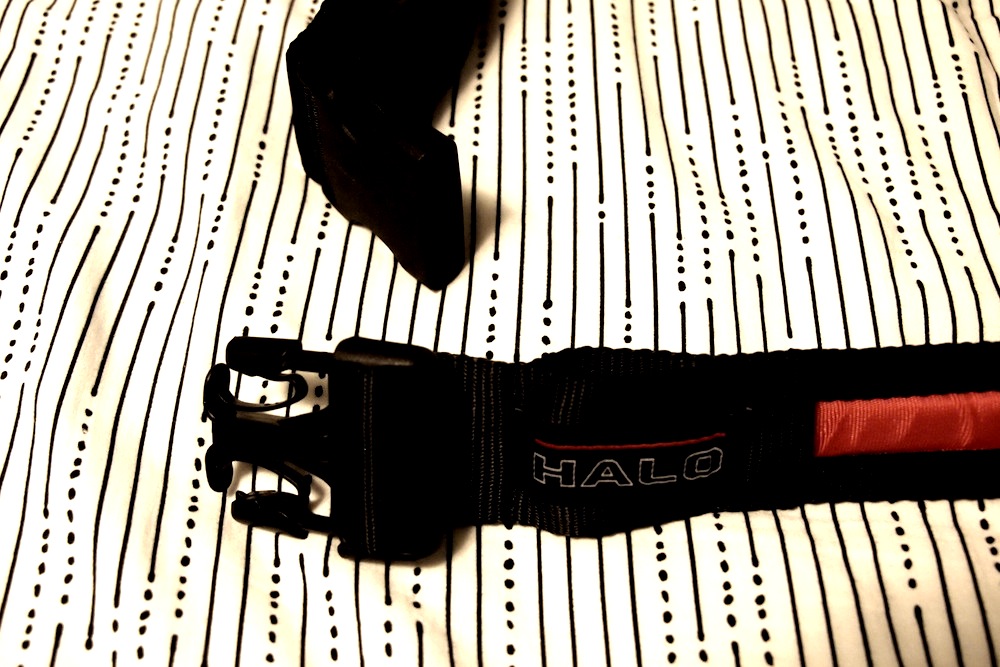
With an intuitive functionality, Halo Belt works like a charm. The light is soft on the eyes but bright enough to make you more visible on the street. Quick access to the button makes it easy for you to switch to flash mode to indicate turns or change of lanes, if you’re an expert at one-handed bike riding. Halo Belt runs on two CR2025 batteries that lasts up to 20 consecutive hours or 75 non-consecutive. Assuming your nightly commute lasts no more than 45 minutes on average, you can get about three and a half months of power on a full set of batteries. If your commute takes less time, more power to you (and your belt).

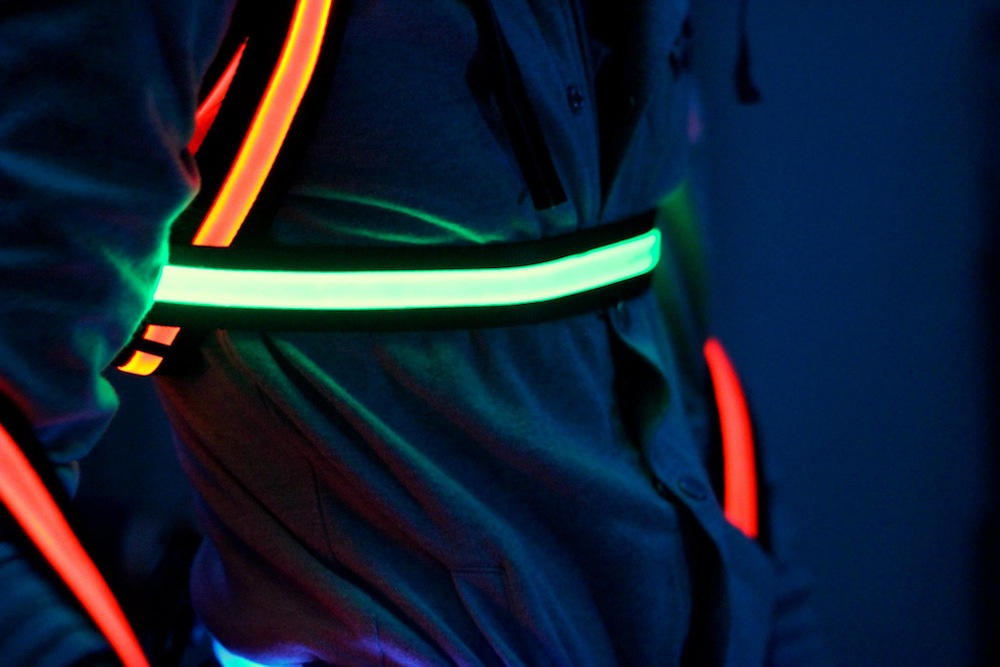
Even with prolonged use, the LED light never gets too hot, and you can wear the belt in as many styles as you want: around your shoulder and arm like a messenger bag, high-waisted, loose on the hips. With four color choices, you can also use it to categorize teams during a night game of basketball in the park. We’ve even seen photos on Halo Belt’s Facebook that show wearers utilizing the belt as a Halloween accessory. Take it to your next concert or club night and hit up strobe mode for an attention-grabbing look. What was made as a commuter’s utility belt has clearly become a fashion item of its own caliber, and the possibilities make Halo Belt an exciting and fun accessory.

Bottom Line
Halo Belt first appeared on Kickstarter in June, completed its funding in August, and fell into our hands late October. Aspiring entrepreneurs should look at the Halo Belt team as a prime example of how to successfully promise, create, and deliver a product in a timely manner – all while keeping backers in the loop with monthly updates, tweets, and Facebook statuses. Halo Belt project starter Vincent Ng clearly had the sourcing and design logistics figured out to offer a simple and well-made item without losing his backers’ faith or over-promising any features. In fact, Halo Belt underestimated itself for how cool it could be to multitask a seemingly basic strap of LED light into something fun, fashionable, and useful. If only Halo Belt included an extra set of batteries… because now that daylight savings is in effect, I might just wear it all the darn time.

Halo Belt is available today for $85 in red, blue, green, and yellow. 


Source : digitaltrends[dot]com

Oct 18, 2012

Yelp tries public shaming to discourage businesses from gaming reviews and ratings

yelp consumer warning

Yelp, in its latest measure to discourage businesses from gaming its reviews and ratings, will display warning signs on businesses suspected to be be illicitly enhancing their visibility and profile.

Yelp has become critical to local business’ success. Patrons consider the number of stars a vendor receives as well as user reviews on Yelp a great — and legitimate — source of first-hand feedback. Over the years, the platform has become a standard for judging the quality of services, and accordingly, small businesses have inevitably found ways to game the system and rack up the positive reviews. Now, Yelp is taking measures to crack down on companies that are resorting to these illicit tactics.

“The allure of a page full of five-star reviews can turn even the most ethical business owner starry-eyed and persuade some to attempt to game the system by paying for reviews,” Eric Singley Yelp VP of Product says.

It’s incredibly easy to find sources for faked reviews — a quick Craigslist scan reveals as much. Other more elaborate schemes involve entire businesses that are contracted by small businesses to improve visibility and ratings on the site. Such contracted organizations will use gray or black hat techniques including publishing false reviews and slandering competing businesses — the result of this being that the entire Yelp review system’s reliability is degraded. 

But Yelp will start taking an unconventional approach by publicly shaming businesses through a pop-up that warns consumers of the vendors’ less-than-legitimate actions. Businesses that Yelp is certain are gaming the system will be flagged starting today, and the platform revealed that the feature is launching with nine businesses that “will have the consumer alert message posted on their profile page.” The alert will appear for a period of 90 days and be removed thereafter unless the business in question doesn’t quit its scammy ways.

Yelp reviews’ controversial history has even led to a class action lawsuit against the company for allegedly extorting businesses to place ads on its site to surface their positive reviews. These issues have also kindled interest by researchers to detect false reviews using statistics and algorithms. Last year Cornell researchers developed a computer algorithm that in field trials was 90 percent accurate in detecting false reviews. And in June, researchers from the State University of New York, Stony Brook devised a statistical technique that spotted businesses with false reviews by comparing the statistical distribution of reviews. That method was said to work with 72 percent accuracy.

Review scammers are clever and their efforts are becoming more and more sophisticated as outlets try to fight them. Yelp claims to be ahead of the game compared to competitors, and the site will soon begin identifying businesses with a “large number of reviews submitted from the same Internet Protocol (IP) address.”

Yelp assures users and businesses that play by the rules that, “we are not going to let a few bad apples spoil the bunch.”


Source : digitaltrends[dot]com

Aug 7, 2012

6 Craigslist alternatives for online classified ads

online classifieds craigslist ebay oodle

Whether you want to more visibility to your classified listings, or just feel like abandoning Craigslist, here are six alternative services at your disposal.

So you’re sick and tired of Craigslist playing drama queen in light of its new “exclusive license” agreement, in which anything you post on the site becomes a Craigslist copyrighted material. You’re not alone. While we give Craigslist credit for being the go-to online classified ads website, there are plenty of other services that do an equally fine job with a prettier interface. If you’re looking to get the most exposure to whatever’s being listed or you’re just over Craigslist, here are six additional sites you can use to target a new audience or switch to altogether. And yes, they are all free.

eBay Classifieds

Formerly known as Kijiji, eBay Classifieds is one of Craigslist’s largest competitors, thanks to eBay’s credibility. Like Craigslist, eBay Classifieds covers the scope of most categories: selling, renting, job opportunities, and community events. Not included under this umbrella are personal ads, so you’ll need to head somewhere else to find your Missed Connection or potential love interest.

Using eBay Classifieds might be an even better option than Craigslist, thanks to the user-friendly interface. You can also sort items by price and view them in photo thumbnails, which is far more helpful than having to read all the Craigslist headlines and hoping the image attached is not some boring stock photo. Ads on eBay Classifieds also stay on the site for 60 days compared to CL’s 7-day limit in most cities.

Oodle

Oodle acts as its own classified ad service, but also aggregates posts from eBay, ForRent.com, and other competitors to make your search experience more thorough. Oodle has also been a service of choice for many companies in the past who used to offer classified sections, such as Aol and The Washington Post Express. And yes, Oodle has offer a personals section. Users have the ability to link their posts to respective Facebook accounts as well to add more credibility or increase exposure via the Facebook Marketplace. If the same user has posted several items, you can sort them all under the same lister.

One thing Oodle has over eBay Classifieds is the ability to post if you’re a seeker — meaning if you’re looking to buy, rent, or need certain services. You can also access these listings or edit your own post from its free iOS app.

Backpage

Much like Craigslist, Backpage offers a minimalist design interface: The listings are sorted by date, headlines, and location just like you’re used to seeing on CL, and a tiny camera icon denotes that the post contains pictures. Backpage offers “paid upgrades” to give your posts more visibility. This includes the option to automatically repost your listing at the top of the page every certain amount of days for certain amount of times, or paying to make your post a Sponsored Ad with a highlighted location on the page.

Backpage has recently come under fire, however, for some excessive prostitution ads and sex trafficking activity, so we probably wouldn’t recommend it for its Adults section.

Recycler

Recycler does exactly what its name sounds like: help buyers and seller swap items using the site as the medium of communication. While you can also post home rentals on the site, it seems more popular among sellers looking to get rid of used items. Recycler offers listings in most major cities in the United States only, so those in rural areas might have a tougher time trying to target their group of audience through this site.

Adoos

Adoos does a good job highlighting various sections of classified ads, such as real estate, for sale, vehicles, community, services, and jobs. The little icons and pops of color are nice on the eyes and help organize your flow of content better than what you might find on CL. If you do not select your city, Adoos will search listings from the across the country, which might be helpful if you’re looking for online coupons or vouchers that aren’t location-specific. You can log into the site using your Facebook account as well, for maximum exposure. Unfortunately, you’ll have to sort through some spam as Adoos listings are often just advertisements for external sites.

Hoobly

Back on the minimalist front, Hoobly is a basic classified ads site that is helpful for those who want just snippets of photos to accommodate their search. The site can scour its listings from around the world or country-specific, and shows you each headline with a small excerpt to give you an idea of what the ad entails. Unlike Craigslist, Hoobly users need to register their e-mail addresses before posting, rather than just receiving a verification e-mail when you are about to publish. This could, however, help with cutting out the spam.


Source : digitaltrends[dot]com