Pages

Showing posts with label dinner. Show all posts

Nov 10, 2012

How Samsung, Microsoft and stupidity are staining Apple’s brand image

Microsoft apple logo samsung

Clever marketing from competitors and its own stumbles have left Apple’s effortlessly cool brand image looking more effortlessly clueless.

I’m at an IBM event this week, and at dinner I had what has been an increasingly frequent experience.

It used to be that attendees at these events gushed about the new Apple gadget they were carrying, and anyone who expressed reservations seemed out of touch with the group. Much like talking about religion or politics from the minority position at the dinner table, bashing Apple was one sure way to ensure everyone thought you were an idiot.

But last night, instead of showing off an Apple device, another guest showed off his new Samsung Galaxy S III phone, which led to more chatter about my new Microsoft Surface tablet. It spiraled into an “everyone dump on Apple” event, and by the end of the evening, Cupertino’s sole defender seemed to be considering other options.

This may be anecdotal, but I’ve seen the same event played out several times recently among analysts and other influencers in the tech space. It makes me think Apple’s image is changing, and the firm’s products are losing their magical edge.

Samsung’s anti-Apple marketing

The blemish on Apple’s spotless image didn’t just appear there; Samsung helped etch it into the glossy white plastic quite intentionally. Its excellent marketing campaign has attacked Apple’s image on three vectors.

The first is questioning Apple’s leadership. Samsung’s ads paint Apple’s “upgrades” as features the company accidentally or intentionally left out of prior products (larger screens, 4G radios), or obvious improvements (headphone jacks on the bottom). In some cases, they also point out where Apple still lags behind the curve after launching a new device, like the lack of NFC in the iPhone 5. Samsung wants to depict itself as the innovator Apple is struggling to match.

Second, the campaign raises the idea that Apple fans aren’t smart consumers. They’re depicted slogging through long lines waiting for their technology, and getting unreasonably excited about aspects of the product that aren’t exciting. In fact, the not-so-subtle message is that Apple buyers are kind of dense.
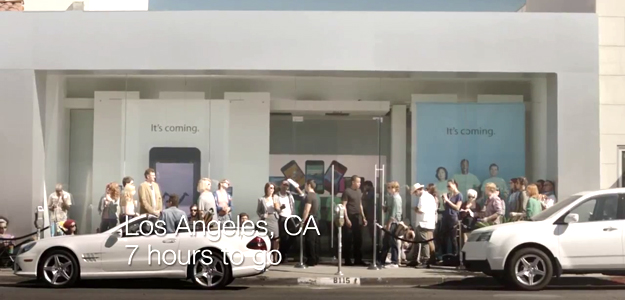
Samsung Apple commercial iphone 5 samsung galaxy s3Finally the ads build on this dense concept by showcasing Apple users as people you wouldn’t want to emulate: Your parents. Dorks. Clueless hipsters. This is designed to strip away the prestige that Apple products typically carry.

For all its mocking, Samsung actually copied Apple with its first smartphones, but has since diverged, trying to drag away the perceived market leadership with it. The Korean company waged a similar type of warfare on Sony in the television space, which was once the clear leader. Samsung first emulated Sony, then partnered with the company, then took the market away. Sony has never recovered. Granted, Sony had additional issues that complicated things, but the plan worked, and Samsung appears to be following the same playbook with Apple.

Microsoft Surface

Samsung isn’t the only company slinging mud on Apple’s image. The Microsoft Surface tablet is doing relatively well, and Apple’s efforts to disparage it have largely been ineffective (at least so far). It appears to have been designed specifically to make the iPad look wanting in comparison.

As I write this, the Surface is still generating lines, but the important part is it looks both more advanced and more unique than Apple’s offerings. This impression dovetails nicely with Samsung’s efforts, because while the two companies aren’t aligned on products, they are aligned on a common message: Apple’s offerings don’t convey status anymore because they appear to be bought by stupid people.

The too-soon iPad 4 and too-expensive iPad mini

The third leg on this this ugly three-legged stool comes from Apple itself. Its latest launch even showcased an array of different products under one roof, a “big bang” event that trivializes individual products. Firms like Compaq were famous for this approach, but Apple has avoided them like the plague since Steve Jobs returned in the late 90s. Worse, the new iPad made buyers of the old version – launched only back in March – look stupid.

Meanwhile, the iPad mini was priced well out of line with competing models, with inferior specs. When Steve Jobs launched the iPad, it was the lowest priced tablet from a major vendor in its class, and since then, it has remained price competitive against the alternatives. The iPad mini is priced at a 65 percent premium, but lacks the same high-quality displays found on far cheaper competitors. Smart people would probably not buy it as a result. I wouldn’t be surprised to see Apple discount it significantly once initial demand falls off, leaving early buyers upset and looking stupid yet again.

Destroying Apple’s brand

Apple’s strongest asset is the power of its brand, and the historically valid belief that Apple products are purchased by smart people who are well regarded. This asset is being systematically destroyed, overtly by Samsung, covertly by Microsoft, and stupidly by Apple. Apple is not effectively defending this incredibly valuable asset, and the end result will likely resemble the company that existed before Steve Jobs’ return. That also means a market less dominated by Apple. Since I’m writing this on my Surface Tablet, I’m thinking this may turn out to be a good thing.


Source : digitaltrends[dot]com

Oct 29, 2012

Localise, Mobilise and Socialise More This Summer

You’re up early, it’s a beautiful, balmy summer’s day and you’re headed to the beach with your gang, later you’re going for a hike, then sundowners, dinner, and for the revelers, a night on the tiles. All of these activities are social and you are likely making plans, making choices and communicating through a number of social networks, liking, posting, uploading, sharing, commenting, tweeting, and retweeting as you go. In essence your online activities are social and mobile. Your laptop remains firmly in your bag – that’s work right – and your comms time is spent on your phone and on your tablet or iPad.

Summer is just around the corner, and with that the holidays, where our behaviour becomes more socially driven. With this comes the opportunity for brands to deliver marketing campaigns that will capture some of the increased spending and brand interaction during the holiday season – and if they are clever they will have directed it to social and mobile ad spend.

You might trick yourself that you’ll have a “digital detox” once you leave the office for vacation but “relapse” to Internet usage is unavoidable. While you may be physically away from your computer, it’s hard to stay away from surfing the web on your mobile – whether it be sharing holiday photos, checking where your friends are hanging out, or looking for shopping discounts. South Africans are never truly offline, with nearly 8 million of us accessing the Internet through our mobile phones.

For social media in particular, there is a vast percentage  (13% penetration of population. Ref Social Bakers) of the population using Facebook with approximately 6 million Facebook users in South Africa (ref World Wide Worx). Facebook presents a mechanism for companies to have a dialogue with their customers and market their products. Furthermore, in general, 65% of Facebook users only use the site when they’re not at school or work. The extra hours of summer playtime leads to increased time spent by people on social media, providing businesses with the timely opportunity to engage and attract these potential customers.

There are many ways to sincerely incorporate your brand into your customers’ conversations on Facebook. Here are some practical steps to optimise your brand’s social marketing this holiday season.

Establish integrated Brand Awareness: Start creating a context for engagement before the height of the buying season to generate demand for your products. Spread information about your specific offers or products across all your media channels to ensure that your customers are exposed to your message consistently. The customers that were initially engaged will help spread the momentum and encourage others to purchase too.

Utilise Promotions: After you have the initial awareness of your offering, it is time to get your customers to act. While customers are aware of your product, promotions provide a heightened incentive for them to interact. A specific campaign over this period that is incentivized with prizes provides customers more reason to buy now and generate real sales rather than just the awareness (which you should have already built on).

Activate the Last-Minute Shoppers: The value of last-minute impulsive shoppers should not be overlooked. These shoppers are reached more easily through mobile and social where they can receive and process information on-the-go and make decisions, which are endorsed and referred to by their friends.

Facebook pages for companies, at the most basic level, can provide brand details and act as an informational resource for customers. Applications, such as promotions and idea generation, take this interaction to the next level to generate engagement and activation of customers. The majority of Facebook applications are not fully optimised for mobile, but the local social marketing solution evly provides a range of off-the-shelf and customisable apps optimized for effective use on any device. evly offers a solution for brands and agencies to engage with their Facebook fans no matter where their users are, wherever the conversation is happening. For a limited time, evly is offering discounts, up to 70%, on its off-the-shelf apps, as well as special bonuses with free design and mobile enabled set-up.

evly is South Africa’s leading social media marketing platform, servicing leading brands and agencies, encouraging fan / brand interaction, engagement and ROI. The brand is currently offering a special discount on its Facebook apps to help brands and companies engage with and activate their customers during this summer and holiday season. 

No tags for this post.
Source : techtalkafrica[dot]com