Pages

Showing posts with label profits. Show all posts

Nov 1, 2012

Apple increased R&D spending by more than a third in 2012

Despite grumblings from critics who feel as if Apple has lost its edge, everything seems to be getting better at 1 Infinite Loop with sales, profits and staff increasing this year - And more than a billion dollars being added to the company's R&D budget.

To some, the recent announcement of the new, smaller generation of iPads and lack of long-expected, much-delayed iTV announcement is a sign that Apple has stopped innovating when it comes to consumer electronic devices, and started consolidating and revisiting old successes. Can’t they come up with something new? the doubters wonder and, it turns out, they’re not entirely alone: Apple seems to be thinking the same thing, and has responded appropriately: By adding more than $1 billion to its research and development budget in 2012 alone.

That figure comes from the company’s annual Form 10-K, a financial report that the company has to provide for investors according to Securities and Exchange Commission rules; the 2012 Form 10-K reveals that Apple’s R&D spending rose to $3.4 billion this year, up from $2.4 billion in 2011. This rise comes, in part, due to increased competition in the key computer and mobile hardware spaces, as the report explains. “The Company expects competition in these markets to intensify significantly as competitors attempt to imitate some of the features of the Company’s products and applications within their own products or, alternatively, collaborate with each other to offer solutions that are more competitive than those they currently offer,” the report notes, going on to add that “these markets are characterized by aggressive pricing practices, frequent product introductions, evolving design approaches and technologies, rapid adoption of technological and product advancements by competitors, and price sensitivity on the part of consumers and businesses.” In that kind of environment, it’s no wonder that the company wants to stay ahead of the crowd as much as possible.

It doesn’t help that Apple keeps getting involved in patent infringement lawsuits, something that the report admits are “often expensive, time-consuming [and] disruptive to the Company’s operations, and distracting to management” (Maybe Apple should start paying its R&D staff even more to decrease the likelihood of any future such lawsuits). And, yet, even with increased competition and increased likelihood of legal action, Apple had a pretty great year, if you go by what’s in the report: The company has roughly $121 billion worth of cash in its coffers, up from $81 billion at the same time last year (which was itself up from 2010′s $51 billion), thanks in large part to sales being up 45 percent on the last year, from $108 billion in 2011 to an impressive $156 billion this year.

Also up: Profits, which rose 61 percent from 2011 levels to $41.7 billion, and gross margins, which rose from 40.5 percent in 2011 to 43.9 percent. Even its number of employees rose, with the company adding almost 13,000 staff worldwide. All in all, Apple’s apparently had a pretty great 2012 – No wonder that it can afford to spend more looking for the Next Big Thing… even if it seems to be taking its time in actually finding it.

(Via.)


Source : digitaltrends[dot]com

Oct 26, 2012

‘Don’t underestimate BB10,’ RIM boss says during demo of upcoming BlackBerry OS [video]

As the iPhone 5 flies off the shelves and Samsung reports record profits, the boss of the firm that once ruled the smartphone roost has said in an interview that BlackBerry 10 – set for launch early next year – should not be underestimated.

With so many product launches taking place in the tech world this month, it’s not hard to think Research In Motion should be in the mix too, rolling out its new BB10 phones and next-generation mobile operating system. But, of course, it’s not. For RIM’s new offerings, we still have to wait at least several more months.

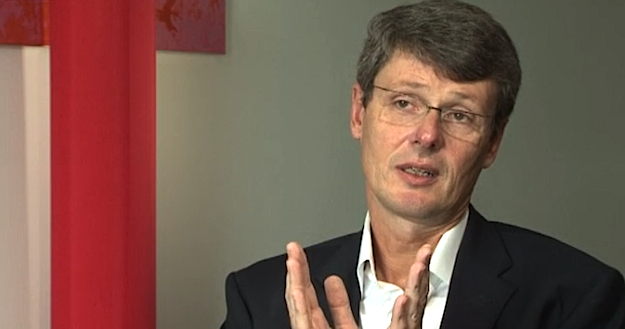
The company is trying to keep itself in the picture though – lest it be completely forgotten by consumers playing with their newly acquired iPhone or Samsung device – with RIM boss Thorsten Heins giving an interview to the BBC this week, offering a glimpse of the new OS while answering a few questions about the company’s current state of affairs.

The demo – given on a Dev Alpha B device similar to the one handed out to developers earlier this year – involves a good deal of touching and swiping, as well as a little bit of ‘blending’ (check out the demo below to learn more), with Heins describing the theme of BB10 as “the integration of various applications into what we in BB10 call the BlackBerry flow…..[so there’ll be no] application grid.”

BB10 is about real-time multi-tasking, Heins said, enabling the user “to live in the multi-taking space,” making it simple to jump between running applications. He also mentioned the BlackBerry Hub, which acts as a kind of notification system that pulls in information from various apps and programs.

Too late?

Heins, it has to be said, didn’t look particularly pleased when Cellan-Jones suggested it was all coming too late, staring straight back at the BBC man with an expression that suggested he was momentarily imagining a scenario involving the interviewer, the Dev Alpha B device and a painful surgical procedure, but overall Heins was cheerful and enthusiastic throughout. And by the way, in response to the accusation that RIM has missed the boat, Heins said, “Don’t underestimate the dynamic this platform is going to create in the market.”

Interestingly, when asked about the recent NY Times article which featured people claiming to be embarrassed about getting their BlackBerry phone out in public, Heins said, “Without going into detail, I would kind of question the sources that were used for that article,” adding that, according to what he sees in markets outside the US, there’s “huge growth and huge commitment to BlackBerry.”

You can check out the interview below.


Source : digitaltrends[dot]com

Sep 1, 2012

Opinion: Apple’s war on Google isn’t just business, it’s personal

Busted droid google apple patent war litigation

Apple’s relentless pursuit of Google has less to do with patents and profits and more to do with personal betrayal – and for that reason, it won’t end until Apple’s pockets are empty.

While watching the coverage of the Apple vs. Google battle, we can easily forget that this fight isn’t about market share or about market dominance. Apple isn’t using litigation to make up for any internal shortcoming or weakness, even though this is how the media often portrays the situation. The lawsuit is about revenge for a deep and personal betrayal. In this battle, similar to the one between Palestine and Israel, the only outcome Apple will accept is the death of Android. And this battle isn’t tactical; no limit to time or money will stop this battle, only Android’s death. In effect, Apple’s founder, Steve Jobs, declared all-out war against Android, and he was the only one who could call it off.

To understand this conflict, you have to understand Steve Jobs and what he believed Google’s founders and CEO did to him.

Steve Jobs

Steve Jobs saw himself as the ultimate manipulator, and he likely was. He was P.T. Barnum, and almost everyone else was a rube. Jobs actually was insecure, and took perceived challenges to his status seriously.

For instance, when Jobs returned to Apple before he was CEO, an internal analyst riding with him in an elevator didn’t show Jobs the respect he felt he deserved. After becoming CEO, Jobs waited to ride in the elevator with that analyst again. He had the analyst fired during the elevator ride so that Jobs could demonstrate his superiority.

Those close to Jobs can tell story after story of seemingly petty acts that were, in hindsight, all designed to preserve Jobs’ self-image – that he was better than everyone else. In Jobs’ mind, he took advantage of others; they didn’t take advantage of him.

So you can imagine that someone taking advantage of Jobs, particularly publicly, would be tantamount to a declaration of war.

Betrayal

Steve Jobs was not known as a people person. If you were to count the number of people he personally helped, you likely could use one hand and have fingers left over. But he clearly took a liking to Google’s founders; he put Google’s CEO on Apple’s board. That was a prestigious position, and one Jobs didn’t appoint lightly.

Given Google domination of search and Jobs’ light understanding of the Web and hosted services, this seemed like a perfect partnership. In Jobs’ mind, no chance existed that the two companies ever would be competitors.

eric schmidt google ceo apple board of directorsBut suddenly they were – while the Google CEO still was on Apple’s board. Jobs was blindsided by people he was helping. He felt they had used their trusted positions to steal his ideas and shoot him in the back (he viewed all Apple ideas as his).

This betrayal happened while Jobs was trying to recover from cancer, and he undoubtedly was off his game. No doubt he felt vulnerable, and that a trusted friend took advantage of him during this time was a particularly low blow.

Now let’s add one final blow: Google gave away the resulting iOS copy for free. In effect, Google went to every Apple competitor and said, “We’ll take our inside knowledge of Apple and help you knock them off the top spot,” which is what Samsung did. So if Android was stabbing Steve Jobs and Apple in the back by stealing Apple’s technology, providing it for free was gleefully twisting the knife.

Apple employee loyalty to Jobs was high, particularly among those in power at the company. The massive betrayal of an iconic leader like Jobs can be, and in this case was, felt by the rank and file within Apple, and his pain translated to most of them.

In short, had Google planned to institutionalize a war with Apple, it could not have been more effective.

Vendetta

Google now has a vendetta, and Samsung is simply a stepping stone. Once upon a time, Samsung was a major Apple supplier, and clearly Apple knew that company someday would be a competitor. But Apple wouldn’t be fond of Samsung creating knock-offs of Apple products. This is likely why Apple is initially hitting Samsung harder than the other licensees, but Apple’s plan is to go after every one of them. Apparently, at least for now, Apple plans solely to compete with Amazon because Amazon ripped off Google, and Apple thinks that is poetic justice. (Amazon took Android, forked it, and made Android its own OS, and is no longer connected to Google).

Apple hired its chief attorney from Intel, the only technology firm of scale that has developed an offensive litigation strategy. Intel litigation is designed to destroy the other side regardless of whether Intel wins or loses. Intel hires the best to assure its success.

Apple isn’t going to stop litigation until it either runs out of a resource (which is unlikely at the moment) or Android is effectively dead. This is a fight to the death. From Apple’s perspective, only the death of Android, the product that represents the craven betrayal of Apple’s founder, is acceptable. Until Apple achieves this goal, Apple is likely to partner with anyone (including Microsoft) to move against Google’s interests until and unless Apple can convince Google to exit this business.

Unless Google exits, the present litigation is only the beginning. This war will continue to escalate. At some point, the costs to Google will exceed any reasonable benefits to the company. The only question is how long that will take.

Guest contributor Rob Enderle is the founder and principal analyst for the Enderle Group, and one of the most frequently quoted tech pundits in the world. Opinion pieces denote the opinions of the author, and do not necessarily represent the views of Digital Trends.


Source : digitaltrends[dot]com