Pages

Showing posts with label reputation. Show all posts

Nov 14, 2012

Honda’s Sport Hybrid system milks more miles – and performance – from a gallon of gas

Honda rediscovers its engineering wizardry with three new remarkable drivetrain technologies.

Honda's 2014 Accord PHEV

Honda built its reputation early on with top-notch engineering and a propensity for going its own way. For the last several years, however, cost cutting coupled with a drive to become a more mainstream auto manufacturer seemed to push Honda away from its ingenious roots. Thankfully, the winds of innovation seem to be blowing strongly again from Honda Headquarters.

Honda has introduced a trio of new Sport Hybrid drivetrain technologies, beginning with small and simple vehicles up to larger all-wheel drive vehicles. Honda is calling these new technologies “Sport Hybrid Intelligent Dual Clutch Drive. If that name seems clunky, remember, Honda is composed of engineering wizards, not wordsmiths.
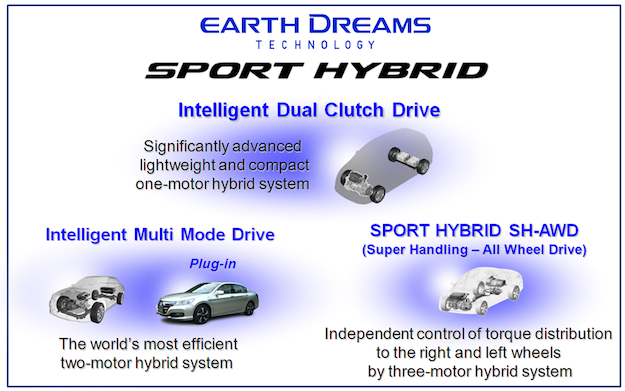
Honda SPORT HYBRID Systems

At the bottom of the range is the One-Motor Sport Hybrid Intelligent Dual Clutch Drive. Designed for small vehicles, the system improves upon efficiency as well as acceleration.It uses a new inline four-cylinder 1.5-liter Atkinson cycle engine, mated to a seven-speed automatic transmission with a built-in electric motor and Lithium-ion battery pack. This arrangement improves efficiency by more than 30 percent over the outgoing version. As one might expect, the system is capable of electric only driving mode (EV) during stop-and-go and low-speed driving.

In the middle – and with an even longer name – is the Two-Motor Sport Hybrid Intelligent Multi Mode Drive/Plug-In. The Two-Motor system follows along the same lines as the One-Motor, improving efficiency and acceleration. This system has been designed with mid-sized vehicles in mind and will be first implemented in the 2014 Honda Accord Plug-In. The Two-Motor system is capable of three drive modes: “EV Drive,” “Engine Drive,” and “Hybrid Drive.” EV Drive is essentially what it sounds like: electric-only driving with energy coming from the on-board battery pack, which is charged at home or at a charging station. Engine Drive is for medium- or high-speed driving and relies on power generated from the gasoline engine, which is directly locked to the front drive axle by a lock-up clutch. Lastly, Hybrid Drive is for stop-and-go driving when the on-board electric power has been depleted and the gas engine is relied on for electricity generation but does not power the wheels.

Last, we have the Three-Motor Sport Hybrid SH-AWD (Super Handling All-Wheel Drive). With the power output of a V8 and the fuel efficiency of a four-cylinder, the Three Motor system is ideal for larger vehicles like the Honda Ridgeline pickup or the Pilot, Honda’s large SUV. The Three-Motor system is powered by a fairly typical 3.5-liter V6, which has been mated to a seven-speed automatic transmission. Here’s where it gets tricky. In the rear of the vehicle are two electric motors, one on each rear wheel. This system allows for either motor to most efficiently deliver torque to its respective wheel, whether it is positive or negative torque. For instance, as a vehicle goes around a corner, the inside wheel spins more slowly, and the outside spins more quickly as it travels a greater distance. The electric motor on the inside of a given corner in the road will capture energy of the slowing inside wheel and transfer it to the outside wheel, requiring less energy to be exerted by the gasoline engine up front.

Personally, we can’t wait for these new technologies to be implemented into future Honda vehicles. In the meantime, however, who said powerful and efficient drivetrain technologies couldn’t make for riveting reading?


Source : digitaltrends[dot]com

Sep 27, 2012

Why are we all so terrified of Google?

Why are we all so terrified of Google

Google’s data-hoarding reputation may be well deserved, but is helping users connect the dots really such a bad thing?

Our story begins in a bar in Amsterdam in the summer of 2001. I was slightly inebriated and a heated conversation with friends turned into a debate on privacy and porn-surfing habits. I can remember being amazed when one of my friends claimed he didn’t surf porn on the Internet because Google might be recording his every perverted move.

He’s not a celebrity. I can’t imagine why anyone would be interested in a list of his porn preferences. Is Google going to use it to blackmail him? Maybe threaten to send his wife a list? Does anyone in the wider world care about his predilection for busty MILFs? (I don’t want to impugn his anonymous honor, so I should point out that’s my predilection, not his.)

More than a decade later, the Web is awash with scaremongering stories about how Google is turning us all into products it sells to advertisers. Our enjoyment of all these ostensibly free Google services, from Gmail to Google Maps to YouTube, must be tempered by the idea that Google is pimping us out behind our backs. What is it that people are so afraid of? What does everyone imagine that Google is going to do with our information?

What does Google record?

At the time I thought it was highly unlikely that Google would keep that kind of information. Turns out I was wrong about the likelihood of Google recording everything. The ability to compile detailed information on browsing habits has been central to its development as an advertising company.

Google compiles information about you from any of its services that you use. That can include Web search history, emails and contacts from Gmail, chat history, Google+ likes and posts, documents accessed in Google Docs, YouTube activity, Blogger and Picasa photos, posts, and comments, information on purchases through Google Wallet and Checkout, Google Voice data on numbers and call duration – the list goes on and on.

data liberation front googleThe search engine giant can keep that information indefinitely. You can find details on what Google does with your data on the Google website. That’s the big question, isn’t it? Google also started the Data Liberation Front so you can find out how to access and move your data in Google products.

What does Google actually do with your information?

There are basically two things Google does with your data:

1) It aggregates large quantities of anonymized data to improve its own and partner’s services

2) It uses your information to serve targeted advertising to you

Aggregated data allows companies to measure trends, analyze what people want, how they behave, and theoretically improve services or tailor them for specific demographics. Concerns generally focus on stereotyping, but companies always use stereotypes to classify consumers, at least with aggregate data from Google they are getting a more reliable picture.

Targeted advertising is about analyzing what you search for and talk about in emails and elsewhere and then trying to serve ads that cover those topics. If you talk about football incessantly then expect to see football-related ads popping up more often. If you consider that you’ll be served with advertising whatever you do, surely targeted advertising is better? At least it might be something you’re actually interested in.

google now privacy dataWith services like Google Now, the company is looking to tie all the information it is learning about you together in order to serve you useful information before you need it. How is that a bad thing?

The company is not behaving altruistically, but it is also not inherently evil simply because it compiles information on you. Google uses the information to improve its services so it can make more money.

The obvious answer for anyone concerned about Google compiling information on them is simply not to use Google services. Good luck finding alternative services that don’t do the same, though.

Why worry about Google specifically?

I have to assume that the panic and vitriol surrounding Google’s data collection is merely because it is the biggest search company around and so many people use its services. Obviously Facebook, Microsoft and many, many other companies are also doing their best to compile detailed data on your online activities.

You also have to consider your ISPs and the government. Whether Google is compiling data on you or not, you can be sure that the ISPs are and governments can easily compel them to hand that data over, although they rarely refuse requests anyway.

The real concern

According to comScore, Google accounted for 66.5 percent of all searches and that amounted to 11.4 billion searches – in April 2012 alone. All that information has to be stored physically somewhere. Huge data centers are storing vast quantities of data, often inefficiently, according to the New York Times. We are struggling to store data as fast as we produce it.

data center google privacyThe carbon footprint of your digital life could be substantial, especially as cloud services really begin to take off. At least Google is aiming for efficient data centers. Still, the amount of electricity being consumed to power these data centers is rising steadily. That NY Times article also includes the claim that “data centers used about 76 billion kilowatt-hours in 2010, or roughly two percent of all electricity used in the country that year, based on an analysis by Jonathan G. Koomey, a research fellow at Stanford University.”

When you consider how much of that data is junk, the whole thing just seems stupid. Royal Pingdom’s annual Internet stat roundup for 2011 revealed that 71 percent of all email worldwide was spam, that 48 hours of YouTube video was uploaded every minute, and that there are well over 100 billion photos on Facebook.

The privacy principle

I understand that privacy is a point of principle for some people. It’s not about what they are doing, which is usually inane and of no interest to anyone; it is about a perceived lack of respect. Our society is packed with double standards on this issue, though. Privacy laws are different from country to country. Are you concerned that the police can take a DNA sample from you, along with fingerprints and photographs, even if you are just arrested on suspicion of a “serious offense?”

Here in Scotland the police can take a DNA swab from you if “a police officer has reasonable grounds to suspect that you are committing, or have committed an offense”. I’m wary of that old argument that if you have nothing to hide you won’t mind giving up your privacy, but Google’s data compilation doesn’t scare me. It doesn’t get much more private than DNA does it? We’re already giving up our privacy in far more worrying ways than online activity.

Google and the rest of the data mining, online advert gang are merely adhering to a long established trade-off, namely that we accept advertising in return for free services. I don’t think it’s a bad deal, and if you’re really concerned about privacy you need to look beyond Google.

[Image credit - Network server room: .shock/Shutterstock]


Source : digitaltrends[dot]com

Aug 18, 2012

The king is dead: Can Samsung slay Apple and steal its crown?

apple store logo samsung lawsuit

As Apple’s reputation for execution falters in the post-Jobs years, Samsung’s ruthless pace could put it ahead, even if customers would ultimately suffer.

Last week when I argued that Apple should win its litigation battle against Samsung to preserve innovation and great products, Samsung fans, behaving like poor copies of their Apple counterparts, pounded me. But these Samsung fans got me thinking about whether Samsung is to Apple what Apple has been to Microsoft for the past decade.

Apple has excelled by taking Microsoft ideas and improving on them. The problem hasn’t been that Microsoft didn’t innovate; the company just didn’t execute. Microsoft manufactured smartphones and even had the idea for the iPhone before Apple did. Microsoft produced MP3 players before Apple had an Apple iPod Touch-like product on the market. They played music and did most of what the iPod Touch did years before the Touch came to market. Even though Microsoft wasn’t the first with tablets, Microsoft tablets were on the market years before the iPad.

Now granted, Microsoft’s PDA was a poor emulation of the Palm Pilot, which came out of the poorly executed Apple Newton. So we could argue about who was really first. But now Samsung is doing to Apple what Apple did to Microsoft and what Microsoft did to Apple with Windows. So is Samsung replacing Apple, just as Apple replaced Microsoft and as Microsoft replaced Apple? OK, now I’m even getting confused. I’m going to argue Samsung is replacing Apple, much as Samsung replaced Sony, and that this is bad for you, the consumer.

Samsung is faster

The consumer electronics market is speeding up. Smartphones in particular have moved quickly to 4G along with larger screens and faster processors. Apple, which once led this market in technology, always had issues, with the latest radios being late to both 3G and 4G. More recently, Apple has fallen behind in screen size. Even if the iPhone is 4 inches, the market appears to have already moved to 4.5 inches, placing Apple behind.

These diagramsis link clearly illustrate that Samsung copied Apple. But you can also see Samsung improved on Apple’s hardware designs. Samsung appears to be on the cutting edge of these changes far more often than Apple is (the Galaxy S III often ranks higher than the iPhone 4S in the market). This suggests Apple is having trouble keeping up, and Samsung, not Apple, is increasingly driving the high-profile markets they share (with the clear exceptions of iPods and PCs).

Consider the Galaxy Note that we reviewed earlier this week. In many useful ways it is superior to the iPad. Granted, the Galaxy Note lacks the sheer eye candy of a Retina screen, but in terms of being a useful product, the Note feels like a better execution than the iPad 2.

Whether you agree with this assessment of the Galaxy Note, you have to agree that Samsung is cycling its products quicker and thus improving them faster than Apple does, which should result in a sustainable execution advantage. Given this is how Samsung beat Sony, one can easily conclude that, using the same strategy, Samsung may be poised to beat Apple.

Apple slide

Besides Samsung’s speed advantages, there are early indications that Apple is getting weaker. I’m seeing reports out of the Apple stores that satisfaction is dropping as Jobs’ policies of focusing staff on customer satisfaction are replaced by policies focusing staff on sales (and Apple has had a history of underpaying staff). On top of this, the stores appear to be downsizing staff significantly. For the first time, I’m hearing stories of sales experiences similar to those in traditional stores, in which Apple sales reps ambush folks walking in and appear to be operating on commissions now and want to close sales.

samsung galaxy tab 10.1 noteOn the product side, the product-refresh cycle has clearly slowed down. The expected iPhone launch (traditionally in June) has apparently slipped until September, the Mac refresh was very late, and unless something happens quickly, even the fourth-quarter refresh of the iPods (generally in August) will be late. Word out of Apple suggests postponed decisions, missed deadlines, and an increase in secrets leaking out of the company, all of which points to Apple having difficulty executing.

With Samsung increasing its level of execution and Apple falling off, one has the potential to replace the other, but the customer gets screwed.

Why you, the customer, are still screwed in a Samsung world

The issue comes back to customer satisfaction. Even with Apple’s apparent decline in execution, the company maintains by far the highest customer satisfaction and loyalty scores in the industry (they have dropped a lot of late, though). Samsung, on the other hand, sucks (the link is to Net Promoter Scores, which showcase both satisfaction and customer loyalty). I’ve personally bought a number of Samsung products, and the company’s service and support organization is truly horrid, particularly compared to Apple’s.

Customer satisfaction speaks to whether we are happy with what we purchase. Samsung’s scores suggest that if Samsung wins, consumers as a group will be less happy than they are now. Unless Samsung improves the way it treats customers, I can’t support that company replacing Apple at the top of the pile.

Guest contributor Rob Enderle is the founder and principal analyst for the Enderle Group, and one of the most frequently quoted tech pundits in the world. Opinion pieces denote the opinions of the author, and do not necessarily represent the views of Digital Trends.

[Image credit: Apple Store Songquan Deng / Shutterstock]


Source : digitaltrends[dot]com