Pages

Showing posts with label technologies. Show all posts

Nov 14, 2012

Honda’s Sport Hybrid system milks more miles – and performance – from a gallon of gas

Honda rediscovers its engineering wizardry with three new remarkable drivetrain technologies.

Honda's 2014 Accord PHEV

Honda built its reputation early on with top-notch engineering and a propensity for going its own way. For the last several years, however, cost cutting coupled with a drive to become a more mainstream auto manufacturer seemed to push Honda away from its ingenious roots. Thankfully, the winds of innovation seem to be blowing strongly again from Honda Headquarters.

Honda has introduced a trio of new Sport Hybrid drivetrain technologies, beginning with small and simple vehicles up to larger all-wheel drive vehicles. Honda is calling these new technologies “Sport Hybrid Intelligent Dual Clutch Drive. If that name seems clunky, remember, Honda is composed of engineering wizards, not wordsmiths.
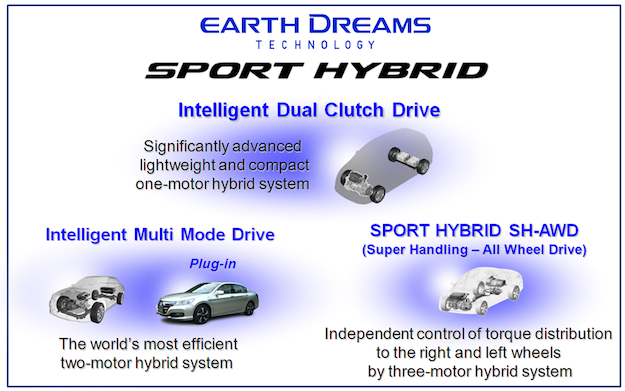
Honda SPORT HYBRID Systems

At the bottom of the range is the One-Motor Sport Hybrid Intelligent Dual Clutch Drive. Designed for small vehicles, the system improves upon efficiency as well as acceleration.It uses a new inline four-cylinder 1.5-liter Atkinson cycle engine, mated to a seven-speed automatic transmission with a built-in electric motor and Lithium-ion battery pack. This arrangement improves efficiency by more than 30 percent over the outgoing version. As one might expect, the system is capable of electric only driving mode (EV) during stop-and-go and low-speed driving.

In the middle – and with an even longer name – is the Two-Motor Sport Hybrid Intelligent Multi Mode Drive/Plug-In. The Two-Motor system follows along the same lines as the One-Motor, improving efficiency and acceleration. This system has been designed with mid-sized vehicles in mind and will be first implemented in the 2014 Honda Accord Plug-In. The Two-Motor system is capable of three drive modes: “EV Drive,” “Engine Drive,” and “Hybrid Drive.” EV Drive is essentially what it sounds like: electric-only driving with energy coming from the on-board battery pack, which is charged at home or at a charging station. Engine Drive is for medium- or high-speed driving and relies on power generated from the gasoline engine, which is directly locked to the front drive axle by a lock-up clutch. Lastly, Hybrid Drive is for stop-and-go driving when the on-board electric power has been depleted and the gas engine is relied on for electricity generation but does not power the wheels.

Last, we have the Three-Motor Sport Hybrid SH-AWD (Super Handling All-Wheel Drive). With the power output of a V8 and the fuel efficiency of a four-cylinder, the Three Motor system is ideal for larger vehicles like the Honda Ridgeline pickup or the Pilot, Honda’s large SUV. The Three-Motor system is powered by a fairly typical 3.5-liter V6, which has been mated to a seven-speed automatic transmission. Here’s where it gets tricky. In the rear of the vehicle are two electric motors, one on each rear wheel. This system allows for either motor to most efficiently deliver torque to its respective wheel, whether it is positive or negative torque. For instance, as a vehicle goes around a corner, the inside wheel spins more slowly, and the outside spins more quickly as it travels a greater distance. The electric motor on the inside of a given corner in the road will capture energy of the slowing inside wheel and transfer it to the outside wheel, requiring less energy to be exerted by the gasoline engine up front.

Personally, we can’t wait for these new technologies to be implemented into future Honda vehicles. In the meantime, however, who said powerful and efficient drivetrain technologies couldn’t make for riveting reading?


Source : digitaltrends[dot]com

Oct 16, 2012

Best 25 Mobile Apps in Academia

Smartphones and other mobile technologies are undoubtedly playing a very big role in today’s classroom, in Schools and colleges especially when it comes to the best apps to get teachers organized and make students learning easier. From Dropbox to Documents to Go, Lab Guru, Wikipedia and Evernote, these are just a few of the mobille apps in academia, we have only lited the first five here:

  • DropboxDropbox is a free service that lets you bring your photos, docs, and videos anywhere and share them easily. With Dropbox, you’ll have no need to email yourself a file again, all thanks to the wonderful cloud computing, with Dropbox, University professors can now be able to access their files from other devices they’ve connected to their personal networks.
  • Documents To Go:This is another useful app that is available for almost all smartphone and PDA platforms, This App offers up the full suite of Microsoft Office programs, it enables you to view native Microsoft Word, Excel and PowerPoint files & attachments, supported file formats include .doc,. docx,. xls,. xlsx,. ppt,. pptx.
  • Lab Guru:This is a web based research and management system, it enables you to Plan your experiments and track your research progress, Manage biological and molecular collections, as well as retrieve your lab’s research history.
  • Attendance:As the name implies this is used to assist Educators with iDevices to keep track of which students attended which classes and when those classes were attended.
  • Evernote:Evernote helps you remember and act upon ideas, projects and experiences across all the computers, phones and tablets you use. For a student or Lecturer, this app helps you sort your digital files into scrapbooks and make sure all necessary materials sit in the proper place.you can head over to Online Universities for a complete list of the best 25 Mobile Apps in Academia and we hope you’ll find them interesting

Report an error

No tags for this post.
Source : techtalkafrica[dot]com

Sep 22, 2012

Has 4G become meaningless?

4G meaningless smartphones data carriers lte

A cesspool of acronyms, overoptimistic marketing claims and incompatible technologies has made 4G incomprehensible to the average consumer. Now carriers will suffer for the mess they’ve created.

Recently, the investment firm Piper Jaffray conducted a study that found a full 47 percent of U.S. consumers don’t feel the need for 4G. This isn’t good news for the carriers, which have been fiercely touting their 4G networks for a few years now. Almost all new smartphones have some kind of 4G connectivity, including the new iPhone, at long last.

Part of consumers’ apathy over 4G might come from their inability to understand the difference between different flavors of it. The same survey found that 51 percent of consumers said that all 4G networks are the same. Not only can’t they name which is best,

That’s bad news for an industry as competitive as wireless communication, with recent marketing campaigns based upon name calling as a means of brand differentiation. With carriers betting ever more heavily upon data tiers as a main revenue stream, what can carriers do about consumers who don’t seem to understand their services?

How to be 4G

Confusion is the name of the game, and the carriers haven’t helped explain to consumers the benefits of 4G. Commercial mobile technologies are standardized by a complex number of bodies such as the ITU (International Telecommunication Union), the 3GGP (3rd Generation Partnership Project), and the IEEE (Institute of Electrical and Electronics Engineers). Still reading? Good. They are tasked with bickering until they set a strict, definite standard for each iteration.

These powers that be hold conferences, conduct studies, and perform secret ritual sacrifices in order to define what it each G – or generation – actually means. 4G is, of course the next numerical step, but the powers stumbled when it came to defining what that actually meant.

Strange encounters of the fourth generation

The 4G war got off to a specular fail from a marketing standpoint. There were many, vastly different technologies all vying for subscribers.

Sprint tried to get the ball rolling with WiMAX in 2008, a technology descended from the same tech in your Wi-Fi router. It was branded 4G, though real-life speeds were often more equivalent to a particularly fast 3G device. This was promising, but Sprint eventually declared the technology dead and migrated to LTE (Long Term Evolution, if you were curious). One down.

T-Mobile further muddied the waters with an upgrade to HSPA+, which is technically more like 3.5G, but which has been branded 4G.

AT&T had a wide, but much decried 3G network (partly blamed on iPhone exclusivity for years). While AT&T deploys its 4G LTE network nationwide, it’s also making things needlessly confusing by offering HSPA+ alongside, and branding it 4G just like T-Mobile. If you have an AT&T iPhone 4S, you might see a 4G logo appear sometimes, but it’s not the “true” 4G LTE you would get by upgrading to an iPhone 5.

Verizon launched a 4G LTE network in late 2010 – in its truest sense – it fulfilled the 4G guidelines.

Simple, right?

Setting low bars

No. Not simple, at all. Once the carriers got to building their new networks, the powers that be decided to change the definition of 4G. They lowered the minimum speed guidelines, so that carriers wouldn’t have to do too much heavy lifting, meaning that 4G networks would not be as revolutionary as they had first planned. Hence the bickering over “true” 4G. On top of that, building 4G networks gave carriers a chance to improve their existing networks with beefier backhaul – the connections that tie cell towers back to the backbone of the Internet. This greatly improved 3G speeds and availability, closing the gap between 3G and 4G.

cell tower 4g data speedsIt’s not surprising that the average consumer doesn’t care about 4G when they don’t get it, and 3G networks are progressively getting better. Coverage matters more than speed to many people — a souped-up network means squat if there isn’t a tower in your area.

The consumers don’t care

With so many different carrier definitions of 4G, and even an official designation that’s a moving target, it’s hardly surprising that people are confused. So what can the carriers do?

Agree on a standard speed definition. This is probably impossible, because the telecom industry is notorious for talking at, rather than with each other. But setting a baseline speed for 4G would at least let customers know what they’re being promised.

Stop slapping 4G on everything. This is really aimed at AT&T and T-Mobile, which are allowed to brand older HSPA+ 3G tech as 4G due to a magical shift in definitions back in 2010. While this is legal, it confuses people to a point where they don’t care.

Stop lying about speeds. Advertised speeds are not the same as real world speeds. T-Mobile might advertise 42mbps, but that’s the theoretical limit. That doesn’t look so rosy when you’re getting 45kbps downloads. Averages work much better, and leave less room for error.

Change phone branding conventions. While some handset-makers are responsible for this, it isn’t in a carrier’s best interest to have a phone named after wireless services. For example: The HTC EVO 4G LTE. Not the easiest name to understand. This particular model caused a friend to ask “What is a 4G?” as if it were some kind of new device. Apple keeps it simple with 3, 4s, 5 and so on. Heck, even Samsung does with its flagship line of Galaxy phones (S2, S3). I wonder where that inspiration came from?

Conclusion

The carriers have themselves to blame for the consumer confusion they’re currently stewing in. Unexplained acronyms, incompatible networks, technologies that vanish as soon as they’ve appeared – it’s as if they’re running Area 51, not voice and data networks. Carriers have the leverage to make the average consumer more interested in 4G, but it’s all up to them.

More speed is nice, but most of us would just settle for better reception. After all, if a guy with a mohawk can put a robot on Mars with less cash than it took to put on the Olympics, why can’t I have cell reception in an elevator?


Source : digitaltrends[dot]com

Aug 20, 2012

OnLive acquired by Lauder Partners, but who will own the streaming video game company in the future?

onlive microsoft

OnLive's new owner Lauder Partners has a history of investing in streaming technologies, but will it hold on to the troubled gaming company?

OnLive is dead, long live OnLive. Or at least live a little longer than previously expected. The world’s first full cloud-based streaming video game business isn’t closing shop completely, just as corporate communications director Brain Jaquet said on Friday. Rumors that the entire OnLive staff was laid off on Friday as an anonymous investor with “substantial funding” took ownership of the company and its assets also turned out to be true though.

Who is OnLive’s new master? GamesIndustry International reported on Monday that Lauder Partners, one of the initial investors that backed OnLive during its second round of fund raising in 2009, has taken control of the company.

The news clarifies just who lost their jobs and who made the transition to the new corporate structure of OnLive in the wake of its dissolution as a private entity. Reports from Kotaku and Joystiq are corroborated by an official statement.

“Almost half of OnLive’s staff were offered employment at their current salaries in the new company immediately upon the transfer, and the non-hired staff will be given offers to do consulting in return for options in the new company. Upon closing additional funding, the company plans to hire more staff, both former OnLive employees as well as new employees.”

The stock deal for former employees does not extend to OnLive’s founder and CEO Steve Perlman. “Like all shareholders, neither Steve nor any of his companies received any stock in the new company or compensation in this transaction at all. Steve is receiving no compensation whatsoever and most execs are receiving reduced compensation to allow the company to hire as many employees as possible within the current budget.”

Anonymous sources from within OnLive said that it was Perlman’s mismanagement and refusal to sell his company to interested bidders that caused it to implode this month.

Lauder Partners has invested heavily in streaming technologies over the past three years. Following its investment in OnLive in 2009, the LLC has backed local television streaming service Aereo, as well as Smart TV software makers Flingo and TrickPlay.

Lauder isn’t likely to maintain full ownership of OnLive. The transition period will entail streamlining OnLive’s business beyond mere staff cuts, establishing firm content deals like the service’s agreement with Ouya’s Boxer8, and hunting for a new buyer. OnLive competitor Gaikai was purchased by Sony earlier this year, the first shots fired in the new streaming battlefield for video game console makers. Priority one for Lauder will be polishing OnLive until it shines and selling it to the highest bidder.


Source : digitaltrends[dot]com

No more secrets: How technology is making honesty the only policy

security camera header privacy honesty

Sorry, Pinocchio. Pervasive new technologies will make lying or even bending the truth impossible, ushering in an age of “extreme truth” that you may want to embrace before it arrives.

My friends Don Pepper and Martha Rogers just wrote a book called Extreme Trust: Honesty As a Competitive Advantage. The ideas inside it are going to change your life. Their basic premise is that:

Lots of traditional, widely accepted, and perfectly legal business practices just can’t be trusted by customers, and will soon become extinct, driven to dust by rising levels of transparency.

By transparency, they mean that, for example, every interaction through a digital device leaves a record that can later be searched, cross-referenced, duplicated and potentially shared.

This means you leave a trail every time you make a phone call, use an app, visit a website, open a door with a security card, get money from an ATM, text someone, use an EZ Pass-like device to pay a toll, or leave a parking garage.

This, of course, is just the tip of the iceberg. Digital cameras are everywhere. By one account, Great Britain has almost 4 million permanently mounted security cameras. Smartphones now come with one or two cameras, which means if anything of interest happens anywhere in the world, the odds are someone will record it.

The Looxcie wearable camcorder sits on your ear and records everything that happens in front of you. When something interesting happens, you press a button and save the last 30 seconds.

If Google and others have their way, smartglasses will soon be on the market. These will likely expand significantly the number of events that get recorded automatically.

Nowhere to hide

Social media allows us to share information. If a party is lame, you can warn away friends. If a company screws you, 900 of your close and personal online friends will hear the details.

It used to be that if you drove across town to spend $10 on a movie, there was no record of your actions. Today, there might be 100 data points showing your progress across town and back.

social media button sharing transparencyLike it or not, our lives are being documented and archived, which leaves less and less room for the old-fashioned ways of fudging the truth.

For example, there are businesses that charge you, say, $10 a month for a service. Being busy, you might forget about the service, stop using it entirely, and still get charged $10 a day for years on end. Don and Martha say that’s not right, that companies can see when you stop using a service and they have a self-interest in pointing this out to you.

Their advice is simple and powerful:

1. Do things right.

2. Do the right thing.

3. Proactively.

Let’s consider how this might apply to your life. If you’re a student, you might “forget” to mention a bad grade to your parents, unless they specifically ask, “How did you do on your geography test of April 8?” But with online tools such as Blackboard prevalent, and your friends and your friends’ parents exchanging stories online, the odds are pretty high you will eventually convince your parents that you aren’t trustworthy.

Now imagine that you have a job and your employer decides to implement a quantified approach to your office, meaning that your supervisors now track how long you leave the building at lunch, how many times you say something positive versus negative in meetings, how many suggestions you make each year for improving workflow, and 29 other metrics.

Here’s the problem: Most of us don’t look so good when we quantify our lives. We exercise less than we think, and eat more. We spend more time thinking about work than working hard. We probably have a higher opinion of ourselves than is warranted.

My intention isn’t to depress you. To the contrary, I want to motivate you to take Don and Martha’s advice to heart. Do things right. Do the right thing. Proactively.

No matter how closely starts to quantify everything you do, you will be ahead of the pack. Why? Because most people aren’t going to realize that extreme truth has become the new normal until it is too late.

Near the end of their book, the authors include this passage:

Transparency is like a disinfectant for business. It will purify things and help start the healing, but it’s going to sting like hell.

They’re writing about companies, but if you substitute “our lives” for the word “business,” you get the idea.

This weekend, we had some friends over and I listened as my wife recalled some of the decisions we made 10 or 12 years ago: why we decided to move, how we found our new house, etc. On nearly every subject, I thought: That’s not what actually happened.

Human beings are used to living with perceptions of facts, not facts themselves. But in the coming months and years, that’s all going to change. Get ready for extreme truth, because it’s coming fast.

Bruce Kasanoff is a speaker, author and innovation strategist who tracks sensor-driven innovation at Sense of the Future. Kasanoff and co-author Michael Hinshaw teamed up to explore more of the opportunities unearthed by disruptive forces in Smart Customers, Stupid Companies.

[Image credits: Surveillance camera alphaspirit/Shutterstock; Social media button: Lasse Kristensen/Shutterstock]


Source : digitaltrends[dot]com