The online ad market is growing by leaps and bounds, according a new report that predicts it to reach $143 billion worldwide in the next five years.
International spending on Internet advertising is expected to rise by almost 50 percent over the next five years, according to a new report from a team of analysts tracking the global online ad market. The report, issued today by research and analytics firm Digital TV Research and entitled Online Advertising Forecasts, predicts that ad spending online will reach $143 billion dollars in 2017.
That figure is a significant rise over the anticipated figure for 2012 – $92 billion – and more than double the amount spent on Internet advertising just two years ago, which amounted to $66 billion. According to Digital TV Research, what’s driving the increased rate of growth is the changing demographics of the Internet itself; simply, the more people that get online, the more important online advertising will become. Specifically, the report says, the growth of broadband Internet worldwide plays an important role: By 2017, the number of homes expected to have broadband Internet access is estimated at 745 million across 40 countries (The report covers only 40 countries), which represents almost half (49.2 percent) of total households in those countries. In comparison, those figures for 2010 were 473 million, or 33.5 percent of total households.
The report goes on to estimate that, despite the overall leap in spending, individual cost-per-household won’t dramatically increase; author Simon Murray suggests that it may rise as little as $26 per broadband household, from 2010′s $139 per household to somewhere in the region of $165 per household.
Overall, America will continue to lead the way in Internet ad spending. Its ad spending is expected to increase by more than double by 2017, from the 2010 figure of $26 billion to $58 billion in five years’ time; overall, however, its share of the international online advertising revenue pie is anticipated to stay the same between the two periods, at 40 percent. The United Kingdom is also expected to remain in second place in the global spend table when it comes to online advertising, with its spending reaching an estimated $11.7 billion by 2017. China is expected to overtake Japan for third place at some point in 2014, with its ad revenues projected to grow from the 2010 figure of $2,600 million to $10,808 in 2017.
These figures, however, only tell part of the story – As Digital TV Research admits, the report offers numbers “for advertising expenditure via fixed broadband, and therefore do[es] not include mobile advertising.” That may skew thinking, as mobile ad spending is itself is growing significantly. Estimates from eMarketer earlier this year projected US mobile ad spending to almost double in 2012 compared with 2011 ($2.4 billion compared with $1.23 billion in the previous year), with the trend expected to continue as smartphones become more and more accepted as “the norm” by the mass market of users. Admittedly, $2.4 billion is a long way down from $92 billion, but nonetheless: An almost 100 percent increase year-on-year? That’s got to be worth paying attention to.
In recent years, purchasing an Internet domain and launching a website have become incredibly easy and affordable, even for people who aren’t computer experts. With just a few clicks, anyone can reserve a URL and purchase hosting for their site; this is usually inexpensive, particularly for savvy shoppers who take advantage of a godaddy promo code or other discount during checkout.
Despite this, some parts of the domain registration process, including decisions about domain privacy, may still seem a little mysterious to neophytes. This article explains the distinction between free privacy options and premium “who is” privacy controls sold by firms such as GoDaddy.com.
Domain registrars are legally obligated to collect personal information about their customers, and to make that information publicly available in databases called “WHOIS” directories. Many people, however, are reluctant to provide this information due to concerns that it will be harvested by identity thieves, scammers and other unscrupulous individuals. Consequently, many prefer to pay an extra fee for “private registration”, by which their chosen domain registrar is given legal ownership of the domain. It is therefore the registrar’s information that’s listed in the WHOIS directory, rather than details about the individual controlling the domain.
Paid domain privacy options usually cost around $10 per year; many companies offer discounts to customers who purchase privacy for several years at a time. Others waive the fee entirely if the customer also purchases or transfers several domains at once. There are also free domain privacy services that claim to provide similar protection, and many people are confused about which type of privacy protection is right for them.
There is no single answer. Do a little research and try to answer this question: does the company providing the privacy protection sell its customers’ contact information to other organizations? Many people are horrified to learn that domain privacy providers list their own information on a site’s WHOIS record, but will sell their clients’ REAL information to other businesses!
Remember that domain privacy firms DO collect your personal information because they’re legally required to do so; however, they are NOT obligated to divulge this information unless compelled by a court order. Some companies are fiercely protective of their customers’ privacy, but others will divulge the true WHOIS information with only a little outside pressure. Investigating this will help you choose wisely.
It’s important to understand that there are also several “do-it-yourself” privacy options for domain owners who don’t want to pay for a private WHOIS listing. Individuals concerned about releasing their name and home address may elect to rent a P.O. Box and register their domains using that contact information. The WHOIS database lists a contact email address for each domain owner; many don’t wish to reveal this information because they don’t want to offer their email up to potential spammers and phishers. The solution to this is simple; set up a separate email address for the WHOIS listing. You can even have the incoming messages forwarded to your regular email inbox, eliminating the need to log into multiple accounts every day.
BIO:Daria Cortese is a freelance writer and technology enthusiast who lives near Philadelphia with her husband and five cats.
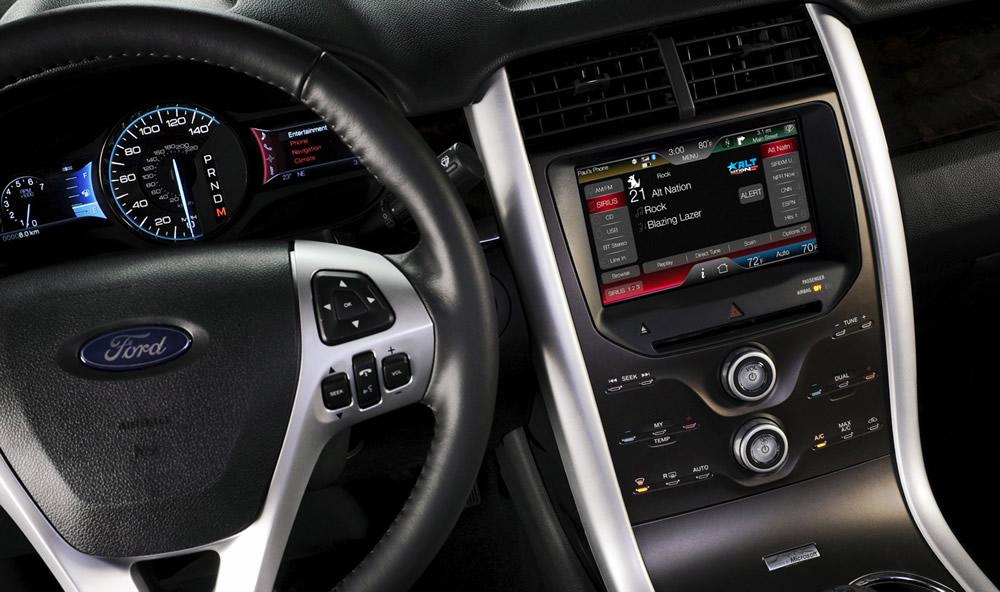
Despite some criticism over complicated controls, Ford's Sync infotainment systems is selling well five years after its debut.
It’s been five years since Ford and Microsoft launched the Sync in-car infotainment system and, despite getting its share of criticism, the system has made it into five million Ford and Lincoln vehicles.
Sync debuted at the Consumer Electronics Show (CES) in 2007, and one was one of the first systems to allow drivers to sync (get it) their smart phones and other devices with their car’s systems. It allows drivers to make hands-free phone calls, read text messages, and give turn-by-turn directions, even on cars that don’t have a built-in navigation system.
A lot has changed in five years, though. The original Sync only used physical buttons but newer versions (usually paired with Ford’s MyFord Touch and MyLincoln Touch) have touch screens and voice recognition. Like other car companies, Ford has tried to eliminate buttons on its infotainment systems, and to integrate other functions like climate control, audio, and navigation, into one interface that reminds drivers of their tablets and phones.
MyFord Touch also added functions such as music and video streaming, and a voice-activated climate control system that maintains an interior temperature set by the driver. It can also use a smart phone to access the Internet via a USB connection.
The addition of MyFord Touch’s touch screen may not have been a good thing, though. The original Sync got fairly positive reviews, but MyFord Touch has been consistently criticized. Testers have complained that MyFord Touch is too complicated, that the controls don’t respond promptly or are too hard to read, and that the whole package can easily distract drivers.
Ford launched “MyFord Touch 2.0” to correct some of the problems. A software update streamlined some of the menus and tried to make the touch screen and voice recognition controls more responsive.
Consumer Reports said the system “stinks,” and would not wish it on an enemy. Despite the recent upgrades to MyFord Touch’s software, the magazine said its fundamental design was flawed.
While Ford advertises the combined infotainment system as “Sync with MyFord Touch,” only the basic Sync platform was developed by Microsoft, with Ford adding other functions to it to create MyFord Touch.
Glitches aside, five million sales is an impressive tally for the original Sync. Despite MyFord Touch’s deleterious effect on Ford’s ratings in initial quality surveys and other tests, this infotainment system remains popular.
Sync is compatible with both iOS and Android, and is available on most 2013 Ford and Lincoln models.
Obama has four more years in the White House, but what will his policies mean for the future of the tech we use every day?
A couple of years ago, President Obama was having dinner with Silicon Valley movers and shakers, including an ailing Steve Jobs. Although no recording of the dinner has been made available, legend has it that the President asked Jobs what it would take for Apple’s manufacturing jobs to come back to America.
“Those jobs aren’t coming back,” replied Jobs.
Whether that is true or not, during the campaign both President Obama and Governor Romney focused a lot of their energies on plans to bring that kind of manufacturing back to American shores. Now that the president has won a second term, what does that mean for American technology and manufacturing?
Mr. Obama’s plan was built on education and training, investing in clean energy, and giving tax incentives to companies that bring jobs back to America.
Jobs’ grim reply was based on the fact that American workers are no longer trained for the needs of high-tech manufacturing. Obama believes that making college more accessible, both at the university and community college level, is part of the solution for closing that skills gap.
A major focus during Obama’s first term was keeping tuition rates down, doubling funding for Pell Grants, and trying to get community colleges to work together with local employers to better train outgoing students for jobs that already exist locally. There’s every reason to believe that push will continue.
Another creative idea from the campaign trail was the creation of “manufacturing innovation institutes,” where businesses and research institutions work together to make sure that American research and development produces corresponding high-tech manufacturing jobs. How the federal government can spur that idea remains to be seen, but it could be a key step in reshaping the American manufacturing sector and making sure the next Apple keeps its assembly lines here at home.
During the campaign, Obama predictably hit Governor Romney on the Republican Party’s close ties with the oil industry. In his first term, the president advocated an “all of the above” energy policy. He’s willing to explore any source, including oil, which can help America reach a majority of energy independence by 2035. It is now expected that investment in alternative energy technologies will only continue in the next four years.
During his first term, President Obama pushed ahead with plans to double fuel economy standards for cars and light trucks by 2025, which is spurring the auto industry’s investments in hybrid and electric vehicles and has led to an American manufacturing boom of sorts in battery technology. Since these rules are now under no threat of repeal, cars and light trucks are expected to sip less and less gas in the next four years. Horsepower may be a different story.
One of the places where we heard repeats of 2008’s campaign pledges was in the area of corporate tax structure. The president promised to end tax breaks for companies that participate in outsourcing during his first term and promised to do the same in his second term (which you can assume to mean that the first effort didn’t go so well).
He also wants to provide tax incentives for companies to bring jobs back to the US. Considering Apple currently enjoys a 1.9 percent tax rate on its foreign earnings, I’m not sure how much of an incentive the US government can provide. Perhaps they will mandate that all federal employees will have to buy an iPad Mini. At least all of our forest rangers will have something to do while they’re stuck in those fire towers.
Any conversation about tax policy centers on Congress. In the coming days, it will be interesting to see if our Republican House makes any overtures of bipartisanship to the president now that they know they are stuck with him for another four years. If history is any indication, don’t hold your breath. There’s probably better chance of an impeachment investigation than bipartisan tax reform.
Whatever the case, many pundits believe that the president will be bolder in his second term, enacting whatever policies he can without congressional approval if Congress proves to be as intransigent as they have been in the past. A lot of the policies mentioned above came to pass through that same kind of executive maneuvering. Because of that, the next four years of America’s technology and education policy might be just as much decided in courtrooms as in the Oval Office.
Pity poor Hotmail, finally ousted from worldwide email service control by Google's Gmail after eight years of competition.
Sorry, Microsoft: The rein of Hotmail is finally over, with the long-lived email service finally being knocked off of the top spot when it comes to the most-used email service on the Internet last month by Google’s Gmail offering.
Originally launched on July 4 1996 as one of the first web-based email services – Its launch was tied to American Independence Day, as the service promoted itself as offering users “freedom” from ISP-based email and email addresses - Hotmail was purchased a year later by Microsoft for an estimated $400 million, and rebranded as MSN Hotmail (Later becoming “Windows Live Hotmail” in 2006/2007). Despite becoming the butt of many online jokes for its ubiquitous quality and age, Hotmail has been continually revised, upgraded and refined by Microsoft, with the company even going so far as to introduce an “all-new” update a year ago that mimicked many of the features that won users over to Google.
That, sadly, wasn’t enough to allow the service to maintain user dominance. According to a ComScore report for October – first made public by GigaOm – Gmail usage finally rose above that of Hotmail last month worldwide. This isn’t the first time that this shift has been reported; Google quietly boasted about it happening way back in June of this year, in the middle of a blog post about cloud computing when it announced that it had “more than 425 million active users globally.” However, ComScore disagreed with that number more than a little, claiming at the time that it only had 289 million users active worldwide. ComScore Vice President Andrew Lipsman explained the discrepancy by saying that “there are going to be some users that are left out” of its calculations, as it only tracks home and business use, meaning that Internet access via smartphone or other mobile device, or Internet cafe access, would be missing from their figures (Google, when asked about the difference in estimates, commented that it doesn’t comment on third-party numbers).
Now, however, it appears to be official: Gmail is the king of web-based email services even by third-party metrics. This, apparently, is down to a fall in email provider numbers overall, with Gmail’s simply seeing less attrition than either Hotmail or Yahoo and coming out stronger as a result (It’s perhaps worth noting that Microsoft introduced Outlook.com as its Hotmail replacement in July; I wonder whether adding Outlook and Hotmail users together for October would provide Microsoft with overall control of the market?).
It’s less of a contest when it comes to American email service use, and more of a surprise who wins that particular battle: Yahoo, which has 40.8 percent of the US market, compared with Gmail’s 36.7 percent, or to put that in real numbers, a 7 million user difference between the two (Hotmail languished in far third place, with 18.9 percent of the US market).
After years of undercutting physical booksellers with cheaper titles and greater selection, Amazon is facing trouble placing the books it publishes in stores in the real world.
With its continuing growth in areas outside of its original core business of selling books online – Amazon has, this year, announced the formation of its own videogame studio and is rumored to be getting into the wine business, in addition to its already existing movie production house, digital publishing house, electronics, clothing and grocery stores and “Pinzon” label household products – you’d be forgiven for thinking that everything was coming up Amazon these days. And, while that may be true in the virtual world, the Seattle, Washington company is said to be facing unexpected trouble in another of its satellite business ventures in a way that may make you wonder whether or not there really is such a thing as karma.
The New York Times reported yesterday that booksellers are refusing to handle The 4-Hour Chef, the new book from self-help guru Timothy Ferriss that just so happens to be the first product of his deal with Amazon’s publishing arm. Despite Ferriss’ proven track record in book sales – His first book, The 4-Hour Workweek sold almost half a million copies in its original edition, according to Neilsen BookScan figures, with the sequel The 4-Hour Body reaching similar sales heights (Both made it onto the New York Times’ non-fiction Bestseller list) – booksellers from independent one-store outlets to competitive chains like Barnes & Noble will not be stocking Chef, citing Amazon’s involvement as the reason why.
“We don’t think it’s in our best interests to do business with Amazon,” said Bill Petrocelli, co-owner of Book Passage, a store in Marin County, CA. Michael Tucker, owner of the Books Inc. chain agrees. “At a certain point, you have to decide how far you want to nail your own coffin shut,” he explained. “Amazon wants to completely control the entire book trade. You’re crazy if you want to play that game with them.” (Books Inc. will special order the title for any customer who asks, however.) Barnes & Noble, one of Amazon’s largest competitors in both the book trade and digital reader business, agrees, and has made it clear that it won’t be stocking Amazon product, with Walmart and Target both only carrying the title in their online stores.
There’s also ill-feeling from stores towards Ferriss for signing with Amazon in the first place. “[Previous publisher] Crown put in a lot of effort to promote [Ferriss' first two] books,” Petrocelli pointed out, adding that Ferriss “decided to walk away. That’s his decision to make but I can’t say I applaud it. I think writers should be supportive of publishers that are supportive of them.”
Not all bookstores are boycotting the book. San Francisco’s Green Apple will stock it, although store buyer Kevin Ryan said that the store won’t be “go[ing] out of our way to promote something from Amazon. We’re not going to stretch.”
For his part, Ferriss seemed prepared for this kind of response. He told the NYT “By signing with Amazon, I expected this type of blowback.” Saying that he’s “griding [his] loins” in preparation, he added “I don’t feel like I’m giving anything up, financially or otherwise” with his new deal. Time will tell if that continues to be the case when The 4-Hour Chef is released on November 20.
The smartphone photo sharing app Instragram was an instant hit when it debuted in 2010. Now, two years later, the app has quickly become the most popular way that phone users share pictures, and may soon become the most popular means to share photos in any way.
When Superstorm Sandy hit the East Coast last week, many people reached for their phones to document the aftermath. Most of them, it seems, used Instagram to snap the photo.
“Sandy was a really interesting event for us,” Systrom said at the Nov. 5 GigaOM conference in San Francisco. “Sandy was the single largest event captured on Instagram — and the largest event captured on cellphones ever.”
According to Systrom, nearly one million Instagram photos were uploaded with the hashtag #Sandy.
That means Instagram is much more than just a way to show off to your friends. Users, Systrom says, are now updating their accounts to document important events like Sandy in what amounts to participation in the event. Instead of passive documentation, Instagram users are communicating with photos and making their Instagram experience more than just about consumption.
That conversation with photos is also about to get even easier, as the smartphone-based app expands onto the Web. The company, which was purchased by Facebook in the spring of 2012 for nearly $1 billion, is rolling out Instagram profiles, complete with user bios and photo streams of recent uploads.
According to a post on the Instagram blog, Web profiles will be rolled out “over the next few days” in a move that is sure to open the platform up to even more users.
Several years before his death in 2011, Steve Jobs began working with Phillippe Starck on the design of a luxury yacht. On Sunday, it was unveiled at a special ceremony in the Netherlands.
The yacht that Apple co-founder Steve Jobs helped to design has been unveiled in the Netherlands just over a year after his death.
The building of the yacht was something of a pet project for Jobs and had been in the works for over five years.
Designed with the help of the acclaimed French product designer Philippe Starck and built by Dutch custom yacht builder Feadship, the 80-meter-long vessel is made with lightweight aluminum and features 3-meter-high clear glass windows as well as a large number of 27-inch iMacs on the deck. Sounds like a floating Apple store, some might say. Indeed, according to Walter Isaacson’s biography of Jobs published shortly after his death in October 2011, the former Apple CEO called on the skills of the chief engineer responsible for the Apple stores, asking him to design special glass that would be able to provide structural support for the vessel.
Named Venus after the Roman goddess of love, the unusual looking boat – whose design will certainly not be to everyone’s taste – was reportedly unveiled at a special ceremony in Aalsmeer in the Netherlands on Sunday. Jobs’ widow Laurene and children Reed, Erin and Eve were at the launch.
Speaking to the BBC about the vessel, Starck said, “Steve and I shared the same idea about the elegance of the minimal, the elegance of work well done,” while at the same time admitting that it does “look strange for a boat.”
In Isaacson’s biography, the Apple co-founder said that despite being seriously ill with pancreatic cancer, he couldn’t suddenly stop working on the design of the boat.
“I know that it’s possible I will die and leave Laurene with a half-built boat,” he told Isaacson, “But I have to keep going on it. If I don’t, it’s an admission that I’m about to die.”
It’s not clear when Venus will make its maiden voyage, or indeed what plans the Jobs family has for the vessel, though we guess at some point it’ll be transported to a location close to their California home.
The Nintendo Wii U will be a hot commodity this holiday season, not just because it's the first new home console from the company in six years, but because there won't be very many of them to go around.
Nintendo’s Wii U will be out in November, but it’s not entirely clear how many of them will actually be sent out into the wild to be snatched up by rabid fans and parents who want the latest and greatest machine under the Christmas tree. Nintendo said during its quarterly earnings report earlier this week that it expects to sell 5.5 million Wii U consoles between November and the end of March. As that release day gets closer, its becoming clear that Nintendo may be basing those estimates on the low number of consoles that will actually be available.
Shortly after Nintendo announced the Wii U’s release date and price in September, a number of retailers including GameStop stopped taking pre-orders for the console. Nintendo of America president Reggis Fils-Aime said at the time that he thought supplies would be adequate. “We’ve learned a lot of lessons from the launch of the DS, the launch of the Wii, and the launch of the 3DS. And our supply chain is solid,” said Fils-Aime, “We want to satisfy all of the demand that’s out there.”
This week Nintendo confirmed that GameStop had sold 250,000 additional “wait list” pre-orders for the Wii U, guarantees for customers looking to get the system whenever they might become available. While that statistic certainly suggests demand for Nintendo’s new device, it also suggests that rumors about Nintendo’s Wii U manufacturing problems hold some truth. In August, word was that Nintendo might even have to detail the console’s European release due to problems manufacturing its signature tablet controller.
Further demonstrating Nintendo’s supply problems is a Thursday report from Computer and Video Games. An anonymous retailer told that outlet that Nintendo would be shipping a paltry 25,000 Wii U consoles in the UK on launch day. Another retailer confirmed that figure. While a third source said it was expecting “between 75,000 and 100,000 units during the launch period,” they also said that Nintendo hadn’t indicated when those systems might be made available.
Nintendo UK failed to quell concerns. “Wii U stock levels will be tight on day one,” said a representative, “However, we will be providing retailers with regular stock deliveries in the run up to Christmas in order to meet demand as quickly as possible.”
Scarcity can be a good thing for technology companies, driving demand to a fever pitch. Since Nintendo is selling its console at a loss, though, it needs to be selling software at a strong clip to make up for lost revenue. If people can’t buy the machine, they won’t be buying the games.
Little did developers realize so many years ago that what they would find themselves allowing years later is the biggest exchange of information imaginable on daily basis. So much that people do not have to ever leave their computers for the content and entertainment they are looking for.
If you are someone that rather enjoys television, you might have not even realized the massive amount of content that is available online for you. No matter which show you might be looking for, you should be able to find it with limited trouble just by browsing online. How to do this, though, might not be something that is as simple as opening a window on the computer.
Streaming Boxes
You are now able to stream to your TV with streaming boxes such as Apple TV via Airplay
Roku TV
There are now streaming boxes such as Apple TV and Roku which are available in the market, Roku’s $50 streaming box for instance comes with an impressive lineup of content, which icludes but not limited to Amazon Instant, Netflix, Pandora, NHL Game Centre, Hulu Plus, HBO Go, MLB.TV, NHL GameCenter, Epix, Crackle, Picasa, Flicker, Mog, Rdio, TED Talks, Revision3, TWiT.TV, NASA, just to name a few. You can take a look at the full list of the content available on Roku’s site, Unfortunately, YouTube is not yet available but it’s available on Apple TV
Apple TV on the other hand started as a relatively limited streaming-video box, but with constant update, this box has become transformed from what we could call a glorified Netflix player to one of the best streaming-video boxes available today. Just like with any other apple product, this product is twice the cost of Roku ($99 in the US), I bought mine for £99 in the UK but you get what you paid for which is high quality and a very good browsing experience that could be described as first class for movies and TV shows.
You need to be careful about finding content on the internet, often times this great content that you stumbled across is carrying a Trojan virus or something similar that can quite literally destroy your computer. This is not something that should keep you from hunting out the real and legitimate sites, because these are in fact worth your time. The point in saying this is that you should always be operating an antivirus program that can scan your computer in real time for incoming threats.
Simply searching those key terms “watching tv free online” should generate numerous websites that can get your search started. However, many of these websites are going to ask you to download things or complete participating offers for membership to the site. While downloading things should not be too much to ask, especially if you are running your scanner, you should shy away from completing participating offers to watch tv online.
These are often coupled with spyware and adware that can access personal information of yours, and you never end up close to getting what you were hoping for in the first place. Remember that there are websites that are actually offering free streaming television online, and you do not need to jump through any hoops to find them and access what they have to offer. All it does take, is a little bit of patience.
As regards to the earlier mentioned downloading, this often means a particular player that is designed to play the files that they have created with the content. This is not an uncommon thing, and many streaming websites only upload their content with specific file types. So it should not necessarily be a red flag when asked to download a player.
Whether you are looking for classic television programming from the 70s or 80s, or even a show that might have aired the night before last, ”How to” is as simple as finding the website, but be mindful of some precaution that should be taken.
Four years after it was optioned and one year after plot details were first discussed, the Mass Effect movie has a new writer. Its new scribe, though, has never has a script produced. How will he change the BioWare adaptation?
Another year, more forward motion on the film adaptation of BioWare’s Mass Effect. While series creator Casey Hudson and Thor writer Mark Protosevich were attached as the writing creative team in 2011, the production has been silent since. Sam Raimi’s production company Legendary Entertainment shed more light on the project on Wednesday, announcing that it’s brought in a new writer to tackle Shepard’s silver screen adventures.
Variety reported that Morgan Davis Foehl has taken over script duties from Protosevich on Mass Effect. Foehl’s background in film and television is predominantly as an assistant editor, working on series like Rescue Me and Queer Eye as well as movies Click and I Now Pronounce You Chuck and Larry. Not exactly the sort of space opera pyrotechnical projects the Mass Effect series is known for. His work in comic books with projects like City of Refuge and Crosshair, the film adaptation of which Foehl scripted, are a bit more in line with BioWare’s source material.
Mass Effect’s producers—including Avi Arad, the Marvel Studios founder producing film adaptations of Metal Gear Solid, Uncharted, and Infamous—chose Foehl for his adeptness at scripting action with an espionage bent.
In 2011, a San Diego Comic-Con panel including the producers of the film said it would only cover the events of the first game, not its two sequels. The original Mass Effect was more focused than its successors. Commander Shepard is the first human to become a Specter, the intergalactic equivalent of a US Marshal, and he/she is tasked with combating the Geth, a robotic race bent on wiping out and dominating organic life. By the end of the game, though, it’s revealed that the true threat is a larger, more ancient artificial species called the Reapers.
Mass Effect borrows much from film already, in its character dialogues as well as its story pacing, but what makes the games so memorable is how personal they are. Its fans are passionate about that aspect of the series as well, to the point that mass petitions and fund raising efforts were started after the release of Mass Effect 3 because fans felt its ending wasn’t reflective enough of their personal choices throughout the games.
With a new writer on board, though, it’s possible that the story plans for the Mass Effect movie have changed since last year. A story separate from Shepard might be the best choice for the screen.
The concept of a navigation system was first proposed around 50years ago. Around 20 years ago, only the Government had access to satellite technology so it amazing that in such a short space of time satellite based technology has made its way into navigation systems and even mobile Phones. You would be hard pressed to find a high or mid-tier phone without a built in navigation system and even some entry level phones (such as the entry level Android phones) come with a ready to use navigation system. Gone are the days when you need to stop and ask for directions but have you ever wondered how your phone determines where you are? Surely the navigation system doesn’t call its friend up and ask it for directions! Does it?
As you read this blog post, a network of GPS satellites are orbiting the Earth at an altitude of about 20,000 KM, making two full rotations around the Earth every day! A few Satellite systems have emerged but only two have made their way into mainstreams phones. At the moment, GPS is more widespread but GLONASS is said to be more accurate due to the way the satellites have been positioned. Many new devices such as the iPhone 4S, iPhone 5, Galaxy S3 as well as the new Sony Xperia phone make use of both GPS and GLONASS satellites to obtain greater accuracy and to shorten location finding times. GPS has 27 satellites and 3 of those are used for backup purposes. Like GPS, GLONASS has 3 for backup purposes as well but only has 24 satellites.
Google Maps on Android
Navigation system on IOS 6
How does it work?
A random number is generated consisting of a long string of data and is continuously broadcasted by each satellite. The contents of the data being transmitted is not important but what is important is that the contents of the data being sent by the satellites and hat being received by the navigation systems is the same.
Your phone compares signals sent from a number of satellites in real-time. Phones use data from 4 satellites since GPS satellites have been positioned so that 4 satellites are able to communicate with a receiver at any given time. Comparing data from 3 satellites is considered to be sufficient but GPS makes use of 4 satellites for additional accuracy.
The phone now knows the distance between itself and the satellites tracking it but doesn’t know in which direction. To do this, it uses trilateration which compares the distance between you and three other locations although GPS uses 4 locations for additional accuracy. If a satellite can see your phone known you must be somewhere in the radius of what that particular satellite can see. If a second satellite can see you then you know that you must also be within the radius of what that satellite can see. However, since two satellites can see you, you know that you must be somewhere where the radius of the two satellites intersects. The introduction of a third satellite can show you exactly where you are.
Now that your phone has your latitude, longitude and altitude it can now compare these coordinates with its own maps in order to determine the details of where you are.
BIO: This is a guest post on behalf of RAM tracking who specialise in vehicle tracking software. Vehicle tracking software uses a similar method to determine where the driver is.
Making a far quieter entrance into the market than its Mini counterpart, the iPad 4 has arrived. It's the fourth refresh the iPad has had in two years. Check out its specs alongside its predecessor and see if the iPad 4 is worth it for you.
Every company with a tablet on the market wants its product to be the “iPad Killer.” Unfortunately for its competitors, Apple has a tendency of killing its own products and bringing them back to life with improvements that leapfrog the last benchmark. In its nearly regular refresh — the fourth in two years — to the iPad, Apple is making some small changes. Visually, nothing changes as the device holds steady at the same dimensions and identical Retina display that was introduced on the iPad 3. The processor got a slight boost to a 1.3GHz A6X dual-core and the front-facing camera gets clearer with a 1.3-megapixel lens. The charging port is also changed out for the new Lightning Connector. Take a look at the full side-by-side spec breakdown below.
It doesn’t seem like Apple will be chasing too many current iPad owners with the iPad 4. The upgrades are fairly minimal from what the 3rd generation offered and likely won’t convert iPad 3 owners. More than likely, the iPad 4′s market will be for folks that are still without a tablet in their possession or for people who passed on the last two refreshes and still own the original iPad or the iPad 2. Assuming the price for the iPad 3 drops similarly to how the iPad 2 did (currently $400 in the Apple Store), it may become an attractive entry level tablet for people that prefer the Apple brand. The iPad 4 feels like it got pushed out to market to make the Lightning connector the universal offering in Apple’s mobile line. It may still be an option for hold outs, but iPad 3 owners may be wise to skip this generation.
(*A quick note: We use the words iPad 3 and iPad 4 to mean 3rd generation and 4th generation iPad.)
The Corvette gets its first redesign in nearly 10 years for the 2014 model year.
Chevrolet will unveil the next generation of its most iconic car, the Corvette, at the Detroit auto show on January 13, 2013. This new ‘Vette will be the seventh generation of the car, and enthusiasts are already referring to it as the C7.
The timing seems right. The current generation Corvette C6 has been in production for nearly 10 years and, while it’s still a great car, the competition is moving on. Camouflaged test mules have been spotted in recent months, and Chevy suspended public tours at its Bowling Green, Kentucky plant so it could retool for the C7.
Those who are in love with the current Corvette needn’t worry, because the C7 appears to be more evolution than revolution. Chevy is not revealing anything other than the car’s Crossed Flags logo (which was redesigned to go with the new car) until January, but spy photos indicate a car with the same basic proportions as the current Corvette.
The long hood, short rear deck, and fastback remain, so the C7 should be easy to recognize as a Corvette. Some of the C6’s curves may be blunted a bit to bring the car in line with Chevy’s current design language, and the C7 may ditch round taillights for square ones to match the Camaro and Malibu.
The biggest change will probably be under the hood. The C7 will be powered by a small block V8, as Corvettes have been since time immemorial, but it will be a brand new engine. Chevy is calling this redesigned V8 the Gen V; it reportedly displaces 5.5 liters (the C6 has a 6.2-liter engine) and features new-to-‘Vette technologies such as direct injection and variable valve timing.
All will be revealed when the C7 makes its debut on January 13. Before its official auto show unveiling, Chevy will have a small launch party for the ‘Vette in downtown Detroit. Ticket sales will benefit the National Corvette Museum.
Like most carmakers these days, Chevy will try to build suspension with teasers. One13thirteen.com has a countdown clock and a series of videos that will be released in the weeks leading up to January 13, 2013.
Production of the Corvette C6 is already winding down. The C7 will begin production in the third quarter of 2013 as a 2014 model.
There are dozens of new car launches every year, but some are more exciting than others. The Corvette doesn’t operate on the same four-year product cycle as other cars, so when Chevy sees fit to build a new one, automotive enthusiasts take notice.
Gearbox Software and Sega will release Aliens: Colonial Marines in February 2013, exactly five years after it was first announced to the public. The game's campaign looks promising but its multiplayer lacks magic.
It takes around ten months to release a game to the public. The press and hardcore video game hobbyists usually follow a game from a game’s initial announcement up until it’s release, usually around two years, but for the general public it’s ten months of television, print, and public marketing. Eight prior to the release, when the heaviest early previewing in the press takes place, and then two months following. That’s how good game business is done.
By that metric, Aliens—a collaboration between 20th Century Fox, Sega, and Gearbox Software—has been terrible business. The game was announced via a cover feature in Game Informer magazine in February 2008. It will finally be released in February 2013. That’s not exactly within the proper business cycle. Based on a preview of a beta build of the game at the New York Comic Con last week, it’s hard to say one way or another if the game was worth the wait.
Sega and Gearbox had two samples of the game on hand, a playable version of its xenomorphs versus Marines competitive multiplayer mode and a guided, unplayable look at the early campaign. Of the two, the campaign looked the most promising. Take note: The next passage includes some story spoilers for both the movies and the game, so if you’ve never experienced the Alien series, skip it.
Picking up just weeks after James Cameron’s Aliens, Gearbox’s canonical sequel sees a full battalion of 400 Colonial Marines sent to the ill-fated planet LV 426 to investigate the disappearance of Ellen Ripley and the crew of the Sulacco. Weyland Yutani, the sinister corporation vying to get their hands on the vicious alien species hidden in a derelict spacecraft on the planet’s surface, has covered up the destruction of the LV 426 colony and the deaths of the series’ protagonists, so the Marines are just doing due diligence to find out what happened to the crew. When they arrive at LV 426 though, Weyland Yutani’s private military is already there cleaning up, and they assault the marines looking to keep things quiet. The first level of the game—played second, strangely, during the demo—puts you in control of Marines fighting humans and trying to evacuate from the derelict Sulacco.
Gearbox’s president Randy Pitchford was explaining during the demo that his team decided that the game needed more complex, thoughtful enemies than just the berserker aliens in their game, and the WY forces (seen briefly at the end of Alien 3) were a perfect choice. In the demo shown, they didn’t seem particularly threatening though. While they certainly had mean firepower—the demo player almost died—they didn’t have very cunning AI, they just burst into the room and blasted away in the open. There were moments when both human forces were fending off aliens, but it was very brief, so it’s impossible to tell if those dynamics will be more seriously explored.
The following level demoed was a concentrated dose of fan service, with a fairly steady, atmospheric tour of LV 426’s surface, revisiting many scenes from the film. The Marines’ ground vehicle Ripley crashed outside, the post-meltdown atmospheric reactor, and the medical bay where Ripley and Newt were attacked by larval alien face huggers were all stops on the Old School Express. It was only at the end of the demo that the action picked back up with aliens popping out and trying to snack on the player character.
The game looked good, albeit not as good as these Sega-provided screenshots make it look. Running on beefy PCs, Gearbox’s proprietary engine (a heavily modified version of the Unreal Engine 3 according to Pitchford) rendered a world as dark, wet, and mean as the one in Cameron’s movie. The character models, human and otherwise, looked nice with smooth animation, but at least in the campaign the aliens moved a bit too slowly in some moments. Gearbox stressed, though, that the game is in beta, meaning the content’s all in place but still being polished. Janky-looking effects, like garish, solid-colored blood spatters from humans and aliens, certainly demonstrate that the game’s delay from fall 2012 was wise.
The competitive multiplayer justified the delay as well. While the inclusion of competitive multiplayer is expected—not only as a modern necessity as a feature, but also as a tradition in Aliens video games like Aliens vs. Predator—my session made it seem like an after thought. Three types of alien were available for play, two swift soldier classes and a beefy bull-like alien that the player could upgrade to based on performance. Controlling the soldiers aliens was frustrating because it often simply didn’t work. Puling the controller’s trigger should make you stick to a wall to sneak up on unwitting marines, but it didn’t always work. The bull class, meanwhile, was too slow to be useful, lumbering around and only killing the most oblivious opponent. It was hard not to feel like Gearbox would have been better served not making the multiplayer component at all, instead focusing on the campaign. Another multiplayer mode was on hand but I didn’t get a chance to try it to see if it fared better.
Aliens looks like a solid piece of fiction in a rich, established sci-fi universe, but it did not look or feel like a game that’s been in production for five years. The campaign looks promising, but without getting actual hands on time with it, it’s still too early to say it looks good. Here’s hoping Gearbox makes the most of these next few months.
In the eight years that Facebook has been providing users with a platform to share their personal data, the social network has time and time again been criticized for violating privacy in its quest to be an ad platform. Facebook’s recent partnership with Datalogix—a service that tracks whether people who view ads on the site end up buying the advertised products in stores—has again raised fears among users about how the social media giant is turning their personal data (both on-and-offline) into a revenue-generating strategy. To understand what exactly this means and how we got to this point, we have to go back to when it all began.
A short history of Facebook and its fight for revenue
Facebook launched in 2004, received its Series A shortly after, and was valued at $98 million dollars by the time it received its Series B in 2005. A year later Facebook opened up to the general public, closed its Series C with a valuation of $500 million, and then its Series D with a valuation of $15 billion—but the company was still far from profitability.
While Facebook’s worth continued to grow, investors began to question the company’s earnings capabilities. In 2008, after passing its 100 million user mark, Facebook began focusing on its monetization strategy and reached profitability in 2009 largely through advertising. Since then, however, while the company’s user-base and revenues have been increasing, the rate of advertising as a percentage of the company’s revenue has been steadily dropping.
As Facebook began focusing on monetization and leveraging the power of its personal information database, alarm bells began sounding for privacy advocates and concerned users who were starting to wonder what the company was doing with this data. Despite these privacy worries, Facebook continued its high user growth rate and passed 500 million users in 2010.
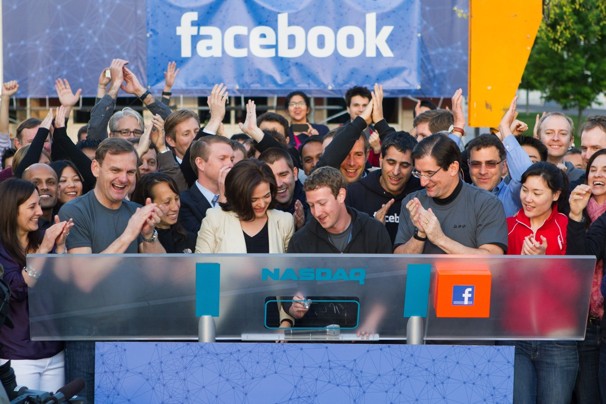
This past February, Facebook went through a highly-anticipated, controversial IPO—opening at $38 per share at a valuation of $100 billion and then dropping below $19 a share just a few weeks later. Investors began to worry and marketers questioned the effectiveness of advertising on Facebook—with big names like GM completely pulling their ad dollars and concluding Facebook ads were “ineffective.”
Facebook, which was competing with heavy weights like Google—the world’s largest display advertising network—for ad dollars, needed to find a way to prove the efficacy of its platform. It opened up its real-time bidding ad–exchange (FBX) in September, and this month, reported hitting the one billion-user mark.
Try as it might, Facebook can’t compete with Google
Last year, Facebook’s advertising revenue grew 69 percent from the year prior, to hit $3.1 billion. In contrast, competitor Google’s total advertising revenue grew nearly 30 percent to reach $36.5 billion. But while advertising rates on Facebook are increasing, click through rates (CTRs) aren’t keeping up.
The average CTR for banner ads in the US is .1 percent, but a Webtrends report found that Facebook’s 2010 CTR was only .051 percent while Google’s was .04 percent—almost 10 times as high. And while advertising rates of Facebook ads in the first quarter of 2012 rose by 40 percent, CTRs reportedly fell by eight percent. Not only that, but while the average CTR for Facebook ads decline by half just two days after being released, advertisers on Google reportedly drive 20 percent of conversions through the search engine’s display network.
And in terms of what the two companies offer in the way of targeting, Facebook is still far from catching up to Google. While Facebook offers targeting by education, workplace, Likes, location and demographics, Google lets you target based on topics and interests, contextual keywords, location, demographics, and also offers the ability for advertisers to extend their audience by retargeting.
To persuade marketers to spend an increasing share of their ad dollars on Facebook despite the not yet promising numbers, the social network needs to find different metrics to prove that their ads are equally or more effective at producing conversions. Unable to challenge Google in terms of display ads, Facebook has turned to new methods to try to prove that it can compete in terms of offline conversions.
When the times get tough… the tough get invasive
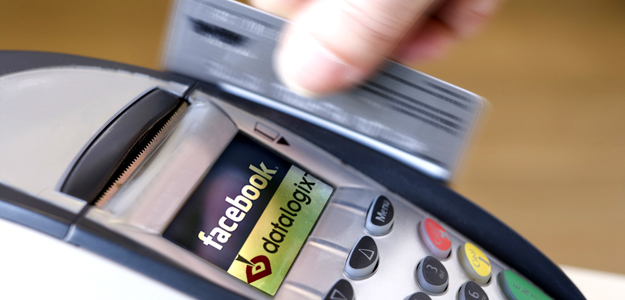
All of this is why Facebook is getting creative. To prove the value of its ads, the company turned to Datalogix to help it gather information around the offline activities of users to show that even if CTRs weren’t high, conversions were.
“As marketers look to build digital campaigns to connect with and influence consumers, many are asking how best to measure success and optimize the impact of their ad campaigns,” the Facebook blog post announcing the partnership explained. “Since the early days of digital advertising, online marketing has been focused on optimizing ad campaigns for the click. But while clicks are an effective way to measure campaigns designed to drive traffic and fulfill direct response goals, increasingly, research from firms like Nielsen suggest that clicks aren’t the right metric for the broader set of marketing objectives beyond direct response.”
But Facebook’s new partnership with Datalogix has consumers deservedly worried that for the first time, their private, offline purchasing data—from information on personal doctor’s prescriptions to data on dietary choices—can be combined with their activity online and then sold to advertisers. It’s a whole new level of invasiveness, and brands stand to profit far more than users even hypothetically could.
What is Datalogix and how will it work with Facebook?
Datalogix has purchasing data from a reported 70 million U.S. households covering a $1 trillion in consumer transactions; the data is largely drawn from loyalty cards and programs at more than 1,000 stores. For each of these users, Datalogix creates a Datalogix ID number that is then matched to Facebook users, who by default are opted into the program. By matching personal data like contact information associated with both the loyalty cards and Facebook accounts, Datalogix can track whether people bought a product in a store after seeing an ad on Facebook.
Datalogix says users’ personal information is made anonymous and collected into different groups of people who saw or did not see an ad, arguing that since data was aggregated by group, it doesn’t pose any privacy violations. Once Facebook turns over data on which group was served a specific ad and which group wasn’t, Datalogix generates a report showing the contrast between the two groups in terms of who actually went out and made purchases of the advertised product or service. This data will help Facebook—and in turn, advertisers—understand how ads are performing.
To date, the two companies have measured 45 ad campaigns and reported that in 70 percent of cases, for every $1 spent on Facebook ads it earned an additional $3 in incremental sales.
Time to kiss your offline privacy goodbye
As you can imagine, this new partnership has caused many privacy advocates to speak up, noting an evolution of Facebook’s infringement on user privacy from collecting and owning user data on its own site, to indulging itself with information of users and non-users on pages outside of Facebook—so long as the site included a Facebook Like button. But with the new partnership, Facebook now has access to the offline data of its users. And unlike data users share on their social media profiles—data created with the intent to share and the knowledge that it might be passed along to third-parties—this offline data is private information that consumers probably don’t realize is being created in the first place, let alone being shared with third parties.
“The Datalogix/Facebook partnership isn’t surprising because data brokers are combining offline and online data much more often lately,” senior privacy strategist with Abine, Inc. Sarah Downey explains. “It’s a process called ‘data enhancement,’ where lots of companies who each know a little about you combine their information to get a much clearer and more detailed picture of who you are. They claim it’s only used for advertising, but the real, demonstrated harms of this data collection include identity theft, stalking, missed job opportunities, and lowered credit limits.
“The argument that data isn’t harmful because it’s aggregated or de-identified doesn’t always stand up. Plenty of so-called non-personally identifiable information has been tied to individuals and re-identified with ease. I’d hope that Facebook took extra precautions to prevent de-identification, but any data sharing runs the risk of being tied back to individuals,” Downey says.
Jeff Chester, executive director of the privacy group Center for Digital Democracy, echoes these concerns. “Individuals are being targeted through the Facebook Exchange. Facebook is working with many different data collection and targeting companies including Datalogix to track and market to individual Facebook users. This is not disclosed by Facebook and users have no control over this.”
Consumers who participate in loyalty programs don’t realize the data gathered about their purchasing history will be shared with third parties and those who are aware that their data might be sold, aren’t necessarily happy about it. An academic study titled Americans Reject Tailored Advertising and Three Activities that Enable It found that 86 percent of those surveyed did not want online advertisers to tailor ads based on their offline activities.
Facebook’s priority: Profit at all costs
Facebook isn’t the only company using offline data to target online viewers. Earlier this year, for example, Yahoo announced it was partnering with ad company CampaignGrid. Through the partnership, Yahoo could tap offline data to target millions of registered voters based on things like party affiliation, voting history, age, location, and more.
But Downey noted that Facebook is unlike any other company when it comes to the amount and depth of information it has about its users.
“The difference here is that Facebook isn’t just another company: It knows more about its one billion users than any other company in history. It was just a matter of time before Facebook started doing data enhancement, given that they have a duty to shareholders to live up to their valuation, and proving that Facebook ads work in brick and mortar stores is an important part of demonstrating their value,” Downey says.
“This Datalogix partnership, combined with their ad network development (currently called Facebook Exchange), shows they’re aiming to track you everywhere you go, both online and off,” Downey adds. “What they’re doing is completely against consumers’ expectation and desires, but it follows Facebook’s historical trend of gradually eroding its members’ privacy. Facebook is the master of small changes that make the most of your personal information, even if you aren’t comfortable with them.”
Ideal for the hearing-impaired community, Netflix plans to finish adding closed captions to online video within the next two years.
Settling a recent lawsuit over the availability of closed captions when watching video on Netflix Instant, company officials with Netflix agreed to make sure 100 percent of all video content includes closed captioning by September 30, 2014. The lawsuit was brought against Netflix during 2010 by a deaf Massachusetts resident named Lee Nettles in addition to the Western Massachusetts Association of the Deaf and Hearing-Impaired as well as the National Association of the Deaf. According to the documentation, Netflix has already added closed captions to 82 percent of video content on the streaming service and will hit 90 percent by September 2013.
Regarding the agreement, Netflix chief product officer Neil Hunt stated “We have worked consistently to make the broadest possible selection of titles available to Netflix members who are deaf or hard of hearing and are far and away the industry leader in doing so. We are pleased to have reached this agreement and hope it serves as a benchmark for other providers of streaming video entertainment.“
In addition to adding captioning to existing content, rules have been put in place for future content additions. During the first year following the 2014 deadline, Netflix will need to add captions an average of 30 days after the video has been made available on Netflix Instant. That figure decreases to fourteen days in the following year and just seven days beyond September 30, 2016. The deal also indicates that the court will continue to check up on Netflix over the next dour years in order to evaluate the company’s progress with adding captions to both movies and television shows.
The agreement was put in place this week after a judge ruled that Netflix was subject to the Americans with Disabilities Act. It’s highly likely that the case will be referenced if more lawsuits are filed against other streaming video services like Hulu Plus or Amazon Instant Video. In order to see all video content that currently offers closed captions on Netflix, users can use the term “Subtitles” within the search function.
The National Highway Traffic Safety Administration is advising consumers whose vehicles have been in a crash in the past three years to have them inspected for fake parts.
The National Highway Traffic Safety Administration (NHTSA) has issued a consumer safety advisory regarding counterfeit airbags. These airbags, which the NHTSA says are installed at third party repair shops, can malfunction and jeopardize the lives of vehicle occupants in a crash.
According to the NHTSA, car owners who have been in a crash may have had their airbags replaced with counterfeits. The counterfeit parts look like original equipment, right down to fake manufacturer logos.
However, the counterfeit airbags are not made to the same standards as genuine parts, and have consistently malfunctioned in tests. In a crash, these fake airbags may not deploy, or they may expel metal shrapnel if they do. In one test, an airbag separated from its mounting point, showering the vehicle occupants with sparks from the bag’s pyrotechnics.
While it does not know the full scope of the problem, at the moment the NHTSA estimates that a very small number (0.1 percent) of American vehicles have counterfeit airbags. The NHTSA is not aware of any deaths or injuries due to counterfeit airbags.
The NHTSA is urging consumers whose vehicle has been in a crash within the last three years, and who have had the airbags replaced by a shop that is not part of a new car dealership, to call the manufacturer and have the replacement parts inspected. The safety advisory also applies to anyone who bought a replacement airbag online.
If the manufacturer finds a counterfeit airbag, vehicle owners will need to have it replaced at their own expense.
Consumers who purchased their cars new and have not been in a crash, and people who own a used car that has not had its airbags replaced in the last three years, shouldn’t have anything to worry about.
So far, the NHTSA is aware of counterfeit airbags being made for the following makes and models:
The NHTSA is advising all consumers, even ones whose cars do not appear on this list, to have their vehicles inspected if their airbags have been replaced in the last three years. In addition, a vehicle may not have counterfeit airbags just because it is on this list, it just means the NHTSA has found counterfeits made for that model. A full list of manufacturer call centers is available at the NHTSA’s website.
Sony delivers a redesign of its PlayStation Store after 6 years. How does it fit into the facelift of its overall gaming business?
Nintendo’s quietly building hype with its Wii U, selling out pre-orders at every retailer around, from its own Nintendo World Store to GameStop. Microsoft is letting the Xbox 360 speak for itself this fall, with a rock solid library, reliable releases like Halo 4 and Xbox Live community staples like Call of Duty: Black Ops 2 to carry the device through what’s likely its last full price season. Then there’s Sony. It’s not entirely clear what Sony is doing with its PlayStation business, other than giving the brand a quiet makeover.
The latest facelift to hit PlayStation: Sony announced the details of a full makeover for the PlayStation Store on PlayStation 3.
Long overdue, Sony finally made public its much-rumored plans to refresh its digital game storefront on Thursday. The redesigned store will go live next Wednesday, and bring with it what Sony hopes will be a markedly smoother shopping experience, opening up what’s become a substantial catalog of retro and modern downloadable games.
What’s changed? Everything. The baby blue theme that has become the trademark of the PSN, key in its little shopping bag logo, has been replaced with a sleeker black and grey theme that recalls Sony’s industrial design (televisions, consoles casings, etc.) The store itself is laid out quite similarly to the current Xbox Live dashboard, with large windows advertising new releases in categories like Movies and Games. The cosmetic shift bellies the more user friendly changes though, as categories for products expand not unlike the Cross Media Bar (XMB) used for navigating the PS3 itself. Selecting PlayStation 3 Games will bring out a slider menu that lets you explore options by price, release date, and other sub-categories that should help people better discover things as well as find things they’re looking for. Even search tools have been overhauled.
“Everyone is trying to solve the same kind of problems, but each [eCommerce] ecosystem is different,” game store development manager Elliott Dumville told Eurogamer, “We have a sense of PlayStation values that we want to be true to, and we need to deliver on that as well as solving interface issues.”
A solid makeover to keep the platform relevant and people spending on the product. It’s the same ethos behind the facelift given to the PlayStation 3 itself, a new model that’s lighter, smaller, and cheaper to make. The only problem is that, while Sony is doing the leg work to make PlayStation more approachable and appealing as a service and as a machine, it’s not offering the full package of new exclusive content and a lower price to go with it. The new store may seem like a small change, but it could be significant for Sony were it brining in a huge number of new users this fall with a cheaper machine. It isn’t though.
Bad Piggies is a complete departure from Rovio’s award winning Angry Birds series. After letting you play as the birds for almost three years now, you will now get to play as the pigs for the first time.
But you won’t be doing any flinging in this game. Other than the main characters of the game, Bad Piggies shares nothing with Angry Birds and is a complete departure in terms of gameplay. We decided to take a look and see just how bad the piggies really are.
Title
Bad Piggies
Developer
Rovio Entertainment Ltd.
Rovio Mobile Ltd.
Platform
iOS
Android
Content rating
4+
Low Maturity
Size
40.9MB / 41.3MB
34MB
Price
$0.99 / $2.99
Free (with ads)
The Premise
The pigs are making plans to capture the eggs from the birds. Unfortunately, the plans were blown away by the wind and the pigs have to get them all back. They have some objects at their disposal and your job is to assemble a vehicle to transport them to the plans.
Gameplay
In terms of gameplay, Bad Piggies is closer to Amazing Alex than Angry Birds. In each level, you have a single pig and you have to assemble a vehicle around him to transport him to the goal at the end of the level. In each level, you get a bunch of objects that you have to arrange in a grid to form the vehicle.
The object include boxes, wheels, rockets, balloons, TNT, umbrellas, etc. Each of them have a specific purpose. The boxes form the frame of the vehicle and everything has to be attached to them. The wheels, of course, facilitate motion. Propulsion devices, such as fans, rockets, bellows, soda bottles, etc. help propel the vehicle to make it go faster or climb up a slope. Umbrellas act as your brakes. Balloons lift the vehicle and sandbags weight it down as long as you want. TNT, when denoted correctly, lets you shoot the pig in a particular direction and achieve greater height than otherwise would be possible. At times you get objects such as motors, that don’t do anything on their own but combined with something like the fan makes the vehicle move faster.
You can access the in-game tips to see how you can use the objects you have at your disposal. Once you assemble the vehicle, you hit the button and the level begins. Depending upon the objects you have, you get buttons on screen to activate or deactivate them. You can, for example, switch the fans on or off, open or close the umbrellas or pop the balloons as required.
There are multiple goals in the level but the main one is always the plans at the end of the level. You need to get there to finish the level and for other achieved goals to count. Other goals include stars that you can collect, reaching the plans before the timer runs out and not using a specific object in a level.
Unlike Angry Birds, you don’t have to collect all stars at once. You can, for example, choose to finish the level before the timer runs out thus getting one star for it, plus one more for finishing the level. After that, you can replay the level and instead of having to finish it in time, you can go after the stars that might be scattered across the level. Once you finish the level with the stars, your previous star for finishing the level on time stays and you also get a new star for collecting it in the level. This way you can collect a maximum of three stars per level. The more stars you collect, the more levels you unlock in the game.
There are three modes in Bad Piggies. The first is ‘Ground Hog’, where you build vehicles that stay on the ground. The second is ‘When Pigs Fly’, that involves building flying vehicles, consisting of balloons, wings and propellers. The third is ‘Sand Box’, where there are no plans to collect but just to build massive contraptions that can go across the enormous levels and collect all the stars.
So how is the game to play? Well, it’s a bit slow and takes a while to become truly interesting. The initial levels are fairly easy and not very interesting. You need to spend some time with the game and unlock more objects before you get involved in it. Once more objects get unlocked the levels start becoming more and more fun. Eventually you will find yourself playing the levels again and again to get all three stars.
Assembling the vehicles can be fairly challenging. You have to take into consideration the objects you have been provided, the grid in which you can arrange them and the terrain you will be traversing. Needless to say, there is a fair amount of trial and error involved and you will find yourself building and refining your designs again and again until you find one that gets the job done. In many of the levels there is no one particular way that you can build a vehicle. You could place things differently and still get similar results.
You can’t get too creative with the positioning, though. The game relies heavily on physics and the placement of each object has repercussions. Place everything on one end of the vehicle and you will unbalance it, making it tilt on slopes. The propulsion objects need to be placed such that they all fire in one direction and they shouldn’t all be on one side or the vehicle will spin like a top in one place. Once you grasp the physics of the objects and know what each does, building the vehicles becomes relatively easy.
If at all you do get stuck, the game helps you out by building the vehicle for you. You will still have to control it yourself after you start it but that’s the easy part. You can use the game’s help three times and if you want more you will have to purchase them using in-app purchasing.
Speaking of pricing, the iOS version of the game costs $0.99 on the iPhone and iPod touch whereas the iPad version costs $2.99. On Android, there are two versions, with one being optimized for HD displays, and both are free to download but have in-game ads that burn through your battery and look ugly. Unfortunately, there is no paid option available on Android at all, so even if you want to you can’t get rid of the ads.
Graphics and Sound
Bad Piggies feature the same visual style as Angry Birds, which is understandable as it comes from the same universe. However, while the Angry Birds visuals were filled with many objects and characters, the Bad Piggies world looks barren and desolate. This further adds to the general lack of excitement you get while playing the game, as you transport a lone pig through an empty world with nothing but the sound of the contraptions and the odd squeaks of the pig to keep you company. The game could have used jazzier environments to spice things up and look less drab.
The music in the game is pleasant but nothing that particularly stands out. There are couple of themes that play while you’re building your vehicles and another that plays once the level starts. The former is calm and engaging whereas the latter is fast and exciting. They get the job done but again, could have been better.
Conclusion
One of the best things I liked about Bad Piggies was that it wasn’t Angry Birds. That game was fun two years ago but has started getting long in the tooth and honestly, I doubt I can sit through another variant of that game. So kudos to Rovio for making a game from the same universe but without the same gameplay.
On its own, Bad Piggies is not all that bad and offers a fairly enjoyable experience. Its drawbacks are that it’s not particularly exciting, especially during the early levels and that itself could put off many people who wouldn’t go further from that point. Also, it lacks the pick up and play nature of Angry Birds, which is not a bad thing, but not a lot of people would want to spend time and mental energy thinking of the perfect vehicle design to get all the stars in the level. In Angry Birds, you can senselessly fling birds at the pigs and although you wouldn’t many stars you’d still finish it and go to the next one. That does not happen here. Even to finish the level you have to be fairly good at the game.
Lastly, the game is packaged in a dull wrapper, with boring visuals and a passable soundtrack that don’t do justice to the gameplay.
Eventually, you end up with a game that you really wanted to play but can’t go beyond a few levels. Especially when there are so many other good games to play out there.
Rating: 3.5/5 Pros: Challenging gameplay Cons: Initial missions are uninteresting, drab visual presentation makes the game seem more boring than it is, no ad-free version on Android