Pages

Showing posts with label controls. Show all posts

Nov 7, 2012

Ford sells five-millionth Sync-equipped vehicle

Ford-Sync

Despite some criticism over complicated controls, Ford's Sync infotainment systems is selling well five years after its debut.

It’s been five years since Ford and Microsoft launched the Sync in-car infotainment system and, despite getting its share of criticism, the system has made it into five million Ford and Lincoln vehicles.

Sync debuted at the Consumer Electronics Show (CES) in 2007, and one was one of the first systems to allow drivers to sync (get it) their smart phones and other devices with their car’s systems. It allows drivers to make hands-free phone calls, read text messages, and give turn-by-turn directions, even on cars that don’t have a built-in navigation system.

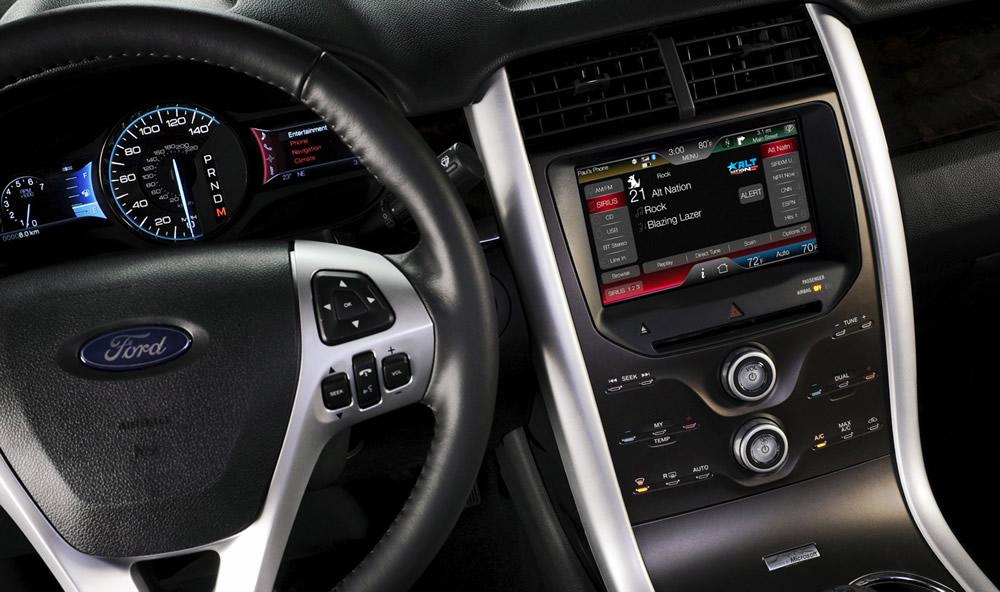
A lot has changed in five years, though. The original Sync only used physical buttons but newer versions (usually paired with Ford’s MyFord Touch and MyLincoln Touch) have touch screens and voice recognition. Like other car companies, Ford has tried to eliminate buttons on its infotainment systems, and to integrate other functions like climate control, audio, and navigation, into one interface that reminds drivers of their tablets and phones.

MyFord Touch also added functions such as music and video streaming, and a voice-activated climate control system that maintains an interior temperature set by the driver. It can also use a smart phone to access the Internet via a USB connection.

The addition of MyFord Touch’s touch screen may not have been a good thing, though. The original Sync got fairly positive reviews, but MyFord Touch has been consistently criticized. Testers have complained that MyFord Touch is too complicated, that the controls don’t respond promptly or are too hard to read, and that the whole package can easily distract drivers.

Ford launched “MyFord Touch 2.0” to correct some of the problems. A software update streamlined some of the menus and tried to make the touch screen and voice recognition controls more responsive.

Consumer Reports said the system “stinks,” and would not wish it on an enemy. Despite the recent upgrades to MyFord Touch’s software, the magazine said its fundamental design was flawed.
While Ford advertises the combined infotainment system as “Sync with MyFord Touch,” only the basic Sync platform was developed by Microsoft, with Ford adding other functions to it to create MyFord Touch.

Glitches aside, five million sales is an impressive tally for the original Sync. Despite MyFord Touch’s deleterious effect on Ford’s ratings in initial quality surveys and other tests, this infotainment system remains popular.

Sync is compatible with both iOS and Android, and is available on most 2013 Ford and Lincoln models.


Source : digitaltrends[dot]com

Oct 25, 2012

Photos of purported Samsung Nexus 10 quick start guide reveal the slate’s design

Alleged photos of the Samsung Nexus 10 quick start guide have popped up giving us a glimpse of the slate’s design and hardware controls layout.

This is by far the most solid evidence of the slate’s existence after a purported photo taken with it appeared on Picasa.

Nexus 10 will be manufactured by Samsung and just like the company’s recent tablets (the Galaxy Note 10.1 and Galaxy Tab 2 10.1) features two speakers at the front. At the back, there’s a prominent Nexus logo and above the display resides a front-facing camera and an ambient light sensor.

The main camera is at the back coupled with LED flash. The rest is really not that surprising — there the usual array of power/lock and volume rocket buttons at the top and Samsung’s proprietary charging port at the bottom.

And here comes the surprising part that got us skeptical. According to the booklet, the Nexus 10 sports a microUSB and microHDMI ports in addition to Samsung’s proprietary charging port at the bottom. This doesn’t seem right, but who knows.

Anyway, the Nexus 10 is expected to be announced at Google’s special event in New York on Monday, October 29. We’ll be there and will bring you all the news as the event progresses.


Source : blog[dot]gsmarena[dot]com

Oct 18, 2012

Battery maker A123 Systems declares bankruptcy

A123 Systems battery pack

Unable to weather the fallout from a major recall, A123 will sell its EV battery division to Johnson Controls Inc.

A123 Systems, builder of batteries for Fisker and other car companies, declared bankruptcy earlier this week. The company will sell its EV battery division to Johnson Controls Inc., so the car brands it supplied shouldn’t be affected.

A123 slid into insolvency after defaulting on a large loan payment. The company had bet its future on a deal with Wanxiang Group Corporation, a Chinese car parts company, that had planned to invest $465 million in A123 before the deal fell through.

The Massachusetts-based company was $376 million in debt and $459.8 million in assets.

Johnson Controls will take over battery production at A123’s three factories (two in Michigan, one in China) and assume ownership of all of its intellectual property. Johnson will pay A123 a total of $125 million, including $72.5 million in post-bankruptcy financing, for the EV battery division.

Johnson may also be paying for a bit of a mess. A123 has been in financial trouble for several months because of a scandalous recall of Fisker Karma batteries.

When a Karma shut down during Consumer Reports testing, the problem was traced back to defective battery packs made at A123’s Livonia, Michigan plant. Production at Livonia was suspended, and the company ended up spending $51.6 million to replace the Karma batteries, and $15.2 million to replace other customers’ batteries.

The Consumer Reports debacle was one of two high profile recalls that involved A123 batteries. In December 2011, Fisker recalled 239 Karmas because of badly placed hose clamps that could have caused coolant leaks and fires. The hose clamps were part of sealed battery packs that Fisker received from A123.

Despite the recalls, A123 still has a few important clients. General Motors will be using A123 batteries in the Chevrolet Spark EV, and BMW uses batteries from A123’s China plant in its ActiveHybrid vehicles. Fisker has not indicated that it will switch battery makers.


Source : digitaltrends[dot]com