Pages

Showing posts with label division. Show all posts

Nov 14, 2012

Samsung denies increasing Apple processor prices

A couple of days ago we reported on the news that Samsung’s chip making division had increased the prices of the processors that it supplies to Apple for use in their iOS devices by as much as 20%. Turns out, that wasn’t true at all.

According to an unnamed Samsung official who spoke to the Korean newspaper The Hankyoreh, Samsung has not increased the prices of the processors. He also said that prices are agreed upon at the beginning of each year and aren’t changed easily.

This puts to rest the news of Samsung increasing the prices but more importantly, the part where people thought they did it just to spite Apple.


Source : blog[dot]gsmarena[dot]com

Mercedes-Benz A45 AMG: Mercedes’ performance brand downsizes

Mercedes-Benz A45 AMG teaser front three quarter

The A45 AMG will be the smallest model ever from Mercedes' performance division, and it has big shoes to fill.

It’s hard to believe that the Mercedes-Benz A45 AMG is made by the same company that created the SLS AMG Black Series and other aggressive performance models. This isn’t a sports car with a 6.2-liter V8, it’s a front-wheel drive hatchback. Although the first hot hatchback from AMG won’t debut until the Geneva Motor Show in March 2013, Mercedes decided to whet appetites with a couple of teaser images.

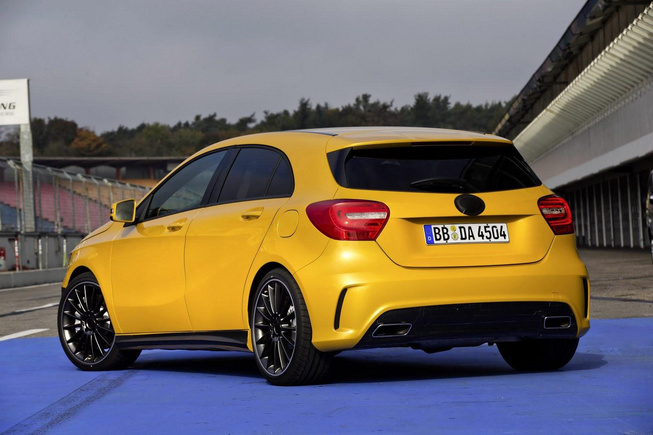
The car in the photos wears virtually no camouflage, and has the requisite hunkered-down stance, big wheels and tires, and body kit of an AMG car. It also wears a version of the Solar Beam yellow paint available on AMG’s Black Series models. However, on this little hatchback, the overall effect is more boy racer than high end European performance car.

The A45 really needs the chops to prove that it isn’t just a cynical exercise in cost-cutting. It will reportedly have a 2.0-liter, turbocharged four-cylinder under the hood. Autocar reported earlier this year that the engine, which also does duty in the regular A-Class, will be tuned to 330 horsepower and more than 295 pound-feet of torque.

The only available transmission will be a seven-speed, dual-clutch, automated manual.

Front-wheel drive cars don’t do well with large amounts of torque; all that power can actually tug the wheels in a phenomenon called “torque steer.” To cancel that out, AMG will equip the A45 with all-wheel drive. That should quiet the torque steer, and hopefully give the car better grip as well.

The all-wheel drive system, designed by Haldex, will reportedly send most of the power to the rear wheels when the driver puts his or her foot down, which could mask the A45’s humble origins even more.

Mercedes-Benz A45 AMG teaser rear three quarterAlthough it’s still a bit unorthodox for AMG, the A45 is shaping up to be a competent performance car. It will need to be competent, too, because this three-pointed star won’t be the only premium performance hatchback on the market.

When it goes on sale, the A45 AMG will face off against the BMW M135i and Audi S3, both of which are new for 2013. The BMW packs a 320 hp inline six and is available with either all-wheel drive or rear-wheel drive. The Audi has a 300 hp, turbocharged four and is only available with all-wheel drive.

The M135i and S3 probably won’t come to the U.S., but the A45 AMG might. Mercedes has talked about bringing other A-Class variants, including the CLA “four door coupe,” to the States, so why not include this performance version?

At this early stage, its hard to tell exactly what Mercedes’ plans for the AMG are. Look for more information, and more detailed specifications, in the coming months.


Source : digitaltrends[dot]com

Nov 8, 2012

Vauxhall grabs three awards at RAC Future Car Challenge

GM, and its UK division of Vauxhall, took three awards from the RAC Future Car Challenge for green technology in both its production and prototype vehicles.

The Royal Automobile Club (RAC) Future Car Challenge is an annual event in which a fleet of vehicles are driven the 63 miles from Brighton to London in the UK, with the winner being the car which used the least energy to get there. This year’s winner was the Renault Zoe, a pure electric car which will be going on sale in Europe soon. But the big news for us in the US was the three awards grabbed by Vauxhall, GM’s UK division. Two of these were won by the Vauxhall Ampera, a rebadging of the Opel Ampera, basically a Chevy Volt with some slightly different styling.

The Ampera took the award for Most Efficient Regular Car (The Zoe being much smaller than the Ampera, the Most Efficient Small Car winner is generally the outright winner), as well as the title for Best Range Extender/Plug-In Hybrid. GM’s HydroGen4 (entered as a Vauxhall) hydrogen prototype took the prototype vehicle class title of Best Fuel Cell Vehicle. This is a nice feather in GM’s cap, especially at a time when they are losing huge amounts of money in the European market. But it is also important to us here. Although we may not get the Renault Zoe in the US, the Volt has become a very high-profile car.

It has been criticized over and over for having been built at a time when GM was in need of government assistance to stay afloat. But this award, among others, shows that the technology works, and that the car wasn’t some cobbled-together political tool for GM to pretend to be green. Add to this the fact that Consumer Reports recently named the Volt as the most reliable car that GM makes, and the criticism starts to look a bit hollow.

The awards from the RAC shouldn’t really come as too big a surprise. We know the Ampera to be an efficient vehicle, especially within this kind of distance. What is potentially more interesting is the prototype vehicles. There is a lot of guesswork out there about what the future of transportation holds, and there was an unfortunate lack of variety among even the prototypes. The HydroGen4 represents the biggest deviation among the award winners from the norm of plug-in electric vehicles. These vehicles have some significant drawbacks, and the potential is there for other alternative fuels to take the lead if a way can be found to make them viable. This might not be hydrogen, but it’s always good to see manufacturers exploring other avenues.


Source : digitaltrends[dot]com

Oct 18, 2012

Battery maker A123 Systems declares bankruptcy

A123 Systems battery pack

Unable to weather the fallout from a major recall, A123 will sell its EV battery division to Johnson Controls Inc.

A123 Systems, builder of batteries for Fisker and other car companies, declared bankruptcy earlier this week. The company will sell its EV battery division to Johnson Controls Inc., so the car brands it supplied shouldn’t be affected.

A123 slid into insolvency after defaulting on a large loan payment. The company had bet its future on a deal with Wanxiang Group Corporation, a Chinese car parts company, that had planned to invest $465 million in A123 before the deal fell through.

The Massachusetts-based company was $376 million in debt and $459.8 million in assets.

Johnson Controls will take over battery production at A123’s three factories (two in Michigan, one in China) and assume ownership of all of its intellectual property. Johnson will pay A123 a total of $125 million, including $72.5 million in post-bankruptcy financing, for the EV battery division.

Johnson may also be paying for a bit of a mess. A123 has been in financial trouble for several months because of a scandalous recall of Fisker Karma batteries.

When a Karma shut down during Consumer Reports testing, the problem was traced back to defective battery packs made at A123’s Livonia, Michigan plant. Production at Livonia was suspended, and the company ended up spending $51.6 million to replace the Karma batteries, and $15.2 million to replace other customers’ batteries.

The Consumer Reports debacle was one of two high profile recalls that involved A123 batteries. In December 2011, Fisker recalled 239 Karmas because of badly placed hose clamps that could have caused coolant leaks and fires. The hose clamps were part of sealed battery packs that Fisker received from A123.

Despite the recalls, A123 still has a few important clients. General Motors will be using A123 batteries in the Chevrolet Spark EV, and BMW uses batteries from A123’s China plant in its ActiveHybrid vehicles. Fisker has not indicated that it will switch battery makers.


Source : digitaltrends[dot]com

Sep 14, 2012

Malware present on PCs before they even reach stores, says Microsoft

Your machine could be infected by malware before you even turn it on for the first time, according to investigations from Microsoft's digital crimes division now made public as part of a lawsuit against a man suspected to be responsible for helping to make such things possible.

Here’s an unexpected new element in the perpetually ongoing struggle over whether you should buy a PC or a Mac: A newly-released report is claiming that malware is being installed on PC machines before they’re even released from the factories – and the source of that new report is theoretically someone who would know: Microsoft.

The claim comes after researchers working for the software giant investigated the sale of counterfeit software in China discovered malware pre-installed on four out of twenty machines tested, with pirated or fake versions of Windows present on every single one of the tested machines. Each of the twenty machines were brand new, and had been purchased for the purpose of testing, and as such hadn’t been used prior to testing.

According to the report, the most aggressive piece of malware found on any of the twenty machines was a software known as Nitol, which links machines to a botnet and has been found on systems as far afield as the US, Russia, China, Australia and Germany, with the malware apparently being controlled by servers in the Cayman Islands.

The investigation is believed to have started a little over a year ago, with Microsoft employees in China purchasing new PCs and laptops as part of a push to discover how widespread counterfeit Microsoft software was in the Chinese market. According to Microsoft’s Patrick Stratton, a manager in the company’s digital crimes unit and the author of the report revealing this information, the discovery of the machine pre-loaded with Nitol was most surprising – and most disturbing.

“As soon as we powered on this particular computer, of its own accord without any instruction from us, it began reaching out across the internet, attempting to contact a computer unfamiliar to us,” he wrote in the report, adding that as soon as a thumb drive was plugged into the machine, Nitol copied itself onto that drive and then, when that drive was attached to another machine, copied itself onto the new machine as well.

The reason behind this information coming to light is a new lawsuit filed by Microsoft against a Chinese businessman known as Peng Yong, who it believes to be the man behind a web domain used by the malware to co-ordinate activities. “In short,” the lawsuit reads, “3322.org is a major hub of illegal Internet activity, used by criminals every minute of every day to pump malware and instructions to the computers of innocent people worldwide.”

Peng, perhaps unsurprisingly, denies any wrongdoing on his part, although it’s worth noting that security firm Zscaler reported that 3322.org was responsible for more than 17 percent of malicious web transactions in the world during 2009. The lawsuit was unsealed by a federal court in Virginia yesterday.


Source : digitaltrends[dot]com

Aug 18, 2012

Motorola files patent lawsuit against Apple, aims to block U.S imports of its products

Google fighting Apple with a lightsaber

Google's Motorola division claims Apple is infringing on seven of its patents and wants to block iPhone, iPad, and Mac computers from being imported to the U.S.

Since Google’s acquisition of Motorola back in February, the Droid expert has stayed quiet about its previous grievances with Apple. But now, according to Bloomberg, Google’s Motorola division has filed a new patent lawsuit against Apple (following Samsung’s lead), opening some old wounds leftover from Motorola and Apple’s long-standing legal disputes. The complaint, submitted to the U.S. International Trade Commission (ITC), names features like location reminders, email notifications, along phone and video players as possible infringements.

The complaints target Apple features used extensively in its product line up and given Google’s desire to block U.S. imports of Apple products (Apple manufactures its product line in Asia), a win would strike a major blow. Google seems to have its sights set on Apple destruction. The original patent dispute between Motorola Mobility and Apple was eventually dismissed in court, but Google’s Motorola division isn’t willing to lay it to rest.

“We would like to settle these patent matters, but Apple’s unwillingness to work out a license leaves us little choice but to defend ourselves and our engineers’ innovations,” wrote Motorola Mobility in an emailed statement.

The official document pertaining to this specific case won’t be available until Monday, so we will have to wait until the weekend’s over to learn the full details. The inevitable battle between Apple and Google may be a whole lot closer than we thought. And it’s nice to know we’ll have more legal battles to obsess over since Apple and Samsung’s recent disputes will soon reach a verdict.

FOSS Patent’s Florian Mueller notes that an ITC judge already made a preliminary judgement in the previous Motorola vs. Apple case, arguing that Apple did infringe on one of Motorola’s patent. The final ruling in the original case is expected to be released sometime next week. It’s also important to recognize, as Mueller points out, that if Motorola does achieve a ban on Apple products in the previous lawsuit, the iPad 4G and iPhone 4S would be exempt. Both use a Qualcomm chipset falling outside Motorola’s patent claims.

For mobile fans, Monday can’t come soon enough. Do you think Google and Motorola stand a chance against Apple?


Source : digitaltrends[dot]com