Pages

Showing posts with label efforts. Show all posts

Nov 9, 2012

Good guy Apple gives $2.5 million to Hurricane Sandy relief

Apple Hurricane Sandy

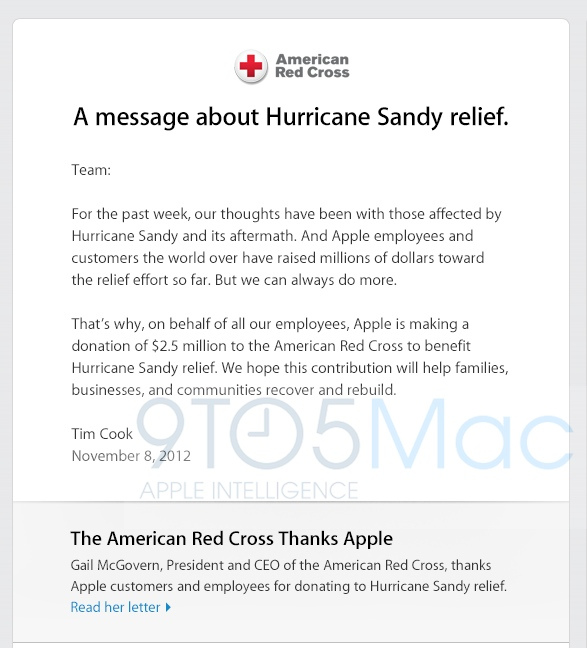
After successfully raising "millions" of dollars toward the American Red Cross' Hurricane Sandy relief efforts, Apple CEO Tim Cook told employees today that the company will donate $2.5 million of its own money to help the storm's victims recover.

Apple will donate $2.5 million to victims of Hurricane Sandy, according to an internal memo obtained by 9to5Mac. The charitable gift comes on top of untold millions raised by Apple customers for the American Red Cross through a special page on iTunes. 

tim-cook-red-cross-memo

Apple originally launched the Hurricane Sandy relief page in iTunes on November 1, just days after the storm decimated communities up the East Coast, including towns and cities in New Jersey, New York, and Connecticut. Apple iTunes customers can give amounts ranging from $5 to $200 through the page.

Sandy is said to be the second most-costly hurricane in U.S. history, after 2005′s Hurricane Katrina. Eleven days after Sandy made landfall, around 265,000 homes in New Jersey, and more than 168,000 in Long Island remain without electricity. An untold number of people are displaced or homeless because of the storm.

News of Apple’s donation follows a joint project between Silicon Valley vacation rental starup Airbnb and the New York City Mayor’s Office, which are urging Airbnb hosts (or anyone with a bit of extra room) to lend out their space to displaced Sandy victims for free. As of this writing, more than 530 hosts have signed up for the effort.

Apple’s charitable giving has increased under CEO Tim Cook. In February, Cook revealed that the company had given a total of about $150 million to charity, a large number, but a small fraction of the electronic giant’s approximately $117 billion in cash it had on hand, as of this summer.


Source : digitaltrends[dot]com

Oct 19, 2012

Is Iran blocking international news broadcasts to the Middle East?

Is Iran blocking international news television from being broadcast in the Middle East and Europe? At least one news channel is claiming that it is, with others condemning the jamming efforts of some unknown body.

Multiple international news organizations are complaining about what they claim is the deliberate jamming of television and radio news broadcasts inside the Middle East, with at least one organization naming Iran as being responsible for the blockage.

Organizations including the BBC, German state broadcaster Deutsche Welle and Voice of America have reported that satellite signals across the Middle East and parts of Europe are being jammed, in what is being termed a “blatant violation of international regulations.” The jamming of signals from multiple broadcasters was confirmed earlier this week by Eutelsat, a French-based satellite provider responsible for the broadcasting of the jammed channels, which reported that the “deliberate and intermittent interference that began earlier this week” originated from Syria.

The BBC issued a statement yesterday about the jamming, saying that “The BBC, together with a number of other broadcasters, is experiencing deliberate, intermittent interference to its transmissions to audiences in Europe and the Middle East. Impacted services include the BBC World News and BBC Arabic television channels and BBC World Service radio services in English and Arabic. Deliberate interference such as the jamming of transmissions is a blatant violation of international regulations concerning the use of satellites and we strongly condemn any practice designed to disrupt audiences’ free access to news and information.”

While the BBC refrained from identifying Iran as the source of the signals, Deutsche Welle director general Erik Betterman didn’t hold back, not only naming Iran as the source, but going on to say that the jamming was an act of censorship by the Iranian government, going on to say that his channel would join with others to issue a protest resolution.

It’s not entirely clear how the signals are being jammed, but one suggestion is that the Syrian source is transmitting another signal on the same frequency as the jammed programming, aimed directly at the Eutelsat satellite sending the original programming. Such a move would essentially made the original signal unavailable to all viewers.

Perhaps not coincidentally, on Monday of this week, Eutelsat dropped nineteen Iranian state television channels from its “Hotbird” service. The move was made following not only the blocking of news programming, but also the European Union tightening its sanctions against Iran in response to the country’s nuclear program (Reportedly, the French broadcasting authority also asked the satellite company to consider dropping one particular channel from the line-up, “Sahar 1 TV”). Amongst the channels dropped was the Islamic Republic of Iran Broadcasting’s own international news channel, Press TV. At the time, Iran officially protested the decision, describing it as a way of “prevent[ing] a dissenting voice to the broadcasting of Western thinking,” and adding that “the Islamist Republic reserves the right to take legal action against these measures.”

(Via.)


Source : digitaltrends[dot]com

Oct 11, 2012

Facebook gets strict with new Open Graph rules and tries to tone down all the over-sharing

Facebook has updated its Open Graph features and actions to decrease the volume of content shared automatically.

 fb open graphFacebook has been doing its part to build its ecosystem thanks to the efforts of third-party developers and its Open Graph. While it’s certainly evolving the way we use and interact with the social network, there have been some noticeable missteps along the way — namely the fact that seamless sharing has turned News Feeds into a flood of your friends’ terrible taste in music and political articles you have no interest in. 

In order to curb some of the Open Graphs over-share problem, Facebook is implementing a few new rules for developers who want to display content. 

Facebook is increasing the size of its image and location-led stories and adding relevant imagery for developers using the Open Graph. So you may begin to notice that stories published to your Facebook News Feed are larger and more prominently featured, but Facebook claims that based on tests, these changes have boosted engagement rates. “Image-led stories have shown 70 percent more clicks for apps that produce high-quality, relevant imagery with low spam rates,” Facebook says. This will affect two types of Open Graph stories: Location-led and image-led content.

Location-led stories will include a visual map, courtesy of Bing, of your location. Non-Open Graph stories will simply display the city and state or country of your location.

location lead facebook storyDevelopers can now choose to publish 200 x 200 images for image-led stories in lieu of the 50 x 50 images they were previously limited to.

image lead facebook story

Users will also begin to see fewer automatically published stories (which is sort of a nice word for News Feed spam and smut) that can results from authenticating third-party Facebook apps. “When apps automatically publish stories on a person’s behalf in a way that is unexpected, such as when they browse an online store, it can surprise and confuse people,” Facebook Product Engineer Henry Zhang wrote in Facebook’s blog post.

Realizing this, Facebook is retiring “unexpected” automatic publishing and replacing it with Facebook approved custom actions based on its “Built-in Action Types.” What this means is that while stories can still be published automatically, you’ll have to opt-into Facebook’s preset actions that include “Like,” “Follow,” “Listen,” “Read” and “Watch.” If a developer’s app prompts you to watch a video for example, and you play the video, you’ll have to have watched that content for at least 10 seconds before a “watched an episode of [TV-episode]” appears on your Timeline.

Another change that Facebook is making includes the removal of a feature that allowed developers to force users to request permission for showing content like an article. If you’ve ever tried to read a Washington Times article that was published to your newsfeed, you wouldn’t be taken straight to the article. Instead you were blocked by an “authentication referral” pop-up that then requested permission from you to republish the fact that you’ve read that article. Instead, users will have to log-into that publisher’s Facebook app.

Finally, you can no longer publish content to your friend’s wall using its API as Facebook found that this feature was, to be blunt, generally hated by users. However Facebook will continue to allow users to publish to friend’s walls using the“feed dialog,” where you can share content with a friend using a third-party app — the difference being that the app is commenting on your behalf. 

If the Open Graph is going to transform the network and engage users the way Facebook wants it to, the platform has to ride a line between keeping brands and developers happy without spamming and annoying users. Among its efforts to do this include the new Promoted Posts feature, which gives users — all users, not just marketers — a way to surface their content (though it is first and foremost a new revenue source).

Still, quality is the focus over at Facebook right now, which is reflecting in an update to its Platform Policy (section III.A.6.) for developers, which states:

“Quality of content: you are responsible for providing users with a quality experience and must not confuse, defraud, mislead, spam or surprise users. For example, you must monitor your app’s negative feedback in Application Insights to ensure it stays below our thresholds, avoid excessive advertisements or bugs, and ensure the description of your app is consistent with your app’s content.”

The result should be a better controlled News Feed with less third-party posted content. 


Source : digitaltrends[dot]com

Sep 26, 2012

Facebook’s fight on faked Likes has officially begun

facebook likes

Facebook is taking on fake Likes, bot-boosted brand pages, and faux accounts, and it's starting now.

Facebook’s efforts to wipe itself clean of fake Likes has hit the ground running, as some business pages have lost huge numbers of fans over the course of the last few days. The social network recently announced it would be ridding the site of fake accounts as well as bot-boosted, paid-for Likes, which sent some account holders into fit: Those Likes they’d amassed (ahem, paid for) could soon be gone.

And now it would appear that Facebook is making good on its promise and cleaning house.  If you head over to Page Data, you’ll see that a who’s who of Facebook Pages have seen huge decreases. Texas HoldEm Poker is down 96,317; Farmville down 45,693, and Justin Bieber down 17,980.

pagedata facebook likes

It stands to reason that if your page was heavily relying on buying Likes or any other malicious tricks to up that number, you’re about to see you’re a drastic blow to that number. According to Facebook, this is in everyone’s best interest: Business page admins will actually have a better idea of how well their posted content is being circulated to their followers and how those respective followers are reacting to it. Spam-boosted Likes aren’t good for anything other than a big number that brands can brag about.

On the user side of things, it’s nothing but good news. Not only will brands have to start showing us more accurate numbers [Sidenote: I’m not entirely certain how many people go around liking Pages and find themselves in awe of their numbers, i.e. “Oh wow! Pepsi has 8,999,828 Likes? Well in that case count me IN!” For what it’s worth, though, brand honesty is always a good thing.], but the move means that fake accounts are feeling Facebook’s wrath as well. It’s becoming an increasing problem and there are plenty of us plagued by a full docket of Friend Requests from what would appear to be fake accounts.

To Facebook’s credit, it’s being incredibly proactive about weeding as much fakery as it can off its platform, and it isn’t coming at an expense to users – unless those users were emptying their pockets on fake Likes. 


Source : digitaltrends[dot]com

Aug 29, 2012

5 Services That Helps You Save Money For Business Aside Groupon

There are many business organisations and individuals looking to save cash in their efforts to survive in this difficult economic condition. There is a huge demand for cheap deals and you will find money saving comparisons made on many sites on internet. Almost everybody is familiar with such deal sites like LivingSocial and Groupon. However, you will also realize there are hundreds of small niche sites that have not been discovered by the users. Here are some of the sites, which will save your money and time ensuring that it will be better spent elsewhere.

1. PickyDomains.com
Consider a situation. You are in need of a new domain name for your product or business but all the good ones are already gone and taken up. In such case your options are, pay thousands of dollars at cybersquatters, helplessly settle for a low quality domain name or hire the services of expensive branding agencies. None of these is desirable options. PickyDomains.com is one of the risk free domains naming service having more than 55,000 contributors. Getting the desirable domain name is easy with PickyDomains.com. You just need to register with them and pay a small fee of $50 for a brand or domain name. Slogans will cost you $75. After you have provided the details of what your aspirations are for the slogan and the domain name, you will get many suggestions from the large workforce of PickyDomain.com. The great thing is that in case you decide not to use any of the slogans or names suggested you get a full refund. This means there is absolutely no risk and you will pay just for results.

2. Bitrix24.com
Are you in need of project management software, platform for your employers to collaborate on, task planner or CRM? If you are, you will be required to spend thousands of dollars on different vendors unless you want to try to Bitrix24.com. In case your company is small having less than 12 employees, you can avail the free basic package offered by Bitrix24.com. This includes task planner, a comprehensive CRM and other useful features like consistent updates informing the employee about the latest goings on inside the business. Bitrix offers an extremely affordable package $99/month for companies with a larger workforce than 12 employees.

3. iSpionage.com
For running a profitable business, you need to know, what your competition is up to. This site iSpionage.com allows you to keep track of the activities of the rivals through analyzing competitor run adverts, monitoring the affiliates, paid search competition, managing via search engine gaps, managing client campaigns and more. There is no need to monitor the software yourself, the site send you the email alerts every time it detects any competitor activity that is significant to you. For just $9, you cannot afford to miss the deal.

4. JetRadar.com
Getting cheap air travel has indeed become a lot simpler after the introduction of specialist sites like Expedia, Cheap Flights and Orbitz. In case you are business executive or a person who requires frequent airplane traveling around the world, the site JetRadar.com will help find the best deals available. Most of the other rivals scan through the sites of select airlines but JetRadar.com checks through each travel agency out there along with all major flight websites and from the 728 listed airlines to get you the cheapest deal. Most travelers are unaware that the best deals are available via the airline websites. Airline companies do this to avoid loss of trade to its rivals. However, JetRadar.com will scan these sites as well to ensure the cheapest deal out there.

5. Logaster.com
For all different kind of businesses, a logo is essential because it helps your clients to keep track of your company and find you out from the crowd if required. You will find graphic designers charging big money for designing logos and yet there is no guarantee that you will get what you were looking for. One option is the crowd-sourcing sites although they will set you back by at least 100 bucks per logo. In contrast, on Logaster.com, for a monthly fee of $4.99 you can create your own design free. In addition, logos are not the only things offered at Logaster.com. You may create a range of designs for different brands including branded envelops, letterheads and business cards.


Source : techtalkafrica[dot]com

Aug 20, 2012

The RIAA appears to be dying, tax records show

The RIAA's revenue has dropped

 RIAA logo tiltThings aren’t looking so good for the Recording Industry Association of America (RIAA), one of the primary groups behind anti-piracy efforts like the Stop Online Piracy Act and the ‘six strikes’ deal with Internet service providers.

As  TorrentFreak giddily points out, the RIAA’s most recent tax filing shows that the group’s revenue for the period that ended on March 31, 2011, has fallen 44 percent over the two years prior. Chances are, the financial outlook is even more grim for 2012.

RIAA revenue for the period topped out at $29.1 million, a significant fall from the $51.35 million the group brought in two years ago. The number of employees also plummeted during the same period, diving from 117 to just 72.

The reason for the fall in revenue is primarily a result of a drop in dues paid by the major record labels that serve as RIAA members. In its filing from two years earlier, the RIAA reported member dues of $49.8 million, reports Digital Music News. The group’s most recent filing shows that number now clocks in at just $27.9 million.

Interestingly, the first half of 2011 was one of the best for the music industry as a whole, according to Nielsen SounScan. The first six months of the year delivered a modest 1 percent rise in total album sales — the first gain the industry saw in six years.

Despite the drop in revenue and member dues, RIAA executives are stilling laughing all the way to the bank. Former RIAA Chairman and CEO Mitch Bainwol received $1.75 million, the most of any RIAA employee. Current Chairman and CEO Cary Sherman (who was the group’s president at the time) received the second highest salary, $1.36 million. The nine other highest-paid RIAA employees all received salaries between $309,000 and $715,000.

The amount of money the RIAA spends on lobbying the U.S. government has remained about the same over the past few years, at a steady $2.3 million annually.

Fortunately for Web users, the amount of money the RIAA has collected in legal fees has dropped significantly, falling from $16.5 million to $2.34 million thanks to the group’s decision to stop going after individual file-sharers in court, reports TorrentFreak.

View the full 2010-2011 RIAA IRS filing here.


Source : digitaltrends[dot]com