Pages

Showing posts with label dollars. Show all posts

Nov 9, 2012

Watching online porn is a good way to get yourself blackmailed by a hacker

Porn ransomware

Browsing online porn sites has become increasingly dangerous thanks to a precipitous rise in "ransomware" viruses, which lock down victims' computers, and demand they pay hundreds of dollars for the ability to regain control of their machines.

Watch online porn? Of course you do. Nothing wrong with that. You’re only human. But we have to warn you: Perusing the NSFW side of the Web could land you with a nasty computer virus that allows criminal hacker gangs to take control of you PC, and hold it hostage until you cough up cash.

Known as “ransomware,” this type of nefarious software is one of the most rapidly spreading threats on the Internet, according to a new report from cybersecurity company Semantic (PDF). The reason: It is an easy way from cybercriminals to make money.

“This malware is highly profitable, with as many as 2.9 percent of compromised users paying out,” the report says. “An investigation into one of the smaller players in this scam identified 68,000 compromised computers in just one month, which could have resulted in victims being defrauded of up to $400,000 USD.”

Semantic researchers Gavin O’Gorman and Geoff McDonald, who authored the ransomware report, say that hacker gangs are likely raking more than $5 million a year by extorting their victims. “The real number is, however, likely much higher,” wrote the researchers.

While about 16 different versions of ransomware viruses exist, says Semantic, they all work in relatively the same way. Hackers trick users into installing the virus on their computer by either installing malicious code on websites, or simply buying ad space on (usually porn) sites, and then running ads that link to a page infected with the ransomware. Once a user clicks the ad, it is secretly installed on their machine through the browser.
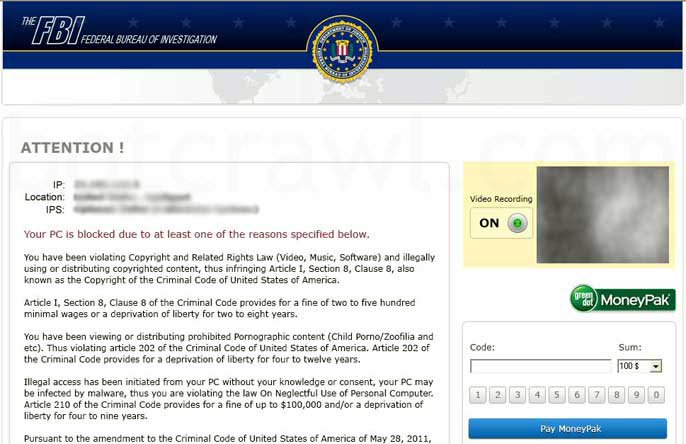
FBI ransomware

After the virus has successfully installed, things immediately go wrong. The ransomware automatically disables a number of key programs that render the computer inoperable by the user. An image will pop up on the screen that is made to look like it’s from a law enforcement agency, like the FBI. The image will tell the user that their computer has been blocked, and they must pay around $200 within 72 hours, or risk arrest for failing to pay a fine for “viewing or distributing prohibited pornographic content”

“Because the compromised individual may have indeed been browsing a pornographic website prior to infection, the message carries some more weight,” the report says. “In addition, the nature of the message may be embarrassing to some, encouraging them to get rid of it at any cost.”

Users tricked by the scheme will then purchase an electronic payment PIN, and enter the number into a box on their computer screen. The hackers can then retrieve the payment. Not surprisingly, however,  the hackers rarely uphold their end of the bargain, and victim’s computers remain locked.

According to Semantic, the number of ransomware infections in the U.S. has skyrocketed over the past few months, jumping from about 1-2 percent of total worldwide infections in March to 20-50 percent of infections, as of September.

Fortunately, there are a number of easy ways to avoid infection. First, don’t click any ads on porn sites. Second, make sure all your programs and plugins (like Flash and Java) are all up to date. And finally, install anti-virus software (this is a good free one), which will easily detect any ransomware and clean it off your machine.


Source : digitaltrends[dot]com

Good guy Apple gives $2.5 million to Hurricane Sandy relief

Apple Hurricane Sandy

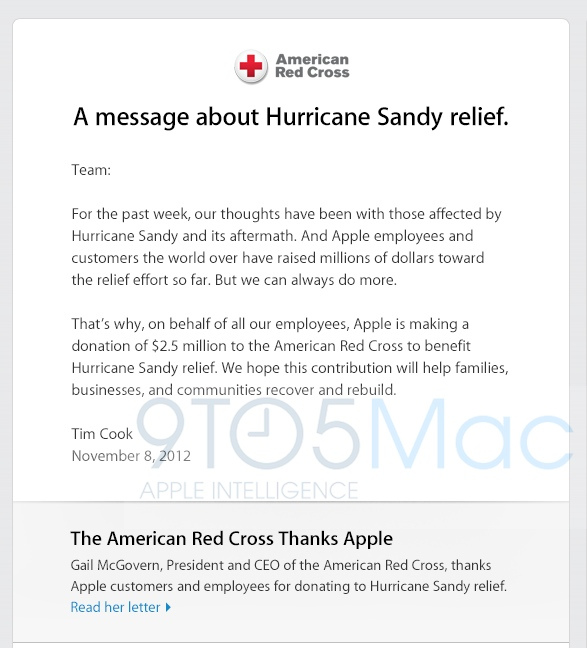
After successfully raising "millions" of dollars toward the American Red Cross' Hurricane Sandy relief efforts, Apple CEO Tim Cook told employees today that the company will donate $2.5 million of its own money to help the storm's victims recover.

Apple will donate $2.5 million to victims of Hurricane Sandy, according to an internal memo obtained by 9to5Mac. The charitable gift comes on top of untold millions raised by Apple customers for the American Red Cross through a special page on iTunes. 

tim-cook-red-cross-memo

Apple originally launched the Hurricane Sandy relief page in iTunes on November 1, just days after the storm decimated communities up the East Coast, including towns and cities in New Jersey, New York, and Connecticut. Apple iTunes customers can give amounts ranging from $5 to $200 through the page.

Sandy is said to be the second most-costly hurricane in U.S. history, after 2005′s Hurricane Katrina. Eleven days after Sandy made landfall, around 265,000 homes in New Jersey, and more than 168,000 in Long Island remain without electricity. An untold number of people are displaced or homeless because of the storm.

News of Apple’s donation follows a joint project between Silicon Valley vacation rental starup Airbnb and the New York City Mayor’s Office, which are urging Airbnb hosts (or anyone with a bit of extra room) to lend out their space to displaced Sandy victims for free. As of this writing, more than 530 hosts have signed up for the effort.

Apple’s charitable giving has increased under CEO Tim Cook. In February, Cook revealed that the company had given a total of about $150 million to charity, a large number, but a small fraction of the electronic giant’s approximately $117 billion in cash it had on hand, as of this summer.


Source : digitaltrends[dot]com

Oct 16, 2012

New Microsoft Surface ad shows a scary world where people dance with their tablets in public

As part of their ongoing marketing campaign for the Surface for which Microsoft is said to have spent a cool billion dollars comes a new ad that was the first to appear on national television in the US.

So what’s the ad about? It’s about people clicking, flipping and throwing their tablets in public while they are dancing. That’s basically all that happens in the video. Does it show what the Surface can do? No. Does it show how much it costs? No. All you get in the end is the date as to when the product will be available. It’s a cool video, to say the least. But will it make you want to buy one? No.


Source : blog[dot]gsmarena[dot]com

Sep 16, 2012

How Much Do Apple, Google, Amazon Spend on Advertising?

Last year, U.S. tech company advertisers continued to increase ad and promo spending billions of dollars, so much so that Google, Amazon and Apple are listed among the six companies with the highest ad-spending growth rates.

Hey, wait a minute, what are these companies spending their money on?

The money is going into unmeasured spending like search marketing, online videos, social media, promotion and direction marketing

Let’s take a look at this awesome infographic made by Muhammad Saleem telling us about how Tech and Advertising spends are increasing and where the money is going

Tech Company Ad Spends
[via OnlineBusinessDegree.org]

Tags: Amazon Advertising, Apple Advertising, Google Advertising

Source : techtalkafrica[dot]com

Sep 5, 2012

What’s not to “Like”? Facebook’s fight on fakery is a page out of the Google handbook

Facebook fights fake Likes

As advertising dollars and proof of ROI becomes more important to a publicly traded Facebook, the fight for the Like button's authenticity marks a serious turn for the site.

Google “Facebook Likes” and you’ll be inundated with a flood of sites and services that promise to deliver that very thing. They don’t mince words in their promotion, flat out saying, you give us money, we give you forced human approval. Prices vary: FB Supplier sells 500 photo Likes for $29. Social Buzzer offers 1,000 Likes for $34.90. BuyFacebook-Likes.org (the .org qualifier being entirely necessary as to point out the uselessness of that label) price is 1,000 Website Facebook Likes for $39. It goes on and on and on and on and on.

buy facebook likesAnd none of it is surprising. Back in February, Facebook began making its marketing strategy crystal clear: Likes equal ads. The platform was going to convert the simple, innocent, non-committal act of hitting the Like button into meaning something about users and their relationships with brands.

Before we go much further, a short history of the Like button is deserved. Originally, it wasn’t even to be – it was going to be the Awesome button. The idea of the Awesome button was the result of a 2007 Facebook hackathon, which eventually evolved into “Like” and was officially introduced in 2009.

Eventually, Like replaced the “Become a Fan” feature altogether. And it’s become a popular one: While Facebook won’t reveal Like button statistics, when it was first made available, 50,000 Websites installed it within the first day, and that climbed to 100,000 sites within its opening month. By 2010, it’d had been implemented into some two million sites, and the feedback was unending praise: Some media sites reported 300 percent increases in referral traffic. So you can only imagine how much its presence has increased since.

In fact, you don’t have to imagine. It’s hard to even name a site you can’t Like. Let’s face it: The Like button is a fundamental piece of the Internet’s tapestry.

But it isn’t without controversy. Back in 2010, Facebook was hit with a lawsuit alleging that the Like button was using minors’ Internet activity for commercial gain. Since then, the company has faced an uphill battle trying to appease the courts while simultaneously being able to keep doing exactly what it’s doing. Concessions like trying to put in plainer language that a Like is essentially a vote for a brand has been about as much movement as the social site has made, though it’s also spent time with the FTC making a defense for the Like button and the customized experience it offers users.

Clearly, the Like is worth fighting for, and Facebook knows it. But not only does the network have to fight the Powers that Be, it also has to battle with the monster it created — spam tactics, like Likejacking and fraudulent Likes.  Last week the company announced it would start removing business page Likes that were put there by fake or hijacked accounts. Facebook tried to downplay what effect this could have, saying that a typical page will only lose one percent of its Likes, which doesn’t really reveal all that much since there isn’t such a thing as a “typical page” given the huge range in Likes. Some have millions, some have tens; pages with high Like numbers could feel the hit far more significantly.

There are two interesting things to take away from all this. The first is how businesses are reacting, which, to summarize, is not well. A handful are frustrated with their declining Like numbers, and rightfully so — Facebook made this metric important, then brands figured out how to work that system, and now the rules have changed. And it’s not something that just tiny, spammy companies have been doing: Buying Facebook Likes is pretty old hat at this point. Still, those who are protesting the announcement are suffering from their own hubris. You can only defend spamming so much. 

But what’s more interesting is that Facebook isn’t acting like Facebook — in fact, it’s acting like Google. Part of the reason buying Facebook Likes has been such a blatant, easy, care-free process is because Facebook’s network is hugely important, yet it isn’t confined by hard, set lines… like, say, a search algorithm is. Anyone who’s even minutely affected by Web traffic has felt the wrath of a Google search algorithm update; the always-iterating engine’s every tiny tweak greatly affects our business. And Google has always defended its algorithm as a science, a machine, a crucial cog in finding the most correct data. Facebook, on the other hand, has traditionally been about feelings, bias, opinions, and… well, likes, and for that matter, dislikes. But these days, it can’t be that amorphous, not when big advertising and marketing dollars are involved. If you had to say what Facebook’s “thing” was, that thing would legitimacy: It made a name for itself as the proprietar of the real online identity, and this is what has made it worth so much. The near-elimination of anonymity could have been seen as a slight, but the network made that a feature, a selling point — and it worked. So anything that challenges that, in the wake of things like stock prices and shareholders, has got to go. To do that, Facebook is taking a page out of Google’s book by rooting out the fakers.

Even some of the language Facebook is using sounds like what we hear about SEO tactics. Facebook says that businesses will actually benefit from this because Likes from fraudulent sources aren’t all that helpful: The site takes into account how active a business page’s followers are, so if you bought 10K Likes from spam profiles, then they arguably shouldn’t be successfully circulating your content. That idea sounds a lot like whenever Google issues a search algorithm update and reminds everyone that writing for humans instead of trying to learn its secret sauce is best practice.

We’ve taken yet another step away from SEO and into the next generation of Internet optimization. The search engine certainly isn’t going anywhere, but now it’s not the only one making rules the rest of us have to abide by.


Source : digitaltrends[dot]com

Aug 31, 2012

The 6 Biggest Videogame Auctions


CC Via Flickr
A game console for 200 dollars is something that a lot of people invest in these days. Add a few games for 50 dollars a pop and you start having to need a larger wallet to pay for all this. But some people love their games so much that they are willing to spend almost 100 times as much on just a single game or a specific console. The world of gaming memorabilia is quite astonishing and the figures that circulate from time to time are staggering. Here is a list of some of the most ludicrous (or amazing) gaming purchases in the world.

Legend of Zelda Prototype

When an American man put up a Zelda game on his eBay profile there were not many eyebrows raised at first. But when they looked at the picture and read the description they saw one of the most sought after pieces in the world of gaming. He had, somehow, got his hands on the prototype release for the original Legend of Zelda for NES. The item got huge publicity in the world of gaming and after a long few days of bidding the final bid came to $55,000 for a single game. We can at least hope that the buyer got free shipping with that price…

Stadium Events

This game is seen as one of the rarest in the world of gaming and around 200 copies are said to be in circulation. Again it is for the ancient, yet brilliant, NES console and the story behind one of the games was quite astonishing. Someone put up a few old NES games on ebay to sell with no real knowledge about games. A game aficionado saw that Stadium Events was one of the games and the bidding war started. As the dust settled the game had reached a value of over $41,000 and the seller must have been shocked when the auction closed.

CC Via Flickr

The Ultimate 11

This game was released back in 1996 and there are only 10 known copies around the world. This makes it one of the rarest games in the world and it came as no surprise when someone purchased this game and Kizuna Encounter for a combined $55,000. Saving old video games seems to be the way forward if you want to make a lot of money.

Nintendo World Championships

Nintendo have created some of the best games in history and this one was sold 26 times with the gold cartridge and 90 times with the regular one. A gold cartridge will set a collector back around $10,000.

Bangai-O: Prize Edition

Even though there is no recorded price for this Sega Dreamcast game it is well known that only five copies were produced. The Dreamcast did not have a big breakthrough and this game never really hit the market at all.

Looking to earn some money to buy your own piece of gaming memorabilia? Check out IronFX who specialise in Forex Trading.


Source : techtalkafrica[dot]com