Pages

Showing posts with label likes. Show all posts

Nov 6, 2012

The problem with your socially-sourced election predictions

social media and election predictions

As the 2012 presidential election comes to a close, our interest is being held captive by early results sourced by the likes of Twitter and Facebook. But for all of the infographics created from this data, is there really enough here to offer election predictions?

Finally, November 6 is here. Election Day has come and that means the campaigns we’ve watched unfold over what feels like a lifetime are coming to an end. And this has been an election season the likes of which we’ve never seen: It’s infiltrated every last pore of our existence thanks to the deluge of social media outreach and coverage.

And it’s not over yet. While the votes have yet to be counted, we apparently already have an outcome: Obama will be our president for another four years.

How do we know this? Social media. Statistically, candidates who have more Facebook Likes and Twitter followers tend to win. Three recent gubernatorial races went to the candidate with largest Twitter follower counts.

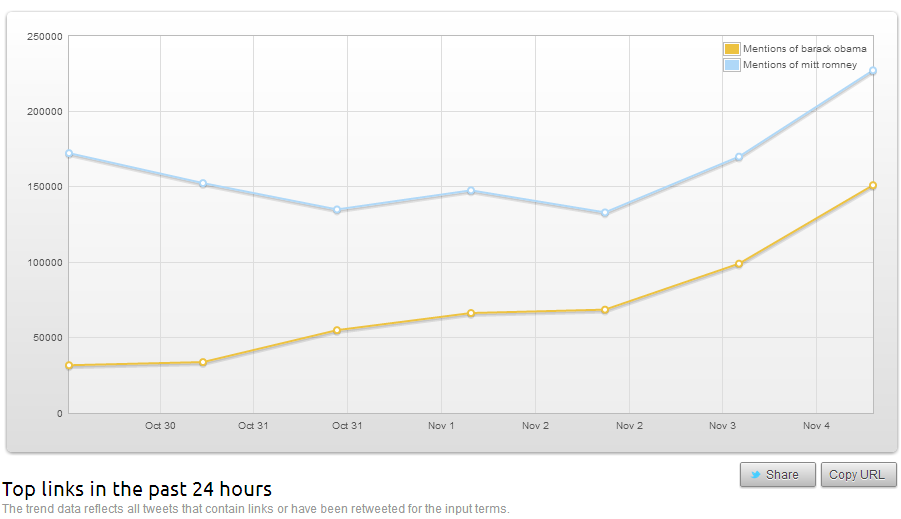
But wait – there’s also an argument that @mentions indicate who our winner is going to be. The candidate everyone’s talking about will be the next president. In that case, Mitt Romney takes the lead.
topsy election

And if you think Web buzz in general is going to predict our next president, then once again it’s Romney for the win.

google trends election

Social network-sourced election predictions are everywhere, but whether they mean anything is unclear. There’s no shortage of infographics using eye-catching visuals to colorfully chart out how we’re using Facebook, Twitter, and Instagram to talk about our candidates, but not enough analysis about whether this content is signal or noise.

What we do know is this:

  • People increasingly use social networks; as of May, eight percent of online adults were using Twitter on a typical day.
  • People increasingly get their news from social media and digital outlets; according to a Pew Research Center Report, “the percentage of Americans saying they saw news or news headlines on a social networking site [from the day before] has doubled from nine percent to 19 percent – since 2010.”
  • 88 percent of social media users are registered voters.

election infographicsThe big picture take-away from this is that social media and elections matters; politicians should be creating content here, because constituents react to it. But the data raises more questions than it answers. What about sarcasm, mood, and sentiment? Or spam accounts? Or malicious posts meant to manipulate a social network? We just saw how completely faked information can take over a platform as well as the news cycle, so what’s to keep us safe from similar effects with election predictions?

For all the revealing bite-sized data we can squeeze out of Facebook posts and followers and Twitter mentions and hashtags, there are plenty of glaring inaccuracies as well. According to Twitter, Ron Paul should have been the Republican nominee, and the Iowa primary would have ended quite differently.

For every insightful social media analysis, there are 10 terribly shallow ones. Countless news outlets launch tools or republish infographics that count “buzz” – and if that’s all we we’re looking for, Herman Cain would probably be our next president.

What’s missing, of course, is context. So many of the endlessly-circulated infographics and charts we’ve seen this year are heavy on data and pie charts and graphs and lack anything to put those numbers into perspective.

As a rule, these prediction tools aren’t able to determine if tweets or Facebook posts are coming from people who are even eligible to vote. According to a recent study, 73.7 percent of Twitter users are between the ages of 15 and 25, so there’s plenty of opportunity here for users who can’t vote to be sharing their opinions. To further complicate things, only 0.45 percent of Twitter users disclose their ages. 46 percent of Facebook users are 45 or older, but given how large Facebook is, this number is sort of insignificant; it means that there are plenty of under-aged users on the site who could very well be endorsing candidates they can’t vote for.

Demographics in general are rather ignored – the most notable of them being that the people who use social networks to talk about politics are already politically motivated. This means that those who keep their political ideals to themselves or don’t have strong enough beliefs to broadcast them – but will still vote – aren’t being counted. In traditional prediction methods, pollsters specifically reached out to this subset in order to create more accurate views of the elections, but since the data being pulled from social networks is all self-motivated, these data simply get left out.

German researchers recently looked at Twitter’s predictive abilities, saying: “While we find evidence of a lively political debate on Twitter, this discussion is still dominated by a small number of users: Only four percent of all users accounted for more than 40 percent of the messages.” This was back in 2009, but surely the scale still speaks to a notable discrepancy.

“So long as you understand the data and the demographics of social users, you can measure sentiment in perspective and target relevant messages to those groups,” says 140Proof founder and CTO John Manoogian III says. “The problem comes when pundits and analysts mistakenly assume that social media aggregates the tastes and preferences of all voters — it does not. Sites like Facebook and Twitter have political leanings. But social media does pretty strongly indicate what young, educated, and/or professional voters are saying.”

A much bigger factor is the failure of sentiment and mood analysis. The mechanisms we use to measure social media talk aren’t sophisticated enough to know if you’re slamming Obama or endorsing him. Some people can barely read sarcasm, so don’t expect applications pulling in tweets and posts to consistently do so. If you write “Oh sure, I totally believe Romney has women’s interests at heart,” in a Facebook post, it will likely be interpreted as a pro-Mitt statement.  

There’s also the fact that we want this to work; we want to be able to use social media to tell us how we all really feel. “This is the so-called file-drawer effect: researchers do not publish negative results, hence, only positive results are known and it seems that something is possible most of the time when it could be due to pure chance,” says researcher Daniel Gayo-Avello. “A paper [I wrote with] Eni Mustafaraj and Takis Metaxas showed that, in fact, results could be guessed roughly half of the time; that is not an impressive predictive ability, isn’t it?”

“Thus, by not knowing (because they are seldom published) about negative results, everybody assumes that simple methods simply work; and, indeed, they ‘work’ but half of the time, akin to a broken watch which ‘works’ twice a day.”

This doesn’t mean all this information isn’t valuable – it absolutely is, and interesting to boot. There’s no argument that politicians shouldn’t be using social networks, and this type of outreach is only going to become more common and more sophisticated.

The big lesson is social networking can be used as an indicator of opinion, but not necessarily decision. There are just too many loose ends involved, and until they can be tied up, you’re just going to have to learn who will win our elections the old fashioned way: by waiting up all night for some guy or gal on TV to announce it. 


Source : digitaltrends[dot]com

Sep 26, 2012

Facebook’s fight on faked Likes has officially begun

facebook likes

Facebook is taking on fake Likes, bot-boosted brand pages, and faux accounts, and it's starting now.

Facebook’s efforts to wipe itself clean of fake Likes has hit the ground running, as some business pages have lost huge numbers of fans over the course of the last few days. The social network recently announced it would be ridding the site of fake accounts as well as bot-boosted, paid-for Likes, which sent some account holders into fit: Those Likes they’d amassed (ahem, paid for) could soon be gone.

And now it would appear that Facebook is making good on its promise and cleaning house.  If you head over to Page Data, you’ll see that a who’s who of Facebook Pages have seen huge decreases. Texas HoldEm Poker is down 96,317; Farmville down 45,693, and Justin Bieber down 17,980.

pagedata facebook likes

It stands to reason that if your page was heavily relying on buying Likes or any other malicious tricks to up that number, you’re about to see you’re a drastic blow to that number. According to Facebook, this is in everyone’s best interest: Business page admins will actually have a better idea of how well their posted content is being circulated to their followers and how those respective followers are reacting to it. Spam-boosted Likes aren’t good for anything other than a big number that brands can brag about.

On the user side of things, it’s nothing but good news. Not only will brands have to start showing us more accurate numbers [Sidenote: I’m not entirely certain how many people go around liking Pages and find themselves in awe of their numbers, i.e. “Oh wow! Pepsi has 8,999,828 Likes? Well in that case count me IN!” For what it’s worth, though, brand honesty is always a good thing.], but the move means that fake accounts are feeling Facebook’s wrath as well. It’s becoming an increasing problem and there are plenty of us plagued by a full docket of Friend Requests from what would appear to be fake accounts.

To Facebook’s credit, it’s being incredibly proactive about weeding as much fakery as it can off its platform, and it isn’t coming at an expense to users – unless those users were emptying their pockets on fake Likes. 


Source : digitaltrends[dot]com

Sep 21, 2012

Netgear goes next-gen with NeoTV streaming video players

NETGEAR's affordable and well-featured NeoTV streaming video players put the squish on the likes of Roku.

Netgear has announced a family of next-gen streaming video players that includes the NeoTV (NTV300), NeoTV PRO (NTV300S) and NeoTV MAX (NTV300SL). The players are among the first wave of products to offer HTML 5 functionality, a streaming method that’s fast replacing Adobe’s Flash plug-in as the industry standard. The new line will utilize digital rights management options like Microsoft’s PlayReady to put hundreds of streaming HD channels, on-demand, right at your itchy fingertips.

Netgear’s new players can edify a traditional TV and upgrade a smart TV, broadening access to apps and providing additional content, all at accessible price points. And if you’re sick of losing the remote in the crannies of your couch, NeoTV’s afford you the ability to use your smartphone to control the on-screen action.

The models deliver Netflix, Vudu, Hulu Plus, YouTube, Best Buy CinemaNow, Pandora, and Rhapsody, all in 1080p and 5.1 Dolby Digital surround sound when available. All three devices also offer Intel Wireless Display (WiDi), a service that allows you to wirelessly display compatible devices on your TV screen.

Headlining the new family on the block is the NeoTV MAX (NTV300SL) which – in addition to the aforementioned features – comes with QWERTY remote control and external hard disk drive support.

The NeoTV lineup hits U.S. stores starting September 20, 2012. The NeoTV Streaming Player (NTV300) will retail for $50, The NeoTV PRO Streaming Player (NTV300S) for $60, and the NeoTV MAX Streaming Player (NTV300SL) tops the list at $70.


Source : digitaltrends[dot]com

Sep 10, 2012

What Facebook can tell us about Obama and Romney’s supporters

Compass Labs, a social media platform, has released a comparison of the likes and dislikes of Facebook supporters of Mitt Romney and Barack Obama, revealing the unsurprising differences - and very surprising similarities - between the two camps.

With all the partisan complaining and fighting coming out of this year’s US Presidential Election, you might think that there’s nothing that Democrats and Republicans can agree on, but there is: The shopping experience known as Target. There’s also The Hangover, football and soccer.

These similarities are some of the facts coming from a comparison of Obama and Romney fans on Facebook that’s been released by social media ad platform Compass Labs. Using its data-mining powers for good (Well, informative purposes) instead of evil (That is to say, marketing purposes), Compass has revealed that while Obama may have more Facebook fans, Romney’s smaller number is more passionate and more in tune with what their guy is saying.

Obama has 28,365,075 fans to Romney’s 6,446,941 fans on Facebook – or, at least, those numbers were the case when Compass surveyed the information – but Romney has the edge on both the amount of online chatter about candidates (3,340,348 people talking about him, against Obama’s 3,051,585) and level of fan engagement in terms of those “liking” statuses or messages – 52 percent for Romney versus a paltry 11 percent for Obama.

(Interestingly enough, there are more Republican Facebook fans than Democrat fans by a considerably margin: 706,872 against 515,690, and the level of engagement is equally swapped, with Democrats being more engaged with a 46 percent ration versus the Republicans’ 34 percent. Republicans still have an edge in terms of discussion, however; 241,451 people commenting against the Democrats’ 234,787 people.)

In terms of demographic breakdown, the majority of Romney’s supporters – 43 percent – are older than 55 years of age (Only 11 percent are younger than 25), while Obama’s appeal is spread more evenly across age groups: 24 percent over 55, then 21 percent aged 25-25, 20 percent aged 18 to 25, 17 percent aged 45-55 and 18 percent 35-45 years of age. Obama’s gender demographic is the mirror image of Romney’s, with a 53 percent female, 47 percent male ratio while his opponent has 53 percent male and 47 percent female.

Where Compass’ data breakdown is most fun, however, is seeing the lists of activities, favorite movies, TV shows and brands. For example, while both Republicans and Democrats like football and soccer, Republicans would rather play golf, quilt or go to church than Democrats, who’ll apparently be spending their time power walking, camping or meditating. Everyone agrees that they like The Hangover, but Democrats would rather watch Paranormal Activity while Republicans prefer The Sound of Music (No, really: The Sound of Music actually shows up as the third most popular movie for Republicans. Who knew?).

The television show breakdown seems amazingly obvious: Republicans prefer The O’Reilly Factor and The Sean Hannity Show, while Democrats go for The Daily Show and The Colbert Report (Both sides enjoy Family Guy, however). When it comes to brands, Target shows up on both lists, but Romney fans would prefer to eat at McDonalds and drink something from Starbucks, while Obama’s followers would spend their time talking on something from Samsung Mobile USA or using their Visa cards.

It’d be nice to imagine that such lists will humanize the all-too-often demonized other sides in what’s all too often a ridiculous and desensitized race, but that may be too much to hope for in today’s climate. Instead, I’ll just cling to the idea that even the worst partisan bickering can apparently be defused by a DVD showing Stewie Griffin playing soccer purchased from Target. Just imagine…


Source : digitaltrends[dot]com

Sep 6, 2012

LinkedIn begins rolling out notification feature to increase user engagement

linkedin notifications

LinkedIn announced that it is deploying a notification feature that will alert users about new likes, comments, views and other interactions.

LinkedIn is finally adopting another feature that you find in nearly all other social networks. Today the professional networking platform announced a notification feature that will keep you updated in real-time with the latest interactions between your connections and your content.

For instance, users will now receive a notification about articles that their network has shared from their homepage, updates about profiles views, as well as alerts of accepted connections.

Previously, content published on LinkedIn’s homepage would share the same retail space with a user’s personal updates, and connection confirmations would often get buried amid the shared content. Until now, there was no alert system of any kind, save for an easily-missed update on how many views your profile had accumulated over the week. While this information was available, it wasn’t brought to users’ attention. And timing, as many of us know in a competitive job market, is everything.

The new feature will appear on your profile as an envelope and a flag icon. The envelope icon will open up the messages in your inbox, while the flag will open up any relevant personal notifications. Every time you receive a new message or the latest notification, including comments, likes, accepted connection requests and others, a red circle will appear.

While the new feature offers its users the convenience of parting the personal notifications from their network’s content, the motivation behind the implementation of the feature is to keep its users constantly checking the site. It’s a strategy that not only reels users back onto social networks like Facebook, but dating sites like OKCupid make use of the rather addictive notification feature as well. These notifications should keep users more engaged with LinkedIn, particularly when the professional network releases the notification features to Android, iPhone and iPad devices.

Of course at the end of the day, the changes are fiscally motivated. When comparing LinkedIn to Facebook, LinkedIn’s users, spend far fewer minutes per month engaging with the site. Users on LinkedIn spend approximately 18 minutes per month, while Facebook users spend on average 6.35 hours per month. As LinkedIn follows in Facebook’s footsteps, it in fact has much room for improvement.

To LinkedIn’s merit howver, the company garners more revenue per minute spent on the site. LinkedIn rakes in $1.30 per user per hour, while Facebook receives just 62 cents per user per hour.

Some of you may not see the new feature appear right away, according to LinkedIn. But all members should see that their profiles have been updated within a few weeks.


Source : digitaltrends[dot]com

Aug 28, 2012

Google advertises the Nexus 7 tablet on its homepage

With the slate’s availability expanding even further, Google has featured an ad for the Nexus 7 on its homepage. The ASUS made tablet joins the likes of the T-Mobile G1, Nexus 1, Nexus S, Motorola Droid, as well as the Google Chrome browser as part of the elite club of products, which have been advertised on Google.com.

The ad for the Google Nexus 7 is quite catchy. For about a second after you open Google’s main page, nothing happens. Then the tablet pops up from the page’s bottom, revealing its top end.

With the Nexus 7 already selling like hot cakes, we can reasonably expect that having one of the prime advertising spots on the world wide web will bode even better for the tablet’s commercial success. What do you think?


Source : blog[dot]gsmarena[dot]com