Pages

Showing posts with label facebook. Show all posts

Nov 14, 2012

Facebook rolls out the share button to mobile users

Designed to encourage mobile users to share more types of content with their friends, Facebook is rolling out a new share button for the mobile interface.

Detailed by Techcrunch earlier today, Facebook has launched a share button on the mobile version of the social network and is planning to add sharing capabilities to both the iOS and Android applications at a later date. While the ability to share a particular article, video or picture is commonplace on the Web version of Facebook, mobile users can simply tap on the new share link in order to pass along an interesting piece of content to their friends. When a user brings up the mobile version of the social network, they will notice a new Share button to the right of the Like and Comment buttons. 
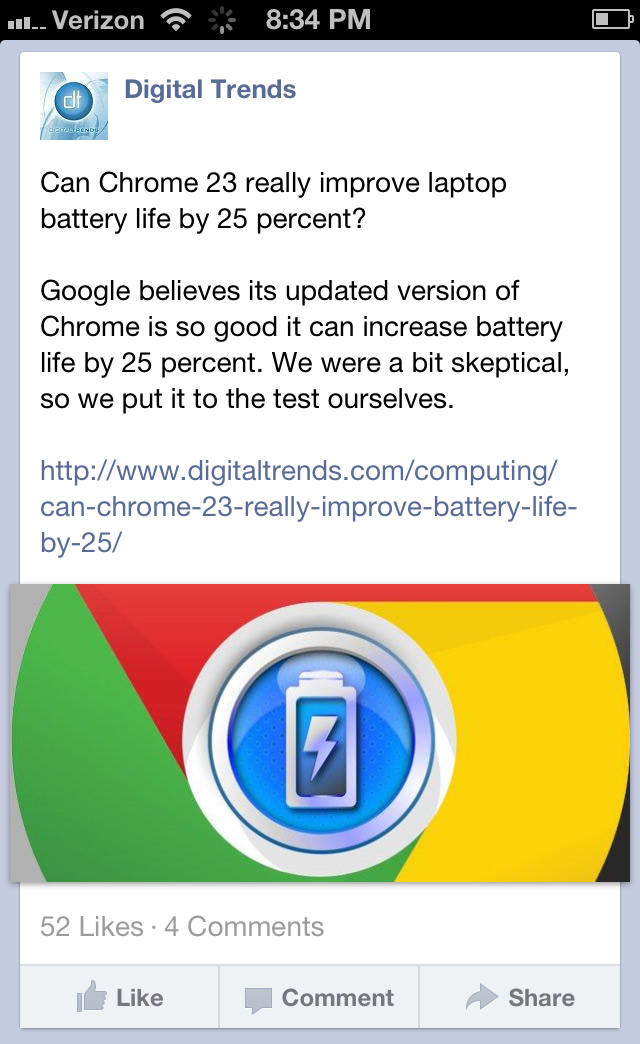
Tapping the new share button brings up an interface that allows the user to write a comment that goes along with the shared content. In addition, the user can isolate the post to a specific subset of their friends through groups or post it publicly in order to reach all subscribers.

Once the user is satisfied with the post, they confirm the sharing action by tapping the Share button in the top right corner of the screen. Alternatively, cancelling the post returns the user to the news feed. The new share button is only appearing within the News feed at this point. When visiting a personal page of a friend or a brand, the share button hasn’t been incorporated within the design yet.

The launch of the new sharing feature marks a trend in Facebook’s strategic approach to mobile. While the inclusion of the sharing button isn’t a technical achievement by any means, the priority of improving Facebook’s mobile interface is evident. According to Facebook’s third quarter results, the social network has approximately 600 million active mobile users each month. In addition, about 120 million of those active users check Facebook exclusively through a mobile device. The addition of the share button on the mobile version of the site could result in a spike in the amount of articles, videos and pictures that are shared each day. 

With the addition of the share button for mobile users, this brings Facebook more in line with social network competitor Twitter. On the web version of Twitter, users are encouraged to retweet posts and share them with friends. It will be interesting to see if mobile users on Facebook transition from the Like action to the Share action. Potentially,  it could significantly increase the amount of shared content people find in their News feeds each day and possibly drown out other status updates from friends and family.

However, it could be extremely helpful to brands and advertisers since the share action is more valuable when attempting to spread a particular piece of content. In a related story noted by The Next Web, Facebook is also rolling out a new feed that allows a user to view posts from brands and other pages into a completely separate feed. While posts from those pages will still appear within the News feed, users can visit this page in order to view recent updates only from liked pages.


Source : digitaltrends[dot]com

Facebook partners with job search Web veterans to unveil its Social Jobs application

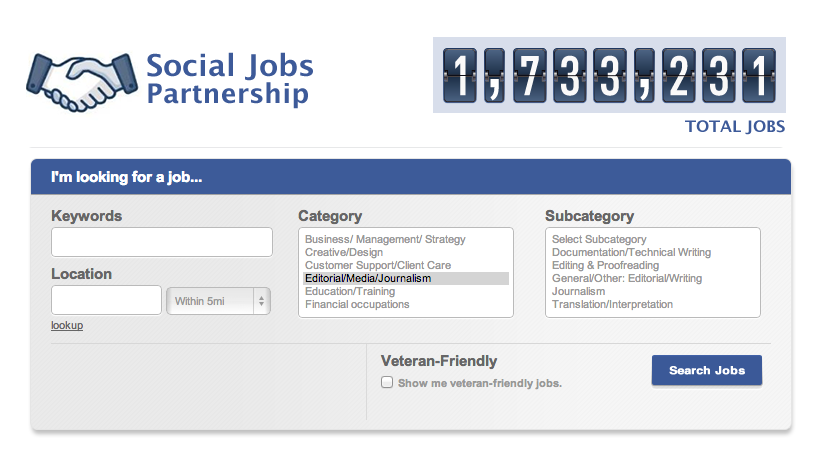
When you spend all your time on Facebook anyway, why not give the job market a quick look for new opportunities? The Social Jobs app aims to bring them straight to socially-apt job seekers.

The elections have come and gone but the high unemployment rate remains. You could either wait for the government to create more jobs, or you can try tapping the power of your social circles and hop on Facebook’s latest job searching app powered by employment websites BranchOut, Us.jobs, Work4Labs, Jobvite, and Monster.com.

As part of the Social Jobs Partnership – an initiative backed by the U.S. Department of Labor, the National Association of Colleges and Employers (NACE), DirectEmployers Association, the National Association of State Workforce Agencies – the collaborative effort aims to direct job listings to where they can get the biggest limelight. The simply-titled Social Jobs app, which does not require you to give permissions or add any third-party software, allows you search for jobs in a variety of industries and outputs listings from the combined opportunities posted on Monster, Jobvite, and the like. You can also narrow your searches by zip code or check the veteran-friendly box to consolidate local, applicable opportunities. At launch, the app hosts more more than 1.7 million jobs with additions on the way.

“Facebook is all about connecting people and we’re thrilled to see developers leveraging our platform to connect job seekers and prospective employers,” said Marne Levine, Facebooks’ Vice President for Global Public Policy. “By allowing job seekers to view and share job openings based on personalized criteria, like location and industry, the Social Jobs Application builds on our broader effort to help people use social media to find jobs in the U.S.”

The condensed location of job searches on Facebook makes perfect sense, given how potential employers are likely already searching for you on Facebook when you apply for a position. Much like the purposes of LinkedIn, Facebook also provides a window for networking opportunities – if users feel compelled to combine their personal social network profile with their professional life. Of course, there are no promises that you’ll find a perfect fit using the app but it sure is nice to have a single bookmark to give the job market a quick sift.

There’s no word on whether the app aims to extend to international markets, but for the moment, Social Jobs is a good start to bring you some potential opportunities stateside.


Source : digitaltrends[dot]com

Nov 10, 2012

This week in Facebook news

This week in Facebook: MItt Romney's page is losing friends, popular users can promote posts, and Facebook is upping your self esteem but killing your self control.

Not a week goes by that Facebook doesn’t issue a handful of releases or create a buzz around itself, and this one was no exception. Here are five of the top Facebook stories you may have missed from the last five days.

Mitt Romney is bleeding Facebook friends

romney facebook page bleeding of friends

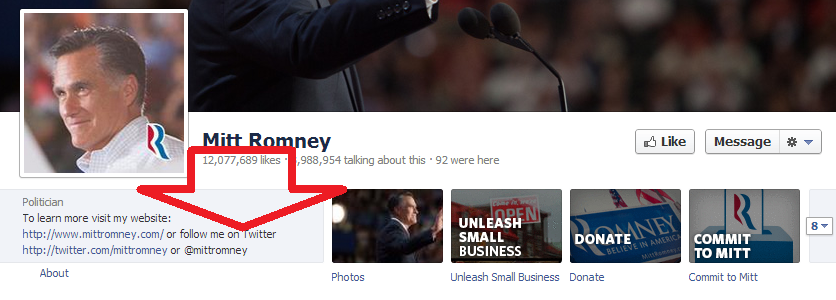
With the election over and along with it Mitt Romney’s campaign, and now Mitt Romney’s Facebook page is stuck in social media purgatory. Campaigners will no longer be updating the page, it just simply “exists.” Whatever the motivation may be, followers of the former presidential candidate’s Facebook page are unliking Romney in droves. “Refresh the page – 12.08 million. Refresh again – 15 less,” Caitlin Dewey of The Washington Post wrote when she first realized what was transpiring. We checked it out for ourselves, and indeed, we were witnessing an exodus of former followers fleeing his Facebook page – based on our eyeball calculation, we estimate about 10 followers were unliking the page every second. At this rate, should it be maintained, the “Likes” count will plummet to zero in just two weeks.

Fedex encourages shipping using its Facebook app

Just in time for the holiday season, and not long after Facebook Gifts was officially announced, Fedex is making a foray into making shipping social – sort of. Fedex’s newly launched Facebook App is called Ship To Friends, which is undoubtedly inspired by Facebook Gift’s own shipping process. On one hand, when we checked out the app we could see the value in the fact that it simplifies the process of shipping a package on the Web. If you’ve ever tried shipping a package on Fedex’s own website, you’ll know how frustrating it is to navigate as well as figure out the price and size of the package. Ship To Friends takes you through the process, with the prices listed clearly alongside delivery hours and dates. It makes you wonder why Fedex.com’s native shipping feature isn’t as easy to use as its Facebook app.

A couple caveats to note from our testing is that that international shipping isn’t supported and the app doesn’t send a shipping request to friends — meaning you can’t request that your friends enter in their own mailing addresses, which is a feature offered on Facebook Gifts. 

Facebook testing audio notifications

facebook audio notification settings

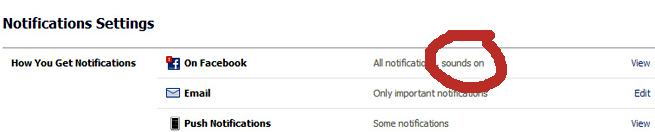
You might remember the days of the iconic “You’ve got mail” alert. It was annoying yet endearing, and apparently something similar may be heading to Facebook. Facebook confirmed with Venturebeat that alerts, which ping users when they receive new notifications, are being tested selectively. The alerts, if rolled out to all users, can be turned on and off in the account settings page.

Popular Facebook users can now get in on Promoted Posts

Facebook promoted post for over 5000 friends

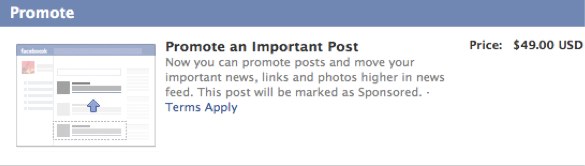
The upper echelons of Facebook users, who have more than 5,000 friends and/or subscribers, were unable to reap the “benefits” of the Promoted Posts advertising product that Facebook launched last month. Namely journalists, celebrities, politicians, and anyone else who would most likely have thousands of subscribers are the ones this change applies to. For those of us that fit in the 5,000 friends and fewer category are only charged $7 for a post to be promoted. It’s being reported that these users are being charged a premium of $49 to promote a post to friends and subscribers.

Facebook inflates egos, users lose self-control

Facebook can be addicting for some people, and for others it can boost self-esteem. A study by researchers from The University of Pittsburgh and Columbia University examined the effects of social media on human behavior and according to the paper, users are selective on what they share online and tend to portray themselves on social networks in a positive matter. This effectively boosts their self esteem. Interestingly enough, the study mentions that people looking in a mirror tend not to feel good about themselves. With this in mind, the researchers found a correlation between high self esteem and self control. “Enhanced self esteem from using a social network can have a detrimental effect on behavior,” says researchers Keith Wilcox of Columbia Business School, and Andrew T. Stephen of The University of Pittsburgh. “We present evidence suggesting that greater social network use is associated with a higher body-mass index and higher levels of credit card debt for individuals with strong ties to their social network.”

The root of the problem is that “elevated feelings of self-worth can lead to more impulsive or indulgent behavior. Citing Wilcox’s previous research, the study adds that inflated feelings of pride, which is related to self esteem, “results in more indulgent choices in subsequent tasks that are unrelated to the source of pride.”

We’ll go ahead and add this to the mountain of behavioral effects social networks are having on us. 

Facebook testing commenting threads

facebook comment threading

If you’ve ever cursed Facebook for overlooking the ability to comment on a comment, it looks like you’re in luck. A blogger and social media manager of Kairay Media discovered that comment threading was enabled on a Filipino Facebook page.

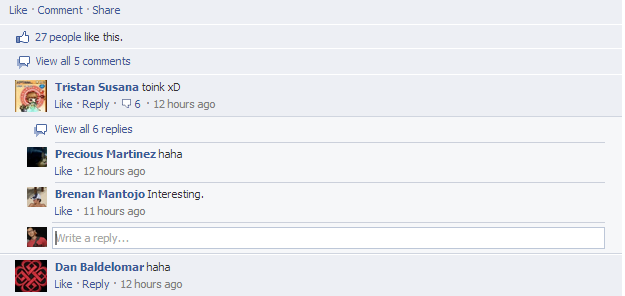
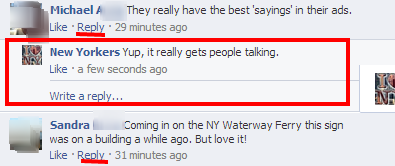
This feature, limited to a small test group, enables users to reply to comments. You’ll see a “Reply” button next to “Like” on the original comments. The replies to the comments can also be “Liked.” A third level of commenting isn’t supported. Facebook confirmed that the structure, as of testing, is as follows:

1. Comment

2. Reply to comment

Facebook’s spokesperson also provided us with the same statement, explaining the purpose of the feature:

“We are testing a new way to add comments to a post on Facebook. With this test you will be able to reply to another comment as well as the original post. This is just a small test at this stage.”

Comment threading, while being tested out at a limited scale, is a much awaited feature that many of us will be glad to embrace. For one thing, it should help to contain those heated arguments or side conversations in its own thread without disrupting the general flow.


Source : digitaltrends[dot]com

Facebook starts testing nested comments, sound notifications

Facebook Login Close-up

Rolling out a couple new features to a subset of users this week, Facebook is testing more in-depth commenting as well as sound alerts for notifications.

Mentioned on Mashable this week, Facebook  has started testing threaded comments on the Web version of the social network. Rather than posting a replay at the end of a long string of comments, this allows Facebook users to directly reply to comments within a conversation that’s on a user’s Timeline page. Beside the Like button on individual comments, Facebook has placed a “Reply” link to open up a comment box. After the reply is submitted,  a smaller version of the user’s profile picture will be positioned underneath the original comment. In addition, there’s another new link called “Write a Reply” that appears underneath the newly nested comment. Facebook has also added a “Hide Replies” button on the original post to allow users to hide that portion of the conversation.

Facebook threadedIn a statement released to Mashable, Facebook corporate communications manager Meredith Chin confirmed the testing process stating “We are testing a new way to add comments to a post on Facebook. Now you will be able to reply to another comment as well as the original post.”

Assuming nested replies works in conjunction with the notifications feature, Facebook users won’t have to tag someone’s name in the reply in order to get their attention. This will also be useful when conversations tend to veer off course from the original post or when brands need to specifically reach a fan. Threaded commenting has been a feature offered through Facebook’s comment plugin for third-party sites, but Facebook has yet to roll out the updated function on the site despite user requests for it. Facebook is currently testing threaded comments on a select group of profile pages, but users can see it in action on this Thai page.

Interestingly, the threaded comments feature currently doesn’t work on the mobile version of the social network quite yet according to ZConnection. Facebook users will simply see a chronologically stream of comments rather than the threaded version that appears on the Web version of the site. It’s possible that this could lead to confusion when replying to a comment within the mobile interface. 

Detailed by Venturebeat, Facebook is also testing a new sound alerting a user that a notification has arrived. This feature is currently being tested on a select group of profiles and there’s no indication from Facebook representatives that the social network will roll out the feature to a wider group. This feature would be ideal for Facebook users that want to be alerted the second that they get a reply to a particular comment, but it could become annoying for someone that receives twenty or more notifications a day. 

The good news is that Facebook has included an option to turn off the sound. If the notification sounds have been added to your profile during this testing phase, you can visit Account Settings and click on “Notifications” to manage the feature. Click the “View” link on the tab in order to reveal a checkbox for the sound notification feature. Check out the YouTube video below to hear the notification feature in action.


Source : digitaltrends[dot]com

Nov 9, 2012

Facebook Friendship Pages gets much-needed, long awaited Timeline face-lift

Friendship Page Screen Shot

Facebook will gradually roll out a new design, inspired by Timeline, to its Friendship Pages.

A fairly forgotten and relatively neglected feature are Facebook’s Friendship Pages. Conversations and activities exclusive between you and a friend are logged and presented in Facebook’s old wall format, but Facebook announced it’s working on a gradual and much-needed face-lift for this feature.

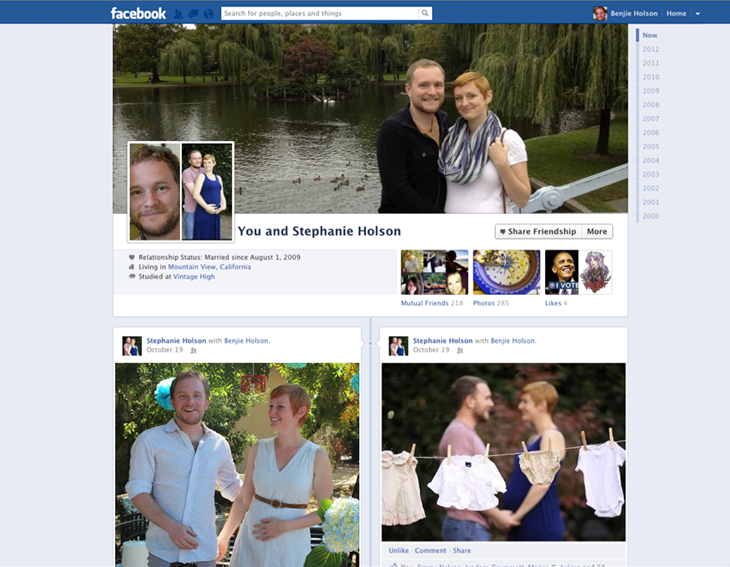
The redesign of the page will parallel Facebook’s Timeline look, including the cover photo, friends, photos, events, and likes. Of course since you’re sharing a page with your friend, all these features will be tailored to you and this person’s mutual relationships and common interests. Photos will show up in the format of images that you and your friend have both been tagged in, and you’ll be able to see the same Facebook pages you’ve liked.

The idea behind Facebook’s Friendship Pages is that they act as a reminder of how, where, and when you and a friend met, or a nostalgic moment. But when the Friendship Timeline is released worldwide, it might encourage users to maintain relationships since the design of Timeline, which emphasizes images, is inherently personalized.

The value in Friendship Pages is more apparent if you’re in a relationship with a significant other. All the memories that you’ve shared are immortalized on a page dedicated to your relationship, where you can track your conversations without digging through your own Timeline history. On the other hand, the last thing any broken-up couple would want to see is a rehash of all the good times.

There are two ways to access your Friendship Page. If you look at a friend’s Timeline, you need to click on a gear icon at the top of their page to open up a dropdown menu. The first option there is “See Friendship,” which will open up the Friendship Page. The second access point is through your friend’s list on your own Timeline. If you click on the box labeled “Friends,” you’ll notice a link titled “See Friendship” that accompanies each of your friend’s profile photos.

If your relationship status isn’t set to single, you can visit facebook.com/us to find you and your significant other’s Friendship Page.

Facebook Timeline and its advertising products have been the primary focus for the network as of late. It’s worth reminding you that the platform has been hard at work with feature updates intended to boost user engagement in its auxiliary services like Facebook Groups, Facebook Messenger, Calendar, and now Friendship Pages.


Source : digitaltrends[dot]com
Nov 6, 2012

The problem with your socially-sourced election predictions

social media and election predictions

As the 2012 presidential election comes to a close, our interest is being held captive by early results sourced by the likes of Twitter and Facebook. But for all of the infographics created from this data, is there really enough here to offer election predictions?

Finally, November 6 is here. Election Day has come and that means the campaigns we’ve watched unfold over what feels like a lifetime are coming to an end. And this has been an election season the likes of which we’ve never seen: It’s infiltrated every last pore of our existence thanks to the deluge of social media outreach and coverage.

And it’s not over yet. While the votes have yet to be counted, we apparently already have an outcome: Obama will be our president for another four years.

How do we know this? Social media. Statistically, candidates who have more Facebook Likes and Twitter followers tend to win. Three recent gubernatorial races went to the candidate with largest Twitter follower counts.

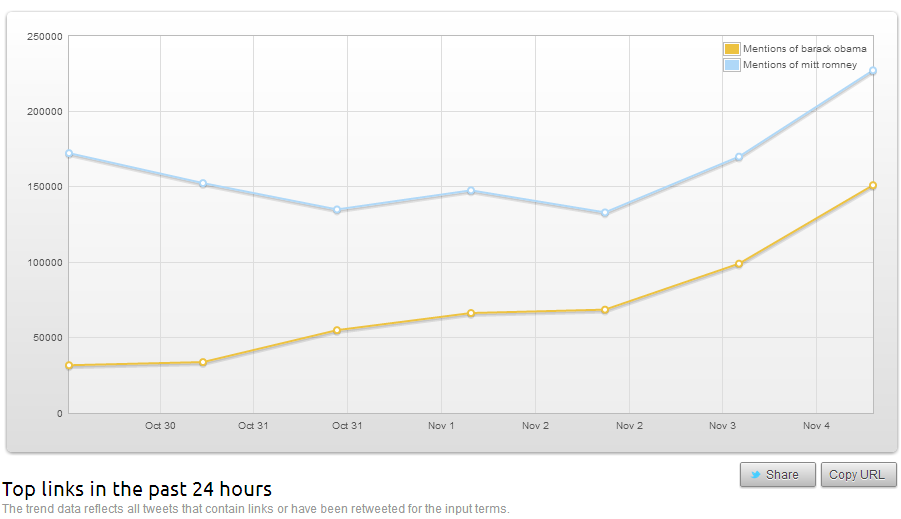
But wait – there’s also an argument that @mentions indicate who our winner is going to be. The candidate everyone’s talking about will be the next president. In that case, Mitt Romney takes the lead.

topsy election

And if you think Web buzz in general is going to predict our next president, then once again it’s Romney for the win.

google trends election

Social network-sourced election predictions are everywhere, but whether they mean anything is unclear. There’s no shortage of infographics using eye-catching visuals to colorfully chart out how we’re using Facebook, Twitter, and Instagram to talk about our candidates, but not enough analysis about whether this content is signal or noise.

What we do know is this:

  • People increasingly use social networks; as of May, eight percent of online adults were using Twitter on a typical day.
  • People increasingly get their news from social media and digital outlets; according to a Pew Research Center Report, “the percentage of Americans saying they saw news or news headlines on a social networking site [from the day before] has doubled from nine percent to 19 percent – since 2010.”
  • 88 percent of social media users are registered voters.

election infographicsThe big picture take-away from this is that social media and elections matters; politicians should be creating content here, because constituents react to it. But the data raises more questions than it answers. What about sarcasm, mood, and sentiment? Or spam accounts? Or malicious posts meant to manipulate a social network? We just saw how completely faked information can take over a platform as well as the news cycle, so what’s to keep us safe from similar effects with election predictions?

For all the revealing bite-sized data we can squeeze out of Facebook posts and followers and Twitter mentions and hashtags, there are plenty of glaring inaccuracies as well. According to Twitter, Ron Paul should have been the Republican nominee, and the Iowa primary would have ended quite differently.

For every insightful social media analysis, there are 10 terribly shallow ones. Countless news outlets launch tools or republish infographics that count “buzz” – and if that’s all we we’re looking for, Herman Cain would probably be our next president.

What’s missing, of course, is context. So many of the endlessly-circulated infographics and charts we’ve seen this year are heavy on data and pie charts and graphs and lack anything to put those numbers into perspective.

As a rule, these prediction tools aren’t able to determine if tweets or Facebook posts are coming from people who are even eligible to vote. According to a recent study, 73.7 percent of Twitter users are between the ages of 15 and 25, so there’s plenty of opportunity here for users who can’t vote to be sharing their opinions. To further complicate things, only 0.45 percent of Twitter users disclose their ages. 46 percent of Facebook users are 45 or older, but given how large Facebook is, this number is sort of insignificant; it means that there are plenty of under-aged users on the site who could very well be endorsing candidates they can’t vote for.

Demographics in general are rather ignored – the most notable of them being that the people who use social networks to talk about politics are already politically motivated. This means that those who keep their political ideals to themselves or don’t have strong enough beliefs to broadcast them – but will still vote – aren’t being counted. In traditional prediction methods, pollsters specifically reached out to this subset in order to create more accurate views of the elections, but since the data being pulled from social networks is all self-motivated, these data simply get left out.

German researchers recently looked at Twitter’s predictive abilities, saying: “While we find evidence of a lively political debate on Twitter, this discussion is still dominated by a small number of users: Only four percent of all users accounted for more than 40 percent of the messages.” This was back in 2009, but surely the scale still speaks to a notable discrepancy.

“So long as you understand the data and the demographics of social users, you can measure sentiment in perspective and target relevant messages to those groups,” says 140Proof founder and CTO John Manoogian III says. “The problem comes when pundits and analysts mistakenly assume that social media aggregates the tastes and preferences of all voters — it does not. Sites like Facebook and Twitter have political leanings. But social media does pretty strongly indicate what young, educated, and/or professional voters are saying.”

A much bigger factor is the failure of sentiment and mood analysis. The mechanisms we use to measure social media talk aren’t sophisticated enough to know if you’re slamming Obama or endorsing him. Some people can barely read sarcasm, so don’t expect applications pulling in tweets and posts to consistently do so. If you write “Oh sure, I totally believe Romney has women’s interests at heart,” in a Facebook post, it will likely be interpreted as a pro-Mitt statement.  

There’s also the fact that we want this to work; we want to be able to use social media to tell us how we all really feel. “This is the so-called file-drawer effect: researchers do not publish negative results, hence, only positive results are known and it seems that something is possible most of the time when it could be due to pure chance,” says researcher Daniel Gayo-Avello. “A paper [I wrote with] Eni Mustafaraj and Takis Metaxas showed that, in fact, results could be guessed roughly half of the time; that is not an impressive predictive ability, isn’t it?”

“Thus, by not knowing (because they are seldom published) about negative results, everybody assumes that simple methods simply work; and, indeed, they ‘work’ but half of the time, akin to a broken watch which ‘works’ twice a day.”

This doesn’t mean all this information isn’t valuable – it absolutely is, and interesting to boot. There’s no argument that politicians shouldn’t be using social networks, and this type of outreach is only going to become more common and more sophisticated.

The big lesson is social networking can be used as an indicator of opinion, but not necessarily decision. There are just too many loose ends involved, and until they can be tied up, you’re just going to have to learn who will win our elections the old fashioned way: by waiting up all night for some guy or gal on TV to announce it. 


Source : digitaltrends[dot]com
Nov 5, 2012

Facebook Camera, Messenger, Gifts added to main iOS app in 5.1 update

facebook ios app 5.1

Facebook has pushed a major update to its main iOS app, porting the best elements of its standalone Messenger and Camera apps, as well as adding Facebook Gifts.

Facebook has pushed some major updates to its iOS app: In the latest version, the best elements of Facebook Messenger and Camera make an appearance in the native iOS app, and for those of you that are lucky enough to have early access to Facebook Gifts, sending gifts to friends can now be done through the mobile app.

Facebook Camera and Messenger were formerly standalone apps, coexisting with the Facebook app but accessible on their own only. Now, the main iOS app offers a healthy dose of the best of both of these apps.

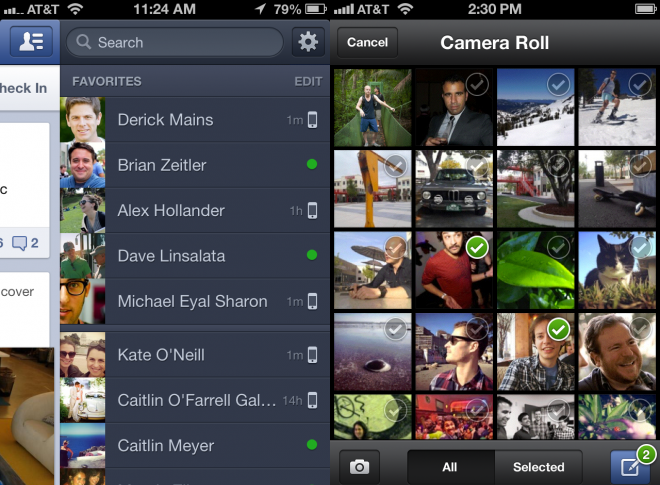
The update that adds Facebook Camera’s features is comparably minor to the other changes. The photo icon at the very top of your Facebook News Feed, which opens up your device’s camera roll, now enables you to select and share multiple photos to your Facebook page. Previously, Facebook only supported sharing one photo at a time. Sharing an album to Facebook was, to be blunt, a huge inconvenience. 

You’ll find the Messenger integration with Facebook’s main iOS app to be convenient for frequent users. It’s now significantly more efficient to instantly message your Facebook friends since online friends are listed on the app. Sliding your News Feed to the left reveals a “Favorites” and “Active Now” list, where you can see all of your Facebook friends that are online at the moment. “Favorites” surfaces the friends that you most interact with, but you can edit the friends that appear on your list. Unfortunately video chatting is a feature supported via desktop only. In 5.0, messages were initiated through the messaging icon, which felt more like we were sending an email than an instant message, and 5.1 makes this much more instant chat-friendly. 

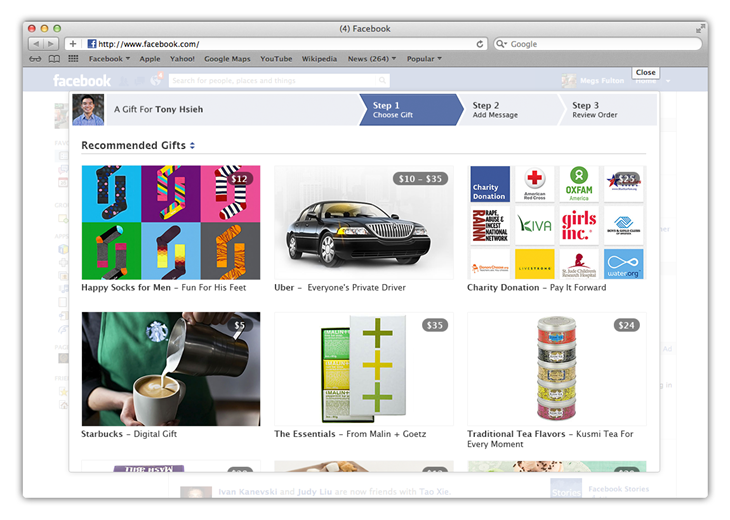
The major news in the 5.1 mobile update is addition of the e-commerce platform that the social networking company calls Facebook Gifts. The platform was launched in September and rolled out slowly to the United States user base. With Facebook Gifts, users can send gifts selected from an assortment of third-party product partners to Facebook friends and family on special occasions like holidays and birthdays. And since launching Gifts, you’re not relegated to sending gifts to just your friends and family anymore. Charity partners are accepting charitable Facebook gifts including the American Red Cross, St. Jude Children’s Hospital, and Water.org.


Source : digitaltrends[dot]com
Nov 1, 2012

Finally, you can now search the Facebook App Center

Facebook Gifts charity

Facebook added a few updates today: The social network has added search and sponsored results to its App Center, and announced 11 partners to its Facebook Gifts program.

Among other announcements today, Facebook finally introduced a search function to its App Center to aid in discovering new Facebook apps. Sponsored Results will also now start showing up when you search the Facebook App Center. Lastly, with the Facebook Gifts event in New York City having been canceled altogether due to Hurricane Sandy, Facebook made the intended announcement anyway to reveal that 11 new charity partners have been added to its Facebook Gifts program. Facebook users can now make charitable contributions on Facebook Gifts to these select charities. Let’s take a closer look at the three announcements. 

Facebook App Center search 

Just as its important for developers to get their apps visible real estate in the Apple App Store and for SEO marketers to get their sites to the top of Google’s search engine, it’s vital for developers to climb to the top of Facebook’s App Center — search and discovery for new apps is incredibly important to their success. Facebook announced today on its developer blog that the social network is finally rolling out a keyword search engine to help with the discovery of published apps within Facebook’s App Center.

“All listed app detail pages will be included in our search index, and no changes are necessary for developers,” Zhen Fang a manager at Facebook, writes in the blog post. Developers won’t be required to make any updates to apps for Facebook to start indexing them. It should help developers get their apps discovered amid the sea of apps offered to attract some of the 220 million monthly users that visit the App Center.

Of course, it also means it will be easier for user to find apps in the first place. At the moment, the only way to view official Timeline Apps is to sort through this page. And if you want to see all the available apps, you’re left to scroll endlessly. This is a much-needed, update to make the App Center a legitimate platform. 

Sponsored Results available in App Center

Facebook made a brief splash with Sponsored Results, which the social network introduced in August. The new advertising product promoted search results in its search engine based on targeted keywords. It enabled third party related apps to be listed, for instance, when you searched Instagram. Today, Facebook announced that Sponsored Results would be coming to the App Center. Developers can, beginning today, promote their apps in the App Center by “targeting Facebook entities, including Facebook Pages, Places, Apps and subscribe-enabled users.” One thing to note about this feature is that it only works on Facebook’s desktop app, and not on its mobile apps.

Gifting charities on Facebook

facebook list of charities for gifts

Facebook’s Gift announcement set to take place at FAO Schwarz in New York City today was canceled due to Hurricane Sandy. It was rumored that Facebook was simply announcing more partners to its program, and for the most part that hunch was correct. Conicidentally enough, the announcement set weeks in advance comes in the aftermath of a devastating hurricane, which Facebook has taken note of:

“We are especially pleased to be launching this test now – when so many people are looking for new ways to help the victims of Hurricane Sandy, or assist those most in need around the holidays,” Facebook product design engineer, Jared Morgenstern, writes in a blog post.

Now you can make charitable contributions using Facebook Gifts to 11 charity partners that Facebook unveiled today. It’s the first expansion of its Gifting platform that now can be used not only for sending gifts for your friend’s special occasions, whether it’s a birthday or an anniversary, but for donations as well. 

Some of you may yet have Facebook Gifts, but don’t fret. Facebook is rolling out the feature gradually and Morgenstern assures us that it’s “coming to you very soon.”

You can check out the list of charity launch partners below:

  • American Red Cross
  • Blue Star Families
  • Boys & Girls Clubs of America
  • DonorsChoose.org
  • Girls Inc.
  • Kiva
  • LIVESTRONG
  • Oxfam America
  • RAINN
  • St. Jude’s Children’s Research Hospital
  • Water.org

Source : digitaltrends[dot]com
DT Daily: Facebook takes aim at Craigslist, Halo 4 reviews arrive

Facebook takes aim at Craigslist, Halo 4 reviews arrive, the U.S. government launches a stolen phone database, Kim Dotcom reveals more details about his new cloud storage service, and Walmart teams up with streaming video company Boxee.

Related Links:


Source : digitaltrends[dot]com
Oct 31, 2012

Archos 80 Cobalt is an 8-inch, Android 4.0 tablet

Archos has announced their upcoming Android tablet on their Facebook page. Called the Archos 80 Cobalt, the tablet has an 8-inch, 1024 x 768 resolution display and runs on Android 4.0, Ice Cream Sandwich.

Inside, the Archos 80 Cobalt runs on an unspecified SoC with a dual-core 1.6GHz CPU and a quad-core GPU with 1GB of RAM. There is 8GB of internal storage space with microSD card slot. There is a 2 megapixel camera on the back and a VGA camera on the front.

No pricing and availability information has been released so far.


Source : blog[dot]gsmarena[dot]com

Facebook to take on Craigslist with classifieds plan, report claims

money-facebook

Facebook is set to challenge the king of online classifieds Craigslist with the launch of its own service, a report claims.

In an effort to find new revenue streams, Facebook is reportedly looking at the possibility of launching a classified ads service that may give Craigslist a run for its money.

The service would offer a mix of paid and free ads and include items for sale, apartment rentals and job vacancies, among other things.

A report by The Daily says “two sources within Facebook” claim the service will be called Marketplace, the same name given to a similar project launched by Facebook five years ago and which is now operated by Oodle.

Whereas Craigslist functions as a noticeboard that sits on the Web waiting for people to come and explore it, Facebook’s Marketplace would target members of its enormous site according to information in their profiles, posting ads in friends’ news feeds – similar to the way in which the promoted posts feature works.

For example, if you wanted to advertise a room in a particular location, you could tag friends who you think might be interested, with only those in the area receiving the ad – they could, however, share it with others if they knew someone who they thought could be interested.

While room ads are likely to be free, selling items will require a small fee – expected to be under $5 – with the ad appearing in friends’ feeds.

With job ads, a vacancy requiring a particular degree would end up in the feed only of those people with that specific qualification, while a ‘projects’ section would allow users to share tips and information on a range of subjects. “It’s possible the next generation of startups could be formed within this section,” The Daily suggests optimistically.

Whether such a service will pose any kind of threat to Craigslist remains to be seen, though with the well-established and popular classifieds site open to all, it should have little trouble in maintaining at the very least a decent chunk of its massive user base. Facebook, meanwhile, will be hoping it can use its Marketplace service to generate some much-needed revenue from its 552 million users.

While a launch date for the service appears not to have been set, The Daily’s sources claim it is being fast-tracked for launch.


Source : digitaltrends[dot]com

Oct 27, 2012

Tired of politics on Facebook? Replace it with cat pictures

Unpolitic.me

Ideal for everyone tired of listening to campaign rhetoric being spouted by Facebook friends, there's a Chrome extension that can help silence the noise.

Covered in detail by The Register recently, Buzzfeed and the creators of Unbaby.me have developed a new Chrome extension to help people avoid endless political posts on Facebook and Twitter as the 2012 Presidential election rapidly approaches on November 6. While the previous Firefox and Chrome extension Unbaby.me replaced all baby photos on Facebook with images of bacon, puppies and art among other things, the Chrome-only Unpolitic.me extension replaces the majority of political posts on Facebook and Twitter with various pictures of cats.

facebook-unpolitic-meWhile Facebook does provide filters to help users avoid updates from specific Facebook friends, this type of application can be particularly helpful for anyone that’s tired of hearing about politics. It allows the Facebook user to avoid political posts, but still read other interesting updates about friends, family and activities from politically outspoken friends.

The Unpolitic.me extension works by actively scanning a user’s social media feed for mention of specific keywords related to politics. While the user has the option of adding any specific keyword into the mix, a large number of default keywords have already been selected for the user.

For instance, the creators of the extension have added “Romney, Obama, election, voting for, republican, democrat, Ron Paul, 47 percent, binders, debate, how messed up is this country, Biden, Paul Ryan, Akin, Scott Brown, Elizabeth Warren, abortion, romnesia” along with 30 other keywords to help identify political posts. 

In addition, the user of the Unpolitic.me extension has the ability to use any image-based RSS feed. The creators of the extension have set the default as a stream of cat pictures from Instagram users. However, the user of the extension can change the RSS feed to anything else in addition to adding more feeds into the mix. There’s no reason that a usr has to stick with cat pictures.

For instance, someone that likes all types of cute animals could add more image streams of puppies, panda bears and bunnies. The makers of the extension recommend using RSS feeds that provide large resolution pictures. In addition, there’s no limit to the number of RSS feeds that a user can choose to use.

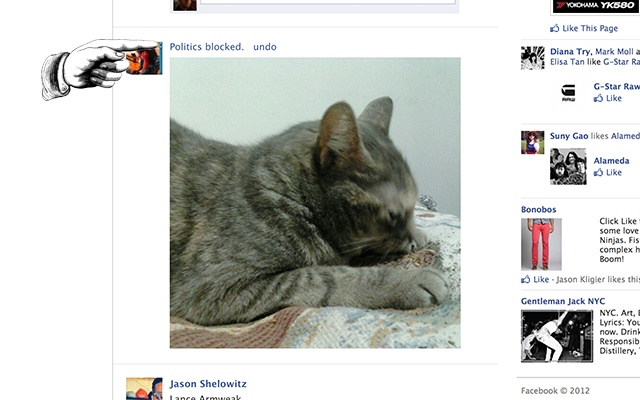
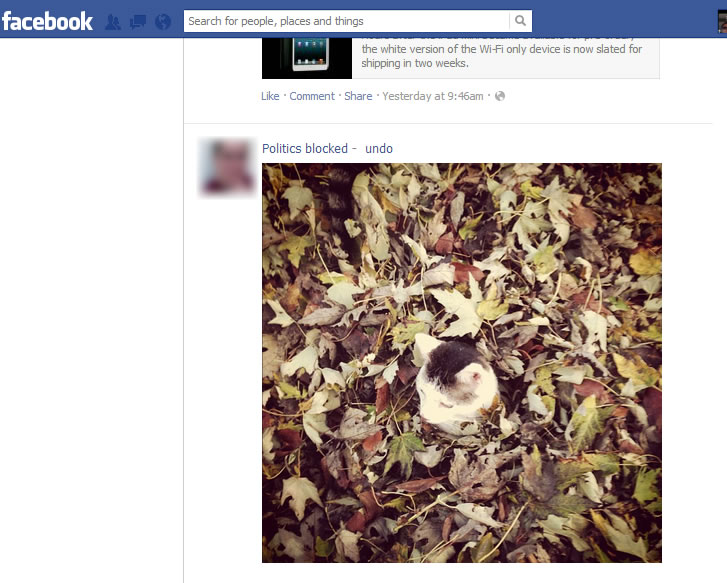
twitter unpoliic meThe Unpolitic.me extension will randomly pull from those feeds and replace the content on the page. On Facebook, a post about politics is simply replaced with the phrase “Politics blocked” and the replacement image. There’s also a link to remove the image if the user really wants to see what was originally posted. On Twitter, the user also has the ability to undo the content block. However, Twitter users will see a link to Buzzfeed’s animals section rather than a photo pulled from the RSS feeds chosen by the user. 

Conceptually, the Unpolitic.me extension can be used to block any type of content found on Facebook or Twitter. If a user doesn’t like a particular organization, any posts about said organization can be blocked by adding a few keywords in the settings of the extension. However, the extension can only block posts that include words. For instance, if a Facebook friend posts an political meme without adding a description, the person using Unpolitic.me will still see the political post within their Facebook feed. 


Source : digitaltrends[dot]com
Oct 26, 2012

One third of young adults in America are Facebook friends with their boss

Facebook browsing

Despite the possibility that bad behavior posted on the Web could lead to real-world consequences, more young adults are befriending their boss on Facebook.

Detailed in a new study commissioned by AVG, approximately thirty-three percent of Americans between the age of 18 to 25 are Facebook friends with their boss in the workplace. While the average of all eleven countries was around twenty-five percent, the United States and Italy tied for the highest percentage of young adults that befriended their boss on the popular social network. Alternatively, the lowest percentages came from Germany, Japan and France. AVG’s sample size across the eleven countries included approximately 4,400 young adults. 

Facebook Login Close-upRegarding this social trend with young adults, AVG Security Evangelist Tony Anscombe stated “AVG’s latest research clearly shows young people today have a comfort with using online social networks that is leading to blurring between their professional and private lives. It seems obvious that posting abusive content about a boss or workplace is not very sensible, but it’s important to understand that not only could it damage a person’s existing career, it could also negatively impact on future opportunities too.”

In addition, an average of thirteen percent of young adults claimed to have posted a negative comment on Facebook about their boss or workplace after a stressful day at the office. Employees in Germany, Spain and Italy were the most likely to complain on Facebook. Nearly sixty percent of Americans don’t take advantage of Facebook’s filtering tools to restrict the content that can be viewed by co-workers. People working in Japan and the Czech Republic were the most likely to bypass those security filters while young adults in Germany and France are more diligent about hiding updates from co-workers. 

Approximately 43 percent of young adults had performed an audit of all social profiles on the Web in order to make themselves look attractive to employers. In addition, thirteen percent of young adults in America mentioned that information found on one of their social pages was brought up during an interview. Regarding the use of information found on social media profiles during the interview process, Anscombe said “Our research findings indicate that today’s 18- 25 year old ‘digital natives’ need to be more aware of their online brand as something employers and recruiters are increasingly investigating.” 

Facebook at workWhile America did rank the highest for boss friendships, young American adults are carefully watching what type of media is posted on Facebook. According to the report, the United States ranked the lowest in young adults that are posting inappropriate images on their Facebook accounts.

Spain ranked the highest as eighty percent of respondents claim to post inappropriate images on their profiles. Interestingly, over half of all respondents wish that they could remove all inappropriate images of themselves off social networks. 

Regarding accessing social networks in the workplace, nearly sixty percent of Americans admit to using a mobile device like a smartphone to access Facebook or other social networks. A previous study indicated that nearly eighty percent of people can’t last a single day without checking up on the latest Facebook status updates. More recently, a man attempting to become more productive while working hired a woman off Craigslist to slap him in the face each time he started wasting time on Facebook. 


Source : digitaltrends[dot]com

A field trip to the Facebook black market in which we buy 1.5 million accounts and email addresses for $5

facebook black market

There's a black market for just about everything, including your private Facebook ID, email address, name and it costs just $5. After one IT specialist found he could net a million users' account information, we had to go and see for ourselves. To no one's surprise, it's very real and very easy.

The seedy underbelly of Facebook has surfaced yet again thanks to Bogomil Shopov, an online IT marketing and community management professional from Bulgaria, who recently was able to purchase one million names, email addresses, and Facebook profile IDs. 

While browsing the Web for free marketing tools and guides for his business, or “zero budget marketing,” as he told me, Shopov was led to Gigbucks. Gigbucks is an “e-commerce” platform similar to Fiverr, where buyers can purchase services or products for as little has $5 or as much as $50. But what he stumbled on was an offer for one million Facebook accounts and their email addresses that were mined from a Facebook app. Out of curiosity, Shopov purchased the Excel list for $5 and shortly thereafter received the list as promised. He recognized that the header was Turkish, indicating that the developers responsible for procuring the user information were from Turkey, but the accounts were primarily of users located in the United States, Canada, and the UK.

After publishing his blog post detailing the transaction, Facebook reached out to Shopov via phone to find out how exactly he’d gotten his hands on all this data. And when we checked out the URL again today, we noticed that the offer had been taken down from Gigbucks. Shopov told us that Gigbucks’s administrators notified him last night that the offer was removed, likely at the request (read: demand) of Facebook.

As Facebook has introduced more seamless interactions into Facebook Connect and its Open Graph apps, it’s become more difficult to know what you’re giving up and what you’re giving access to; it’s all much less noticeable than it used to be. Users may not realize that it’s rather simple for developers to mine your information; too many of us assume that third-party Facebook app developers won’t use your information like this. “The data that we voluntarily provide to social networks, even as we police our privacy settings, is becoming increasingly vulnerable,” says Robert Leshner, founder of Safeshephard. “It’s not Facebook or even LinkedIn that we have to worry about,” Leshner adds. “It’s the weakest link in the privacy chain, and right now that’s third-party apps. The walled garden of Facebook isn’t very well walled off – it’s crumbling.”

How third-party developers do this is by creating apps (that may or may not offer value) for the sole purpose of collecting user data, a practice we’ve talked about before. When you first use a Facebook app, a page pops up that describes the information you’re permitting the developer to access. Your email address, name, user ID, gender, and other basic information is fair game — and if it gets into the wrong hands, can then be aggregated into a tidy list and sold off.

There’s a rather large incentive among blackhat marketers to pay for this valuable list of real email addresses and Facebook accounts (Facebook, after all, has made a name for itself as the proprietor of real identities). These addresses can be used to boost the number of followers on Facebook pages (through invitations), or Facebook users can be placed on email lists. It can also be used to target these specific users based on email addresses, phone numbers, and user ID. Note that you can find the Facebook account associated with an email address simply by typing the email into Facebook’s search bar, similarly to how a researcher previously discovered the Facebook profiles associated with the phone numbers.

A simple Web query reveals an expansive and thriving underground market for Facebook IDs linked to email addresses. It’s reminiscent of the market for hacked Twitter accounts that we reported on earlier this month. In fact, we were able to purchase a couple of these lists for a little as $5 each. Like Shopov, we were sent a .rar file with several .txt files listing over 1.5 million email addresses, names, and Facebook profile IDs. And yes, it really was that easy.

What one of the sellers revealed to us just how prevalent and common the practice of buying and selling this data is: He purchased a list of 32 million email addresses and Facebook accounts from his friends and repackaged the list into sets of between one and two million email addresses to resell. There also appears to be some reusing and recycling going on, as we realized we’d purchased duplicate lists from two different sellers.

With our increasing reliance on using Facebook or other social networks to access third-party applications, our data can be easily misused and profited from by third-parties. Before you allow an app access to your information next time around, you might want to be more mindful.

We reached out to Facebook and will update you with their response.


Source : digitaltrends[dot]com

Guys, Facebook Collections isn’t gone, just under further ‘development’

facebook collections

Facebook Collections may have temporarily disappeared, but a representative says the feature isn't getting shut down. Instead, a mobile version is under development, which isn't possible unless the feature comes off the site entirely first.

Yesterday, TechCrunch first reported that it noticed Facebook Collections, a Pinterest-esque feature where users can group photo collections from Brands, similar to the form of “Liking” something was missing. We reached out to Facebook to confirm that Collections isn’t particularly gone, but is going under further evaluation before the social network can proceed with how to launch the product (if at all).

“Product development on Collections has not stopped,” a Facebook representative tells us. “Instead we have completed our initial test of Collections and are now analyzing the data to inform product development. For many of the product tests we do, we periodically pause the test to assess how to best progress with the product’s rollout.”

The rep goes on to elaborate that Facebook is working on a mobile edition on which Collections was previously not available. “We want to build out the mobile experience as well as make enhancements, which we can’t do unless we remove the functionality from external users.”

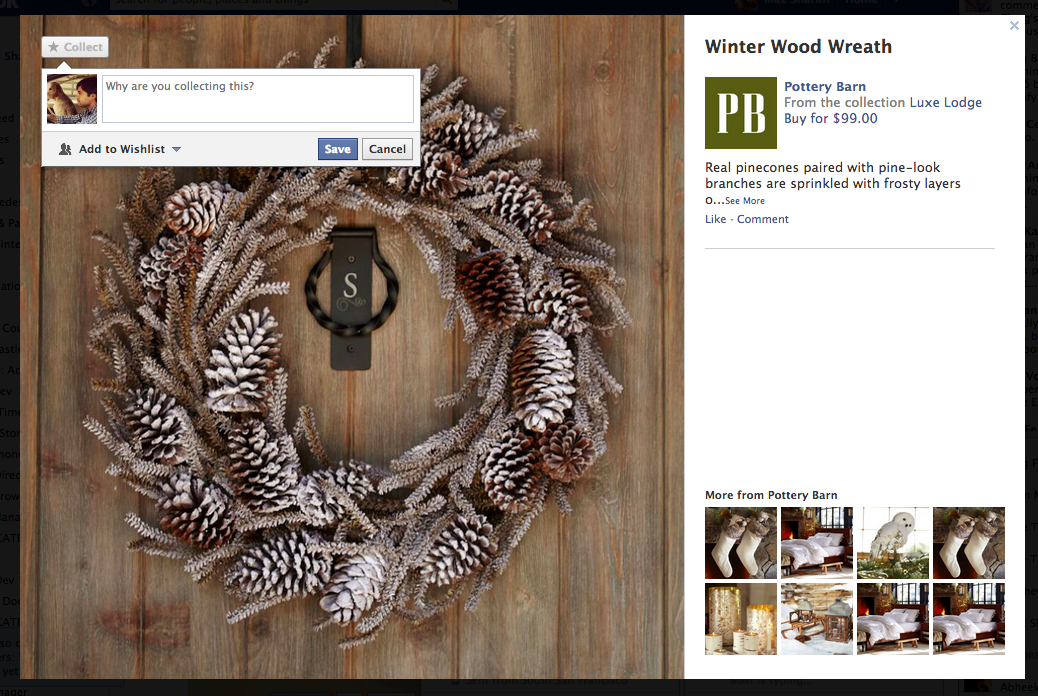
If you haven’t noticed Collections, you’re not missing much. It’s basically a way for Facebook to monopolize on good marketing and social networking strategies from other websites so Facebook users don’t need to leave the site to enjoy such features. But with the sudden disappearance of Collections, either the team is trying to develop it into something more original than the Pinterest scheme, or it may eventually realize the feature won’t really work well on Facebook. For one, Facebook isn’t necessarily a go-to marketplace, and while brands use it to promote and tease products, users aren’t exactly buying things off the site like they used to with Facebook Gifts. Still, as a now-public company, it is the social network’s responsibility to monetize as best it can, so perhaps this truly is the beginning of the Facebook commercial market on a consumer level.

There are no words on when we can expect to hear about Facebook Collections again, although the limited initial testing probably means not too many of you have even used the feature. For now, it remains in flux — though one thing is certain: Facebook is hell bent on turning a dime by targeting the elusive social shopping market.


Source : digitaltrends[dot]com
How to Find Your Facebook ID

As of March 2012, an estimated 901 million people are active users on Facebook, the most popular social media network on the planet, I believe this number has increased to over 1 billion people. The social networks has taken great measures to manage each users account with a number of features to provide their members with security and privacy while using their accounts. When a new member sets up their Facebook account for the first time, the system immediately assigns the Facebook user with an ID number.

For whatever reason, users may want to know how to retrieve their Facebook ID. The steps to do this are simple, and just a few clicks away.

How to Find Your Facebook ID Number

1) Log into your Facebook account.

2) You should be able to see your name beside your profile picture at the upper right corner, click on it

3) There are two ways of doing this, you can either hover your mouse over your profile photo or click on your profile photo and wait for the page to load.

5) Go to the URL bar in your browser with your mouse and slide it along the bar; you should see a string of
numbers appear.

6) Look for the set of numbers that follow after the word “fbid=”.

7) This is your Facebook ID number.

Social networking websites such as Facebook has one priority which is to help their account users stay connected with their family and friends, and also have endless opportunities to meet new people along the way. Email, phone numbers, and physical addresses can all be easily accessed with an active Facebook ID. The Facebook ID number especially comes in handy if you’re a person who uses Facebook applications on a regular basis. It also allows you to compare your social ranking with your friends’ ID’s as well.

Also See: How To Enable Your Facebook Timeline: Fast & Easy

A Facebook user who wants to know how to find their ID number by means of an app can retrieve it by following these instructions:

1) Log into your Facebook account

2) In the search box, type “What is My ID?”. Locate the top search result from your query in the drop-down
menu.

3) You will see the phrase, “Go to App”, click the tab and then click “Allow”.

4) Your Facebook ID will appear.

To locate Your Facebook Fanpage ID, you can follow similar steps

Tags: Facebook ID, Find Facebook ID, Get Facebook ID

Source : techtalkafrica[dot]com

Oct 25, 2012

How To Look For a Job With Facebook

If you are in the market for a new job, you might be wondering how you can make good usage of the time that you are already spending on Facebook. Figuring out how to use Facebook to find your next job is almost as easy as using Facebook itself. In addition to the fact that social networking was designed to help connect people for various reasons, there are also several apps on Facebook that are devoted to helping people connect with a new employer.

facebook

Flickr image by pshab

It is vital that you learn how to protect your privacy on Facebook, however, so that your current employer does not find out that you are in the market for a new job. In addition to setting your post to friends only, you can also block specific people who are on your friends list from seeing individual posts. If you are not sure how to do this, read on for a quick tutorial.

Blocking Friends From Specific Facebook Posts

When you begin typing your status update, you will see a word in grey next to the post button. You can click on it and go down the list to the custom option. Once you have selected the custom option, you will get a pop-up window with a few other options. Under “make this visible to” you should select friends. Under “hide this from” you should list each person who works for your current company. By taking this step, you will ensure that your boss will not find out about your new job search until you are ready for him or her to know about it.

Once you have posted about your new job hunt, you should also individually reach out to all of the people on your friends list who work in an industry that interests you. For privacy reasons, make sure that you contact them via Facebook’s messaging system, rather than leaving a comment on their timeline.

Using Facebook Apps to Find a New Job

If getting the word out to your network of friends does not present you with a viable job lead, then you should utilize Facebook’s apps. There are several apps for those who are looking for a new job, and most of them have different focal points. BranchOut, for example, let’s you connect with others who work in similar industries, and it also enables you to meet new people through your list of Facebook friends.

branchout-homepage

inside-connections

Image courtesy of Personeelsnet

Facebook also has a Marketplace app that acts as the classified ads section of Facebook. At any given time there are millions of job postings listed from around the world, and the listings are easy to search via location, industry, job title and company.

If you properly utilize all of the available options, it is extremely likely that you can find your next job during your daily visit to Facebook.

Tags: Facebook Job Hunting, Facebook Jobhunt, Facebook Jobs, Facebook Jobsearch

Source : techtalkafrica[dot]com

Facebook’s Oldest Users Jostle for Title

Mark Zuckerberg likely never imagined this when he founded Facebook as an undergraduate in his Harvard dorm room.

The website he created as a social network for college students is now the site of a brewing battle between two centenarians over who can lay claim to being the oldest among Facebook’s more than 1 billion monthly users.

Logged on in one corner is Florence Detlor, the 101-year-old Californian who, in August, was designated Facebook’s oldest user by Zuckerberg and Facebook COO Sheryl Sandberg. Detlor traveled to the social network’s Palo Alto campus for a personal tour.

READ MORE: Vest Promises a Hug Every Time You Get a ‘Like’ on Facebook

In the other corner is a New Mexico woman, Maria “Mary” Colunia Segura-Metzgar, who just celebrated her 105th birthday on Tuesday and has her own Facebook page, complete with 86 friends.

Segura-Metzgar, however, is so far removed from the typical Facebook user that she had to shave a few years off her age in order to join the site, according to her 60-year-old grandson, Anthony Segura, who is responsible for signing her up.

“I tried to sign her up on Facebook a few months ago but it wouldn’t accept her birth date,” Segura told ABCNews.com today.  “Then I tried again and just put in 101 and it accepted it for the timeline, even though she was 104.”

“Now on Facebook it says she’s 102 when, in reality, she’s 105,” he said.

Segura, who said his grandmother is too hard of hearing to be interviewed by phone, said he has tried to reach Facebook to rectify the problem, but they have been unresponsive.  A call placed to Facebook by ABC News was not returned as of this writing.

Even though the title would be nice, Segura says it was a much more important reason why he got his grandmother to join Facebook.

“We want to let everybody know in the family that she’s still alive and kicking,” he said.

Segura-Metzgar, known as “Grandmother Mary” to her nearly 40 grandchildren, “too many to count” great-grandchildren and two new great-great-grandchildren born just this week, lives just a few miles away from Segura and his wife, Mayra, in Albuquerque.  They visit her frequently to let her use their iPad to log on and update her page, most recently with photos from her 105th birthday party.

“She’s still very sharp and likes to tell stories of her life and we wanted to be able to record her life as a legacy,” said Segura.  “We’re a very large family and there’s a lot of stories that a lot of the family doesn’t know and we wanted to be able to capture those.  Since ‘Timeline’ came out we thought it was a good idea to put those [stories] on Facebook to have a timeline of her life.”

Segura is also tasked with keeping his grandmother’s friends list to just family and friends, no small task considering he had to deny more than 50 friend requests just Wednesday from curious onlookers.

That same fate befell Florence Detlor, Segura-Metzgar’s younger competition, who, after her personal visit with Zuckerberg and Sandberg was made public, had too many friend requests for the site to process new ones.

Segura-Metzgar, a twice-widowed mother of four, is one of 10 children whose 99-year-old and 97-year-old sisters and “a couple brothers” are still alive, according to Segura.  While she is the only one of her siblings to take on the World Wide Web, Segura-Metzgar hasn’t given up on the old-fashioned way of getting her news and staying in touch either.

“She loves to watch TV and read the newspaper, she’s always done that all her life and she still does it to this day,” Segura said.  ” She’s very involved in politics.  She won’t tell us who she’s going to vote for but she will be voting.”


Source : abcnews[dot]go[dot]com

Oct 23, 2012

Survey: British kids text non-stop, add strangers to Facebook friends’ lists

A new survey in the UK has revealed that kids aged between 12 and 15 know more people on Facebook than you, even if they had around 70 complete strangers on their friends list - but they're not bothered about that.

How many of your Facebook friends have you actually met?

The answer, I suspect, depends on many factors: the amount of time you spend online and what you use Facebook for, amongst many others. But a new study from the UK has found that the average 12 to 15 year old in Britain has never met one out of every four of their Facebook friends – but, despite that, more than 90 percent of them feel confident about their level of online security.

The study comes from British telecommunication and media regulator, Ofcom. Titled Children and Parents: Media Use and Attitudes, it demonstrated the amazingly high use of technology in modern communications between pre- and early-teens in the United Kingdom. For example, the report reveals that texting is the most popular form of communication between those aged between 12 and 15, with the average youth in that age group sending almost 200 texts a week, double the average of the same age group in 2011. In terms of gender, that breaks down as girls being the far more prolific texters, sending around 221 messages per week on average, with boys sending approximately two thirds of that amount; both genders are far above the adult average, however, which is closer to somewhere in the region of 5o texts per week.

The percentage of smartphone ownership has also risen significantly in that age group, up 50 percent when compared with last year. Ofcom now estimates that around two thirds of Britons aged between 12 and 15 owns a smartphone. “Areas such as texting and smartphone ownership [among teenagers] are fast outstripping the general population,” said Claudio Pollack, Ofcom’s consumer group director. “This highlights the challenge that some parents face in keeping up with their children when it comes to technology, and in understanding what they can do to protect children.”

Overall, around 80 percent of parents in the UK feel that they have appropriate levels of control over their children’s Internet usage, even though less than 50 percent have any form of parental controls installed on the devices their children use to access the Internet. With the survey reporting that 80 percent of kids ages 12-15 (and 40 percent of kids aged 5 to 15) have both Internet access and their own social media profiles, that’s perhaps something that may change in the coming months. Of the 80 percent of 12 through 15 year-olds, those with social media accounts have an average of 286 online friends – even though, as pointed out above, they would only consider three quarters of that number “actual” friends, with an average of 72 complete strangers being attached to each account. Nevertheless, 93 percent of those asked feel that they are confident in their personal security online.

The full report is available here; it would be fascinating to see a similar study performed in the US, and see how well the percentages line up – and use that as a guide towards a seemingly more trusting, less personal Internet future.


Source : digitaltrends[dot]com
Oct 19, 2012

All this week’s Facebook news that’s fit to share

Facebook under magnifying glass

Facebook emoticons, anti-virus software, and a Want button lawsuit are just some of the Facebook stories that may have slipped by your radar this week.

Facebook is a platform built on constant iterations — which means its easy to miss new site features and noteworthy updates. We’ve collected this week’s biggest Facebook stories so you don’t have to.

Facebook gets emotional

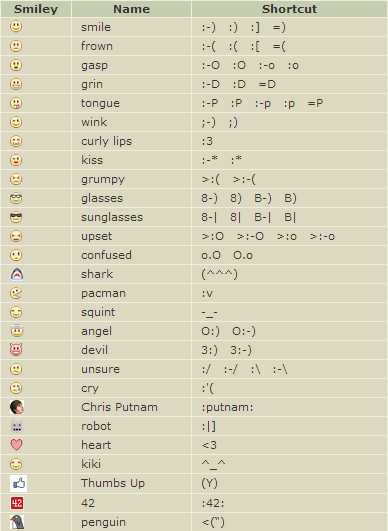
fb emoticonsEmoticons have come along way since we first started using character-number combos to virtually clue others into our feelings. Many messaging apps have started including higher quality, fun options for throwing them into your chats, and Facebook is now doing the same. The social network quietly rolled out a hefty catalog of emoticons that you can add into comments on your friend’s posts this week, although they can’t be published to status updates yet. As for mobile devices, when we tested out the feature on Facebook’s iOS app, the emoticons appeared on the Web app, while it failed to display on the iOS app — however, in Facebook’s Messenger app, there is a + icon that pulls up the new additions. 

You can check out the full list of Facebook-supported emoticons below or head over to fbsmileys.com.

facebook emoticons

Somebody “Wants” to sue Facebook

want button wantbuttondotcom
Facebook wasn’t the first to launch a “Want” button, and CVG-SAB, a company based in Michigan responsible for wantbutton.com, is suing Facebook for infringing on the newly announced tool. CVG-SAB’s “Want” button was launched in September 2010 primarily with e-commerce partners like Shopify, and since has grown to boast more than 160 million want-button views. The claim further states that the similarities between the design of Facebook’s button and wantbutton.com’s button are uncanny and already causing confusion among retailers. Wantbutton.com, in fact, offers a Facebook integration, where items that have been wanted appear on a Facebook user’s Timeline. Whether the complaint will hurt Facebook’s upcoming Collections feature remains to be seen — but our gut tells us the brand-boosting mechanism will launch with the Want button intact, lawsuit or no.

Facebook goes globe-trotting

facebook global brand page

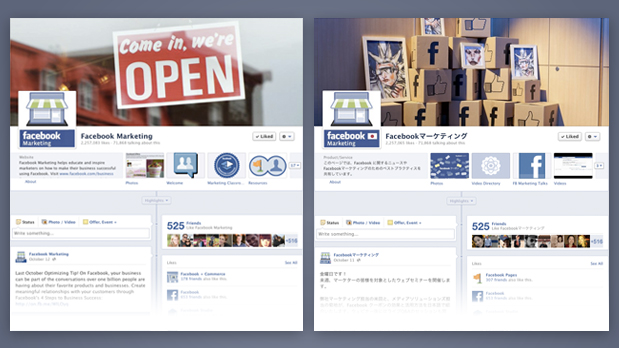
International brands are about to get a boost from the latest Facebook brand page update, which finally rolled out of beta. Facebook was testing international brand pages that can target posts and even languages at the local level. If you live in South Korea, for example, by default you’ll see a Facebook brand page written in the Korean language, as well as geo-targeted Facebook posts that followers from other countries may not be able to see. The update enables companies to manage their brand pages under one roof without resorting to creating multiple accounts or monitoring analytics for multiple pages.
Goodbye, Facebook phone number loophole

identify account on facebook

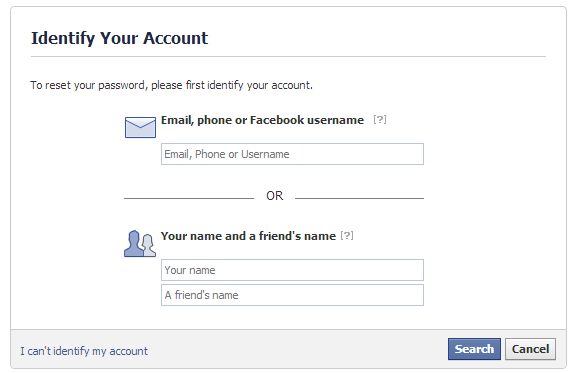
You might recall from last week’s privacy-focused roundup an item about Suriya Prakash, who discovered that a reverse-lookup feature could, if abused, easily uncover Facebook account information based on the phone numbers associated with Facebook profiles. Facebook claimed to have patched up the problem by limiting the number of times that someone could search for phone numbers, although Prakash said that these measures were insufficient and easy to work around.

With the realization that anyone could use the reverse phone number lookup feature, find a user’s phone number, and bypass Facebook’s Login Approval system to reset a password, Facebook took precautionary measures this week. Now if you have the two-factor authentication feature set up and have forgotten your password, you’ll be required to input a phone number, email address, or user name. In order to regain access to your account, you will have to use the email address associated with it or create a new one — no more temporary passwords will be sent to your phone.

Reverse-lookups of the same phone number that’s used for password-reset authentications is now blocked off from appearing in Facebook’s search engine. However, if you’ve published your phone number publicly on your Timeline where other users can see it, you won’t be protected. You should be sure the privacy settings here, under “How You Connect,” are no longer set to “Everyone.” 

Facebook fights viruses with free software

facebook antivirus partners

Facebook’s Anti-Virus Marketplace was launched earlier this year and included free trial subscriptions from partners McAfee, Microsoft, Sophos, and Symantec. This week the social network is added seven additional partners to the Anti-Virus Marketplace including AVG, Avira, Kaspersky, Panda, Total Defense, and Webroot.

The partnership isn’t however just about offering users free services to uncover and get rid of malware and viruses. Facebook is using its anti-virus partner’s data to bolster Facebook’s URL blacklist system, which according to Facebook, “scans trillions of clicks per per day, and before each click, the system consults the databases of all our AV Marketplace partners to make sure the website you are about to visit is safe.” With the inordinate volume of content shared on Facebook, you never know when a malicious site is disguised as a simple URL.


Source : digitaltrends[dot]com