Pages

Showing posts with label rival. Show all posts

Nov 14, 2012

Vuzix M100 Smart Glasses coming next year to challenge Google’s Project Glass

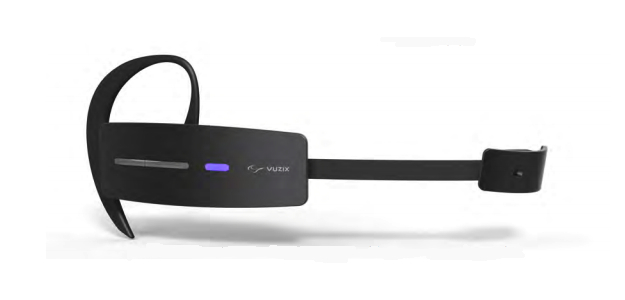
Vuzix M110 Smart Glasses

Vuzix will be demonstrating its M100 Smart Glasses at CES 2013. A rival to Google's Project Glass, the M100 has the ability to use its own apps thanks to its Android OS, and is expected to go on sale in the middle of next year.

Google’s Project Glass has hogged the headlines over the past six months when it comes to augmented reality spectacles, but there are other companies who’re working on similar devices, one of which is Vuzix. Vuzix has been busy perfecting augmented reality lens technology for a while, and its latest toy is the M100 Smart Glasses, prototypes of which will be on display during CES 2013.

Vuzix describes the M100 as an “intelligent hands-free display for smartphones,” but it’s a little more complex than that name suggests, as the M100 has its own 1GHz processor and Android 4.0 operating system, so it will run its own apps. Corresponding versions of these apps are loaded onto your smartphone, which connects to the glasses using Bluetooth.

Well, we call the M100 “glasses,” but it’s really a single stem with the lens mounted onto a Bluetooth headset style earpiece. This projects a 16:9, 240 x 400 pixel color image in front of your eye, which can contain everything from basic web content, email, video, GPS information and anything related to apps the two devices share. A camera can shoot 720p video and capture stills, and the M100 has 4GB of flash memory as standard. Other handy features include an accelerometer, a compass and Wi-Fi.

The extensive feature list means there’s plenty of opportunity for developers to build exciting apps for the Smart Glasses. During a recent interview, Vuzix President, Paul Travers, spoke positively about developers producing apps made especially for the M100, saying an SDK will be available in December and a selection of apps will be ready at launch, but exactly which ones has yet to be decided.

Working prototypes of Vuzix’s Smart Glasses will be on display at CES 2013, and it’s hoped the final versions will be ready to go on sale by mid-2013. The price? Travers told CNet the M100 would cost less than $500.

Google’s Project Glass isn’t expected to be available to the public before 2014, with only the Explorer Edition developer units coming in 2013.


Source : digitaltrends[dot]com

Sep 17, 2012

Canon announces EOS 6D full-frame DSLR along with PowerShot G15, S110 and SX50 HS point and shoot cameras

Few days ago we saw Nikon announce their smallest and lightest entry level full-frame camera, the D600, at the $2100 price point. Now, Canon has announced a rival in the form of the EOS 6D, their own smallest and lightest entry-level full-frame DSLR selling for the exact same price.

The Canon 6D uses a 36 x 24mm CMOS sensor with a resolution of 20.2 megapixels. It’s lower than the 24.3 megapixels on the D600 sensor but since the sensors are of the same size, it should theoretically give the Canon an advantage in low light situations, as the individual pixels are larger and thus will collect more light.

The autofocus system on the 6D has 11 points, way lower than the 39 points on the D600. Having said that, Canon claims their AF system on the 6D offers the strongest low-light performance of any of their AF systems till date. Canon trumps the Nikon in the max ISO department, where it can go up to ISO 25,600 whereas the Nikon can only go up to 6,400. Both offer the option to go beyond that limit using software tricks, at which point the 6D goes up to ISO 102,400 and the D600 up to ISO 25,600. It remains to be seen how good the images actually are at those sensitivities, however.

Where the Canon really shines is in having GPS and Wi-Fi built into the camera, whereas on the Nikon you would need to buy separate accessories. It’s also the first Canon EOS to include these features. The 6D also has a slightly better 3.2-inch 1024k dot display, compared to the 3.2-inch 921k dot display. Neither displays, however, swivel or have touchscreen functionalities.

The Canon EOS 6D will sell for $2,099 body-only and for $2,899 with the 24-105mm F/4 L lens. Unlike the D600, though, that launches this week, you’ll have to wait until December to get your hands on the 6D.

The next one is PowerShot G15, part of Canon’s G-series of enthusiast point and shoot cameras that offer the settings and manual modes of a DSLR in a compact body. The G15 has a 12 megapixel, 1/1.7-inch CMOS sensor and a 28-140mm, f/1.8-2.8 lens. The 3.0-inch display has a higher resolution, 920k dot panel compared to the previous G12 but loses the swivel functionality. As before, it has a front dial and full manual control, along with RAW and HDR shooting modes. The G15 can also record 1080p videos.

The PowerShot G15 will go on sale in October for $499.

The PowerShot S110 is the successor to the S100, a point and shoot camera designed for those who don’t want a lot of control options but still expect high quality photos from their camera. The S110 has a slightly updated 12 megapixel sensor from the S100, along with the same 24-100mm, f2.0-5.9 lens and the GPS functionality. What’s new is Wi-Fi and a touchscreen functionality for the 3.0-inch, 461k dot display.

The PowerShot S110 will go on sale in October for $499 and will be sold in black and white.

Lastly, we have the PowerShot SX50 HS, a super zoom camera with a mind-boggling 50x optical zoom. The lens in question is a 24-1200mm equivalent with f3.4-6.5 aperture. Behind this lens sits a 1/2.3-inch, 12.1 megapixel BSI-CMOS sensor. The SX50 HS has a 4.5-stop optical image stabilizer, 1080p video recording with HDMI out, 2.8-inch, 461k dot LCD, as well as manual and RAW shooting modes.

The PowerShot SX50 HS will go on sale in October for $479.


Source : blog[dot]gsmarena[dot]com