Pages

Showing posts with label retailer. Show all posts

Oct 25, 2012

UK retailer jumps the gun, puts Nexus 4 up for pre-order

Carphone Warehouse Nexus 4

The Nexus 4 has been made available as a pre-order on a UK phone retailer's website, despite not being officially announced yet. Google is expected to launch the phone on October 29, when it could be joined by several other new devices too.

The Nexus 4 has to be one of the most leaked smartphones of the year, and even now, just a few days before the event where it’s expected to be officially unveiled, it gets leaked again — this time by a retailer in the UK.

Carphone Warehouse, an established and popular high street mobile phone shop, has put the Nexus 4 up for pre-order on its website, with a delivery date of October 30, the day after Google’s event.

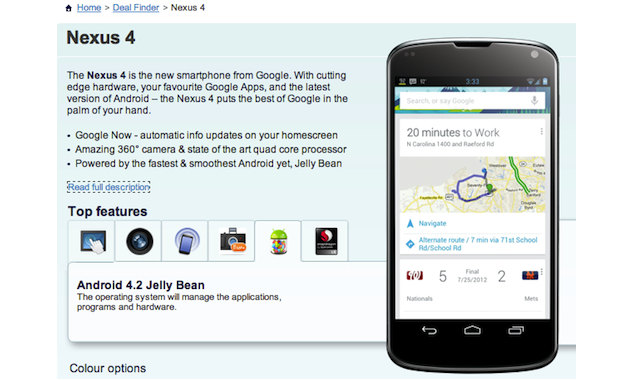
It provides just about all the specification details we could want, starting with confirmation of the 4.7-inch display with a 1280 x 768 pixel resolution and a pixel density of 320ppi, plus a quad-core, 1.5GHz Snapdragon S4 processor, which can also be found in the LG Optimus G and the Asus PadFone 2.

The operating system is listed as both Android 4.2 and Android 4.1.2, depending on where you take the information from on the site. These are two different things, as 4.1.2 has already been seeded to the Nexus 7, Galaxy Nexus and Nexus S, bringing with it only a few changes.Nexus 4 Android 4.1

Android 4.2 is listed separately, and several new software features that may or may not be related are talked about in the description, including a 360-degree photo mode and Gesture Typing, which sounds a lot like Swype.

Continuing to explore the feature list, we find an 8-megapixel camera with 1080p video recording, 2GB of RAM, NFC, a forward facing video call lens and GPS. Although no weight is mentioned, the Nexus 4 is 9.1mm thick.

Finally, the phone is shown to have just 8GB of internal memory and no microSD card slot, the combination of which could be a deal-breaker for many potential owners.

No SIM-free price is given, although it’s available with either O2 or Vodafone from £31 per month, when the device itself will be free. LG’s name isn’t mentioned either, however the company is the only one listed under the “alternative phones” list.

It’s now almost certain the Nexus 4 will be officially announced on October 29, but the question is, what else has Google planned for us?


Source : digitaltrends[dot]com

Oct 15, 2012

iPad mini nudges closer to reality, leaked inventory shows pricing

MobileGeeks.de has got hold of an alleged inventory photo from German electronics retailer MediaMarkt concerning the pricing, storage capacity and colors of the yet unannounced iPad mini.

According to the leaked image the iPad mini will be offered in Black and White with storage options ranging from 8 GB to 64 GB, Wi-Fi only or Wi-Fi and Cellular with prices starting from €249.

The iPad mini Wi-Fi variants are €249 for the 8 gig version, €349 for 16 GB, €449 earns you a 32 gig model and €549 for the 64 GB one. If you want all the trimmings just add another €100 to the quoted prices to receive a cellular option.

These prices are obviously meant to put the iPad mini at odds with its most direct competitors the Asus Nexus 7 and Amazon’s Kindle Fire HD. The Google pureblood offers 16 GB (and even rumored 32GB) of storage for the price of an 8 GB iPad mini (€249), while Amazon gives you 32 GB worth of storage on a Kindle Fire HD for the same asking price.

I’m rather disappointed that the iPad mini would be only 100 euro cheaper than the equivalent 10-inch iPad configurations. Unfortunately, Apple continues the trend of heavily overpricing storage. A 16GB iPad mini would have made lots of sense at around the €250 euro mark.

Still, things could wind up totally different so stay tuned for the unconfirmed October 23 event at which Apple could make the iPad mini official.

MobileGeeks seems to be down at the moment, but still, you will find a link to their article below.


Source : blog[dot]gsmarena[dot]com

Sep 6, 2012

Kobo pushes out new Mini and Glo e-readers, plus the Arc Android tablet

Kobo Arc Tablet

Online e-book retailer Kobo has announced the Kobo Arc Android tablet, plus the Kobo Glo and Kobo Mini e-readers.

Kobo, the online e-book retailer, has swooped in to steal some of Amazon’s thunder by announcing three new products — the Kobo Mini and Kobo Glo e-readers and the Kobo Arc Android tablet.

Let’s start with the Kobo Arc tablet. This isn’t the first tablet that Kobo has released, as the Kobo Vox came out late last year, but was eclipsed by the better specced, more exciting Kindle Fire. Not being Google Certified didn’t help the Vox either, but it appears Kobo has learned from its mistakes with the Arc.

Powering the 7-inch, 1280 x 800 pixel display is a 1.5Ghz, dual-core Texas Instruments processor, along with 1GB of RAM, while the operating system is built around Android 4.0 Ice Cream Sandwich.

Kobo has included the Google Play store this time around too, but has also added its own user interface over the top of the Android OS, along with a new feature called Tapestries.

At first it sounds like a customizable homescreen really, as you can “pin” favorite books, pictures, videos and web links to your Tapestry, but it gets a little more interesting as the Arc will then offer content suggestions based on what you’ve pinned to the screen.

Kobo has also added features such as Wi-Fi, Wi-Fi Direct, a front-facing 1.3-megapixel camera, and a battery that should provide 10 hours of continuous reading. Two models will be made available, one with 8GB and the other with 16GB of internal memory, and they’ll be priced at $199/£169 and $249/£199 respectively when it’s released in November.

Kobo Glo and Kobo Mini

On to the Kobo Glo, then, which is a 6-inch e-reader. The E Ink touchscreen boasts an impressive 1024 x 768 resolution with 210 dots-per-inch, which at the moment, trumps the competition.

The clue as to what makes the Glo standout is in its name, as the screen has an adjustable front light, so it can be read in the dark. Naturally, this affects battery life, and with the light on you can expect 55 hours of reading time, but more than a month with both it and the built-in Wi-Fi switched off.

There’s 2GB of internal memory with a microSD card slot to boost this by 32GB, plus the Glo will accept .ePub books protected by Adobe DRM too. This is especially helpful, as unlike the Kindle, you won’t be restricted to a single store from which to buy your books. It’s set for release on October 1 for $129/£99.

Finally, we come to the Kobo Mini, the company’s basic e-reader. It features a stock 5-inch E Ink screen, 2GB of internal memory, Wi-Fi and a lightweight 134 gram chassis. It too will be out on October 1 at the bargain price of $79/£59.

Kobo’s new hardware range looks great, and is priced competitively, however it will still need to contend with whatever Amazon, Barnes & Noble and potentially even Apple have in store for us before the all-important Holiday season. Will these devices help put Kobo’s name on the map?


Source : digitaltrends[dot]com

Aug 20, 2012

Can Hubert Joly rescue Best Buy?

Customer exiting a Best Buy store

Best Buy is bringing in French turnaround expert Hubert Jolie to revive its ailing business. Can Best Buy avoid being the next Circuit City?

Leading consumer electronics retailer Best Buy has announced that it is hiring Hubert Joly as CEO. Joly most recently headed up restaurant and hotel operator Carlson Co. The Frenchman is expected to take over as Best Buy CEO next month once his visa is secured; in the meantime, Best Buy board member Mike Mikan will continue to serve as interim CEO.

Bringing Joly on board may help the retailer focus on the future rather muddling through the chaos left behind in the wake of former CEO Brain Dunn’s scandalous departure. But public perception is not Best Buy’s only problem: How can Joly — who has no retail experience — hope to prevent the company from becoming another Circuit City?

Who is Hubert Joly?

Best Buy CEO Hubert Joly

Herbert Joly comes to Best Buy by way of Carlson Co., which is not exactly a household name, but it’s the parent company behind plenty of them. The Minneapolis-based firm runs more than 900 restaurants (including T.G.I. Friday’s) and more than 1,000 hotels (including Radisson, park Plaza, and Country Inns & Suites) in 150 countries around the world. The Carlson Companies are closely held, but are generally well-regarded by its employees, especially in terms of supporting workplace diversity.

Joly became Carlson’s CEO in 2008; before that he was the head of Carson Wagonlit Travel (CWT), a partnership Carlson formed with Paris-based Wagonlit Travel. CWT is one of the world’s largest business travel management firms. At the helm, Joly headed a turnaround that saw a nearly three-fold increase in sales and strongly improved profit margins.

These credentials may illustrate Joly’s ability to lead a large corporation and instigate financial turnarounds, but experience in travel, hotels, and restaurants doesn’t seem to have any bearing on consumer electronics, technology, or new media. For that, Best Buy is digging back further into Joly’s career: Before CWT, he served briefly as Vivendi Universal’s CIO, and had overseen the integration of Vivendi and Universal’s assets in the United States. Starting back in 1999, Joly played a major role in restructuring Vivendi’s video game business — at the time, that included the development and expansion of its still-active Diablo and World of Warcraft franchises.

Further back, Joly has additional tech cred: From 1996 to 1999 he was a major player in turning around Electronic Data Systems (EDS) in France. EDS was the technology services company founded by former U.S. presidential candidate H. Ross Perot; it offered data processing, personnel management, and services like claims processing for a variety of companies, as well as the U.S. federal government. Hewlett-Packard acquired it back in 2009, and it now forms much of HP’s Enterprise Services division.

Joly is largely viewed as a turnaround-expert for hire: Companies hire him to come in, initiate forceful turnaround plans, and put the company on firmer business ground. Once that’s done, Joly transitions to another company in need of his skills. Joly’s track record is about as good as they come — and there’s no doubt that Best Buy needs some serious help.

Best Buy’s situation

Best Buy

Best Buy is the United State’s leading consumer electronics retailer, with more than 1,400 retail locations, more than $50 billion in business, and more than 160,000 employees. By any measure, Best Buy seems to be a roaring success, clinching its hold on the consumer electronics space while competitors like CompUSA and Circuit City withdrew from the market or closed up altogether.

But it’s not easy being king. In its most recent fiscal year, Best Buy reported a loss of $1.2 billion — that compares with a profit of $1.3 billion the previous year. Numbers like that make investors and partners very nervous, as the company sees in-store sales declining as customers ship to online retailers like Amazon.com that can often offer better prices (and free shipping) on the exact same products. Increasingly, Best Buy’s expensive-to-operate retail stores are functioning as showrooms for consumers, who may go into a Best Buy location to check out new products, but then purchase the products online at a lower price after they leave. The situation can be exasperated by instances of questionable sales tactics, with stories of customers being pressured to purchase things like (highly profitable) extended warranties, or even preying on seniors and other customers who may not have a strong understanding of products into buying things they may not want or need. (It’s certainly not a universal experience, but with social media even a single negative instance can be substantially magnified.)

Some of Best Buy’s injuries are self-inflicted. A good portion of the company’s loss in its most recent fiscal year stemmed from buying out Carphone Warehouse’s share of Best Buy Mobile and writing down Best Buy Europe goodwill: Best Buy might be the leading electronics retailer in the U.S., but its plans to expand into Europe fizzled out, in part due to the worldwide economic downturn. The costly gambit didn’t work out. Similarly, the company’s plans to turn into a digital media giant with services like Napster and CinemaNow failed to resonate with consumers. Best Buy also inked a deal with LightSquared to bring 4G LTE to its Best Buy Connect offerings — that sure worked out well.

Former Best Buy CEO Brian Dunn

Challenges like these are more-or-less part and parcel of being a massive brick-and-mortar business these days. However, Best Buy truly stepped in it with the abrupt resignation of CEO Brian Dunn in April. Best Buy was very clear it had no problems with Dunn’s operational or financial decision-making. Instead, the “mutual” decision that he should depart stemmed from an inappropriate “extremely close” relationship with a 29-year-old female employee. It’s one thing for a corporate leader to announce a round of belt-tightening in a tough business — as Dunn did when he announced the closure of 50 U.S. Best Buy locations. It’s another thing to have a philanderer in the top chair.

Since then, Best Buy has been struggling for direction. Best Buy founder Richard Schulze resigned as chairman of the company in June, in part for helping keep Dunn’s shenanigans a secret. However, Schulze remained a force to be reckoned with, since he still owned more than 20 percent of the company. Schulze has since engaged in an almost guerrilla campaign to make a $10 billion offer to take Best Buy private. Schulze would cut costs, slash prices, and improve customer service — and, perhaps most importantly, streamline corporate governance into a kind of benign dictatorship that would make the company more nimble. In the meantime, Best Buy announced it was laying off some 600 of its Geek Squad employees and 1,800 additional store personnel to cut costs.

In hiring Joly as CEO, Best Buy’s board is essentially telling Schulze to go packing. Best Buy says it offered to take Schulze’s offer seriously and give him time and flexibility to line up financing, but claimed Schulze’s offer contained “insufficient information.” Schulze describes Best Buy’s actions as an “abrupt public termination” of negotiations. However, Schulze still has his 20 percent stake in the company — and Best Buy hasn’t yet made arrangements with him for a standstill period wherein he won’t take his takeover offer directly to shareholders. Schulze could still try to stage a rebellion.

Can Best Buy avoid being the next Circuit City?

Circuit City going out of business (source unknown)

Hubert Joly certainly has his work cut out for him: Best Buy’s stock is down 13 percent this year, and the company is facing continuing losses due to strong competition from online retailers. Moreover, by bringing Joly on board, Best Buy is essentially signaling to investors that they won’t see details of a turnaround plan until 2013: It is going to take some time for Joly to come on board, get his feet wet, and formulate a strategy.

On Joly’s side, Best Buy is probably the most-recognized electronics retailing brand in the United States, and the company has had some success transitioning business towards highly profitable products like mobile phones. Best Buy is also working to compete with Amazon directly as an online retailer. After all, Best Buy already has enormous inventory management and customer fulfillment systems. It could conceivably focus on offering a premier consumer electronics online shopping experience that would contrast with Amazon’s catch-all online shopping strategy, which has spilled over into everything from tools to groceries to perhaps igloos.

However, regardless of Joly’s successful track record turning around businesses, investors and industry-watchers would be much happier if Best Buy had settled on a new CEO who actually has significant experience in retailing, rather than coming to Best Buy from restaurants and hospitality. But, if Joly really is the turnaround rockstar Best Buy thinks he is, maybe a lack of retail experience will enable some outside-the-big-box thinking that could re-invigorate Best Buy.

Source : digitaltrends[dot]com

Aug 17, 2012

Ubisoft takes on Steam, EA Origin with Uplay PC

Ubisoft has opened its Steam competitor Uplay PC.Is there still room in the digital distribution business for another video game retailer?

Uplay is more than Ubisoft’s digital rights management solution. It’s more than a fragile target for hacking exploitation. It’s also Ubisoft’s new digital distribution platform. The Frenchman’s EA Origin or Valve Steam, if you will!

Ubisoft opened Uplay PC for business on Thursday, an application that let’s people buy Ubisoft games like Assassin’s Creed III direct from the company. It also gives players more direct access to the other perks of Uplay like extra content and community features, but that’s a tertiary purpose for the new client. The secondary purpose is to cut out the digital distribution middlemen like GameStop, Steam, and Amazon.com to reach customers directly. It won’t get all 35 million of Ubisoft’s registered Uplay members—many are console players, many will use competing clients—but it will get them some.

The primary purpose though, as always, is to strengthen Ubisoft’s anti-piracy measures. Uplay was conceived as a DRM solution and Uplay PC is just the latest realization of that effort.

Uplay PC could potentially have a grand effect on Ubisoft’s business on PC though. Despite grumbling in the press and in the PC gamer community, Electronic Arts’ digital distribution service Origin has done quite well for itself. In May, claimed that it was now the “number 2 direct to consumer game service” with 11 million registered users. That’s only people who have installed the Origin client. It’s a far cry from Steam’s 35 million registered users, but a hearty population of potential paying customers nonetheless. EA did say at the time that the majority of revenue generated by Origin is from its own games, but it didn’t specify exact sales data.

Digital sales are already growing for Ubisoft. Its online sales grew 110 percent between March 2012 and the previous year, totaling more than $102 million. Those sales only represent a small portion of the overall $1.36 billion in revenue Ubisoft pulled in over the last fiscal year, but with digital sales expected to continue growing throughout this year, expect that number to grow significantly before fiscal 2013 is out.

Steam is growing too though, and consumers like Valve. EA’s proven that big publishers can make money with their own digital distribution clients, but it isn’t clear how many publishers can replicate that success. Ubisoft’s got the intellectual properties and frequency of releases to make it happen, but there aren’t many other companies in the business who can open a similar service and expect to succeed. Uplay PC can be successful but it isn’t part of a trend. 


Source : digitaltrends[dot]com