Pages

Showing posts with label spotify. Show all posts

Nov 19, 2012

Myspace pitch deck leaks, reveals how the underdog plans to take on Spotify and Pandora

search myspace

After giving us details on the new Myspace last week, the music platform's leaked pitch deck reveals more about how the site plans to challenge Spotify and Pandora for a top streaming service spot.

Last week we finally got a first look at the new Myspace, a sleek, smart, conceptual twist on one of the original social networks. New owners Chris and Tim Vanderhook and Justin Timberlake have more than managed to inspire renewed interested in a platform that very nearly faded into the darkest corners of the Internet.

But the Myspace revival isn’t only UI-deep, and BusinessInsider has gotten its hands on a very revealing pitch deck from the company. According to the document, Myspace plans to challenge Spotify and Pandora and position itself as a top streaming service. Interactive Media (owned by the Vanderhooks) is looking to raise $50 million toward the site’s relaunch – $10 million dedicated to marketing, $15-$25 million for licensing deals, and another $15-$25 for general expenses.

Right now, the new Myspace features an embedded music player that follows you around the site, as well as a video player that automatically fills the screen (which you can optionally pop into the lower right-hand corner). There is no downloadable client, it’s all Web-based, and at the moment there are no premium account options. Of course, in our time with Myspace last week, it was emphasized that we were getting a very early look at the site, and that there’s plenty of growing and building to do. Specifically, the team said the platform would follow what the community of artists and users wanted – including ways to sell merchandise and download music.

And in the pitch deck, you can see Myspace plans to deliver; prospective plans include “subscription, transaction (downloads, merchandise, tickets),” and something called “Myspace TV.” The transaction model is slated to launch in 2013.

The fact the Myspace is positioning itself to take on Spotify and Pandora isn’t surprising. The company has deals with all four major labels as well as an impressive number of indie labels and artists – five million unsigned artists to be exact (the catalog boasts 42 million songs in total). This slide right here pinpoints the competition Myspace is about to get itself into:
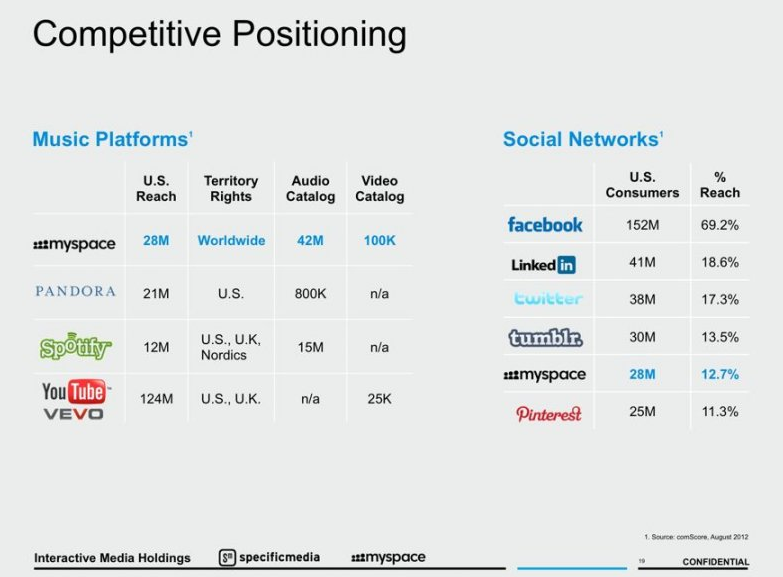
myspace slide

And here’s why it thinks it can do things better: “Myspace has a significant cost advantage with respect to the music streaming costs compared to Spotify and Pandora because our proprietary 27,000,000 song library from unsigned artists accounts for ~50 percent of song plays on our services and has a zero cost basis … Myspace pays the lower Radio rate on the vast majority of our label related song plays.”

Myspace plans to leverage its vast amount of unsigned music and artists to propel itself among other streaming services, which is a bold move: The streaming wars have so far been won by being able to provide licensed music (right, Google Music?). But Myspace also has the four major labels in its arsenal, making it a very viable option. It’s definitely a much more immersive, versatile experience than either Spotify or Pandora, although its plans for introducing a transaction model will likely play a huge role in its potential. For now, we’ll continue to try out the beta and see how this all unfolds in the coming months. 


Source : digitaltrends[dot]com

Oct 3, 2012

Xbox Music launches alongside Windows 8 on Oct. 26

Xbox Music, Microsoft's Spotify competitor raised from the ashes of Zune, will launch alongside Windows 8 at the end of the month.

 xbox spotify

Microsoft has held a nearly year long funeral for Zune in 2012. Now after months of rumors and vague announcements confirming the death of the Zune brand in favor of the name Xbox Music, Redmond is finally ready to unleash its latest attempt to secure a share of the shifting music market. The Spotify-style, advertising supported Xbox Music streaming service will open for business, free of charge, on October 26th. Right in time for the launch of a little operating system

At least, that’s according to sources familiar with Microsoft’s plans. Xbox Music will be available on all of Microsoft’s major consumer products, including Windows Phone, Xbox 360, and the company’s would-be Apple killer, Windows 8. Like the Windows Player app of old, though, Microsoft is aiming to get Xbox Music onto as many platforms as possible, with plans for the service on iOS and Android devices as well. Any adventurous iPhone 5 users gearing up to experiment with an alternative music service hosted by a massive multinational corporation will have to wait a bit though, as the iOS and Android Xbox Music apps won’t be available until an unspecified future date.

All Microsoft media apps will be updated to account for the new service.

As expected, the service will come in a variety of packages. There will be subscriptions for users looking for unlimited, ad-free access and existing Zune Music Pass subscribers will see their accounts transferred over automatically. There will also be a free version that offers ad-supported music a la Spotify.

Official pricing for Xbox Music subscriptions is still unknown. Users that received early access to the service claimed that the unlimited subscriptions would run around $15 per month and $145 per year. Like many media apps, Xbox 360 owners will have to have a premium Xbox Live Gold subscription, an additional $60 per year, to even access Xbox Music on the console.

Microsoft made the right choice killing the Zune brand. Over its six years in the market, Zune was never able to build any cache with users in the way that iTunes or even Amazon’s music and media services have. After eleven years, the Xbox brand is particularly strong, but if Microsoft can’t rely on it to automatically draw consumers. Xbox Live branded games haven’t made the Windows app market on Nokia Lumia phones a booming business after all. Microsoft also can’t expect the Xbox 360 audience to consider access to an advertising-based music streaming service a draw to spend on Xbox Live Gold. The sooner Microsoft realizes that the old Xbox Live Gold subscription model, giving access to basic services that are free on competing machines, is dead, the sooner it can really build a cross-platform strategy around Windows 8.

Source: The Verge


Source : digitaltrends[dot]com

Sep 7, 2012

Portland Digital eXperience: Spotify, Shazam, and the toppling of traditional music consumption

pde spotify shazam

At Portland Digital eXperience, new-wave music products Spotify and Shazam defend their services against an aging industry.

Given its scheduling along side MusicfestNW, one of Portland Digital eXperience’s most anticipated keynotes was the Dave Allen-moderated discussion on the science of music discovery with Shazam and Spotify. And given that nature of the very indie-friendly music festival and Portland’s inarguably hipster, screw-the-man spirit, you can assume the discussion erred toward the tense side.

As a bit of background, Allen is a musician, formerly worked as director of Consumer Digital Audio Services for Intel, and now runs independent record label Pampelmoose. So suffice it to say he takes some issue with how the current state of mainstream music discovery and consumption is working.

Right after panel introductions – which consisted of Allen, Peter Szabo from Shazam and Jason LaCarruba from Spotify, the tough questions started — mostly targeted at Spotify.

First up, Allen had to ask Spotify where those 50 million users it told the Wall Street Journal it planned to get way back during its stateside launch. “I think we’re doing really well getting those users. We’re always trying to launch new features to do that,” LaCarruba said, mentioning the relatively new Radio feature, which he works on (and says will be getting better).  

That said, he admitted that Spotify definitely has not hit the 50M mark; it has 15 million globally, four million of which are paying customers.
Which prompted this comment from Allen: “Your valued at $4 billion. How can that be?”

Shazam, which wasn’t hit quite as hard with the “how dare you!”s, had some impressive numbers to report. The app currently has 35 million users and is adding two million a week. “It’s one of those apps when people first get a smartphone, they download,” Szabo reasoned.

Of course, Shazam has been around longer than Spotify and is a more diverse service.

Piracy and artists’ rights couldn’t go untouched, either. For all their inherent problems, one thing the streaming services — and arguably products like Shazam — bring to the table is that they fight illegal downloading. Both Szabo and LaCarruba generalized a bit here, but reasoned that by cutting down on piracy so largely, it’s paving the way for a better future for artists’ pockets.

As you can assume, Allen had a lot to say about this. Of course, he’s not the only one: Since Spotify’s launch, indie labels and artists — and even The Black Keys — have called out Spotify for hurting musician’s bottom lines. “My last check was $17. Thats not funny,” Allen told the crowd. “I make no money from streaming.”

The defense? Basically, that at least it’s progress against piracy, and that the more people who decide to pay for streaming services like Spotify, the more money will come in. That there’s fun and experimentation in this new music technology and that it’s going to find a sweet spot at some point. And to Shazam’s credit, nine percent of mobile listens lead to a purchase — so there is a proven correlation between discovery and buying there.

Allen’s response? Not good enough.

For starters, he reiterated that streaming platforms can’t honestly think of themselves as a viable way for musicians to make money — and the conversation quickly took a turn into the current generation of music discovery and curation disrupting the old. There were plenty of references about how people used to buy albums and not just singles, about vinyl, about the lost human influence of the DJ — it became fairly clear that instead of a discussion about the science of finding and listening to music, we were watching a tug-of-war between the old and the new.

Don’t get me wrong, there are plenty of problems with our current state of content consumption, but I feel more comfortable placing that blame on the labels and rights holders versus outlets connecting users to music. And it’s because they don’t want to change, they want things to continue as they have been — and that’s something consumers simply won’t settle for anymore.

“My friend doesn’t have to make a mixtape and bring it to me to introduce me to new music — it’s so much more immediate,” says Szabo; to which Allen replied: “I liked the old way.”

Complaining about this “inhuman” experience is warranted, sure, but then you’re tackling a much bigger beast, and that’s the digitalization of nearly all our interactions. It’s not just music — it’s talking to people, buying food, the work office; all of these things have been transitioned thanks to technology.

Jury’s still out on how well the new music models will find compromise for users, artists, and labels; it’s a lot to attempt. And there are no shortage of imperfections along the way — but there’s simply no going backward from here.


Source : digitaltrends[dot]com

Sep 6, 2012

Apple planning to take on Pandora and Spotify, report says

Apple iCloud music

Apple has Pandora and Spotify in its crosshairs, according to a report Thursday, as the tech giant plans a rival offering to the popular music streaming services.

Apple is reportedly looking to establish itself in the music streaming space by taking on the likes of Pandora and Spotify, services which allow users to build customizable online ‘radio stations’ based on their personal music preferences.

Citing “people familiar with the matter”, the Wall Street Journal reported Thursday evening that Apple’s free, ad-supported service will be made available across all of its hardware products, which include its mobile devices and Mac computers.

It could even be coming to PCs running Windows, though devices powered by Google’s Android OS would be excluded, the source told the WSJ. That doesn’t come as too much of a surprise, as Google and Apple continue their no-love-lost battle for supremacy in the mobile sector.

According to the WSJ, Apple is currently in talks with a number of music providers in an effort to hammer out licensing deals for the new service, though a launch is not expected for at least several months.

The WSJ points out that Apple could be a threat to existing services thanks to its firmly established and massive presence in online music sales and the fact that it already has such a large number of music-playing devices, such as the iPhone and iPod touch, in circulation.

Services like Pandora and Spotify, which stream songs based on a user’s existing tastes, have built up a steady following since arriving on the scene, with music fans able to access an enormous library of songs for free as long as they have a connection to the Internet.

But a quick look at the numbers show there could be rough waters ahead for these companies. Pandora has 54.9 million active users, while Spotify, which launched in the US last year, has 16 million. In comparison, there are more than 400 million iTunes accounts up and running. Do you think the Cupertino company will be able to blow away the competition with a streaming service of its own?


Source : digitaltrends[dot]com