Pages

Showing posts with label report. Show all posts

Nov 19, 2012

The copyright study that Hollywood doesn’t want you to see

Copyright troll tactic tested

A report from the U.S. House's Republican Study Committee that criticizes the current copyright system was quickly removed from the organizations website after alleged complaints from Hollywood lobbyists. Here's everything you need to know, and why you should care.

Few issues rile up civic-minded Web users like copyright policy – and for good reason. U.S. copyright laws are ground zero in the fight between content creators – Hollywood movie studios, record companies, software creators, etc. – and us, the Web users, who “consume” that content. Copyright is the reason the largest Internet service providers in the U.S. are about to start bombarding subscribers with notices that say they may be breaking the law by clicking certain links. It is the force that has confused the idea of ownership in the digital era to the point that it is no longer recognizable. And it is for these reasons, and many others, that so many believe copyright reform is critical for both Web users, and the U.S. economy at large.

Which is why many an eyebrow raised on Friday after the influential Republican Study Committee (RSC) released a policy brief that called for a major overhaul of U.S. copyright policy. The findings and recommendations in the study, which is entitled “Three Myths About Copyright Law and Where to Start to Fix it,” were so “reasonable” that copyright reform evangelists in the technology community immediately jumped on the report as a sign that Washington may soon shed itself of the Hollywood lobbyist-imposed view of copyright, and begin fighting for consumer-focused change.

The elation was short-lived, however; less than 24 hours after the policy brief went up on the Web, the RSC pulled the study from its website. (We’ve reposted it below, in full.)

“Yesterday you received a Policy Brief on copyright law that was published without adequate review within the RSC and failed to meet that standard,” wrote RSC Executive Director Paul S. Teller in a mass email. “Copyright reform would have far-reaching impacts, so it is incredibly important that it be approached with all facts and viewpoints in hand.”

The “three myths” of copyright

The policy brief, authored by RSC staff member Derek Khanna, argues that current copyright policy is damaging to the U.S. economy because it “destroys entire markets,” flies in the face of free market capitalism, and imposes painful, “arbitrary” penalties on those who violate copyright law. In short: The policy brief argues exactly what critics of copyright have been saying for years. Only this time, it came from a source within U.S. House of Representatives – something that has never happened before.

Here is a summary of Khanna’s “three myths” of copyright, and why they are myths:

  1. Copyright was not created in order to guarantee that content creators get paid, as copyright reliant industries claim; it was created to “promote the progress of science and useful arts,” according to the U.S. Constitution. Khanna adds that the “purpose” of copyright “is to lead to maximum productivity and innovation.”
  2. Copyright is not, as some claim, “free market capitalism at work,” writes Khanna. It is the exact opposite: “a government-subsidized monopoly,” thanks to the massive, government-upheld penalties on those who violate copyright.
  3. Copyright does not lead to “innovation and productivity,” writes Khanna. He argues that, instead, copyright policy has created “a system that picks winners and losers, and the losers are new industries that could generate new wealth and added value.”

How to “fix” copyright

Khanna says these misconceptions and errant implementations of copyright policy have stifled a number of industries, including the DJ/remix industry (which he says has become “heavily retarded” in the U.S.); areas of scientific inquiry, due to the copyright of scientific papers from the 20th century; public libraries; journalism; and “added-value” industries, which are prohibited from transforming things like books and movies to include user-generated content such as “‘VH1 Pop-up video’ add-ons.”

To unbind these industries and others, Khanna suggests these reforms to copyright policy:

  1. Statutory damage reform: Limit the amount of money copyright violators can be charged from the current range of $750 to $150,000 per violation down to something more realistic.
  2. Expand fair use: Allow people to use copyrighted content to create their own content more freely. Khanna points to a paper entitled “Infringement Nation,” which “details how things you do every single day are infringing and leave every single person liable for billions in damages each year.”
  3. Punish false copyright claims: Copyright owners face “minimal or nearly non-existent punishment for bogus copyright claims today,” writes Khanna. He says this “often leads to de facto censorship,” something he says would be greatly diminished if there were penalties for copyright owners who falsely claim ownership.
  4. Heavily limit terms of copyright: Right now, copyright law says that individual copyright extends for the life of the author plus 70 years. For corporate copyright owners, the period is potentially even longer: 120 from the date of creation, or 95 years from first publication. Khanna recommends limiting this to an initial “free” 12 years of copyright protection, with the ability for copyright owners to renew the copyright for additional years at a cost.

A tipping point for copyright reform?

While the RSC has disowned Khanna’s report – for reasons officially unknown, but speculated to have something to do with “lobbyist pressure” on the organization, according to an anonymous source who spoke with Ars Technica – the ideas in the brief could represent a sea change for the GOP, which is currently seeking to draw in young voters for which copyright reform is a major issue. The Web-centric fight over the Stop Online Privacy Act (SOPA) and the PROTECT IP Act (PIPA) from earlier this year has also led Congress to reconsider its relationship with Hollywood studios and other heavy hitters in copyright-centric industries.

“It’s always hard to get legislation of any kind passed, but I think the chances have improved enormously since SOPA and PIPA were defeated earlier this year,” said Gigi Sohn, president and CEO of rights advocacy group Public Knowledge, in an email with Digital Trends.

Sohn says that a number of Khanna’s ideas – many of which have been long supported by Public Knowledge and other copyright reform advocates – could make their way through Congress in the coming months and years.

“Some of the possible provisions might include those that 1) expand fair use, including the ability to circumvent technological protection measures for lawful uses; 2) punish copyright holders who willfully and recklessly abuse copyright law and the takedown provisions of the [Digital Millennium Copyright Act]; 3) shorten copyright terms; 4) reduce statutory damages and 5) ensure that the ‘first sale’ doctrine is preserved in the digital age,” said Sohn.

In fact, some of these provisions are already floating around Washington. For example, earlier this month, Rep. Darrell Issa (R-CA) announced a proposal that seeks to allow consumers of movies and music to convert this content into digital formats.

Why you should care (if you don’t already)

Despite the passion surrounding the copyright debate, it is perfectly understandable why many Web users’ eyes glaze over at the mention of any type of policy reform. It’s complicated, even boring. But according to experts on both sides of the debate, copyright is something we should all pay attention to.

“Copyright affects every person’s ability to create, innovate, and express themselves freely,” said Sohn. “If copyright is too strong, it makes those abilities much harder for everyone but the biggest media companies.” She adds that citizens should “tell their Senators and Representatives that reforming our copyright system is important to them and that they want Congress to act in the upcoming term to make copyright law more balanced.”

PJ Kuyper, president of the Motion Picture Licensing Corporation (MPLC), agrees that copyright is important, but believes that it should be respected, not gutted.

“Copyright is not a conservative or liberal issue nor is it about more government or less government,” Kuyper said in an email to Digital Trends. “We should all be on the side of copyright because it is about property rights. No one has a monopoly to music or movies, just a monopoly on their song or their movie. It is no different than car keys giving you a monopoly on your own car.” (Emphasis his.)

What do you think? Should Congress adopt the ideas promoted by Khanna and Public Knowledge? Or should copyright be even stronger than it is today? Let us know your thoughts in the comments. And check out the full RSC policy brief below:

RSC policy brief: Three Myths about Copyright Law and Where to Start to Fix It


Source : digitaltrends[dot]com

New report says Apple iMac computers still on target for 2012 launch

iMacs (October 2012)

Despite last week's report indicating production problems could delay the launch of Apple's new iMac computers until 2013, it seems the machines are still on target for a 2012 release, and may already be arriving at distribution centers around the world.

Concern amongst those waiting for Apple’s new iMac computers escalated last week, after a French blog reported the release had been delayed, possibly until 2013. While it was impossible to judge the validity of the report’s sources, talk of a delay regarding a new Apple product was hardly a surprise, given the problems it has seen with the iPhone 5 and the iPad Mini so far this year.

However, 9to5mac.com has refuted the site’s claims, saying its own sources tell them the 21.5-inch iMac is already arriving at distribution centers in the U.S. and elsewhere in the world; indicating the planned November release will go ahead after all.

As for the 27-inch iMac, Apple gave it a tentative December release date, which is not only likely to be met, but perhaps even improved upon, with the massive computers becoming available to order around the same time as the 21-5-inch iMac.

Apple’s new iMac’s are considerably slimmer than older models, and some high-tech manufacturing processes have been used to fit all the computer hardware inside. The trouble Apple has had manufacturing the iPhone, which has been described by Foxconn as the most difficult device it has ever assembled, only made the rumored iMac delay seem more likely.

So, while a delay in their launch may have been averted, the iMac computers could still be a rarity in stores and online. Apple CEO Tim Cook warned there would be a “significant shortage” of the company’s range-topping desktop machines during the first three months after launch, so it’ll be wise to get an order in early if you’re desperate. You know, just like every other recent Apple release.

The only good thing is there’s unlikely to be a huge run on the $1300-plus computers during the Christmas shopping season, as eager buyers rush to claim the last remaining iPad Mini tablets and new iPod music players instead.


Source : digitaltrends[dot]com

Samsung may debut 4.99-inch, 1080p touchscreen at CES 2013

1080p Generic Phone

A new report indicates Samsung may debut a full high definition display suitable for smartphones during CES 2013. Could it be destined for the Galaxy S3's successor, or a new device entirely?

Samsung could be preparing to debut its own smartphone-sized 1080p display during CES 2013, hot on the heels of HTC’s Droid DNA. Full high definition displays are all set to be next year’s must-have new smartphone feature, although their size will see them used on hardware that tips over into smartphone/tablet hybrid territory.

A Korean newspaper claims Samsung has developed a 4.99-inch touchscreen with a 1080p resolution and a pixel density of 441ppi. While the resolution is the same as the Droid DNA’s, the pixel density beats it by one point.

It’s unlikely we’ll see the hardware related to Samsung’s new screen at the show though, as it’s not expected to go into production until later in the first quarter of 2013, which means Samsung could follow LG’s example and only show off the panel itself.

There are two logical, future homes for Samsung’s Full HD screen: The successors to the Galaxy S3 and Galaxy Note 2. The slightly odd 4.99-inch screen size could mean it’s destined for the Galaxy S4, as by keeping it under 5-inches — even if it is by a ridiculous 0.01 of an inch — it could still (just) be classed as a true smartphone.

There’s also a chance Samsung could introduce a new device which neatly fits in-between the 4.8-inch Galaxy S3 and the 5.5-inch Galaxy Note 2. An earlier rumor put the Galaxy S4’s announcement for sometime in March, which seemed a little too soon into the S3’s life, however maybe Samsung is planning an event for that time, but it’s for our mystery 1080p phone and not for the S4.

We won’t find out until closer to the time, but provided the talk of a Samsung 1080p screen is correct, we should get to see it in action during CES 2013, which begins on January 8.


Source : digitaltrends[dot]com

Nov 14, 2012

Online ad revenues to skyrocket in five years time

The online ad market is growing by leaps and bounds, according a new report that predicts it to reach $143 billion worldwide in the next five years.

International spending on Internet advertising is expected to rise by almost 50 percent over the next five years, according to a new report from a team of analysts tracking the global online ad market. The report, issued today by research and analytics firm Digital TV Research and entitled Online Advertising Forecasts, predicts that ad spending online will reach $143 billion dollars in 2017.

That figure is a significant rise over the anticipated figure for 2012 – $92 billion – and more than double the amount spent on Internet advertising just two years ago, which amounted to $66 billion. According to Digital TV Research, what’s driving the increased rate of growth is the changing demographics of the Internet itself; simply, the more people that get online, the more important online advertising will become. Specifically, the report says, the growth of broadband Internet worldwide plays an important role: By 2017, the number of homes expected to have broadband Internet access is estimated at 745 million across 40 countries (The report covers only 40 countries), which represents almost half (49.2 percent) of total households in those countries. In comparison, those figures for 2010 were 473 million, or 33.5 percent of total households.

The report goes on to estimate that, despite the overall leap in spending, individual cost-per-household won’t dramatically increase; author Simon Murray suggests that it may rise as little as $26 per broadband household, from 2010′s $139 per household to somewhere in the region of $165 per household.

Overall, America will continue to lead the way in Internet ad spending. Its ad spending is expected to increase by more than double by 2017, from the 2010 figure of $26 billion to $58 billion in five years’ time; overall, however, its share of the international online advertising revenue pie is anticipated to stay the same between the two periods, at 40 percent. The United Kingdom is also expected to remain in second place in the global spend table when it comes to online advertising, with its spending reaching an estimated $11.7 billion by 2017. China is expected to overtake Japan for third place at some point in 2014, with its ad revenues projected to grow from the 2010 figure of $2,600 million to $10,808 in 2017.

These figures, however, only tell part of the story – As Digital TV Research admits, the report offers numbers “for advertising expenditure via fixed broadband, and therefore do[es] not include mobile advertising.” That may skew thinking, as mobile ad spending is itself is growing significantly. Estimates from eMarketer earlier this year projected US mobile ad spending to almost double in 2012 compared with 2011 ($2.4 billion compared with $1.23 billion in the previous year), with the trend expected to continue as smartphones become more and more accepted as “the norm” by the mass market of users. Admittedly, $2.4 billion is a long way down from $92 billion, but nonetheless: An almost 100 percent increase year-on-year? That’s got to be worth paying attention to.


Source : digitaltrends[dot]com

Nov 5, 2012

Apple reportedly considering replacement for Intel chips in future Macs

It looks like there might be a divorce between Apple and Intel in the making. Report has emerged that the Cupertino giant is considering a replacement of Intel silicon in future Mac offerings for its own chips.

Such a move should hardly be a surprise as Apple has amassed quite a lot of expertise already in developing the chips for its iOS devices. As they grow more and more powerful with each product cycle, it is only logical that it won’t be long before they pack enough oomph to power a Mac with all the bells and whistles.

Another benefit from such a move from Apple would be the company’s ability to unify the experience which its mobile and desktop devices have to offer – much like Microsoft has done with Windows 8. Currently, there is a significant difference between OS X and iOS.


Source : blog[dot]gsmarena[dot]com

IDC reports total of 27.8m tablets shipped in Q3 2012, Android gains momentum at Apple’s expense

There are a total of 27.8 million tablets shipped worldwide in Q3 of 2012 according to a preliminary report from IDC. Compared to the same quarter last year, this is nearly 50% jump in sales and just 6.7% over the previous quarter.

Android tablet have started gaining more considerable market share, as Samsung has shipped 5.1 million tablets in the third quarter, which is twice as much as they managed in the previous quarter, and an increase of 325.0% from 3Q11, when it shipped 1.2 million tablets. This puts the company in second place with 18.4% market share.

Apple maintains its king of the hill position, shipping 50.4% of all tablets in Q3. That’s down from 65.5% for the previous quarter. The anticipation around the announcement of the company’s new iPad mini and iPad 4 are the reason for the slowdown in Apple’s tablet sales. Now that those are out, IDC expect the company to post strong Q4 results.

Vendor

3Q12 Shipments

3Q12 Market Share

3Q11 Shipments

3Q11 Market Share

3Q12/3Q11 Growth

1. Apple

14.0

50.4%

11.1

59.7%

26.1%

2. Samsung

5.1

18.4%

1.2

6.5%

325.0%

3. Amazon.com

2.5

9.0%

NA

NA

NA

4. Asus

2.4

8.6%

0.7

3.8%

242.9%

5. Lenovo

0.4

1.4%

0.2

1.1%

100.0%

Others

3.3

12.2%

5.4

28.9%

-38.9%

All Vendors

27.8

100%

18.6

100%

49.5%

Still, analysts also think that Android’s tablet upswing will continue as the Apple iPad mini might come off as too expensive at $329 for the regular 7-inch tablet consumer, which would be lured by the Amazon and ASUS’ tablets. Speaking of those two, Amazon, ASUS along with Lenovo round up the top 5 tablet manufacturers.


Source : blog[dot]gsmarena[dot]com

Oct 31, 2012

Facebook to take on Craigslist with classifieds plan, report claims

money-facebook

Facebook is set to challenge the king of online classifieds Craigslist with the launch of its own service, a report claims.

In an effort to find new revenue streams, Facebook is reportedly looking at the possibility of launching a classified ads service that may give Craigslist a run for its money.

The service would offer a mix of paid and free ads and include items for sale, apartment rentals and job vacancies, among other things.

A report by The Daily says “two sources within Facebook” claim the service will be called Marketplace, the same name given to a similar project launched by Facebook five years ago and which is now operated by Oodle.

Whereas Craigslist functions as a noticeboard that sits on the Web waiting for people to come and explore it, Facebook’s Marketplace would target members of its enormous site according to information in their profiles, posting ads in friends’ news feeds – similar to the way in which the promoted posts feature works.

For example, if you wanted to advertise a room in a particular location, you could tag friends who you think might be interested, with only those in the area receiving the ad – they could, however, share it with others if they knew someone who they thought could be interested.

While room ads are likely to be free, selling items will require a small fee – expected to be under $5 – with the ad appearing in friends’ feeds.

With job ads, a vacancy requiring a particular degree would end up in the feed only of those people with that specific qualification, while a ‘projects’ section would allow users to share tips and information on a range of subjects. “It’s possible the next generation of startups could be formed within this section,” The Daily suggests optimistically.

Whether such a service will pose any kind of threat to Craigslist remains to be seen, though with the well-established and popular classifieds site open to all, it should have little trouble in maintaining at the very least a decent chunk of its massive user base. Facebook, meanwhile, will be hoping it can use its Marketplace service to generate some much-needed revenue from its 552 million users.

While a launch date for the service appears not to have been set, The Daily’s sources claim it is being fast-tracked for launch.


Source : digitaltrends[dot]com

Oct 27, 2012

Holiday TV sales: Why October is the best month to buy

Holiday-TV-sales-Why-October-is-the-best-month-to-buy

A recent report suggests that October is the prime time to buy that new TV. Check out our guide to the best TVs out there - and snag yourself a good deal.


Anyone who’s done a bit of shopping in the last week or so was probably confronted with the reality that the holiday season, like it or not, is once again being thrust upon us. It’s not even Halloween yet and Christmas decorations are already dominated retail stores across the country. Can’t we have some Halloween candy before we have to start thinking about holiday gift buying?

No, unfortunately, we can’t – not if we want to get the best stuff at the best price, anyway. A recent report issued by the Wall Street Journal — which took up to six years worth of holiday pricing data into account — indicates that prices on many hot-ticket items, including TVs, actually rise the closer we get to Christmas. In fact that same report shows us that the best holiday-season time to buy a TV is – dig this – right now, in October.

With that in mind, we urge you to start getting serious about some decision-making if you’ve been planning to put a TV under the tree this year. To help you along, we’ve assembled a short-list of top-performing TVs that we found at great prices from online retailers. Happy Holidays, already.

Please note: Due to the highly dynamic nature of online retailing, pricing and availability of the models listed below is likely to change. When possible, we will update our list to reflect those changes, but it is always best to check retailers on a day-to-day basis.

Panasonic ST50 tv buying guidePanasonic ST50 series 3D Plasma TV

If Panasonic’s ST50 series isn’t on your short-list already, then you need to do some more research. This is, by far, one of the best performing, high-value TVs on the market this year. When it comes to picture quality, this is the model to beat. You can pay more, but you will get less. You can read our review for more juicy details, or you can take us at our word and head to Amazon to pick up the 50-inch for $1050 or the 55-inch for $1250 right now. 

Samsung PNE6500 holiday buying guide tvSamsung PNE6500 series Plasma TV

This Plasma series from Samsung runs a very close second to Panasonic’s ST50 series in terms of both picture quality and price. One notable Samsung advantage, however, is its Smart Hub Internet apps interface, which stands as one of our favorites for accessing online video content. Check our our Samsung PN60E6500 Review.

Panasonic UT50 holiday tv buying guide

Panasonic UT50 series 3D Plasma TV

Another Panasonic? Yes. While the UT50 series doesn’t offer a picture quite as refined as its more expensive ST-50 series cousins, it wins the bang-for-your-buck award hands down. Right now, we’re seeing the 50-incher going for as little as $830 and the 60-inch model for around $1300. 

LG LM7600 holiday tv buying guide

LG LM7600 series 3D LED/LCD TV

The LG LM6700 series was what we originally had in mind for this pick, but the model is getting harder and harder to find. Plus, since the year is winding down, so are the prices for the step-up LM6700 series. That makes the LM7600 a shoe-in with its stunning design, dazzlingly bright picture, and six pair of 3D glasses included free. LG’s Magic Motion remote is a lot of fun, too. $1470 gets you the 55-inch model at Amazon right now. 

Vizio E322AR holiday tv buying guideVizio E322AR 32-inch LED TV

Need a TV for the bedroom, kids’ room, or bonus room? We think this 32-incher is the ticket. It packs plenty of Internet apps and built-in Wi-Fi. For around $300 at most retailers, this is a hard one to pass up. Need to go razor thin? Check out the Vizio M320SL for $100 more. 

Vizio E601i-A3 holiday tv buying guideVizio E601i-A3 60-inch LED Smart TV

That a 60-inch LED TV loaded with Internet apps and built-in Wi-Fi can be had for under $1000 seems almost too good to be true, but we’re here to tell you this TV from Vizio is no joke — just be sure to turn off the motion smoothing feature as soon as you get it plugged in. The picture quality isn’t as solid as our next Vizio entry, but if you’re looking to gain inches without shedding dollars, this model will do it. It’s in stock at Costco and Amazon. 

Vizio M650VSE holiday tv buying guideVizio M650VSE 65-inch

Yeah… Vizio got all serious with its holiday pricing this year. As a result, it gets three mentions on our list. This year, the manufacturer outdoes itself with a solid-performing 65-inch, ultra-thin, LED TV available for $1500 at Costco and Amazon. If you must have 3D, dig down deep in your pockets for another $300 and grab yourself the 3D-capable M3D650SV. 

Sony HX850 holiday tv buying guideSony HX850 LED Smart TV

Sony’s HX850 series costs more dollars per inch than any other TV on our list, but it earns a place here because it is the best-performing LED television we’ve seen this year and the price has been cut down significantly. The 55-inch version is going for $2000 at a number of popular retailers. Better get on this one while the getting’s good.


Source : digitaltrends[dot]com

Oct 25, 2012

Windows Phone Store reaches 125,000 apps, but report shows growth has slowed

Windows Phone Store

A new report indicates that Microsoft's Windows Phone Store has reached 125,000 apps, just ahead of Windows Phone 8's launch. However, despite incoming new hardware, growth has slowed over recent months.

A report published by AllAboutWindowsPhone.com shows Microsoft’s Windows Phone Store now contains more than 125,000 applications, up from 100,000 at the beginning of May.

The exact, official figure may be slightly lower, as according to the report, the amount of apps available depends on how you count them, as not all are live or available in all locations.

Regardless, 125,000 is a respectable figure, but it’s a long way short of the 675,000 apps in its Google Play store and Apple’s 700,000 available in the iTunes App Store, a figure it confirmed during the iPad Mini event this week. Apparently, the Windows Phone Store is growing at the rate of around 215 apps per day, and there are 30,000 currently active developers too.

Microsoft hasn’t confirmed these figures, but has the ideal opportunity to do so on October 29, when it will officially launch Windows Phone 8. While a growing app store is essential for the success of a mobile platform today, the rate of new apps being added has slowed over the past few months, which as the report points out, will be due to Windows Phone 8’s impending release.

Looking at the “Items Added” chart, the difference is startling. In December last year — the store’s high point, just after the release of Windows Phone 7.5 Mango — more than 12,000 apps were added, but fast forward to July 2012 and less than 5,000 made their debut. August was much the same, as is October so far, but a spike to around 6,500 came in September.

We know what you’re thinking, with just weeks to go before sparkly new Windows Phone 8 hardware goes on sale, why aren’t developers busily submitting new apps to capitalize on the rush? Microsoft has made things difficult in this area, as it still hasn’t released the Windows Phone 8 SDK to all developers, an essential piece of software to create and test new apps.

It should make an appearance on October 29, right after Microsoft reveals everything it has held back about Windows Phone 8, so November and December should see a big increase in apps being submitted and released. At least, Microsoft better hope it does.


Source : digitaltrends[dot]com

Oct 15, 2012

Despite Pinterest fatigue, it’s proving itself a powerful social shopping destination

Pinterest no longer has its early luster, but a report by eMarketer shows the platform is a social shopping destination with high conversion rates that translate into sales.

Since launching in March 2010, Pinterest has ridden the virtual collector hype and risen to the top of the Web faster than any platform before it. By July 2012, comScore estimated the total users in the United States totaled 23.4 million. It’s a far cry from the hundreds of millions of users that Twitter and Facebook have amassed to date, but according to eMarkerter, Pinterest has the purchasing power that competing social networks would kill for.

Women tend to make up the majority of users on Pinterest, Facebook, and Twitter, and it turns out this demographic has quite a big or buying power. The latest figure from June estimates that as many as 79 percent of Pinterest users are female. For the record, competitor social networks Twitter and Facebook also slightly skew in favor of a more female-friendly user base. 62 percent of Twitter users are women and 58 percent of Facebook users are women.

And according to eMarketer’s report, based on a study by SteelHouse, as many as 59 percent of female Pinterest users in May 2012 (based on 303 respondents) had clicked through Pinterest to an external site and made a purchase. This figure is higher than media company BlogHer’s results, which showed that 47 percent of female users that had made a purchase on Pinterest after using the site. But it’s apparent that Pinterest holds considerable influence over its user’s purchasing habits.

In particular its users are more likely to follow retailers than on Twitter and Facebook, which indicates higher brand loyalty. There’s also a higher chance that a user will make purchases on Pinterest than on other social networks.

The BlogHer study also found that blogs held the top spot for “sites whose recommendations have helped influence U.S. female social network users to make a purchase” in February 2012 with 61 percent. Pinterest followed in second with 47 percent, while Facebook and Twitter round out the list with 33 percent and 31 percent of female users, respectively.

If you want to get more specific about Pinterest’s purchasing power, research firm Vision Critical and Emily Carr University found in March 2012 that in Australia, Canada, the U.K., and the U.S., one in five users purchased items that they pinned themselves. 12 percent made the purchases online while 16 percent purchased a pinned item offline.

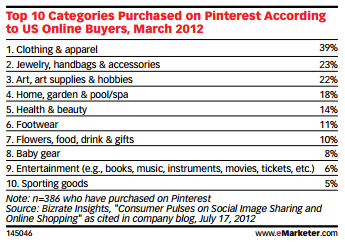
top categories purchased on pinterest

Bizrates Insights went deeper to discover the product categories that were most purchased by Pinterest users in the same month. 39 percent of users purchased clothing and apparel, 23 percent purchased jewelry, handbags & accessories, while art, art supplies & hobbies accounted for 22 percent of the purchases.

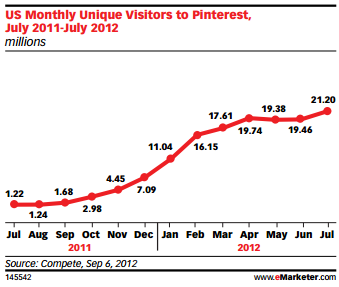
us monthly unique visitors to pinterest

Despite the rapid ascent to become the third largest social networking site, the hype has waned and Pinterest’s growth is stabilizing. There was one month between April and May, where the number of unique visitors dropped, and eMarketer points to a survey conducted by SheSpeaks and Women’s Marketing Inc. which indicated that more than half of the female respondents were not using the site daily (or at all) and only 30 percent of those surveyed used Pinterest for longer than one hour per day. While Pinterest may never grow to the size that Twitter, Facebook, or even Google+, user numbers aren’t everything — especially when you aren’t in the display ads business. What does matter for Pinterest is click-through purchasing rates, and all signs indicate the platform is facilitating the connection between shoppers and retailers.


Source : digitaltrends[dot]com

Oct 12, 2012

UK government also probing Huawei, says it currently has no security concerns

Huawei Show Photograph: Reuters

Following the House of Representatives damaging report, the UK has revealed it has also been examining Huawei amid security concerns.

The story following the House of Representatives report that Huawei and ZTE pose a security threat to US national security continues, as international governments examine their involvement with the Chinese companies and look for their own evidence of security risks.

In the UK, it has been revealed that a parliamentary committee has also been examining Huawei’s presence in the country for a while, as it’s a major supplier of network equipment to British Telecom, Vodafone, O2 and most other network providers, plus it’s responsible for much of the infrastructure behind EE’s 4G network.

Should any discrepancies be identified, the continued rollout of both fiber and 4G broadband could be slowed or halted. Both projects, and the relationship with Huawei, are well established, and disruption would be costly. The report is due to be published at the end of the year.

Quite apart from the network disruptions, there’s a political aspect at work too, as Prime Minister David Cameron had a meeting with Huawei’s CEO Ren Zhengfei last month, where a £1.3 billion deal was reached. One of the first stages is for Huawei to move its UK workforce into a new 140,000 square foot office building in April next year.

A Cabinet Office spokesperson, Derek Smith, has been talking to the UK press about the government’s view on both Huawei and ZTE ahead of the final report, which is notably different to that of the US House of Representatives.

Cyber Security Evaluation Centre

Smith told TechRadar.com that “the Cabinet Office is confident that there are no security concerns,” and “comparisons with the US don’t hold up with what we’re doing here. We have a very strict evaluation process for products from any country, not just China, coming into the UK.”

He then referred to Huawei’s Cyber Security Evaluation Centre, which opened in 2010, where hardware and software are tested to, according to Huawei “ensure its ability to withstand growing cyber security threats.” The closest the blurb gets to admitting the centre is more about checking Huawei’s equipment is the admission that it’s there to “build mutual trust in the area of cyber security.”

A 2011 report covering the center’s opening from notorious scare-mongers The Daily Mail is far less subtle, starting with the headline “New cyber attack fears over the Chinese ‘Red Army Lab’ being used for BT tests.” The piece goes on to quote numerous security experts who warn against using Huawei’s services, plus it reveals that Huawei has an identical copy of BT’s computers and telecoms system back in its Shenzhen head office, so it can evaluate new hardware. Thankfully, the system isn’t connected to the UK network.

For now, it seems Huawei’s operations in the UK are safe, but things will take a turn for the serious — not to mention politically embarrassing — should the forthcoming report not back up the Cabinet Office’s statements, as Huawei is already sitting at the table with its slippers on in the UK, instead of only knocking on the door in the US.


Source : digitaltrends[dot]com

Oct 10, 2012

Rumor: Armie Hammer may play Batman in Justice League movie

The Lone Ranger

Once again, Armie Hammer is Warner Bros.' top choice to play Batman in a still-hypothetical Justice League movie.

According to a recently published report on Digital Spy, actor Armie Hammer (pictured above at right) is being strongly considered for the role of Batman in Warner Bros. inevitable film based on DC Comics’ Justice League superhero team. 

If that sounds familiar to you, it’s not because we’re reprinting old stories in some kind of ill-conceived “Digital Trends Greatest Hits” initiative. Hammer was originally the top candidate for the Batman role back when Mad Max director George Miller was attached to the Justice League project. That attempt to get this movie made fell apart a few years ago, yet Warner Bros. is determined to pick up a slice of that sweet superhero team movie cash generated by The Avengers earlier this year, and will not rest until someone, somewhere is filming a big-budget Justice League feature film.

As for why Hammer once again leads the list of names vying for the Bruce Wayne/Batman role in this film, Digital Spy’s unnamed insider source claims that Hammer’s recent ascent to the fringes of the Hollywood A-list has put him “back on WB’s radar.” Hammer will next appear as the titular lawman in Disney’s Lone Ranger feature film alongside Johnny Depp, which is undeniably a pretty major role (even if Depp’s silly, borderline-racist crow hat will inevitably overshadow Hammer’s performance).

In case you’re wondering if Hammer’s hypothetical Batman might officially replace the fan-favorite Batman portrayed by Christian Bale in Christopher Nolan’s recently-concluded Batman trilogy, don’t worry: According to the anonymous source, Hammer’s version of the character will only be used in this initial Justice League film and any sequels it might spawn. Unless plans change, Hammer won’t be appearing in any solo Batman adventures.

Finally, Digital Spy claims that the Justice League film will include a relatively standard roster for the superteam. Though the Justice League (and its innumerable spin-off groups) has seen hundreds of members over its half-century-plus in existence, this initial Justice League movie will focus on the core group of Superman, Batman, Wonder Woman, The Green Lantern, Martian Manhunter and The Flash. No, we have no idea which iterations of The Flash or Green Lantern Warner Bros. plans to use, but we’ll let you know as soon as we hear anything more concrete than just “our shadowy informant said…”.

Working under the assumption that these rumors are all true, this news doesn’t so much fill us with joyful anticipation as it raises questions in our comic book-addled brains. As much as we like Hammer — other than the Trent Reznor score, his work as the Winklevoss Twins in David Fincher’s The Social Network was easily our favorite part of that film — he simply seems too young and soft to properly portray Batman. Yes, Bruce Wayne grew up in a mega-wealthy family and has never wanted for money, but there’s a certain edge to the character that seems minor but is, in fact, one of his defining traits. Christian Bale was able to pull this off flawlessly, but so far Hammer has yet to do anything that suggests he might have that certain killer instinct that makes Bruce Wayne more than just your average playboy.

More crucially, if Hammer is cast, and his Batman is used solely in Justice League movies, what happens when The WB wants to start churning out new Batman films? Will they go back on their plan? Will they find another actor? Assuming the latter, won’t the public be confused by two entirely separate Batmen coming from the same production studio? Objectively speaking, one of them has to be better than the other, so in that case the studio would be running the risk of overshadowing its own projects and cannibalizing any potential audience either franchise might attract.

Whatever happens, this film isn’t scheduled to hit theaters until at least 2015, so Warner Bros. certainly has lots of time to figure things out. In the mean time, as usual, we invite you to visit the comments section below to either vilify this rumored news, or figuratively clap like one of those wind-up cymbal monkeys. Whichever more accurately conveys your current emotional state.


Source : digitaltrends[dot]com

Oct 4, 2012

iPad Mini apparently enters production, instantly hits supply problems

A new report suggests the Apple iPad Mini has gone into production, and that it's already plagued by supply problems.

Sources speaking to the Wall Street Journal have said that components for the device we currently know as the iPad Mini have entered mass production. As with everything iPad Mini related, the sources are anonymous but “familiar with the situation.”

The report says it’s the device’s touchscreens that are being built, and again speculates that they will measure 7.85-inches, and have a lower resolution than the 9.7-inch iPad.

However, previous rumors have suggested the iPad Mini will share the new iPad’s 2048 x 1536 pixel Retina screen, and that production was supposed to start in August.

This news comes soon after a quote from an anonymous Apple investor, who in turn was quoting from a gaggle of unnamed sources, said invitations to the press event for the iPad Mini’s announcement would appear on October 10. An October launch has been on the cards for a while, but then, so was a joint iPhone 5/iPad Mini event.

Supply problems

But, nobody said making a hypothetical product was going to be easy, as no sooner had the elves begun working on the iPad Mini, than those ever problematic supply problems arrived. This time it’s Brian White, an analyst for Topeka Capital Markets with the inside gossip, saying that suppliers had found the iPad Mini’s specification a “challenge” and that the production had suffered because of it.

This, White says, is the reason for the iPad Mini’s delayed launch.

He goes on to talk about “continued yield challenges” — supply chain geek talk for producing the right number of products, at the right time, to make the most profit — before adding that while the iPad Mini is “on track to reach acceptable volume levels for launch,” there will be supply problems “during the first month or so.”

In other words, demand will likely outstrip supply, which is just the way Apple likes it.

The iPad Mini is supposed to be Apple’s response to the popularity of budget tablets such as Amazon’s Kindle Fire and Google’s Nexus 7. For this reason, if it does ever arrive, the price will most probably be the primary talking point, and it’s expected to be no more than $300.

We’ll know more on October 10, or not, as the case may be.


Source : digitaltrends[dot]com

Sep 29, 2012

Google and Asus may be building a $100 Nexus tablet

Google Nexus 7 tablet in landscape orientation

A recent report says the two Android-loving companies responsible for the Nexus 7 are working on a $100 tablet.

If you’re wanting to buy a Nexus 7 then now is the time to do it because Google’s still offering a $25 credit for Google Play with tablet purchase. But if you can wait until Christmas there may be a brand new, even cheaper Nexus tablet to get your hands on. 

According to Digitimes, a source that seems to be right as much as it’s wrong, Google and Asus are working on a $100 Nexus tablet. The new Nexus will reportedly be ready in time for Christmas, the most magical time of the year (at least in sales numbers). The rumor comes from unnamed sources invloved in Asus’ supply chain. Apparently the tech giants are working on slimming down the Nexus 7 and offering it in two different variations: one running for an extremely budget-friendly $100 and the other staying at the $200 price point.

The current Nexus 7 managed to keep the price low without cutting too many corners. The only drawbacks — depending on how you look at them — are its lack of 3G connectivity and scratch-resistant Corning glass in place of the Gorilla brand. The mini-tablet still managed to pack in 1 GB of RAM, a quad-core Tegra 3 processor, NFC, GPS, microphone, and a front-facing camera. Asus wrapped all that up in a tight, 7-inch package and it was sold for a steal at $200. 

This new, thinner Nexus would no doubt be an attempt to solidify Asus and Google’s place as the go-to budget tablet makers even if the much-anticipated iPad Mini makes an appearance near the end of the year. If Google could pull it off, the cheaper tablet would definitely end up in a lot of stockings over the holidays. The low price of $100 would definitely appeal to impulse buyers, much like the Touchpad’s fire sale.

Unfortunately, it doesn’t seem likely this rumor will end up being anything but smoke and mirrors. We all know what happened with the $200 Surface tablet rumor… It didn’t come true. The truth is that Google would be losing a whole lot of money if it sold a tablet at $100 without dropping the specs to the point of embarrassment. It doesn’t matter how advanced the Jelly Bean software is, even Project Butter can’t save sub-par hardware. If Apple is good at any one thing, it’s delivering a smooth user experience and Google knows it needs to bring its A game in that department as well. 

Do you think there’s any truth to this rumor? Would you buy a cheaper Nexus 7 over an iPad Mini if you had the choice?


Source : digitaltrends[dot]com

Sep 23, 2012

Rescued 655-Pound Sea Turtle Released

abc wnn turtle rescue jt 120923 wblog Rescued 655 Pound Sea Turtle Released

(ABC News)

ABC News’ Katie Kindelan and Candace Smith report:

A giant sea turtle that has been described as “like a swimming dinosaur” has been released back into the waters this weekend after it was rescued from a mud flat near the tip of Cape Cod, according to New England Aquarium officials.

The 7-foot-long, 655-pound black male leatherback turtle, an endangered species, was treated with “drugs to stabilize its blood values and oxygen levels,” The Associated Press reported.

The turtle was found late Wednesday night on a mud flat in Pamet Harbor, near the town of Truro, Mass., by staff from a local Audubon sanctuary.

Due to darkness and the remote location, the staff had to leave the turtle until Thursday morning. Then they had to rely on a team of volunteers and a transport cart normally used to carry stranded dolphins to hoist the turtle onto a vehicle to take it to the Aquarium’s marine animal care center.

READ MORE:  Rare, Tiny Sea Turtles Spotted

Aquarium spokesman Tony LaCasse described the turtle as “near death” when he arrived at the aquarium.   One of its massive flippers had been partly severed, likely the result of some sort of predatory attack or a run-in with a boat, according to LaCasse.

The straight line of damaged tissue on the flipper points to a possible entanglement in a vertical line in the water, perhaps from a lobster pot or a boat mooring.  Nearly 20 leatherbacks have died in New England waters this season from such accidents, according to the aquarium.

The injury to the turtle’s left flipper affected its ability to forage for food and could have led to an infection.

A leatherback rescue is rare because the animals are open-ocean turtles and cannot be kept in captivity.  Even at 655 pounds, the turtle is considered skinny in comparison to its fellow leatherbacks, which typically weigh around 1,000 pounds, according to LaCasse.

Leatherbacks flock to Cape Cod and surrounding islands each June to feed on the jellyfish that are abundant in the waters. They migrate south for the winter beginning this month and into October, according to the aquarium.

The Associated Press contributed to this report.


Source : abcnews[dot]go[dot]com

Sep 21, 2012

Endangered Sea Turtle Fights for Life After Rescue

ABC News’ Katie Kindelan and Candace Smith report:

A giant sea turtle described as “like a swimming dinosaur” is clinging to life at the New England Aquarium after it was rescued from a mud flat near the tip of Cape Cod.

The 7-foot-long, 655-pound black male leatherback turtle, an endangered species, was found late Wednesday night on a mud flat in Pamet Harbor, near the town of Truro, Mass., by staff from a local Audubon sanctuary.

READ MORE:  Rare, Tiny Sea Turtles Spotted

Because of darkness and the remote location, the staff had to leave the turtle until Thursday morning. Then they had to rely on a team of volunteers and a transport cart normally used to carry stranded dolphins to hoist the turtle onto a vehicle to take it to the Aquarium’s marine animal care center.

Aquarium staff are now working overtime to save the turtle, only the fifth of its kind in 40 years to have been found stranded and alive on a Massachusetts beach.

“We are crossing our fingers and will do everything we can do to keep it alive,” the Aquarium’s Tony LaCasse told ABCNews.com.

“The feeling is to view a live leatherback up close is such a rare opportunity,” he said.  “The staff are keen to work with such an animal.”

LaCasse described the turtle as “near death” when he arrived at the aquarium.   One of its massive flippers had been partly severed, likely the result of some sort of predatory attack or a run-in with a boat, according to LaCasse.

The straight line of damaged tissue on the flipper points to a possible entanglement in a vertical line in the water, perhaps from a lobster pot or a boat mooring.  Nearly 20 leatherbacks have died in New England waters this season from such accidents, according to the aquarium.

The injury to the turtle’s left flipper affected its ability to forage for food and could have led to an infection.  Biologists are now treating the turtle with drugs for dehydration, trauma and shock.

A leatherback rescue is so rare because the animals are open-ocean animals and cannot be kept in captivity.  Even at 655 pounds, this one is actually skinny in comparison to its fellow leatherbacks which typically weigh around 1,000 pounds, according to LaCasse.

Doctors treating the turtle have not been able to confirm its age but estimate it is at least 25 to 30 years old.

Leatherbacks flock to Cape Cod and surrounding islands each June feed on the jellyfish that are abundant in the waters. They migrate south for the winter beginning this month and into October, according to the aquarium.

Officials say though they hope for the best, the leatherback’s chance for a full recovery is unclear, because in order to get stranded on the mud flat where it was found it had to be critically ill.


Source : abcnews[dot]go[dot]com

Sep 12, 2012

Study: Watching live TV becoming less popular while DVR usage rises

Watching TV

As more people transition to digital recording, consumers seem to prefer using the DVR over catching a television show when it's live.

According to Nielsen’s latest Cross-Platform report that studies how content is consumed, the average amount of live television watched each day has dropped by approximately two percent over the previous year. Alternatively, the amount of time spent watching content recorded on a DVR has increased by approximately eight percent over the same time period. In addition, the number of people watching television programs over the Internet on a computer or streaming shows on a mobile smartphone has increased year-over-year. Regarding physical media, the amount of people watching DVD or Blu-ray discs decreased slightly over the same time period and video game usage remained the same. 

Cross Platform Time Watching TVSpecific to age, older adults were vastly more likely to spend more time watching live television than younger adults. Men over the age of 35 spend approximately five and a half hours per day watching television while women of the same age range spend a bit over six hours. The younger 18 to 34 year old demographic spends about three and half hours watching television on the male side and slightly more than four hours per day on the female side.

DVR usage was highest among adults between the ages of 35 to 64 while watching video on the Internet was most popular with young adults between the ages of 18 to 34. When it comes to watching video on a mobile phone, children between the ages of 12 to 17 and young adults between the ages of 18 to 24 were the most likely to watch programming on their smartphone. Regarding ethnicity and race, African-Americans consumed the most traditional live television with an average of 210 hours per month while Asian-Americans watched the least with an average of 100 hours per month.

When it comes to cord cutting, the amount of people that are subscribing to cable television has dropped by about five percent year-over-year. Television service through satellite or telecommunication companies has stayed relatively stable. Interestingly, the number of people that subscribe to broadband Internet service and only watch broadcast television over-the-air has increased over the past twelve months.

Regarding home theater hardware, the amount of DVD or Blu-ray players used in U.S. homes decreased by nearly three percent while the amount of DVR devices has increased by nine percent year-over-year.

In addition, the amount of high definition televisions within U.S. homes increased by nine percent and video game console market penetration also increased by three percent. Specifically, forty-six percent of U.S. homes have a gaming console and thirty-nine percent have a seventh-generation gaming console within the home.

In addition, gaming consoles are getting more usage as an entertainment hub than a standalone DVD or Blu-ray player. Beyond simply playing games, PlayStation 3 owners spend an average of 36 minutes on the console each day for other entertainment like streaming video on Netflix, Vudu or Hulu Plus. In addition, Xbox 360 owners spend about 32 minutes per day on the console and Wii owners spend about 17 minutes on the console each day. Households that utilize a seventh-generations gaming console are more likely to have broadband Internet access, spend money each month on extra services and experiment with new electronic devices within the home. 


Source : digitaltrends[dot]com

Social casino games will generate $2.4 billion in revenue by 2015. Will gambling save Zynga?

As executives abandon Zynga in droves, a new report on the future of social gambling bodes well for the company's new ventures.

The social game dream is dead! No longer can companies rely on Facebook’s unwitting users to sit in front of a screen, dropping dollars on in-game items and clicking on ads just so they can watch a virtual farm thrive. The market for viral social games like Farmville is shrinking, just as companies like Zynga thought they were going to get rich on people’s addictive habits.

But wait! There’s still plenty of opportunity to take advantage of people’s addictive habits after all! That’s why Zynga, Big Fish, RocketPlay, and others are turning to the oldest type of social game on the planet: Gambling for real money. Why keep trying to reinvent the Mafia Wars wheel when you can just get people betting on football games and playing poker?

Zynga and the other social game makers will likely see their gamble pay off big according to new data compiled by SuperData. That analyst group’s latest report on “Social Casino Metrics” predicts that revenue from real money social game gambling will total $1.6 billion by the end of 2012. By 2015, the take will be $2.4 billion.

“Both small social game developers and large land-based casino operators are looking at this new space,” says SuperData VP Janelle Benjamin, “With declining margins in the overall social games segment, casino-style games offer a healthy growth potential.”

According to SuperData, the average social gambler is spending almost twice as much as the average social game player, $78 to $43 in July alone, a dead period in the year when most people are spending on activities rather than gaming. The bulk of spending is happening in the US. $660 million of all social game gambling revenue this year will come from the US’ more than 35 million active players (around 11 percent of the total population.)

 If clicking on a virtual cow on Facebook wasn’t depressing enough, social games will now be the virtual equivalent of Atlantic City slot machines.

The expected growth of the social gambling market doesn’t necessarily mean that Zynga’s survival is guaranteed. Corporate upheaval may kill the company first. It’s bleeding executives right now. After its stock was crippled in August, chief operating officer John Schappert quit the company. Chief technology officer Allan Leinwand followed last week, and chief marketing officer Jeff Karp quit on Tuesday. Maytal Ginzberg, Zynga’s executive in charge of real money gambling operations, just joined the company on Aug. 31.

Source: Venturebeat


Source : digitaltrends[dot]com

Drones: 13 things you need to know from Congress’s new report

Congress drones report privacy spying technology

A new Congressional report lays out in vivid detail the danger drones could pose for personal privacy. Here's everything you need to know.

Starting in 2015, the skies above the United States will become infiltrated by a rare creature: drones. Also known as unmanned aerial vehicles (UAVs), drones are currently forbidden from flying in U.S. airspace above 400 feet, unless the Federal Aviation Administration (FAA) provides a license. But thanks to a bill passed by Congress early this year to make these licenses easier to get, drones will likely become a part of everyday life for Americans. 

While fun and futuristic, this coming reality unearths serious questions about privacy and personal liberty in the 21st century. A report published last week by the Congressional Research Service (CRS) shows that our laws are currently unprepared to deal with the privacy implications posed by the use of drones. The report (pdf) is an excellent read — at least if you’re a wonk like me. But if you don’t have time to peruse a 20-page CRS report, here are the 13 things you must know about the looming drone privacy apocalypse.

1. There will be 30,000 drones in the sky in less than 20 years

drone swarm

The FAA estimates (pdf) that within the next 15 years, more than 20,000 drones will take to the skies in the U.S., including drones operated by police, military, public health and safety agencies, corporations, and the public in general. That number is expected to jump to 30,000 within 20 years from today — a number the FAA refers to as “relatively small.” Currently, the FAA has only given out about 300 licenses to fly drones capable of cruising at more than 400 feet in the air.

2. Matters of privacy are all about “reasonableness”

reasonable

The Fourth Amendment to the U.S. Constitution guarantees our right against “unreasonable searches and seizures.” The key word here is “unreasonable” — and thanks to our rapidly changing technologies, its definition is in near-constant flux.

CRS researcher and legislative attorney Richard M. Thompson II, who authored the report on drones, explains in the report that “the reasonableness of drone surveillance [as considered by the courts] would likely be informed by location of the search, the sophistication of the technology used, and society’s conception of privacy in an age of rapid technological advancement.”

It’s this last part — “society’s conception of privacy” — that you should worry about on a daily basis, as it applies to the use of information gathered by everything from drones flying over our back yards to GPS capabilities in our smartphones to our Facebook profiles. Once society becomes generally “OK” with certain information becoming public, or becoming public in a certain way — once we think of these things as “reasonable — the Fourth Amendment protects us less. 

3. The Fourth Amendment: It depends what the definition of “search” is

surveillance-camera-shutterstock

As with what can be considered “reasonable,” the definition of what constitutes a “search” under the Fourth Amendment is a slippery beast. The Fourth Amendment provides for little wiggle room when it comes to activities performed in your home, behind closed doors and curtained windows. (No searches without a warrant there — most of the time, anyway.) But as soon as you leave the confines of your house, things start getting more complicated — and things get even worse when you consider surveillance that uses planes and helicopters. Throw drones in the mix and, well, the fine line across which surveillance by the state becomes “search” gets downright knotty.

Thompson’s CRS report explains that a court reviewing the use of drones under the Fourth Amendment will have to consider past cases that involved “privacy in the home, privacy in public spaces, location tracking, manned aerial surveillance, those involving the national border,” and instances when warrants aren’t needed to perform a “routine” search (like searching a car at a U.S. border), to determine the definition of a “search.”

4. Drones will have the ability to see through walls and ceilings

x-ray vision

Thanks to technology like the Xaver 800 from Camero, which uses electromagnetic radar to construct 3D images of hidden objects, law enforcement and military personnel can now “see” through walls. Combine this with laser radar and thermal imaging techniques, and our homes practically have glass walls, as far as the police are concerned. Thompson estimates that similar technology will eventually be outfitted on drones, allowing them to see through ceilings and walls. The question before the courts will be: Without a warrant, is that reasonable?

5. Drones could be outfitted with face recognition technology

face recognition

In addition to seeing through our walls, Thompson writes that law enforcement organizations “might seek to outfit drones with facial recognition or soft biometric recognition, which can recognize and track individuals based on attributes such as height, age, gender, and skin color.”

Considering that the FBI is currently undertaking a $1 billion project to build out its face recognition capabilities, this one seems all but inevitable. However, as Thompson explains, the sophisticated nature of such technology may determine whether the use of face recognition technology on drones “is lawful under the Fourth Amendment.”

6. Aerial searches in manned aircraft are not against the Fourth Amendment — but drone surveillance may be different

helicopter

While the Fourth Amendment provides strict protections for privacy inside the home, anywhere outside the home falls into other categories of protection. The first is “curtilage,” which is defined as the area surrounding a home (like a front or back yard). Areas outside of that are referred to as “open fields.” The Fourth Amendment protections apply differently for each of these categories; curtilage is often nearly as highly protected as inside the home, while open fields may not be protected at all.

That said, existing case law (precedent) determines that police may use airplanes and helicopters that fly within federal aviation guidelines to look in on citizens’ curtilage — even if it’s fenced in or otherwise hidden from public view — without a warrant. It is not yet clear whether drones would fall into the same category as planes and ‘copters, according to Thompson.

7. Long-term tracking is different from short-term tracking

Real_Time_GPS_Tracking_Device

In the recent Supreme Court case United States vs Jones, the Court ruled that the tracking of an individual using GPS for a long period of time (say, a month) constitutes a “search” under the Fourth Amendment due to how much information can be gathered about a person over an extended period, thus requiring a warrant to perform the tracking. But previous case law upheld law enforcement’s ability to track users outside their homes for a shorter period of time without the need for a warrant.

Now, because drones can stay in the sky for long periods of time — and, in the case of Lockheed Martin’s Stalker drone, possibly forever — they could be used to track people’s movements for extremely long periods of time. Because of this, the courts will have to decide whether the use of long-duration flight drones for surveillance purposes constitutes a search under the Fourth Amendment.

8. U.S. borders are a search free-for-all

US-border-drone

As you may have gathered, reasonable expectations of privacy have a lot to do with where a person is. But the one place you should have zero expectation of privacy is near a U.S. border. Border agents already have the ability to search things like your car, without a warrant, within 25 miles of a U.S. border.

Because of the looser restrictions near U.S. borders, the use of drones is, and will be, extremely prevalent. And since the surveillance using drones “may be considered more passive” than surveillance agents on the ground, or in planes and helicopters, by the courts, explains Thompson, drones “may be even less likely to run afoul of Fourth Amendment requirements.” (Emphasis mine.)

9. Technology sophistication matters

 thermal-imaging-camera

Under the Fourth Amendment, all technology is not created equal. The use of gadgets that anyone can get their hands on (like binoculars) for surveillance purposes are more permissible by the courts than technology that is extremely sophisticated (like radar that can see through walls).

With this in mind, the courts will likely have to decide what types of technology can be attached to drones for surveillance use. Is a low-powered camera allowed while a high-powered camera isn’t? Should drones be outfitted with face recognition systems? It’s not yet clear — and it’s something that the courts (or Congress) must establish.

10. The more common drones become, the less privacy protections you may have

privacy

As with the public definition of “reasonable” under the Fourth Amendment, the public’s expectations of privacy with regards to certain technology changes with time. The more a technology is used, the more acceptable (read: reasonable) it is. Thompson points out that as drones become increasingly commonplace, the more the public will accept the use of drones for surveillance purposes, potentially changing which types of surveillance practices are and are not protected under the Fourth Amendment.

11. Americans are worried about drones

drone camera

According to a study released in June by Monmouth University (pdf), 80 percent of Americans approve of using drones for search and rescue missions, while 67 percent believe drones should be used to “track down runaway criminals.” 

And yet, 42 percent of respondents said they would be “very concerned” about their own privacy if drones were used by law enforcement. Twenty two percent would be “somewhat concerned,” and 16 percent would be “just a little concerned.” A full 15 percent said they would not be concerned at all.

Oh, and only 23 percent said they would feel comfortable with using drones to catch speeding motorists.

12. There are ways to fight back against drone privacy invasion now

S 3287

The courts are not the only government body that can decide what is and is not allowed by drones. Congress can also take action, and it’s already begun to do that. Rep Austin Scott (R-GA) and Sen. Rand Paul (R-KY) recently introduced the Preserving Freedom from Unwarranted Surveillance Act of 2012 (H.R. 5925, S. 3287), which would require the federal government to gain a warrant based on probable cause before drones could be used for surveillance purposes. And Rep. Ted Poe’s (R-TX) Preserving American Privacy Act of 2012 (H.R. 6199) would also require law enforcement to obtain a warrant for drone surveillance, among other restrictions.

Thompson suggests that “Congress could also limit the admissibility of evidence in a criminal prosecution to situations where its acquisition was the purpose of the drone search.”

If you’re afraid of waiting to let the courts decide how drones can be used for surveillance — a decision that will come after the drones are already being used for that purpose — I suggest you look into vocally supporting some of these bills.

13. We’re just making this up as we go along

winging it

Valuable tidbits about the Fourth Amendment aside, the key takeaway from all this is that laws are nothing more than a man-made creation. In other words, they are made up. And as technology advances faster than our government can respond, those in charge of crafting the rules are forced to figure out all the implications on the fly — not just for drones, but for all emerging technologies. More important, our view of drone surveillance (or GPS tracking or Facebook data scraping) plays a major role in how the government will decide these issues for us. We would do well for ourselves to pay close attention.

Shutterstock images: camera via Sto; X-ray via jgl247; helicopter via Sofron;  gun/thermal imaging camera via Brent Wong; privacy via Thomas Skjaeveland; winging it via Yuri Arcurs


Source : digitaltrends[dot]com

Sep 7, 2012

Lionsgate-Summit wants Vin Diesel for The Last Witch Hunter

Vin Diesel

Vin Diesel's next role may see the muscular action star slaying witches.

According to a report over at The Wrap, Vin Diesel (pictured above; you’re welcome ladies) is currently in talks with the Lionsgate Entertainment/Summit Entertainment conglomeration to assume the lead role for the studio’s upcoming The Last Witch Hunter. As the name suggests, the film revolves around a man with a knack for bumping off witches, or, as The Wrap puts it, The Last Witch Hunter “follows the last remaining witch hunter who must stop a witch uprising in modern day manhattan.”

Neat concept, right? Apparently Hollywood thinks so too, as the script for this thing, written by Cory Goodman (whose only prior writing credit was on 2011′s Priest), found its way on to the 2010 edition of the Black List. For those of you currently scratching your heads, the Black List is a short roster of the best scripts in Hollywood that have yet to be made into films. Former Black List scripts that eventually spawned movies include Aaron Sorkin’s The Social Network (it made the list in 2009) and Joe Penhall’s adaptation of Cormac McCarthy’s The Road (which is featured on the 2007 list.) If you’d like to learn more about the List or read through the entire collection of Black Lists dating back to its inception in 2005, have a look at the List’s official site.

Anyway, back on topic: Vin Diesel as mankind’s last hope against the apparently terrifying menace of witchcraft. As much as we’d like to have something cynical to say about this idea, we can’t really come up with anything. We like the premise, we like the idea of Diesel as an action movie star, and we like everything we’ve heard about the script. The only possible problem we can see with this project is that the concept of witches doesn’t seem to generate much excitement among prospective viewers.

Remember 2011′s Season Of The Witch? Of course not, you didn’t see it. Very few people did. The movie, which starred Nicolas Cage as a world-weary knight devoted to routing demonic evil, pulled in a little less than $25 million here in the US, and nearly earned $67 million worldwide. On a production budget of $40 million, those figures leave a lot to be desired and may indicate that contemporary audiences just don’t care about angry women who can vomit pestilence and spin their heads all the way around.

Then again, Season Of The Witch may have been stymied by its lack of long-term, pre-release advertising, or the overexposure of its male lead. Vin Diesel, by comparison, is far more suited to being an action star than the 48-year-old Nicolas Cage. Likewise, he hasn’t been headlining three movies a year for the past decade. Maybe audiences will more readily accept Diesel as a hunter of the wolfsbane and eye of newt set.

Whatever happens, it’s going to be a while before we see how this project turns out. Diesel has yet to sign an official agreement to star in The Last Witch Hunter, and even once that’s completed the film will likely need at least a year of production prior to its theatrical debut. Fingers crossed that this project can avoid any unforeseen roadblocks.


Source : digitaltrends[dot]com