Pages

Showing posts with label friends. Show all posts

Nov 14, 2012

Facebook rolls out the share button to mobile users

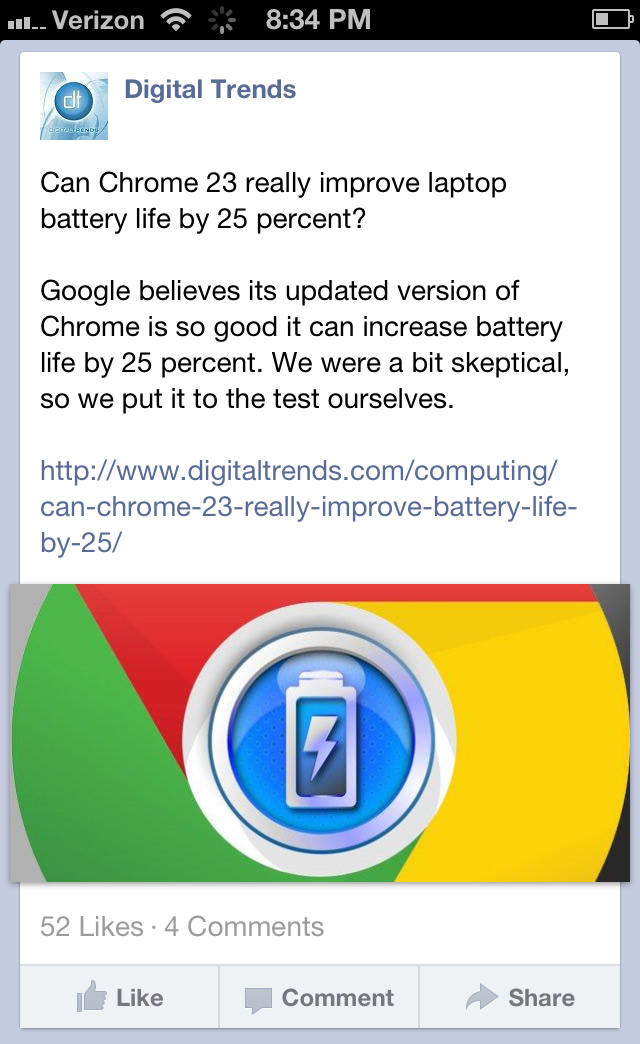
Designed to encourage mobile users to share more types of content with their friends, Facebook is rolling out a new share button for the mobile interface.

Detailed by Techcrunch earlier today, Facebook has launched a share button on the mobile version of the social network and is planning to add sharing capabilities to both the iOS and Android applications at a later date. While the ability to share a particular article, video or picture is commonplace on the Web version of Facebook, mobile users can simply tap on the new share link in order to pass along an interesting piece of content to their friends. When a user brings up the mobile version of the social network, they will notice a new Share button to the right of the Like and Comment buttons. 

Tapping the new share button brings up an interface that allows the user to write a comment that goes along with the shared content. In addition, the user can isolate the post to a specific subset of their friends through groups or post it publicly in order to reach all subscribers.

Once the user is satisfied with the post, they confirm the sharing action by tapping the Share button in the top right corner of the screen. Alternatively, cancelling the post returns the user to the news feed. The new share button is only appearing within the News feed at this point. When visiting a personal page of a friend or a brand, the share button hasn’t been incorporated within the design yet.

The launch of the new sharing feature marks a trend in Facebook’s strategic approach to mobile. While the inclusion of the sharing button isn’t a technical achievement by any means, the priority of improving Facebook’s mobile interface is evident. According to Facebook’s third quarter results, the social network has approximately 600 million active mobile users each month. In addition, about 120 million of those active users check Facebook exclusively through a mobile device. The addition of the share button on the mobile version of the site could result in a spike in the amount of articles, videos and pictures that are shared each day. 

With the addition of the share button for mobile users, this brings Facebook more in line with social network competitor Twitter. On the web version of Twitter, users are encouraged to retweet posts and share them with friends. It will be interesting to see if mobile users on Facebook transition from the Like action to the Share action. Potentially,  it could significantly increase the amount of shared content people find in their News feeds each day and possibly drown out other status updates from friends and family.

However, it could be extremely helpful to brands and advertisers since the share action is more valuable when attempting to spread a particular piece of content. In a related story noted by The Next Web, Facebook is also rolling out a new feed that allows a user to view posts from brands and other pages into a completely separate feed. While posts from those pages will still appear within the News feed, users can visit this page in order to view recent updates only from liked pages.


Source : digitaltrends[dot]com

Nov 10, 2012

This week in Facebook news

This week in Facebook: MItt Romney's page is losing friends, popular users can promote posts, and Facebook is upping your self esteem but killing your self control.

Not a week goes by that Facebook doesn’t issue a handful of releases or create a buzz around itself, and this one was no exception. Here are five of the top Facebook stories you may have missed from the last five days.

Mitt Romney is bleeding Facebook friends

romney facebook page bleeding of friends

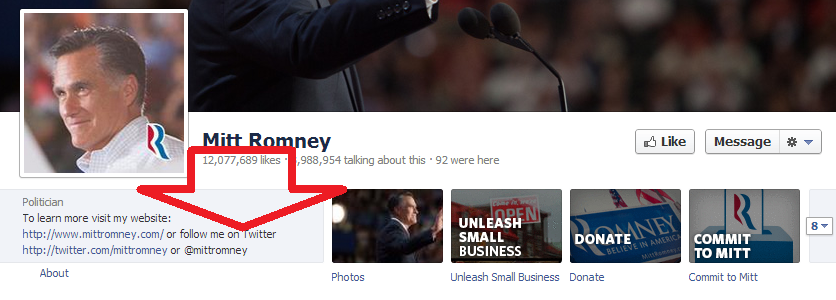
With the election over and along with it Mitt Romney’s campaign, and now Mitt Romney’s Facebook page is stuck in social media purgatory. Campaigners will no longer be updating the page, it just simply “exists.” Whatever the motivation may be, followers of the former presidential candidate’s Facebook page are unliking Romney in droves. “Refresh the page – 12.08 million. Refresh again – 15 less,” Caitlin Dewey of The Washington Post wrote when she first realized what was transpiring. We checked it out for ourselves, and indeed, we were witnessing an exodus of former followers fleeing his Facebook page – based on our eyeball calculation, we estimate about 10 followers were unliking the page every second. At this rate, should it be maintained, the “Likes” count will plummet to zero in just two weeks.

Fedex encourages shipping using its Facebook app

Just in time for the holiday season, and not long after Facebook Gifts was officially announced, Fedex is making a foray into making shipping social – sort of. Fedex’s newly launched Facebook App is called Ship To Friends, which is undoubtedly inspired by Facebook Gift’s own shipping process. On one hand, when we checked out the app we could see the value in the fact that it simplifies the process of shipping a package on the Web. If you’ve ever tried shipping a package on Fedex’s own website, you’ll know how frustrating it is to navigate as well as figure out the price and size of the package. Ship To Friends takes you through the process, with the prices listed clearly alongside delivery hours and dates. It makes you wonder why Fedex.com’s native shipping feature isn’t as easy to use as its Facebook app.

A couple caveats to note from our testing is that that international shipping isn’t supported and the app doesn’t send a shipping request to friends — meaning you can’t request that your friends enter in their own mailing addresses, which is a feature offered on Facebook Gifts. 

Facebook testing audio notifications

facebook audio notification settings

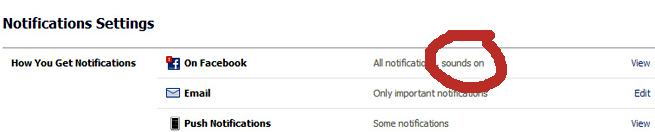
You might remember the days of the iconic “You’ve got mail” alert. It was annoying yet endearing, and apparently something similar may be heading to Facebook. Facebook confirmed with Venturebeat that alerts, which ping users when they receive new notifications, are being tested selectively. The alerts, if rolled out to all users, can be turned on and off in the account settings page.

Popular Facebook users can now get in on Promoted Posts

Facebook promoted post for over 5000 friends

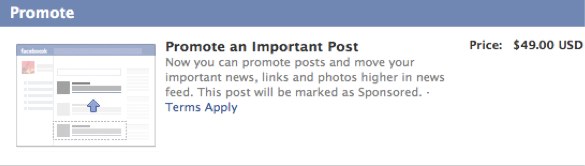
The upper echelons of Facebook users, who have more than 5,000 friends and/or subscribers, were unable to reap the “benefits” of the Promoted Posts advertising product that Facebook launched last month. Namely journalists, celebrities, politicians, and anyone else who would most likely have thousands of subscribers are the ones this change applies to. For those of us that fit in the 5,000 friends and fewer category are only charged $7 for a post to be promoted. It’s being reported that these users are being charged a premium of $49 to promote a post to friends and subscribers.

Facebook inflates egos, users lose self-control

Facebook can be addicting for some people, and for others it can boost self-esteem. A study by researchers from The University of Pittsburgh and Columbia University examined the effects of social media on human behavior and according to the paper, users are selective on what they share online and tend to portray themselves on social networks in a positive matter. This effectively boosts their self esteem. Interestingly enough, the study mentions that people looking in a mirror tend not to feel good about themselves. With this in mind, the researchers found a correlation between high self esteem and self control. “Enhanced self esteem from using a social network can have a detrimental effect on behavior,” says researchers Keith Wilcox of Columbia Business School, and Andrew T. Stephen of The University of Pittsburgh. “We present evidence suggesting that greater social network use is associated with a higher body-mass index and higher levels of credit card debt for individuals with strong ties to their social network.”

The root of the problem is that “elevated feelings of self-worth can lead to more impulsive or indulgent behavior. Citing Wilcox’s previous research, the study adds that inflated feelings of pride, which is related to self esteem, “results in more indulgent choices in subsequent tasks that are unrelated to the source of pride.”

We’ll go ahead and add this to the mountain of behavioral effects social networks are having on us. 

Facebook testing commenting threads

facebook comment threading

If you’ve ever cursed Facebook for overlooking the ability to comment on a comment, it looks like you’re in luck. A blogger and social media manager of Kairay Media discovered that comment threading was enabled on a Filipino Facebook page.

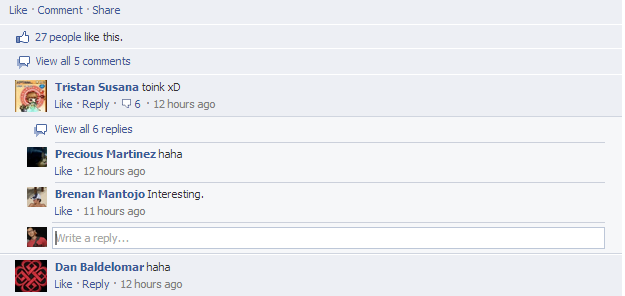
This feature, limited to a small test group, enables users to reply to comments. You’ll see a “Reply” button next to “Like” on the original comments. The replies to the comments can also be “Liked.” A third level of commenting isn’t supported. Facebook confirmed that the structure, as of testing, is as follows:

1. Comment

2. Reply to comment

Facebook’s spokesperson also provided us with the same statement, explaining the purpose of the feature:

“We are testing a new way to add comments to a post on Facebook. With this test you will be able to reply to another comment as well as the original post. This is just a small test at this stage.”

Comment threading, while being tested out at a limited scale, is a much awaited feature that many of us will be glad to embrace. For one thing, it should help to contain those heated arguments or side conversations in its own thread without disrupting the general flow.


Source : digitaltrends[dot]com

Oct 27, 2012

Tired of politics on Facebook? Replace it with cat pictures

Unpolitic.me

Ideal for everyone tired of listening to campaign rhetoric being spouted by Facebook friends, there's a Chrome extension that can help silence the noise.

Covered in detail by The Register recently, Buzzfeed and the creators of Unbaby.me have developed a new Chrome extension to help people avoid endless political posts on Facebook and Twitter as the 2012 Presidential election rapidly approaches on November 6. While the previous Firefox and Chrome extension Unbaby.me replaced all baby photos on Facebook with images of bacon, puppies and art among other things, the Chrome-only Unpolitic.me extension replaces the majority of political posts on Facebook and Twitter with various pictures of cats.

facebook-unpolitic-meWhile Facebook does provide filters to help users avoid updates from specific Facebook friends, this type of application can be particularly helpful for anyone that’s tired of hearing about politics. It allows the Facebook user to avoid political posts, but still read other interesting updates about friends, family and activities from politically outspoken friends.

The Unpolitic.me extension works by actively scanning a user’s social media feed for mention of specific keywords related to politics. While the user has the option of adding any specific keyword into the mix, a large number of default keywords have already been selected for the user.

For instance, the creators of the extension have added “Romney, Obama, election, voting for, republican, democrat, Ron Paul, 47 percent, binders, debate, how messed up is this country, Biden, Paul Ryan, Akin, Scott Brown, Elizabeth Warren, abortion, romnesia” along with 30 other keywords to help identify political posts. 

In addition, the user of the Unpolitic.me extension has the ability to use any image-based RSS feed. The creators of the extension have set the default as a stream of cat pictures from Instagram users. However, the user of the extension can change the RSS feed to anything else in addition to adding more feeds into the mix. There’s no reason that a usr has to stick with cat pictures.

For instance, someone that likes all types of cute animals could add more image streams of puppies, panda bears and bunnies. The makers of the extension recommend using RSS feeds that provide large resolution pictures. In addition, there’s no limit to the number of RSS feeds that a user can choose to use.

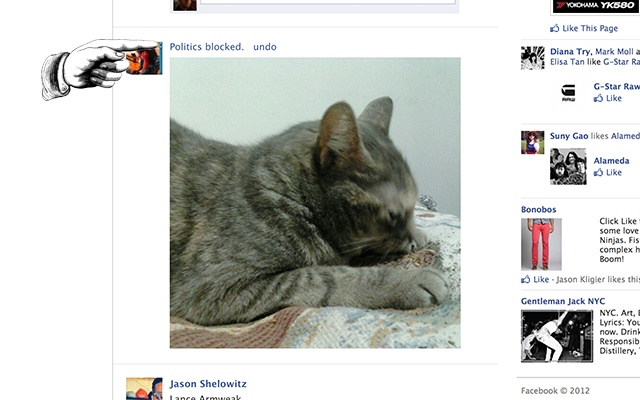
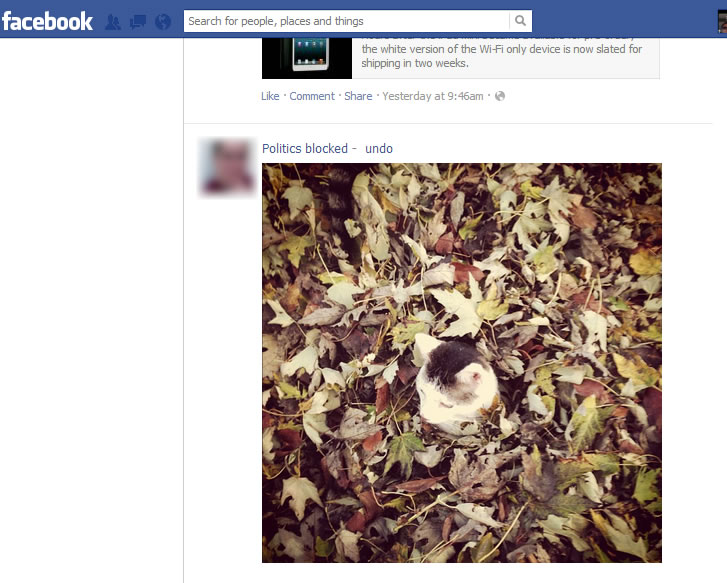
twitter unpoliic meThe Unpolitic.me extension will randomly pull from those feeds and replace the content on the page. On Facebook, a post about politics is simply replaced with the phrase “Politics blocked” and the replacement image. There’s also a link to remove the image if the user really wants to see what was originally posted. On Twitter, the user also has the ability to undo the content block. However, Twitter users will see a link to Buzzfeed’s animals section rather than a photo pulled from the RSS feeds chosen by the user. 

Conceptually, the Unpolitic.me extension can be used to block any type of content found on Facebook or Twitter. If a user doesn’t like a particular organization, any posts about said organization can be blocked by adding a few keywords in the settings of the extension. However, the extension can only block posts that include words. For instance, if a Facebook friend posts an political meme without adding a description, the person using Unpolitic.me will still see the political post within their Facebook feed. 


Source : digitaltrends[dot]com

Sep 30, 2012

How YouTube is shedding its former self to get polished for primetime

youtube star

As YouTube grows up into the premium network Google wants it to be, there are some familiar friends and faces getting left in the dust.

The YouTube community is a passionate one. It gave a home to millions of users who were formerly stuck within the confines of blogs. It’s the place where the viral video was born, where a handful of very famous stars got their big break, and where amateur vloggers have become Web-celebrities.

YouTube is one of the constants of the Internet: While the digital landscape hasn’t stopped changing, the site has managed to stay relatively true to its origins – but that’s a problem now that Google wants to turn it into a more professional platform. The first hints of YouTube’s evolution can be traced to nearly a year ago, when the homepage received a heavy overhaul that pushed and promoted its premium channels.  It was part of a restructuring effort Google has long been pursuing – turning YouTube into a television competitor, albeit on a smaller scale. No, it’s not cable, and no, a premium YouTube channel isn’t going to challenge HBO – but the promoted push means its edging toward a much more legitimate reputation than it originally had.

Cosmic Panda and the #SaveYouTube fallout

Last year, Google decided to clean up YouTube. Cosmic Panda, as it was dubbed, was sleeker, minimalist, and the biggest departure from what YouTube used to look like yet. The idea behind Cosmic Panda was to make channels clearer, to pump Google+ (no surprises there), and create a more professional environment.

On its surface,  this was simply a cleaner makeover – something YouTube routinely implements. But at its core, there were real consequences for the people that had been using YouTube to grow their reach, and growing the platform’s in the process. Popular YouTubers saw drastic drops – some as high a 60 percent – in their viewership numbers. The front page redesign was a big source of this hurt, because it started promoting users’ customized content here instead of popular or tending videos.

Naturally, there were hints of revolt, with infamous YouTuber Onision leading the charge. The Web star, who’s been using YouTube since 2007, started the #SaveYouTube campaign (which, as you can assume from the hashtag, got its legs over on Twitter) when he noticed his and other popular YouTube channels were losing viewers. “For many other channels, I noticed [viewership] dripping months ago,” he told me back in June. “I wasn’t worried at first as their viewership decline seemed to be based on them uploading fewer videos… but then some of my favorite channels started suffering, even the big ones were getting almost half the views they used to, despite the fact their upload rate and quality didn’t change.”  

saveyoutube campaign

While viewership numbers were declining (in large part thanks to the site’s cleaning out of old accounts – which I’ll get to), YouTube was also going on the offense to recruit new talent. Google’s the only one that knows what its intentions were, but these things combined lead to a logical conclusion: Out with the old, in with the new. At least, that’s how it has seemed.

“YouTube should respect and promote those who made it what it is,” Onision said. “Whoever is calling the shots needs to take a step back, and grow a heart, learn respect for YouTubers like Charles Trippy, What the Buck, Live Lava Live, and other YouTubers who were once the foundation of the site’s image.”

Long live Google+ and the new numbers that matter

It’s not just the attitude over at YouTube that has changed – it’s the numbers. Back in May, major YouTube celebrities have seen their subscribers drop drastically. Plenty of power users noticed, including Onision. He pointed out that a hefty number of YouTube creators, some with over a million views, were losing subscribers. YouTube responded days later, saying:

“In the past few months we have been scrubbing YouTube of inactive and closed accounts. Why? Because these accounts had been inactive for years, were not linked to our more up-to-date and secure systems, and well, nobody uses them. This had the knock-off effect of some creators seeing a drop in subscribers.”

Deleting old accounts before notifying users is a strange, curious thing to do: Why would any site want to kill user numbers? For instance, what about all those Google+ accounts that haven’t been touched since launch? I also can’t imagine Gmail deleting users that aren’t using their email address, at least not without notification. But YouTube was doing just that for months before telling anyone.

There were suggestions this was a Google+ promoted scheme: By scrubbing YouTube of old, inactive, not Google+-tied accounts, those users, should they choose to create a YouTube account in the future, would also have to create a Google+ one. It’s part of Google’s strategy to tie all its products into the G+ platform, so it’s essentially hedging its bets that eventually these inactive accounts will return to YouTube, sign up again, and become G+ users at the same time. At least, that’s one suggestion.

There’s also the evidence that Google’s priorities with YouTube have shifted. Views slightly dipped earlier this year, and subscription numbers continue to slowly sink – but things don’t matter as much now. What does? Engagement levels. Last spring YouTube started tailoring things so that video recommendations were more strongly based on how long you watched a video, and time spent watching individual videos has increased. Unique visitors is way up to, according to recent Nielsen reports.

Why would YouTube want to get you to watch videos for longer? The answer should be obvious: Because that’s how we watch TV.

Death to Reply Girls

The YouTube clean up isn’t all subscription numbers and algorithm tweaks – it’s also very literal. Since last spring, the platform has been trying to get rid of its Reply Girl problem. To be brief, Reply Girls are girls that position themselves just so in reply videos, get lots of clicks with said position, and for many, make their livelihoods doing so. They’ve been a common YouTube trope, but their less than professional demeanor has made them an enemy of the site. YouTube confirmed the Reply Girls will now be treated like spam.

One fairly well known Reply Girl, known on YouTube as – you guessed it – TheReplyGirl, had something to say about it. “This change is going to kill almost every reply channel,” she said in a video. “If it doesn’t kill them, it’s going to slow them down.”

It’s a small change, and honestly, one the nearly all YouTube users will be completely fine with. You should have to create meaningful content in order to make money or gain views on YouTube. But it’s the principle here, and it shows that YouTube isn’t a democratic free-for-all of video creation anymore and that Google will heavy-handedly impact how the platform evolves.

What now?

Now it’s been a few months since most of these changes went through, and the Daily Dot and online video data analyst platform ChannelMeter took a look to see how things were shaping up for some of YouTube former big names. And since the attitude changed and massive redesign, things have generally not been kind to a handful of YouTubers:

youtube infographic

The times, they’ve been unkind – to some users. To others, like the team over at Recipe Rehab, they’ve been pretty damn good. The show, from the Everday Health YouTube Channel, will become part of the ABC family this fall. It’s the first time a YouTube show has been picked up by network TV, and that’s a big deal. It means the shift is working out for Google; the quest for the living room is on and alternatives to cable know that the competition is heating up.

You can’t blame Google for throwing its hat into this ring and throwing it hard, but that comes with consequences. That means the YouTube of yore is gone; off-the-cuff, casual content can head for the hills – it’s time for professional, premium primetime. Because that’s where the money’s at. 

Source : digitaltrends[dot]com

Sep 22, 2012

Facebook wants you to snitch on friends that aren’t using real names

Specifically for data collection to analyze usage patterns, Facebook friends are being used against each other to identify fake names.

 Facebook changes users' default email to @facebook.com address

Designed to weed out anyone on Facebook that’s using a pseudonym over a real name, the social network rolled out a method of name verification several month ago using third parties. According to TPM, Facebook uses a pop-up window to survey users on the validity of their friend’s names. Hoping that friends will snitch on each other, Facebook is attempting to collect the data to gain a “better understanding of our ecosystem” according to a Facebook representative. However, it’s definitely possible that the data could eventually be used to identify specific accounts that are violating Facebook’s Name policy.

facebook snitchWithin the pop-up survey, Facebook states “Please help us understand how people are using Facebook. Your response is anonymous and won’t affect your friend’s account. Is this your friend’s real name?” The window also displays the user’s profile picture, name and current location. The Facebook user can choose between four answers: “Yes, No, I don’t know this person and I don’t want to answer.”

According to Facebook’s official policy on names, users are required to use their real name as it would appear on a credit card or identification card. Nicknames are allowed, assuming the nickname applies to the first or middle name. Under account settings, a Facebook user can also add an alternate name which could be an extended nickname or a maiden name before a woman getting married. Professional additions to names should also be added to the alternate name section rather than changing the main account name.

When asked about the data, a Facebook representative told TPM that the data is completely anonymized. The representative stated “This isn’t so we can go and get that person in trouble. None of our surveys are used for any enforcement action. Basically, what this model does is help better inform us in how to classify different types of accounts. Just because we’re showing a question about a particular user doesn’t mean we suspect them of anything. The user is chosen by a system.”

Regarding the use of fake names, Facebook policy very plainly states “we remove fake accounts from the site as we find them.” Assuming the snitching data isn’t actually being used for enforcement, then Facebook is clearly ignoring the official policy despite finding users with fake names. According to Facebook’s internal estimates, approximately 8.7 percent of the 955 million user accounts are fake. Nearly 46 million are duplicate accounts, 23 million are classified incorrectly and about 14 million have been created by “undesirable” people like spammers.

Last year, Google had to quickly revise the company’s police on fake names in respect to Google+. Rather than asking a user to alter their nickname or pseudonym, Google simply deleted the accounts without notifying the user. Shortly after an uproar from influential Google+ users, Google+ vice president Bradley Horowitz said that the policy would be revised to include a warning process before actually suspending the account. In addition,  Google added a section in the Google+ profile for other names. Similar to Facebook’s alternate name section, Google+ users can use this section to display a nickname, maiden name or professional title.


Source : digitaltrends[dot]com

Thousands turn up to party in tiny Dutch town after Facebook invite goes viral, ends in riot

Oh no, not again. A girl in the Netherlands had been hoping to have a small party with close friends to celebrate her 16th birthday. Using Facebook to invite guests, she forgot to set the event as private. Perhaps you can guess what happened next.

When a Dutch teen living in the tiny town of Haren used Facebook to invite friends to her 16th birthday party, little did she know the chaos that would ensue.

Merthe Weusthuis had been hoping for a small celebration with just a few friends, but failing to make the Facebook event private destroyed any hopes of a quiet gathering.

To Merthe’s dismay, the invitation soon went viral, going out to an estimated 30,000 people. A number of websites were set up highlighting the party, some of which referenced Project X, a movie about a suburban birthday party that spins out of control. But the mischief makers didn’t leave it at that. A Twitter account and YouTube video also hit the Web, inviting party-goers to “be there.”

Fearing the worst, Merthe fled her hometown. And judging by what happened Friday night, she was wise to do so.

An estimated 3,000 party revelers descended on Haren, population just 18,000. As things got out of control, police moved in to disperse the crowd, but in the process were reportedly pelted with stones and bottles. The situation deteriorated further, with stores vandalized and looted and a car set on fire. Road signs and street lights were also said to have been wrecked.

Police, who had been expecting large crowds to turn up, reportedly made 20 arrests.

“[Merthe] posted the invitation on Facebook and sent it to friends, who then sent it to other friends and soon it spread like wildfire across the Internet,” police spokeswoman Melanie Zwama told AFP before Friday night.

Similar incidents

An incident of this nature isn’t the first, and is unlikely to be the last. In 2011 a girl in Australia was forced to cancel her 16th birthday party after her invitation sent using Facebook went viral, with more than 200,000 people indicating they would be attending the event, scheduled to take place in the girl’s house.

A girl in Germany also saw her Facebook invitation fall into the hands of thousands of people, resulting in some 1,500 revelers turning up to her birthday party. Fortunately, in that incident, there were no reports of trouble.

Perhaps users of the social networking site need to be a little more careful when using it to send out party invitations, unless, of course, their home is able to accommodate hundreds of thousands of guests, in which case it should be just fine.

[Source: Sky] [Image: Yuri Arcurs / Shutterstock]


Source : digitaltrends[dot]com

Aug 31, 2012

Must-Have iPhone Apps For Tech Junkies

There are so many apps for your iPhones. Sometimes finding the best applications for your cellular device can be the hardest. Here’s some apps to impress your friends with your tech-savvy taste. They have high user ratings, and can be found in your iPhone App store.

Instagram

Instagram has been around for a while, but it has gained a significant amount of popularity since it’s been released. If you have an interest in photography, you may want to download this app.

Instagram allows the user to be turned into an “iphonographer” (the slang term being used by iPhone users). You can use various filters on images, similar to the filters in Photoshop (but much easier to figure out). This app is perfect if any activity, whether you are documenting your trip at an amusement park or just documenting nature. You can even meet other photo-junkies and connect with your friends too.

Another great feature of Instagram is that it has a similar feature to Twitter. It uses hash-tags to tag the photos like Twitter also uses (#TooCool). It even connects with your Facebook and Twitter account which enables you to upload them for friends to see. Did we mention it’s even free to use Instagram?

Price Check by Amazon

Price Check by Amazon is a handy app if you are looking to get the best deal on the latest products on the market. The Price Check app contains a bar code scanner feature to take with you on the go. The apps allows you to scan an item at any store to compare prices through Amazon. This can save you some serious cash in the long-run if you use the application as much as possible. It’s another free app too. Don’t forget to encourage your friends to download it. That way they can save on purchases too!

Flashlight

Flashlight is the perfect app for a reliable light source. It turns your iPhone camera flash feature into a light source in case you are walking in the dark or looking for something lost in a crevice. I find the app most helpful when I’m jogging at dusk. I turn the app on so cars can see the bright light from my phone.

The app is free and will be sure to light up your night. Your friends will likely be impressed as well because the light is super bright. Be sure to not shine it directly into someone’s eyes.

MapMyRun

MapMyRun is perfect for getting into shape. You won’t ever lose track of how far you ran, or how long it took your anymore. This app uses the GPS feature in your phone to document everywhere you are running. It even allows you to sync up with your friends trails so you can compete on how fast each of you ran your course. The app is free, so download it and share it with your fitness friends.

Author Bio: Working in an information technology field, Patricia Goldbum loves to try the latest gadgets on the market. She is constantly trying out new apps. She brings a lot of her knowledge into her business practice. She recently purchased product ID labels to protect her business’s assets.


Source : techtalkafrica[dot]com

Aug 20, 2012

No more secrets: How technology is making honesty the only policy

security camera header privacy honesty

Sorry, Pinocchio. Pervasive new technologies will make lying or even bending the truth impossible, ushering in an age of “extreme truth” that you may want to embrace before it arrives.

My friends Don Pepper and Martha Rogers just wrote a book called Extreme Trust: Honesty As a Competitive Advantage. The ideas inside it are going to change your life. Their basic premise is that:

Lots of traditional, widely accepted, and perfectly legal business practices just can’t be trusted by customers, and will soon become extinct, driven to dust by rising levels of transparency.

By transparency, they mean that, for example, every interaction through a digital device leaves a record that can later be searched, cross-referenced, duplicated and potentially shared.

This means you leave a trail every time you make a phone call, use an app, visit a website, open a door with a security card, get money from an ATM, text someone, use an EZ Pass-like device to pay a toll, or leave a parking garage.

This, of course, is just the tip of the iceberg. Digital cameras are everywhere. By one account, Great Britain has almost 4 million permanently mounted security cameras. Smartphones now come with one or two cameras, which means if anything of interest happens anywhere in the world, the odds are someone will record it.

The Looxcie wearable camcorder sits on your ear and records everything that happens in front of you. When something interesting happens, you press a button and save the last 30 seconds.

If Google and others have their way, smartglasses will soon be on the market. These will likely expand significantly the number of events that get recorded automatically.

Nowhere to hide

Social media allows us to share information. If a party is lame, you can warn away friends. If a company screws you, 900 of your close and personal online friends will hear the details.

It used to be that if you drove across town to spend $10 on a movie, there was no record of your actions. Today, there might be 100 data points showing your progress across town and back.

social media button sharing transparencyLike it or not, our lives are being documented and archived, which leaves less and less room for the old-fashioned ways of fudging the truth.

For example, there are businesses that charge you, say, $10 a month for a service. Being busy, you might forget about the service, stop using it entirely, and still get charged $10 a day for years on end. Don and Martha say that’s not right, that companies can see when you stop using a service and they have a self-interest in pointing this out to you.

Their advice is simple and powerful:

1. Do things right.

2. Do the right thing.

3. Proactively.

Let’s consider how this might apply to your life. If you’re a student, you might “forget” to mention a bad grade to your parents, unless they specifically ask, “How did you do on your geography test of April 8?” But with online tools such as Blackboard prevalent, and your friends and your friends’ parents exchanging stories online, the odds are pretty high you will eventually convince your parents that you aren’t trustworthy.

Now imagine that you have a job and your employer decides to implement a quantified approach to your office, meaning that your supervisors now track how long you leave the building at lunch, how many times you say something positive versus negative in meetings, how many suggestions you make each year for improving workflow, and 29 other metrics.

Here’s the problem: Most of us don’t look so good when we quantify our lives. We exercise less than we think, and eat more. We spend more time thinking about work than working hard. We probably have a higher opinion of ourselves than is warranted.

My intention isn’t to depress you. To the contrary, I want to motivate you to take Don and Martha’s advice to heart. Do things right. Do the right thing. Proactively.

No matter how closely starts to quantify everything you do, you will be ahead of the pack. Why? Because most people aren’t going to realize that extreme truth has become the new normal until it is too late.

Near the end of their book, the authors include this passage:

Transparency is like a disinfectant for business. It will purify things and help start the healing, but it’s going to sting like hell.

They’re writing about companies, but if you substitute “our lives” for the word “business,” you get the idea.

This weekend, we had some friends over and I listened as my wife recalled some of the decisions we made 10 or 12 years ago: why we decided to move, how we found our new house, etc. On nearly every subject, I thought: That’s not what actually happened.

Human beings are used to living with perceptions of facts, not facts themselves. But in the coming months and years, that’s all going to change. Get ready for extreme truth, because it’s coming fast.

Bruce Kasanoff is a speaker, author and innovation strategist who tracks sensor-driven innovation at Sense of the Future. Kasanoff and co-author Michael Hinshaw teamed up to explore more of the opportunities unearthed by disruptive forces in Smart Customers, Stupid Companies.

[Image credits: Surveillance camera alphaspirit/Shutterstock; Social media button: Lasse Kristensen/Shutterstock]


Source : digitaltrends[dot]com

Aug 16, 2012

App that lets you ‘impregnate your friends’ blasted by family planning groups

A new iPhone app that lets you "impregnate your friends" with the touch of a button is causing controversy just a day after its release.

There are already plenty of smartphone apps available that let you see what you or a friend look like bald, or with pink hair, or even how you might look in 50 years’ time.

The latest one to be added to the genre, however, is creating quite a stir just a day after its release.

Knocked App, created by Sydney-based start-up Appy Dude, allows users to ‘knock up’ their friends with a single tap, showing what they’d look like just prior to giving birth.

But according to a report in Melbourne’s The Age, family planning groups in the country have criticized the app as irresponsible.

The tongue-in-cheek blurb on the creator’s website says the app features “‘evolutionary’ technology that delivers pregnancy into the digital age.”

Users can impregnate anyone they meet “simply by taking a photo of them, marking up the image and pressing a button.” It adds that thanks to the ability to share the resulting image on social networking sites, “you can meet someone and conceive with them with just the press of a button.”

Appy Dude’s Angus Mullane told The Age that the 99-cent iPhone app is intended as a bit of harmless fun. “We really just wanted to give people a laugh. It’s had an amazing response. It’s all over Facebook with teenage girls scaring their mums and stuff like that,” he said.

‘Absolutely dreadful’

The app has already upset some people, however, with Joanne Ramadge of Australia’s Sexual Health and Family Planning group calling it “absolutely dreadful.”

She told The Age, “Teenage pregnancy is an extremely serious issue and to treat it in such a trivial way is not a considered or helpful approach….Teenage pregnancy causes quite a lot of distress and problems for young people and their families and it should not be treated in such a light-hearted way.”

Ramadge added that in a worst case scenario it could even be used to bully. “This could be very easily used to make someone look as if they’re pregnant and dispersed in a way that could be quite horrifying and devastating for some people,” she explained.

Mullane, who admitted Knocked App might not be to everyone’s taste, said that Apple seemed to take plenty of time to approve the app – it was submitted two months ago before going live on Thursday – suggesting evaluators took a long, hard look at it before allowing it through.

“Impregnating girls and guys of all ages has never been this easy,” it says on Knocked App’s website, adding “Not even the Octomom will be able to keep up with you!”

A bit of a laugh? Absolutely dreadful? Let us know what you think of Knocked App in the comments below.


Source : digitaltrends[dot]com

Google planning to roll out gift cards, wishlists for Google Play

Google Nexus 7 Tablet review google play android tablet

Ideal for the upcoming holiday shopping season, friends and family will soon be able to purchase Google Play gift cards for Android users.

Noted by the enthusiast blog Android Police yesterday, a new version of the Google Play store application for Android phones contains options that will allow users to purchase gift cards for the store as well as place apps on a wish list. The gift card function could be particular helpful for Google assuming it launches prior to the holiday shopping season. Friends and family will be able to purchase and send gift cards electronically to be used on new Android smartphones or tablets like the Nexus 7. This feature could also be helpful for Android-themed sites that like to run giveaways to generate a larger readership. Apple has offered this feature within the App Store for several years and physical iTunes gift cards can be found at many large retailers around the United States.

Google-Play-Gift-CardsGoogle did offer $25 Google Play gift cards with the purchase of a new Nexus 7 tablet, but the physical gift cards aren’t as widely available as an iTunes card. Similar to iTunes, the amount of the Google Play credit is tied to a user’s account and the credit can be redeemed by purchasing applications on the Google Play store.

According to the blog post, an Android user will eventually be able to go to play.google.com/redeem in order to enter a gift card code and add a specific credit to their account. However, Google hasn’t officially announced this new feature and hasn’t indicated a timeline when gift cards will be active.

Beyond gift cards, the wish list feature allows the user to add applications in addition to media like books, magazines, music, movies and television shows to a specific list. While this feature could allow users to bookmark items on the Google Play store to purchase at a later time, it could also be tied into a publishing function that publicly displays a wish list.

A link to that list could be sent to friends or family members prior to the holidays, however Google would also need to include a function that allows people to gift specific applications. Apple added that feature to the App Store during 2010, but never created a wish list function for users.

In addition to these two new features, Android Police also noted that Google has enabled a new technical feature called Smart App updates. Prior to this change, Android users had to re-download an entire app each time that they wanted to upgrade to the latest version. This process consumes a significant amount of battery power when the app is extremely large or the download speed is slow.

However, Smart App updates allow the user to only download the difference between the two versions. For example, the blog post noted that a recent update to the popular photo sharing application Instagram required a 3MB download rather than 13MB for the entire application. This feature was originally announced at the Google I/O conference during June 2012 and the development team in charge of the new feature estimated that download times would be cut down to a third for all app updates.


Source : digitaltrends[dot]com