Pages

Showing posts with label battle. Show all posts

Nov 9, 2012

Dish literally wins some and loses some in ongoing DVR lawsuits with TV networks

A continuing legal battle between Dish Network and the broadcast networks it carries over whether or not ad-skipping DVR technology should be allowed had two decisions passed down this week - But if you think either one will bring the fight to a close, you'll soon have another think coming.

In the ongoing battle between television networks and channel carrier Dish Network, the winner seems to be “the legal system,” with two rulings this week that allow the networks to continue fighting with Dish, with the skirmish taking place on two fronts – which was part of Dish’s problem.

The first ruling came on Wednesday as US District Court Judge Dolly Gee refused to allow Fox Broadcasting’s attempt to block Dish’s ad-skipping DVR tech. Although the court order relating to the case is under seal – in part, to allow both parties involved to redact information contained therein that they may deem confidential or proprietary information -  the Hollywood Reporter revealed that Gee’s ruling wasn’t as simple as just allowing Dish’s “AutoHop” and “PrimeTime Anytime” features to continue without any restrictions; apparently, she believed that the systems may, in fact, infringe on particular copyright as they pertain to allowing the DVR to make copies of broadcast material in order to skip past commercials (Dish, for their part, responded by saying again that it did not believe that copies made using PrimeTime Anytime infringed on Fox’s exclusive reproduction rights under federal copyright laws in the same way that AutoHop didn’t translate into unauthorized distribution under the same laws, nor contravene VOD provisions of the involved parties).

In a statement released in response to the ruling, the company called Gee’s decision “a victory for common sense and customer choice,” adding that “the court [confirmed] a consumer’s right to enjoy television as they want, when they want, including the reasonable right to skip commercials if they choose.” Fox’s response statement was, as you might expect, a little less pleased with the verdict (“We are disappointed the court erred in finding that Fox’s damages were not suitable for a prelimary injunction,” being the exact phrase they used) but also found something to be happy about: “We are gratified the court found the copies DISH makes for its AutoHop service constitute copyright infringement and breach the parties’ contract.” Fox has already filed for appeal.

In a separate hearing also presided over by Judge Gee, however, Dish was the denied party as its attempt to prevent NBC from pursuing legal action against the company in California instead of New York – where the company is already fighting related legal battles against ABC and CBS – ran aground. NBC filed the suit in May, and a New York judge allowed the case to proceed in California two months later. Now, Gee denied Dish’s appeal against that decision, writing in her decision that “the Court finds that the dismissal of the contract claims would subvert rather than serve the policy objectives of Rule 13(a) and the first-to-file rule.” NBC’s Californian case against the company will continue.


Source : digitaltrends[dot]com

Oct 26, 2012

Apple accepts its punishment, says Samsung didn’t copy the iPad’s design

Apple UK Judgement

After losing a court battle in the UK, Apple has carried out its punishment by publishing a statement on its website saying Samsung didn't copy the iPad's design. But, this being Apple, that's only the beginning.

When Apple lost a court case in the UK, where it accused Samsung of copying the design of its iPad tablet, it was ordered to publish a statement confirming the outcome of the trial on its website. This was to help avoid Samsung’s reputation being damaged by Apple’s overzealous litigation around the world.

Apple appealed the decision, saying that not only would such a statement ruin the look of its website, but also that it had no wish to start advertising for its competitor in its own “shop window.”

Earlier this month, the appeal was turned down, and Apple’s punishment stood, albeit with a few changes. The statement would still have to be printed on its website, but it could be placed elsewhere with only a link appearing on the homepage, and the initial six month period was reduced to a month instead.

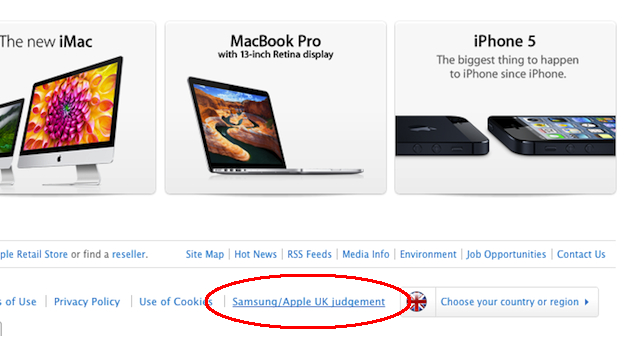
Today, that link and webpage have gone live. By visiting the UK branch of Apple.com, you’ll find the link, named “Samsung/Apple UK Judgement,” next to the region selector at the very bottom of the page, alongside such often visited links including “Use of Cookies” and “Privacy Policy.”

Click it and you’re taken to an apple.com URL called “legal-judgement,” except you wouldn’t know it was an Apple page if you didn’t check the address bar in your browser, as there is no branding and no return link to Apple.com. It’s a white page with five paragraphs of text in the center.

Yep, five paragraphs. All Apple was required to publish was a statement provided by the UK courts, and a link to the official case documentation. However, Apple has also added a few other quotes from the trial too, such as a glowing review of the iPad’s design and the Judge’s comment that Samsung’s tablets are simply “not as cool” as Apple products.

It also mentions the recent $1 billion judgement in the US, and a similar patent trial in Germany, which had the opposite outcome.

The statement will remain on Apple’s website for now, and it’ll be joined by print advertisements — presumably featuring the same statement — in several UK daily newspapers and technology magazines soon.


Source : digitaltrends[dot]com

Sep 26, 2012

Court drama: Apple wants more money, Samsung says trial was unfair

The courtroom battle between Samsung and Apple continues as Apple seeks $707 million more and a Galaxy S3 ban while Samsung alleges juror misconduct.

The continuing saga of the Apple vs Samsung patent war is far from over. In the aftermath of the California trial which ended with a verdict awarding $1.05 billion to Apple, there have been various filings and motions from each of the combatants. It seems neither side was entirely satisfied with the jury’s verdict.

Apple wants more money

Apple filed a motion late on Friday, as reported by Reuters, asking for an additional $707 million on top of the $1.05 billion already awarded. It wants $400 million in damages for design infringement, $135 million for willful infringement of its utility patents, $121 million in supplemental damages, and $50 million of prejudgment interest on damages to see it through until December (we’re not sure where the extra $1 million comes in).

…and a sales ban

The Cupertino company is also seeking a court order for a permanent U.S. sales ban on all of Samsung’s infringing products. It wants the injunction to cover “any of the infringing products or any other product with a feature or features not more than colorably different from any of the infringing feature or features in any of the Infringing Products.”

Most likely it is hoping to extend the ban to cover Samsung’s Android flagship, the Galaxy S3.

But the judge may not grant any additional damage. Stanley M. Gibson, an experienced technology and IP trial lawyer at Jeffer, Mangels, Butler & Mitchell, told us: “In terms of the Apple motions, the judge will have to look at those on a product by product basis and given the large verdict already it may be difficult to convince her to award enhanced damages… the more interesting and impactful part of the case will be whether she uses a permanent injunction and how the language of such an injunction is framed if one issues.”

Samsung wants a new trial

Samsung’s lawyers have also been hard at work filing for a mistrial due to juror misconduct. The allegations of juror misconduct focus on the jury foreman Velvin Hogan and his prior knowledge of patent law as a video recording patent holder. In an interview with CNET after the trial juror Manuel Ilagan said of Hogan, “He had experience. He owned patents himself…so he took us through his experience. After that it was easier.”

Hogan also appeared on Bloomberg TV and said of the jury, “Some were not sure of how prior art could either render a patent acceptable or whether it could invalidate it. What we did is we started talking about one… (I) laid it out for them.”

The jury should rely solely on evidence presented during the trial so Samsung will argue that Hogan could have affected the verdict because of his prior knowledge.

In addition to the juror misconduct claim Samsung is not happy about the time constraints applied by Judge Koh. It said, “The Court’s constraints on trial time, witnesses and exhibits were unprecedented for a patent case of this complexity and magnitude, and prevented Samsung from presenting a full and fair case in response to Apple’s many claims.”

Chances of success with this approach are not good for Samsung. According to Stanley M. Gibson, “An argument regarding juror misconduct will be hard to win.  It also is not likely that the judge will reconsider her prior limitations on time and judges have wide discretion on these issues.”

The fight goes on

The two companies will meet again in the U.S. in a December hearing where Apple’s motion to get Samsung devices banned will be heard.

They are also engaged in various court battles around the world. Apple lost a case against Samsung and Motorola in Germany earlier this week that focused on its multi-touch patents. There was also a win for Samsung in Tokyo at the end of last month.

Anyone who thought the California verdict was decisive can think again because this one looks set to run on and on.

Meanwhile, the battle for your cash continues as the Samsung Galaxy S3 looks to build on the 20 million sales in its first 100 days after release and Apple announces a record-breaking 5 million iPhone 5 units sold in just three days.


Source : digitaltrends[dot]com

Sep 4, 2012

Nexus 7 Vs. The World: Our favorite cheap tablets

The battle for your budget tablet affections is really ramping up. Which 7-inch tablet should be commanding your attention?

If you’re in the market for a small tablet (say around the 7-inch mark) then you are spoiled for choice right now. There are some great options on the market, persistent rumors about some impending new releases, and prices are getting competitive. Let’s take a look at the contenders, kicking off with the Android platform. 

All three of these Android tablets are priced at $200 (for the 8GB versions) and they all have 7-inch displays. You can see a full comparison table in our Nexus 7 vs. Kindle Fire vs. Nook Tablet: $200 tablet showdown.

Nexus 7

google nexus 7 android tablet review

Our Nexus 7 review makes it pretty clear that Google’s 7-inch Jelly Bean tablet is a beauty. It’s cheap; it’s feature-packed; and it runs the very latest version of the Android platform. With a class-leading quad-core processor and a high resolution IPS LCD screen (1280 x 800 pixels), what’s not to like? The lack of a microSD card slot disappointed some people, and the Nexus 7 depends on Wi-Fi (there’s no mobile network option), but beyond that it’s an impressive piece of kit.

Kindle Fire

amazon-kindle-fire-hand

Amazon’s offering has been around for a while now. It’s a solid device and Amazon is able to link in a great selection of content, but specs-wise it pales in comparison with the Nexus 7. If you primarily want an e-reader then go for a cheap Kindle. If you want a tablet then go for the Nexus 7. The Kindle Fire simply isn’t the best at anything at the moment, though that may change this week. Amazon is rumored to announce a new Kindle Fire.

Nook Tablet

Barnes & Noble Nook Tablet review

The Nook Tablet is almost identical to the Kindle Fire when it comes to specs, which puts it behind the Nexus 7 too. It does boast a microSD card slot and slightly longer battery life than its competitors, but is that enough? At the moment, it’s tough to beat the Nexus 7.

Other Android tablets

You may also consider the Samsung Galaxy Tab 2 (7.0) which is freshly available on Verizon’s 4G LTE network, but at $350 we think it has priced itself out of the market. You could pick an older entry in the Samsung Galaxy tablet range for less and there are other options out there including the Acer Iconia Tab range, but none of them measures up to the Nexus 7 when it comes to bang for your buck.

On the Android horizon

There have been various rumors about a Kindle Fire 2. It could be a larger tablet to compete with the iPad, or perhaps it will be another 7-inch tablet with upgraded internals. We’ll have to wait and see, but a Kindle Fire upgrade seems imminent. Amazon enjoyed enough success with the original to make a follow up a foregone conclusion.

We also know that Barnes & Noble is working on a new Nook device. The release date is uncertain, but we can expect something capable of carving out a niche in this competitive space.

iPad mini

7.85-inch iPad mini concept by John Anastasiadis of iMore

Is the iPad mini fact or fiction? We still don’t know, but all those iPad mini rumors just won’t go away. If Apple was to release an iPad mini then there’s no doubt it would represent a real challenge for all these 7-inch Android tablets. The deciding factor could be pricing. Suggestions of superior specs and a comparable price tag simply don’t add up. If Apple was to drop an iPad mini for around the $200 mark and accept a slim profit margin in order to strike out at its competitors then it would certainly do well. We’re not convinced that’s really Apple’s style, though.

The wealth of iPad apps available and Apple’s legion of loyal fans would make it successful even at a higher price point than the competition.

BlackBerry PlayBook

RIM’s original tablet release didn’t set the world on fire, but the software has been updated since then, and the price has fallen. Check out our BlackBerry PlayBook 2.0 review to get a feel for what it can do. The latest PlayBook supports 4G, but it certainly isn’t cheap. 

What it offers over the Nexus 7: Well there’s a rear-facing camera that can record HD video, but not much else. The price of the U.S. version of the latest BlackBerry PlayBook has not been announced yet, but it could be north of $500 off-contract and that’s way too high to compete.

Microsoft Micro Surface

Microsoft Surface Tablet display screen apple ipad killer

There were rumors about a 7-inch Microsoft tablet prior to the Surface being announced, but the new tablet turned out to be sporting a 10.6-inch display. The Microsoft Surface was unveiled but there was no word on pricing. If you look at the specs and size, you might wonder why it’s mentioned here at all. Well, Engadget reported that an anonymous source told them that the Surface would ship in October for just $200. That would mean Microsoft would make a loss on each one so it seems unlikely, but if it turned out to be true then the Surface would be a really strong contender.

What should you buy?

It’s a predictable answer, but if you want to buy a budget tablet tomorrow then it has to be the Nexus 7. If you’re willing to wait a while then the next Kindle Fire is likely to be worth a look and there’s always an outside chance that the iPad mini will make an appearance. It will also be interesting to find out what the Surface will cost.

We’ll make sure you know about it if something better than the Nexus 7 comes along.


Source : digitaltrends[dot]com

Sep 3, 2012

Apple Seeks Ban on Samsung Galaxy S III, Note 10.1

Ht Galaxy S 3 120619 wblog Apple Seeks Ban on Samsung Galaxy S III, Note 10.1

Image credit: Samsung

The jury might have handed Apple a win in the U.S.-based intellectual property trial, but the Apple v. Samsung battle is far from over.

Early last week Apple requested an injunction on eight of the Samsung phones that were at the center of its intellectual property trial with Samsung, including the Galaxy S 2. But because the law moves slowly many of those phones are no longer on the market.

Apple’s on it though. Late on Friday, Apple requested that Samsung’s latest Galaxy S III, Galaxy Note, Galaxy Note 10.1 and others be banned. The Galaxy S III was released in the U.S. in June and the Galaxy Note 10.1 just a few weeks ago. The complaint filed by Apple actually comes in a separate case from the one that was just ruled on a few weeks ago; this suit deals with different utility patents, including ones that over slide to unlock and universal search.

“Since then, Samsung has continued to release new infringing products, including its current flagship device, the Galaxy S III,” Apple wrote in the amended complaint. “While Samsung’s new products infringe many of the same design patents, utility patents, trademarks, and trade dress rights that are at issue in the earlier case, Samsung’s new products also infringe additional utility patents, some of which issued after Apple filed the Earlier Case.”

On Aug. 24, a California jury found that the majority of Samsung smartphones and tablets violated patents held by Apple and recommend Apple be awarded $1.05 billion. Other courts around the world haven’t been as certain of Samsung’s willful patent infringement: respective courts in Japan and South Korean recently rejected Apple’s claims against Samsung.

Last week, Bloomberg reported that Apple and Google, maker of the Android software used in these Samsung phones, have been meeting to discuss an end to the ongoing disputes.


Source : abcnews[dot]go[dot]com

Sep 1, 2012

Mobile Weekly Wrap: Easy app access and Blackberry’s comeback attempt

Google enters the patent battle, Blackberry lays low, and some awesome apps find new homes in this week's Mobile Weekly Wrap.

Late last week brought the end of a chapter in the Great Patent War. Samsung landed on the losing end of the battle between mega mobile moguls, but for once there was a calm in the mobile world. It lasted for as long as the weekend. Can’t we all just get along, guys? If you were too busy keeping your head ducked to avoid getting caught in the crossfire, you may have missed the news that happened this week. Lucky for you, we’ve got all the stories worth noting from the week of August 26-31, 2012

Patented patent talk

Apple scored a big win in its patent lawsuit against Samsung, but it sure didn’t get to enjoy it for very long. While it was busy losing a lawsuit in Japan, the guys behind the Android OS started to fire up their own war machine. Google watched Samsung fall to Apple, but refused to let their comrade fall in combat without defending their honor. We knew a patent battle between Google and Apple was basically unavoidable, and that notion became reality this week. Google has officially filed a lawsuit against Apple for violating patents owned by the Google-owned Motorola. While it’s probably more annoying to the public than anything, this is the most excitement patent offices have felt since Telsa was alive.

Play Store wants you to play more

While access to Android devices could potentially be stifled, especially the ones made by Samsung, access to apps for the OS is only getting easier. The folks at Amazon have taken their Android app store overseas, where it landed in a multitude of European countries. The selection that the Amazon store offers is smaller than the Google Play Store, but that’s simply because Amazon does quality control. Of course that’d happen in Europe. Here in America we have a free market–we can access terrible things any time we want.

While the Play Store may not be quite as controlled as Amazon, that doesn’t mean it doesn’t have plenty to offer. In fact, Google wants to show you even more than what you’re already seeing by adding a “Recommended for You” section to the Google Play Store. The feature will point you in the direction of apps that you might potentially be interested in, meaning you’ll lose even more of you free time to your Android device.

Blackberry 10 news excites the few that are listening

While the big hitters in the mobile world continue to take swings at one another, the former holder of the portable reins has been laying low and rebuilding. Blackberry has had a rough run of things in the past couple years, but it’s hoping to come up swinging with their Blackberry 10 operating system, but one of the major improvements that it’s touting has nothing to do with software. Blackberry 10 phones will have a removable battery. While it might sound sad that one of the biggest upgrades is the ability to take out a device’s power source, it’ll be great for people that still swear by their Blackberry and use it until it can’t hold a charge.

It also looks like Blackberry 10 adopters will have plenty of options on how to drain those batteries. Developers working on Blackberry 10 builds have been able to submit their apps to the Blackberry App World. This will guarantee that folks planning on picking up the newest OS from Research in Motion will have tons of options to load up their devices on launch day.

Apps and Games of the Week

Modern Combat 3: Fallen Nation ($3, Blackberry) – The military shooter that has been a hit for iOS and Android users makes its way to the Blackberry. It’s the perfect way to break up the business day by taking out frustration on the virtual firing range.

SkyDrive (Free, Android) – Microsoft’s foray into the cloud-based storage market has been available on iOS for a few months, but it just made its way onto Android. If you’re a dedicated Windows user without a Windows Phone, you can still keep your documents with you.

StereoMood (Free, iOS/Android) – StereoMood spins music based on the mood you’re in. Just type in an emotion and the app will provide a playlist that plays to those feelings. It’s been on the iPhone, but it just came to iPad–now a universal app–and Android this week.

WP Politics (Free, iOS) – The election cycle is in full spin. While we’re between conventions, there’s going to be plenty of stories that will be worth tracking in the weeks and months before November 7. WP Politics gives a uniquely interactive way to follow the news, especially with its recently added “The Forum” feature. It delivers the best of the political Twitterverse with no Twitter account required.

Bastion ($4.99, iPad) – Bastion made a splash as a gorgeous looking and fluid playing indie title on PC and consoles. It brings its hand-painted art style, creative story telling, and addicting gameplay to the iPad.

Concept ($1.99, iPad) – See your idea go from first thoughts to full fruition with Concept. This app lets you keep notes that are easily organizable and will let you fully flesh out whatever idea is floating around in your head.

Appetite+ (Free, iPhone) – Appetite+ is a handy little app that lets you compare and contrast the apps you have installed on your device to your friends. See what you have in common or what they may be using that you should look into getting for yourself.

Activision Anthology (Free, iOS/Android) – A collection of classics from the early days of gaming, the Activision Anthology contains all of the best games of yore from one of the biggest developers of those days. Titles like Pitfall, Stampede, Cliff Hangers, River Raid and Kaboom all call this app their home.


Source : digitaltrends[dot]com

Aug 31, 2012

Samsung win: Patent violation case brought by Apple in Japan dismissed by judge

samsung apple torn header patent trial lawsuit

Apple had been hoping to score another win over Samsung in its ongoing global patent infringement battle with the Korean tech firm. However, its latest claim, heard in a Tokyo court on Friday, was dismissed by the judge.

Apple may well have scored a big win against Samsung last week in the patent battle between the two tech giants, but it’s not all going the Cupertino company’s way.

In a Tokyo court on Friday, a judge dismissed Apple’s claim that Samsung had infringed on a patent relating to the synching of music and video data with servers.

Tokyo District Judge Tamotsu Shoji told the court it was “hard to believe the products belong to the range of technologies of the claimant.” Apple was ordered to pay the costs of the lawsuit following the court’s decision.

In a statement given in response to the ruling, Samsung said, “We welcome the court’s decision, which confirmed our long-held position that our products do not infringe Apple’s intellectual property.”

Friday’s decision comes exactly a week after a California court ordered Samsung to pay Apple just over $1 billion dollars in damages after a jury ruled the Korean firm had violated a number of Apple patents related to its mobile devices. The Korean firm now faces the prospect of having eight of its smartphones banned from sale in the US, with a hearing set to take place on December 6.

After last week’s decision, Samsung shares slumped 7.5 percent, wiping $12 billion dollars off the firm’s market value.

Courts around the world are dealing with a number of patent violation cases where Apple and Samsung are accusing one another of infringement regarding various aspects of their respective mobile offerings.

In another case last week – this time in South Korea – a Seoul court ruled that Apple and Samsung had violated each other’s patents, resulting in the judge slapping a national sales ban on a number of products made by both companies. Besides the sales bans, the court ordered Apple to pay 40 million won ($35,500), and Samsung 25 million won ($22,000). Such sums pale into insignificance when compared to the billion dollar fine that Samsung has to pay to Apple in the US.

Still, Samsung can take at least a crumb of comfort from the fact that not all court decisions in its various patent infringement battles with Apple are going against it.

[Source: Bloomberg]


Source : digitaltrends[dot]com

Aug 28, 2012

State of the Web: Will U.S. Internet users rally against the TPP? Not likely

Trans-Pacific Partnership Agreement copyright law

The battle against the Trans-Pacific Partnership Agreement (TPP) has begun to heat up. Will U.S. Web users put up a fight? Sadly, I doubt it.

At the end of next week, the United States Trade Representative (USTR) will host the 14th round of negotiations surrounding a multilateral trade treaty known as the Trans-Pacific Partnership Agreement (TPP). The negotiations will last 10 days, from September 6 through 15, in Leesburg, Virginia.

At present, 11 countries are involved in the TPP negotiations: Australia, Peru, Malaysia, Vietnam, New Zealand, Chile, Singapore, Brunei, Mexico, Canada, and the United States. Japan also plans to join the TPP. And countless “stakeholders” — corporations, non-governmental organizations (NGOs), Members of Congress, and others — are also involved in the talks. The general public — those affected by implementation of the TPP — have not been invited.

How the TPP targets the Web

As with the contentious Anti-Counterfeiting Trade Agreement (ACTA), which was largely shut down by the European Parliament on July 4, the TPP negotiations are highly secretive, and the exact text of the treaty is all but unknown. There have, however, been some leaks — most notably, that of the chapter on intellectual property (pdf) and its frightening article 16.

Last Friday, the Electronic Frontier Foundation (EFF) outlined the problems the TPP could cause for the Internet — problems distrubingly similar to those found in ACTA and the currently-defunct Stop Online Piracy Act (SOPA), like potential censorship of legitimate speech, innovation-hampering regulation of the Web, a mandate for Internet service providers (ISPs) and intermediaries (like Google, Facebook, and any other website) to monitor Web activity and block access to websites accused of copyright infringement or the facilitation of infringement, and the requirement that ISPs cut Internet access to users allegedly engaged in online piracy.

“Private ISP enforcement of copyright poses a serious threat to free speech on the Internet, because it makes offering open platforms for user-generated content economically untenable,” write Carolina Rossini and Kurt Opsahl of the EFF. “For example, on an ad-supported site, the costs of reviewing each post will generally exceed the pennies of revenue one might get from ads. Even obvious fair uses could become too risky to host, leading to an Internet with only cautious and conservative content.”

The problem of stifling free speech as a result of the TPP is a particularly potent one. The document’s “takedown requirements open the door to abuse,” say Rossini and Opsahl, which could result in copyright claims being used to “strike a serious blow to freedom of expression.”

The gloomy news continues. But rather than paraphrase any further, I suggest you just read the post.

The will to say ‘no’

The EFF’s notes of warning compose a ghastly tune we’ve heard all to often in recent years, and it is blaring crystal clear in the crescendoing outcry confronting the TPP. But for those of us who find meaning in this song of injustice, only one conclusion can be reached: the TPP must be stopped, just as we stopped SOPA, PIPA, and ACTA before it.

At first glance, it would seem as though a chorus of opposition has begun to gather. The EFF’s combative article explaining the potential problems inherit in the TPP repeatedly soared to the highly-trafficked front page of Reddit, the forehead of the Internet; if you can feel feverish indignation there, then a good chance exists that a sickness is brewing. Soon the antibodies of the Web will launch into action in an attempt to fight back against whatever cancer has begun to grow — right?

Perhaps — but I doubt the TPP opposition movement will establish meaningful forces in the U.S., despite the country’s leadership role in pushing the treaty and the effects it may have on our laws and our Web.

…and why we won’t

The secrecy of the TPP negotiations places the first hurdle: without the ability to view the document in its entirety, we lack the authority to address our concerns and outrage about the portions we do know about to those who know everything. This imposed ignorance has the tell-tale nature of a tactical maneuver by those hoping to tightly control the public conversation about a controversial action. Until the full document is exposed, those of us in the dark can be brushed aside for simply ‘not knowing what we’re talking about.’

This is a problem not just for the U.S. anti-TPP movement but for all nations involved. The real obstacle for U.S. Internet users is the TPP’s inherently international nature. About one-third of Americans (110 million people) currently hold passports — a significant jump from the 48 million who had one in 2000. And yet, we remain foolishly unconcerned with international issues (pdf) — at least those that don’t involve natural catastrophes or the dropping of U.S. bombs. The simple fact that discussions surrounding the TPP include the names of other countries will likely cause a good many Americans’ eyes to gloss over.

Another mitigating factor is that the TPP is a trade agreement — a confounding intergovernmental action few have bothered to grasp. During the buildup of opposition to ACTA, we witnessed a slew of misinformed comments, and even “reports,” that labeled that treaty a “bill” or a “law.” Like ACTA, the TPP is neither. I expect this confusion and ignorance to further muddle any chance at genuine, educated opposition to the TPP.

Now, this sweeping, pejorative characterization of my fellow countrymen is not meant to discount the guaranteed involvement of a good many Americans in opposing the TPP. A certain segment of U.S. Web users — the proud disestablishmentarians who click articles like this one for fun — are on the lookout for acts of violence against the Internet. And they will get involved in the tussle, no doubt. Similarly, those who oppose greater globalization will also naturally come out against the TPP — which is, incidentally, far more about increasing the ability for large corporations to make money than it is about stamping out free speech and online innovation. But these factions of activists hold little power against stakeholders of the TPP without the backing of the care-free masses.

Prove me wrong

I say all this after watching U.S. Web users gladly pass the baton of responsibility in opposing ACTA to our cohorts in Europe. Granted, that is where the action was. And the anti-ACTA efforts there worked. But as it stands now, there is no excuse for not telling Washington exactly what we think about the TPP. In fact, the responsibility to do fight the TPP rests with us. After all, Hollywood movie studios and music labels, and U.S.-based pharmaceutical companies (the most rabid proponents of copyright protections) clearly have their grubby mitts all over the TPP. This makes it primarily our responsibility to reign in the overreach, to cut out the tumor.

So for any of you who have made it this far by sitting on a fence, think of the TPP this way: Your government is willing to unnecessarily sacrifice your rights and the Internet you love for the sake of making a buck. Don’t let them. Read, scream, tweet, post, black out websites, call your Senators and Representatives and President Obama a hundred times. Don’t wait for Google or Facebook or your geeky friend to stand up. Shed your insular shell right now, and lead the world in shutting this sucka down.


Source : digitaltrends[dot]com

Aug 17, 2012

Check out our impressions of the PlayStaion All-Stars Battle Royale beta, then win a code to check it out yourself

PlayStation All Stars Battle Royal

Sony’s upcoming brawler, PlayStation All-Stars Battle Royale has begun a closed beta. Check out our impressions of the game and read on to see how you can land yourself a code to check it out.

Show of hands, who hasn’t wanted to see Kratos go head-to-head with Sweet Tooth in a battle to the death? You can put your hands down. We can’t actually see you, you know. Besides, it’s a rhetorical question, because everybody wants to see that. And that is where PlayStation All-Stars Battle Royale comes in.

Developer SuperBot Entertainment has begun beta testing for its PlayStation-exclusive brawler. For a full recap of the game, check out our hands-on preview from April.

The game features four players going at it, with a roster made up of the biggest names in the PlayStation library. So far 20 characters have been revealed and more are to come, but only six have been made playable thus far: Kratos, Sweet Tooth, Sly Cooper, PaRappa, Fat Princess, and Colonel Radec.

These six characters are just a small sampling of the gameplay, as each playable character will have their own moves, which in turn means their own strengths and weaknesses. These six, however, give a good mix of the gameplay styles; they encompass a variety of types, from the brawlers to the ranged fighters.

PlayStation All-Stars Battle RoyalThe game moves quickly – so quickly that you may at first overlook the stages. But that would be a mistake for two reasons: First, they are fairly impressive and attractive mashups of some of the most popular levels in the PlayStation library, and secondly because they all feature an interactive element. Some will just occasionally try to murder you, but others will test your knowledge. One level primarily based on LittleBigPlanet features a quiz. The players are given four options, and each option is represented as a platform. Make it to the platform in time and you avoid getting hurt– assuming you can fight off the others and avoid getting pushed off when the countdown ends.

The six available characters all have their advantages, and each can take the day. The health bar, which I felt was out of balance to the point that it didn’t work at all, has been fixed, and now you have a realistic idea of where you stand — as well as who is the most vulnerable.

The scoring is based entirely on the number of kills versus deaths. This means that you will want to always be the person who scores the last strike that gets the kill. That gives the scoring a bit of a slant. Points based on hits might have made a bit more sense, but the fights do switch from one a free-for-all to more coordinated attacks when a health bar is low and there is blood in the water. On the other hand, that is also a great time to unleash special attacks or target someone who is vulnerable because they are going for the kill. Four players are enough to keep things unpredictable.

The action can get hectic and confusing, but part of that is due to the limited character selection, which leads to multiple players using the same characters. When there are more options, this will likely be greatly improved. 

For now the beta is definitely worth checking out for yourself, but it’s hard not to want to see what the game will be like when you have more than six characters. How they are balanced will be the determining factor of how much fun it is to play. On paper, BioShock’s Big Daddy should have no problem with Sackboy, and Nathan Drake’s wit probably wouldn’t mean much against a super powered, lighting spewing Cole McGrath from Infamous. How the characters are balanced will make all the difference.

That said, the beta is something you should definitely check out if you are interested in the concept of having the best and brightest of PlayStation’s library beating the snot out of each other. Check it out now, then look for PlayStation All-Stars Battle Royale on November 20 on both the PS3 and the Vita. 

And with that in mind, we have ten beta keys to give away so you can try the game out yourself. For you shot at receiving a beta key, simply post a comment below and let us know what character(s) from the PlayStation lineup you would either like to see, or are most excited to play as.

We’ll pick winners on Monday at random. The giveaway is for North America only. Good luck!


Source : digitaltrends[dot]com

Aug 16, 2012

The Battle for Bandwidth [Infographic]

The prevalence of smartphones, tablets, and digital media players, has resulted in a battle for bandwidth on college campuses. Have a look at who’s hogging the bandwidth and why, in addition to the highlights I picked out for you below.
  • 68% of institutions allow students unlimited internet connectivity.
  • 77% of institutions report increased bandwidth usage as significant issue for their network.
  • 41% of students have 3 or more devices connected to the internet at any given time.
  • The three largest bandwidth consumers are tablets, smartphones, and digital media devices.
  • 50% of IT departments claim they do not recover costs of bandwidth supplied to students.

Take a look at the infographic below

The Battle for Bandwidth
Presented By: OnlineColleges.net


Source : techtalkafrica[dot]com