Pages

Showing posts with label network. Show all posts

Nov 19, 2012

Nintendo cleans up Wii U Miiverse after accidental “hacking”

Nintendo says that Miiverse, its new Wii U online gaming and social network, wasn't hacked on Sunday after a user posted images of a debug mode for the network online. The menu was just an inactive prototype, but why was it there at all?

Of the many small troubles reported about Nintendo’s Wii U, not all are the fault of the Japanese video game giant. It isn’t Nintendo’s fault after all that users are unplugging their Wii Us in the middle of a 5GB mandatory system update, accidentally breaking the console in the process. Other technical issues concerning new owners definitely should have been caught by Nintendo in the quality assurance testing phase. For example: Users probably shouldn’t be able to access Miiverse’s debug mode, whether it’s active or not.

NeoGAF member Trike posted images on the forum on Sunday night after seemingly accessing the Miiverse debug menu—a debug menu is an interface built into software to let developers freely manipulate it, typically to fix problems—on accident. By navigating through menus attempting to set up a friend list, he found himself navigating menus for a prototype version of the Miiverse, as well as browsing commands including “Delete Admin” or generating new passwords. There were even references to possible unannounced Wii U games including Metal Gear Solid, Yoshi’s Land Wii U and Soul Hackers, an old Japanese RPG recently ported to the Nintendo 3DS.

The post indicated that Nintendo’s security for Miiverse was so poor that users could stumble into administrative tools, potentially accessing personal information of other users. For a fledgling online gaming network, such a security gaff could spell certain death. According to Nintendo, though, these menus are simply mock ups and don’t actually represent functioning Miiverse admin tools.

“It has come to our attention that some people were able to access a mock up menu on Miiverse following the launch of Wii U in the US,” reads a statement Nintendo issued to GamesIndustry International, “Please note that this was only a mock up menu and has now been removed and is not accessible.”

Mock up menu or not, it’s troubling that Nintendo’s fledgling network was opened to the public before it was properly polished. Between this, reports of glitch-troubled third-party software and the need for a sizable firmware update on the first day, evidence suggests that Nintendo’s Wii U was rushed to retail to make it in time for the holiday season. Nintendo’s Wii was a rock solid product from day one when it released in 2006. Hopefully for Nintendo, this rocky launch week isn’t a sign of trouble to come.


Source : digitaltrends[dot]com

Nov 14, 2012

Wireless Router Buying Guide

Wireless router buying guide

We separate marketing from reality to outline the specs and features you need in a wireless router.

Wireless Router Buying Guide

Looking to set up a network in your home so you can connect all your PCs to your broadband Internet service, share data files, and stream audio and video between rooms? Don’t know what equipment you need? Confused by the spec charts for the gear you know you need? Skeptical of the pie-in-the-sky performance claims? We can help.

We’ll assume you already have broadband Internet access (via DSL, cable TV, or whatever solution you might have). The next thing you need is a wireless router that will go between your broadband Internet device (i.e. your DSL or cable modem) and one of your PCs. (Or between your modem and data switch if you already have a more elaborate network). We’re suggesting a wireless model because you don’t want to string Ethernet cable around your home unless you absolutely have to; besides, a wireless router is the best way to access the Internet using your smartphone. And if you ever discover you absolutely must have a wired connection, the router will have a built-in switch to handle it.

Features and wireless networking standards

Now let’s talk about the features you should look for in a wireless router. Just like smartphones, new wireless networking standards are coming out more often than ever. The current standard is 802.11n. Just about every router you can find on store shelves these days should comply with this standard, and this spec typically appears at the top of the list of features printed on the box, so it shouldn’t be hard to find when you go shopping.

There are, however, two new standards now in development that will soon make 802.11n old news: 802.11ac, and 802.11ad. The latter is still a few months off, but 802.11ac routers are already available, such as Buffalo’s AC1300, or D-Link’s DIR 865L. This new standard supplements 802.11n and offers considerably faster speeds, but the problem is that this standard isn’t supported by any of the devices most people currently own. So basically, if you get an 802.11ac router, it’ll probably still be backward compatible with all your 802.11n hardware, but you’ll have to wait for a while before you can get your hands on a device that can actually utilize your router’s 802.11ac capabilities.

Because of this rapid progress in wireless networking standards, if you have older wireless gear, you’ll want to make sure that any new router you buy will remain compatible with whatever previous IEEE standard your other hardware is based on (examples include 802.11a, 802.11b, and 802.11g). And if you want further assurance that your wireless router will work with other wireless devices you already own (wireless network adapters, media-streaming boxes and so on), look for the Wi-Fi Alliance’s Wi-Fi Certified logo. The alliance’s 300 member companies conduct extensive interoperability testing to ensure that products claiming to adhere to 802.11 specifications are in fact compatible.

Wi-Fi network speeds

You should take manufacturers’ speed declarations with a colossal grain of salt. For example, you’ll encounter many claims of “theoretical” maximum bandwidth of 300 or 450Mb/sec (megabits per second), but you’ll never see throughput that high in realistic environments in which walls, doors, appliances, and other barriers separate your router from its client devices. When transferring files using TCP/IP (the most common file-transfer protocol that Windows computers use), you’ll more likely achieve speeds of 100Mb/sec at close range – much less than that at longer distance.

The 300Mb/sec claims aren’t fabrications; they’re just not based on real-world conditions. Fortunately, most wireless routers manufactured in compliance with the 802.11n standard should be capable of streaming high-definition video over a reasonable distance, provided there aren’t too many obstacles in the path between the router and its client.

All wireless routers have built-in switches for making hard-wired network connections, but cheaper routers will have switches rated at only 100Mb/sec. You won’t regret spending a few extra dollars to buy a model with a gigabit switch (that’s 1,000Mb/sec). A gigabit switch won’t make downloading files from the Internet any faster (the fastest cable modems currently deliver only 50MB/sec to 60Mb/sec), but it will make a significant difference in the speed at which you can move files across hard-wired network connections inside your home.

Wireless data security

Wireless networks are as insecure as they are convenient – if you don’t take steps to secure your network, just about any troublemaker within range can eavesdrop on your online activities, leech off your Internet connection, access any of the files stored on your computers, infect your systems with viruses, and cause all sorts of other problems.

If you’re operating an older router that’s limited to WEP (Wired Equivalent Privacy) security, however, you might as well not have any security at all. Cracking WEP security is literally child’s play. The router you buy should support at least WPA2 (the second implementation of the Wi-Fi Protected Access protocol), but every device you add to your network must also support WPA2 for this to work. Your network is only as secure as the least-secure device that’s connected to it.

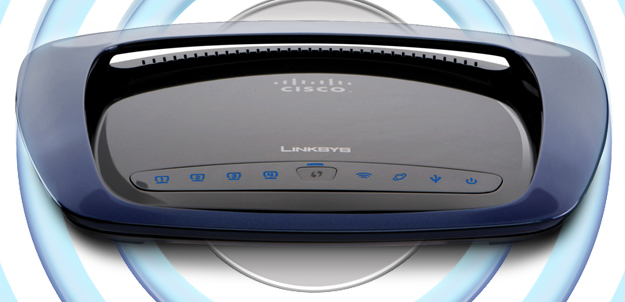
Linksys WRT610NDual-band and tri-band routers

Manufacturers have sold dual-band routers for years, but now many are starting to roll out tri-band routers as well. What does all this ‘dual’ and ‘tri’ business mean? Dual-band typically means that the router is equipped with two radios: one that operates on the 2.4GHz frequency band, and one that runs on the 5.0GHz frequency band. This enables you to set up two separate wireless networks, which is nice to have if you want to use one network exclusively for transferring data files and the other for streaming media, for example. Make sure you read the fine print though – some dual-band routers only have one radio that can operate on either the 2.4GHz or 5.0GHz bands, but not both at the same time. Netgear’s WNDR4500 or Linksys EA4500 are both capable of running on the 2.4GHz and 5.0GHz bands simultaneously.

Tri-band routers are a bit of a new thing, and chances are you’ll have some trouble finding one to purchase. If you’re reading this in 2014 or later however, tri-band routers will likely be ubiquitous by now. Essentially, these routers have a third radio that operates on the currently unlicensed 60GHz frequency band. Using a new technique to beam the radio signal directly to the antennas of connected devices (a process called beamforming) allows some of these routers to achieve data throughput rates of 7Gbps – considerably faster than the measly 300Mbps that 802.11n routers are capable of. 

If you’re only looking to get basic internet access and don’t need all these bells and whistles, you can save a bit of money by going with a single-band N router like the Securifi Almond, or a D-Link DIR-636

Quality of Service

Despite the label, Quality of Service (QoS) is not related to the quality of your Internet connection; rather, it’s a set of mechanisms within the router’s firmware that reserves certain resources for different applications. If you rely on a VoIP (Voice over Internet Protocol) service, such as Vonage, for telephone service, QoS allows you to configure the router to assign that data flow higher priority. So if someone in your home is downloading a large file while you’re talking on the phone, the quality of your call won’t degrade.

QoS can also be used to optimize your network’s performance with online games, video streaming, and similar applications. QoS can’t increase your network’s bandwidth or speed up your Internet access, but it can make the best use of the online resources you do have.

D-Link-DIR-855USB connections

The last router feature we’ll examine is USB support. You’ll find USB ports on many routers, but it’s important to find out what that port is used for. On some routers, it’s merely a means of transferring setup information (network ID and password, for example) from the router to a client via a USB memory key. Better routers will allow you to plug in a USB mass-storage device to add NAS (network-attached storage) functionality. Plug a large USB hard drive into your router and every device on your network will have access to that storage resource – it’s like having a cheap server. A good number of routers on the market have USB support, like Netgear’s WNDR4500 for example.

What to spend: price vs. performance

Let’s sum up with a discussion of prices. Depending on the type you get, you can spend anywhere from $35 to nearly $200 on a wireless router. 802.11ac routers will likely cost you a bit more, but the cheapest products will likely sacrifice advanced features such as Quality of Service, USB connectivity, and dual- or tri- radios. They might also be more difficult to set up and may not have strong tech support on tap. If you run into problems. If you don’t need those features and are confident in your own skills, those shortcomings won’t matter.

A cheap router that delivers subpar performance, however, is no bargain. Product reviews will give you a hint as to what you can expect, but setting one up in your own home is the only sure way of knowing how the router will perform in your unique environment. When you buy yours, make sure the retailer you do business with offers a liberal return policy if you’re not satisfied. 


Source : digitaltrends[dot]com

Run with – or against – anyone in the world in real-time with Yog

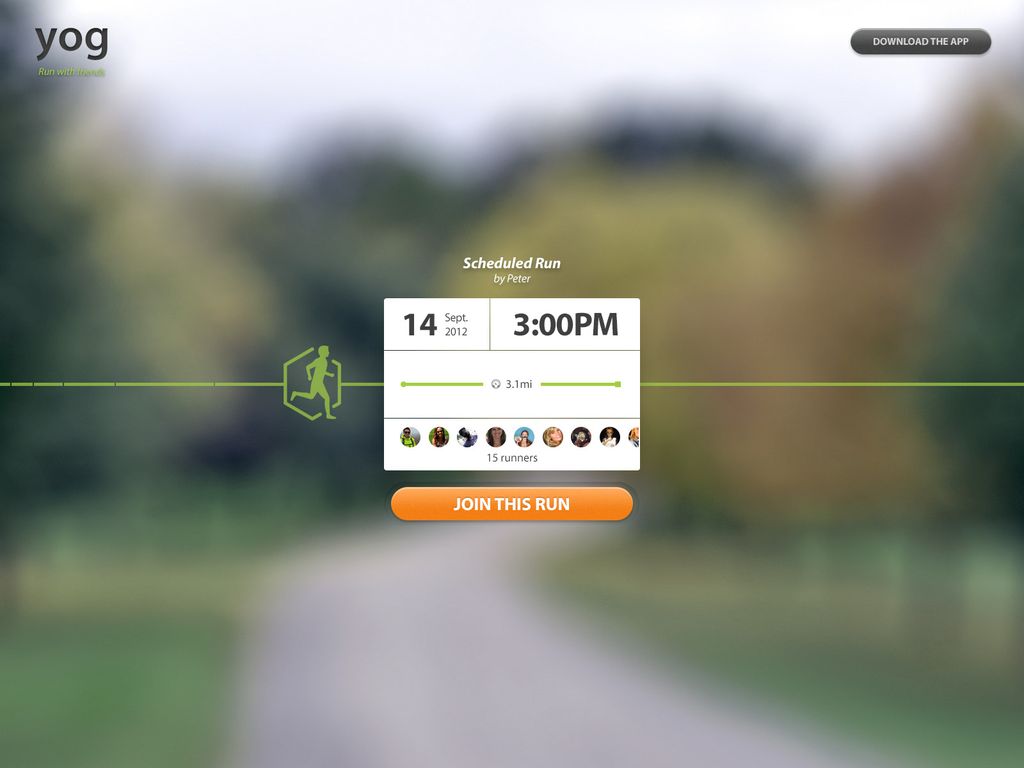
yog web page

Yog, launching today out of beta, is a mobile social network for runners that allows users to run with or against each other in real-time.

If you need a running buddy or someone to challenge you, the Yog network  is more than happy to turn your workout into a cooperative or  competitive effort. The iPhone app connects you with other runners, so you can join them, or race them, depending on your motivation. 

Fresh out of 2011’s class of GE and OMD’s incubator, the social running application for iPhone is launching officially out of beta today after 14 months of testing. Yog was founded by self-professed Yoggers and co-founders Will Dennis, Yog’s backend and Web “ninja,” and Peter Pelberg, who tells me he’s the guy who handles everything but the code. More officially speaking, Dennis is the CTO and Pelberg the CEO of Yog.

There are plenty of running and fitness apps out there that brandish the title of “social” simply because they allow you to push your workout stats to Twitter or Facebook. But Yog is actually social because it turns your solitary run into a shared experience. And based on this social framework, “motivation” was built into the app by incorporating features that encouraged habit and peer pressure – two social characteristics, Pelberg concluded, that drive human motivation.

yog set up

Yog lets you run with anyone in the world in real-time. Yoggers with the app can set up a date, time, and distance that they’d like to run, and then invite friends from your iPhone contact list or Facebook friends to join the running group. But what makes the experience social is that these runs are publicly viewable on Yog’s system. Anyone who sees the invite shared using Facebook, Twitter, email or other channels can add themselves to the group whether or not they have Yog’s iPhone app downloaded.

For instance an interested runner from New Zealand, who may not necessarily be friends with you but happened to stumble on your Facebook post through a mutual friend, can join in on the run. If a runner doesn’t have the app, an email or text message with a link to download Yog will be sent to them and proceed to add them to the group.

The run itself begins promptly on the designated date and time, but group participants can run from anywhere in the world. In fact, Yog’s beta stage had global testers from four continents and 25 countries. The only requirements for you to participate is that you have to have your iPhone on hand while running (which would could see being a bit cumbersome), and you must be running outdoors. Pelberg confirms that for now, the app won’t work on treadmills since the co-founders are outdoor runners and encourages users to enjoy the great outdoors. And to curb cheaters who would think to ride a car or a bike, which would completely defeat the purpose of self-improvement, Yog automatically disqualifies runners who exceed the fastest recorded mile time ever run in human history.

yog live runs

During the race, each runner’s distance is updated in real-time and displayed on a progress bar showing the distance that has been covered by each user. 

“We see this social aspect as being both beneficial to people that are just starting to run and need motivation and need somebody to run with, and for competitive runners, we see it as a great training tool to rally people around training for 5ks, 10ks, half marathons, and up to ultra-marathons,” says Pelberg. Runs can be as short as 0.1 miles and as long as 50.9 miles.

At the end of each race, runners can view what place they came in, as well as personal metrics like calories burned, average miles per hour, pace, and other statistics. While Yog itself is a free app, access to your statistics requires a one-time $0.99 fee that lasts until perpetuity.

“We see this physical act of exercise as a tremendous platform on which to build a really rich digital experience that changes the way you run and think about running,” he tells me. “Everybody on our system is running together; that’s our currency. We’re creating an entirely new running experience.”

Yog’s working on adding features as well. On the immediate agenda, the Yog team has built the backend architecture for user profiles, “so that we’re able to understand and populate a user profile when we implement that down the line.” But profiles won’t be surfaced just yet since the team plans on implementing features in babysteps.

Down the road, leader boards, self-improvement metrics, skill-based matching, and Wahoo armbands are ideas that the team is toying with and could make it into the app in the near future.

Yog is available in the Apple App Store.


Source : digitaltrends[dot]com

Nov 9, 2012

Dish literally wins some and loses some in ongoing DVR lawsuits with TV networks

A continuing legal battle between Dish Network and the broadcast networks it carries over whether or not ad-skipping DVR technology should be allowed had two decisions passed down this week - But if you think either one will bring the fight to a close, you'll soon have another think coming.

In the ongoing battle between television networks and channel carrier Dish Network, the winner seems to be “the legal system,” with two rulings this week that allow the networks to continue fighting with Dish, with the skirmish taking place on two fronts – which was part of Dish’s problem.

The first ruling came on Wednesday as US District Court Judge Dolly Gee refused to allow Fox Broadcasting’s attempt to block Dish’s ad-skipping DVR tech. Although the court order relating to the case is under seal – in part, to allow both parties involved to redact information contained therein that they may deem confidential or proprietary information -  the Hollywood Reporter revealed that Gee’s ruling wasn’t as simple as just allowing Dish’s “AutoHop” and “PrimeTime Anytime” features to continue without any restrictions; apparently, she believed that the systems may, in fact, infringe on particular copyright as they pertain to allowing the DVR to make copies of broadcast material in order to skip past commercials (Dish, for their part, responded by saying again that it did not believe that copies made using PrimeTime Anytime infringed on Fox’s exclusive reproduction rights under federal copyright laws in the same way that AutoHop didn’t translate into unauthorized distribution under the same laws, nor contravene VOD provisions of the involved parties).

In a statement released in response to the ruling, the company called Gee’s decision “a victory for common sense and customer choice,” adding that “the court [confirmed] a consumer’s right to enjoy television as they want, when they want, including the reasonable right to skip commercials if they choose.” Fox’s response statement was, as you might expect, a little less pleased with the verdict (“We are disappointed the court erred in finding that Fox’s damages were not suitable for a prelimary injunction,” being the exact phrase they used) but also found something to be happy about: “We are gratified the court found the copies DISH makes for its AutoHop service constitute copyright infringement and breach the parties’ contract.” Fox has already filed for appeal.

In a separate hearing also presided over by Judge Gee, however, Dish was the denied party as its attempt to prevent NBC from pursuing legal action against the company in California instead of New York – where the company is already fighting related legal battles against ABC and CBS – ran aground. NBC filed the suit in May, and a New York judge allowed the case to proceed in California two months later. Now, Gee denied Dish’s appeal against that decision, writing in her decision that “the Court finds that the dismissal of the contract claims would subvert rather than serve the policy objectives of Rule 13(a) and the first-to-file rule.” NBC’s Californian case against the company will continue.


Source : digitaltrends[dot]com

Nov 8, 2012

Samsung Galaxy Express steams into your local AT&T store, where it’s yours for $100

Samsung Galaxy Express

AT&T has provided more details about the Samsung Galaxy Express, set to be released onto the network next week. Aimed at first-time smartphone owners, it has 4G LTE connectivity and a sensible price tag.

Previously announced in September, AT&T has now provided some more details about the Samsung Galaxy Express, it’s latest mid-range Android smartphone. The network is pushing the Galaxy Express as being suitable for first-time smartphone owners, or those who’re planning to upgrade from a basic device.

It’s making it an attractive proposition too, as it has slapped a $100 price tag on the front, provided you scrawl your signature on the bottom of a two-year contract. For that, you’ll get a curvy, Galaxy Ace 2-alike device that will happily connect to AT&T’s 4G LTE network.

The specification, while not quite up to the standard of the current crop of superphones, is still intriguing, particularly the screen. It measures 4.5-inches, a fairly unusual size, and one that’s shared by devices such as the Nokia Lumia 920, the Motorola Atrix HD and the Huawei Honor 2. It’s a Super AMOLED Plus panel too, meaning it’s the same as that seen on the Galaxy S2, and not the often unfairly maligned PenTile display used on the Galaxy S3.

Inside is a 1.5GHz, dual-core processor of currently unknown parentage, which should see the Android 4.0 Ice Cream Sandwich operating system perform well. There’s no information on the amount of RAM, nor any clues on how much internal memory will be found inside the Galaxy Express, although a microSD card slot is present.

A 5-megapixel camera sits on the real panel, and other features include GPS, Bluetooth and a 2,000mAh battery.

Anyone interested in the Galaxy Express will be pleased to know it’s going to be available from AT&T on November 16. It’s also part of an AT&T offer where you’ll get $100 off a second Samsung smartphone when you buy a Galaxy-branded device with a new contract.


Source : digitaltrends[dot]com

With Twitter accounts hacked, users urged through email to change passwords

Twitter usernames and passwords leaked — but you don't have to worry

This morning Twitter sent out a network-wide email to its users whose accounts were compromised, and urged them to change their passwords.

Users have been calling out Twitter for its vulnerable account authentication for some time now, but the social network still remains mum about the apparent holes in its security. Today Twitter was finally subject to its largest attack, which due to its scale, forced the company to send user-wide alerts via email notifying its users that their accounts have been compromised.

In an email sent this early this morning, Twitter had acknowledged that accounts had been compromised by a third-party site, and urged its users to change their passwords. We checked Twitter and noticed that many compromised accounts were used to tweet spam, but the original users have been able to regain access to them.

Here’s what Twitter said in the email:

“Twitter believes that your account may have been compromised by a website or service not associated with Twitter. We’ve reset your password to prevent others from accessing your account.

You’ll need to create a new password for your Twitter account. You can select a new password at this link: https://twitter.com/pw_rst/…

As always, you can also request a new password from our password-resend page: https://twitter.com/account/resend_password

Please don’t reuse your old password and be sure to choose a strong password (such as one with a combination of letters, numbers, and symbols).

In general, be sure to:

Always check that your browser’s address bar is on a https://twitter.com website before entering your password. Phishing sites often look just like Twitter, so check the URL before entering your login information!

Avoid using websites or services that promise to get you lots of followers. These sites have been known to send spam updates and damage user accounts.

Review your approved connections on your Applications page at https://twitter.com/settings/applications. If you see any applications that you don’t recognize, click the Revoke Access button.

For more information, visit our help page for hacked or compromised accounts.

-The Twitter Team”

Earlier last month, Dennis Jones and his Twitter handle @blanket was hacked, which lead him to discover a mature black market for hacked Twitter, Minecraft, and YouTube accounts. Each account can sell for as little as $60. Digging deeper, we discovered that hacking Twitter accounts as basically become child’s play. Many “hackers” are simply teenagers who browse forums like hackforums.net. These communities are full of tutorials that can guide anyone step-by-step through taking over coveted Twitter handles. These forums are also a proliferating marketplace for selling or trading programs used in malicious virtual attacks, including cracking passwords.

We reached out to Twitter and inquired about how many accounts have been compromised, and who was responsible for the attack. We’ll update you once a spokesperson gets back to us.


Source : digitaltrends[dot]com

Nov 1, 2012

Finally, you can now search the Facebook App Center

Facebook Gifts charity

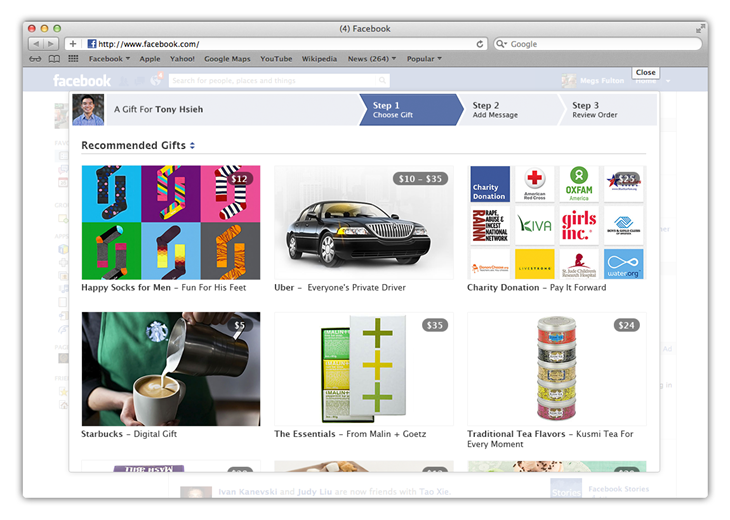
Facebook added a few updates today: The social network has added search and sponsored results to its App Center, and announced 11 partners to its Facebook Gifts program.

Among other announcements today, Facebook finally introduced a search function to its App Center to aid in discovering new Facebook apps. Sponsored Results will also now start showing up when you search the Facebook App Center. Lastly, with the Facebook Gifts event in New York City having been canceled altogether due to Hurricane Sandy, Facebook made the intended announcement anyway to reveal that 11 new charity partners have been added to its Facebook Gifts program. Facebook users can now make charitable contributions on Facebook Gifts to these select charities. Let’s take a closer look at the three announcements. 

Facebook App Center search 

Just as its important for developers to get their apps visible real estate in the Apple App Store and for SEO marketers to get their sites to the top of Google’s search engine, it’s vital for developers to climb to the top of Facebook’s App Center — search and discovery for new apps is incredibly important to their success. Facebook announced today on its developer blog that the social network is finally rolling out a keyword search engine to help with the discovery of published apps within Facebook’s App Center.

“All listed app detail pages will be included in our search index, and no changes are necessary for developers,” Zhen Fang a manager at Facebook, writes in the blog post. Developers won’t be required to make any updates to apps for Facebook to start indexing them. It should help developers get their apps discovered amid the sea of apps offered to attract some of the 220 million monthly users that visit the App Center.

Of course, it also means it will be easier for user to find apps in the first place. At the moment, the only way to view official Timeline Apps is to sort through this page. And if you want to see all the available apps, you’re left to scroll endlessly. This is a much-needed, update to make the App Center a legitimate platform. 

Sponsored Results available in App Center

Facebook made a brief splash with Sponsored Results, which the social network introduced in August. The new advertising product promoted search results in its search engine based on targeted keywords. It enabled third party related apps to be listed, for instance, when you searched Instagram. Today, Facebook announced that Sponsored Results would be coming to the App Center. Developers can, beginning today, promote their apps in the App Center by “targeting Facebook entities, including Facebook Pages, Places, Apps and subscribe-enabled users.” One thing to note about this feature is that it only works on Facebook’s desktop app, and not on its mobile apps.

Gifting charities on Facebook

facebook list of charities for gifts

Facebook’s Gift announcement set to take place at FAO Schwarz in New York City today was canceled due to Hurricane Sandy. It was rumored that Facebook was simply announcing more partners to its program, and for the most part that hunch was correct. Conicidentally enough, the announcement set weeks in advance comes in the aftermath of a devastating hurricane, which Facebook has taken note of:

“We are especially pleased to be launching this test now – when so many people are looking for new ways to help the victims of Hurricane Sandy, or assist those most in need around the holidays,” Facebook product design engineer, Jared Morgenstern, writes in a blog post.

Now you can make charitable contributions using Facebook Gifts to 11 charity partners that Facebook unveiled today. It’s the first expansion of its Gifting platform that now can be used not only for sending gifts for your friend’s special occasions, whether it’s a birthday or an anniversary, but for donations as well. 

Some of you may yet have Facebook Gifts, but don’t fret. Facebook is rolling out the feature gradually and Morgenstern assures us that it’s “coming to you very soon.”

You can check out the list of charity launch partners below:

  • American Red Cross
  • Blue Star Families
  • Boys & Girls Clubs of America
  • DonorsChoose.org
  • Girls Inc.
  • Kiva
  • LIVESTRONG
  • Oxfam America
  • RAINN
  • St. Jude’s Children’s Research Hospital
  • Water.org

Source : digitaltrends[dot]com

Curalate’s Promote tool takes the pain out of Pinterest contests for marketers and users

Curalate launches its Promote promotion module today to solve the pain points of running contests on a visual social network like Pinterest.

Pinterest is every social media marketer’s dream come true. Still, it’s something of a misunderstood tool, not to mention that there are few resources available to brands to help with their campaigns. Today Curalate, a social media monitoring and analytics service for image-based marketing, is solving that pain point with the launch of “Promote.” Brands can now take the guess work out of hosting contests and promotions on Pinterest, while tracking how well the campaigns are doing.

The inherent problem with creating an analytics platform to track the virality of pins on Pinterest is due to the image-based nature of the network. What brands want to know is, “What’s my most popular product on Pinterest, and in what color is it popular?” But the answer to that isn’t as simple as it seems. “That’s a very difficult question to answer for a brand today,” says Curalate CEO and co-founder Apu Gupta.

Tracking the comments and text accompanying a pin is unreliable. When a Pinterest user talks about an image that they’ve pinned, Gupta explains, most won’t say “I love this sweater from JCrew.” They’ll say “I love this sweater.” And you might think that URLs are a way for a brand to track pins, but you’d more often be wrong than right. If a user has pinned a scarf from a catalog page feating a cornucopia of scarves in 10 colors, it wouldn’t be possible to figure out algorithmically what color scarf has been pinned from that page.

This is where Curalate comes in, and it gets interesting. Curalate tracks where the images are being shared on the visual social network from pins to repins. Its robust analytics platform is powered by a sophisticated algorithm that examines every pixel in a pinned image, and matches that image to a database of images to determine what type of product was pinned by a Pinterest user. “We look at several million images daily and compare that to billions of images that we already know about,” says Gupta.

Promote is a new product feature launched today by Curalate. The product combines Curalate’s analytics technology with Promote to offer brands a frictionless way for creating and running promotional contests using Pinterest. Without a service like Curalate, Pinterest contests are a complicated ordeal; Gupta says they are broken. “The way that brands try to run these contests places a lot of burden on the consumers.” The contest process even for us, when Gupta described the process was overwhelming. To submit an entry for a Pinterest contest, participants may be asked to name their board in a specific way, hashtag pins, and pin multiple pins. Once that’s done, participants typically are required to email the brands with the location of their pins. It’s a logistical nightmare for both contest participants and the brand hosting the contest.

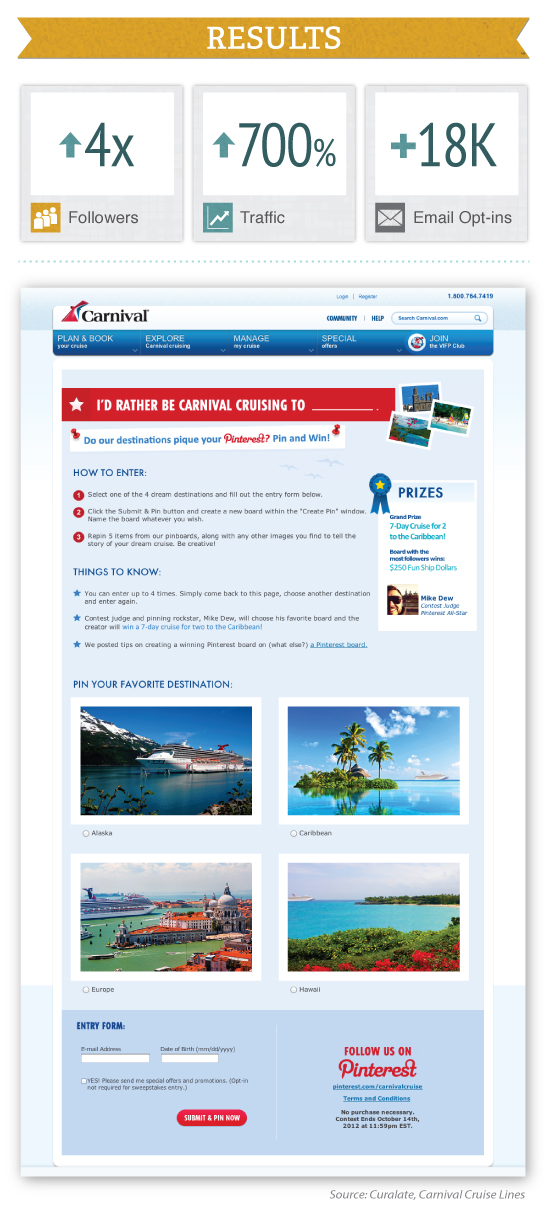
Gupta pointed us to a case study that represented Curalate’s capabilities during the beta testing phase with its client, Carnival Cruise. During an 11-day entry period, Carnival Cruise saw a fourfold increase in followers, 700 percent boost in traffic to its site, and 18,000 email opt-ins (45 percent of entrants).

Pinterest, compared to Facebook and Twitter, is still a fledgling social network with just an estimated 12 million users (as of May 2012). But a recent study by BizRate Insights sheds light on the power that it packs as a key driver for commerce. It’s the fourth largest driver of traffic, and 70 percent of users are on Pinterest to figure out what to purchase. Just 17 percent of Facebook users could state that as a reason for using Facebook. And 43 percent use Pinterest to keep up with brands and retailers, compared to just 24 percent of Facebook users. For this reason Pinterest is an enticing marketing platform for brands looking to sell their services or products.

Giving the interest in photo-sharing lately (Instagram is quickly becoming a hub for marketers) Gupta reveals to us that Pinterest is just one platform that the company is working with at the moment, and hopes to expand its service to other visual social media marketing channels in the near future.

 You can view an example of a Curalate Promote contest below:

carnival cruise


Source : digitaltrends[dot]com

Reddit Co-Founder Defends Site and Internet Freedom of Speech

abc alexis ohanian reddit ll 121031 wblog Reddit Co Founder Defends Site and Internet Freedom of Speech

Image credit: ABC News

Reddit has had quite a few months of attention-grabbing news – both positive and negative.

On the positive side, the social network, which is built around forum threads, was used by President Obama to connect with voters in one of the site’s “Ask Me Anythings,” or AMAs. It also deployed an “Internet 2012″ bus through Middle America during the presidential debates to share stories about people across the nation who are using the Internet to build businesses.

“We wanted to break this false narrative of innovation only coming from Silicon Valley. We certainly feel that way here in New York. We’ve got a great, booming tech sector,” Reddit co-founder Alexis Ohanian told ABC News’ Paula Faris in an ABC News/Yahoo! News Newsmakers interview. “It’s so much bigger than that. We went from Denver to Danville interviewing people and just met with people who were using the Internet to help themselves, whether they were entrepreneurs or students or farmers.”

The tour was focused on the jobs being created across the nation as a result of the Internet, but also the power of the Internet and the freedom it allows everyone, Ohanian shared.

“But all of that rests on this premise that all links are created equal,” he said. “All that rests on the fact that it’s a flat network without hierarchies. I like saying the world is not flat, but the World Wide Web is. And preserving that technological level playing field, where all links are created equal, is so important.”

But with freedom also comes people that abuse it. And Reddit has been at the center of a story that surrounds that freedom in the last few weeks. In mid-October, a reporter at Gawker.com uncovered one of Reddit’s biggest “trolls” (or anonymous users who instigate or provoke readers).

Going by the name of “Violentacrez” on the site, the 49-year-old computer programmer had consistently posted images of child pornography and other inappropriate content.

Ohanian said that he and his team at Reddit were still trying to figure out how to handle the sort of content that was put up on the site.

“The challenge that Reddit faces, like all other social media sites, is how do we be better stewards of the technology,” Ohanian said. “I really do believe that most people are good. We always hear about the exceptional ones. Sometimes, it’s the exceptional good – but, oftentimes, it’s the exceptional bad ones. And we need to find ways as a public to curb the effects of the bad ones.

“There certainly always have been bad people and good people,” he added. “This platform, this technology, is enabling for anyone who’s on it. So that gives the potential next great founder the chance for her to start that great company – and that’s awesome. But it also gives the jerk the chance to be a jerk, and do it at scale and have lots of other people see that and witness that. There are yet no good technological solutions for humanity.”

Ohanian added that it is an issue for all social networks – not just Reddit, but also Twitter, Facebook and Google Plus.

“This is something that exists throughout social media right now,” he said. “The subreddits, these individual platforms for communities, are just like Twitter accounts, they’re just like YouTube Channels.

“The people who use the platform have the ability to be offensive,” he said. “I don’t know how to deal with someone who leaves an offensive comment on Reddit, unless we find a kind of standard that we can, perhaps, all agree on. The technological solutions just aren’t there.”


Source : abcnews[dot]go[dot]com

Oct 26, 2012

Tips and tricks to insta-turn you into a better Instagrammer

better instagrammer header tips and tricks for instagram

While most of us love Instagram, we don't always know how to use it best. Use these tips and tricks to perfect the images you're sharing on the network, as well as improve how you're interacting within the extremely loyal Instagram community.


Instagram: For some of us, it’s an addiction. For others, it’s a marketing tool. Either way, we can all agree that the service has revolutionized photo-sharing by giving us something that’s incredibly simple, fun to use, nostalgic, and most of all social, all wrapped up in one beloved platform. Being a photo-based platform, there are ways to get better photos with your device in your quest to gain more comments and likes. Here are a couple of tips to start off.

instagram advanced cameraAdvanced isn’t everything

Straight out of the box, Instagram for Android provides you with its Advanced Camera setting. Head over to the menu/profile settings and turn it off. Your device’s standard capabilities are much better and also provide you with more versatility when it comes to getting a better photo.

The Advanced Instagram Camera can make composition easier for you. It can also eliminate the need for cropping your image afterward if you know exactly what you want. But just like in real photography, there is no reason to limit yourself if you want to change your creative vision later.

Android Users: Experiment with exposure

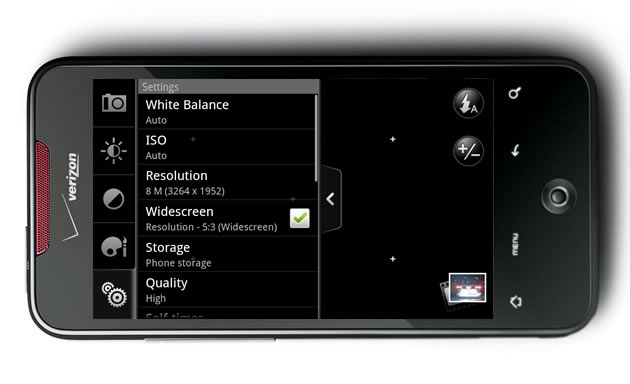
Most Android devices have exposure control settings. Users can control variables like contrast, exposure compensation, ISO, white balance, and more. Playing with these settings can help you to get better results before you apply Instagram’s filters. Let’s run through this quickly:

  • Contrast: How much of a difference there is between the bright and dark areas. The more contrast, the greater a difference. It also greatly affects colors.
  • Exposure compensation: Telling the camera to make the overall exposure brighter or darker.
  • ISO: How sensitive the camera will be to light. It’s a good idea to usually just leave this in the Auto setting. However, if you’re taking photos of your dog, baby, or another squirmy subject that just won’t stay still, feel free to raise this up to ISO 800 or 1600.
  • White balance: This changes the overall color rendition of the image without making it look monochrome or Sepia. 

android camera settings
Getting a better image to begin with will mean that Instagram’s filters will also do a potentially better job and you’ll get a higher quality final result.

iPhone Users: Lock it up

iphone camera ae af lockThis is a popular technique many iOS power users love:

  • Touch the screen to focus on a subject; you’ll see the blue box show up when you tap, and then hold for a second. This will lock the focus and exposure.
  • Recompose the image, if need be.
  • If needed, also provide a bit of fill flash.

Sometimes, a flash can provide light that is too harsh. Try putting a tissue over the light so you don’t blow out all of the lovely natural colors on your sushi plate (just a hunch).

Get creative with Instagram’s arsenal

Photography, for artists, casual users, and just about everyone in-between is all about falling in love just a little bit every day with each picture we take. With that said, you can make your images better by experimenting with all that Instagram gives you. For example, some filters are more versatile than others, but there are certain ones that were meant for specific shades of light or that look best with their included borders.
filter options
Want to make your images look like they weren’t taken with a phone? Compose your scene so that it can possibly have some sense of depth, and then apply the tilt/shift filter accordingly.

instagram tilt shift

Sayonara, screenshots

instragram screenshotIt happens to the best of us: Sometimes, we can’t help but share those hilarious text or Twitter exchanges with our dear Instagram followers. But adding that Walden filter to it is a bit unnecessary – meaning, don’t do it. This just isn’t the place to share those text-moments, head over to Twitter, Facebook, or Tumblr for that. And the moment is too good not to post to Instagram, it is also well worth #nofilter.

The personal touch

Go ahead and use some hashtags, just don’t make a habit out of listing every possible topic for a photo.  No more than two or three are ever really necessary – you don’t want to be that person (see if you can spot which of the examples below completely overuses hashtags while also failing to add a caption that sounds even remotely human). Also, be sure to act like a real person; interact with other users genuinely, like you would in real life, and don’t pretend to be something you’re not (it’s okay to just take pictures of your cat or your food, just don’t wax philosophically in the comments about your artistic eye). 

hashtag examples


Source : digitaltrends[dot]com

How to Find Your Facebook ID

As of March 2012, an estimated 901 million people are active users on Facebook, the most popular social media network on the planet, I believe this number has increased to over 1 billion people. The social networks has taken great measures to manage each users account with a number of features to provide their members with security and privacy while using their accounts. When a new member sets up their Facebook account for the first time, the system immediately assigns the Facebook user with an ID number.

For whatever reason, users may want to know how to retrieve their Facebook ID. The steps to do this are simple, and just a few clicks away.

How to Find Your Facebook ID Number

1) Log into your Facebook account.

2) You should be able to see your name beside your profile picture at the upper right corner, click on it

3) There are two ways of doing this, you can either hover your mouse over your profile photo or click on your profile photo and wait for the page to load.

5) Go to the URL bar in your browser with your mouse and slide it along the bar; you should see a string of
numbers appear.

6) Look for the set of numbers that follow after the word “fbid=”.

7) This is your Facebook ID number.

Social networking websites such as Facebook has one priority which is to help their account users stay connected with their family and friends, and also have endless opportunities to meet new people along the way. Email, phone numbers, and physical addresses can all be easily accessed with an active Facebook ID. The Facebook ID number especially comes in handy if you’re a person who uses Facebook applications on a regular basis. It also allows you to compare your social ranking with your friends’ ID’s as well.

Also See: How To Enable Your Facebook Timeline: Fast & Easy

A Facebook user who wants to know how to find their ID number by means of an app can retrieve it by following these instructions:

1) Log into your Facebook account

2) In the search box, type “What is My ID?”. Locate the top search result from your query in the drop-down
menu.

3) You will see the phrase, “Go to App”, click the tab and then click “Allow”.

4) Your Facebook ID will appear.

To locate Your Facebook Fanpage ID, you can follow similar steps

Tags: Facebook ID, Find Facebook ID, Get Facebook ID

Source : techtalkafrica[dot]com

Oct 25, 2012

Imgur evolves into a more socially-friendly service – without alienating its loyal Redditors

imgur

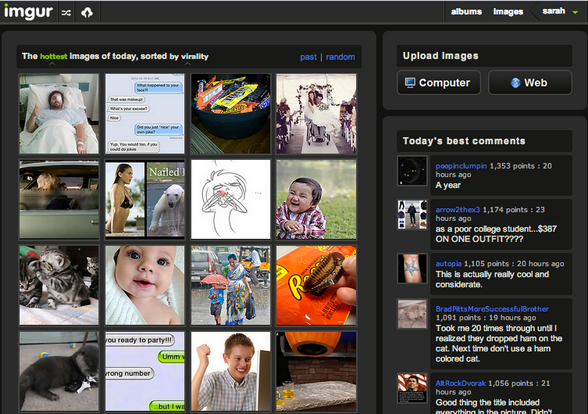
Imgur made some rare but dramatic changes to its service, adding Reddit-like functionality to look more like a social network. A new commenting system has also been introduced to the site, giving users more options for how they discovery Imgur-hosted images.

Imgur has undergone a redesign, which is a rarity for a site that pushes updates less frequently than even Reddit. But if the new features are any indication of a shift in the site’s focus, it looks like Imgur is intent on becoming a fully functioning social media platform for user generated content.

In an August 2012 AMA with Imgur creator and CEO Alan Schaaf, who developed and launched the site back in Feburuary 2009 from his dorm room as a Junior at Ohio University, we got a glimpse at some of the impressive data supporting Imgur. The number of page views, duration, and bounce rate were so encouraging, it was clear the site had a shot at being more than just an uploading and hosting service. And that high rate of engagement means Imgur is an attractive asset for advertisers that can overlook the NSFW and oftentimes copyright-violating content that the site is home to. 

Here’s a quick look at some of Imgur’s analytics:

  • Visits: 205,670,059
  • Unique Visitors: 45,046,495
  • Pageviews: 2,313,286,251
  • Pages / Visit: 11.25
  • Avg. Visit Duration: 00:11:14
  • Bounce Rate: 35.31%
  • % New Visits: 17.05%

The update is subtle, and while it doesn’t overwhelmingly impact Imgur’s function, it definitely hints at the platform’s direction. Before today, Imgur was little more than an image hosting service. Auxiliary features (like the Imgur gallery) are the bells and whistles that were gradually added over time, but have never been the focus. Even the algorithm powering what images did or didn’t make it to the gallery depended on the traffic the images generated on third-party sites like Reddit.

Today that changes: When users upload images directly to Imgur, they can submit the images directly to Imgur’s coveted gallery. The updated sorting algorithm will surface the best images to the gallery’s front page based on certain variables including the number of votes the image receives from within Imgur, the number of views the image receives, and the period of time that users have interacted with the image. Imgur users can also now sort and discover new content based on the hottest, newest, and top scoring images.

Long-time Redditors know that upvotes for submitted content is as valuable as being upvoted for comments, so the comment update to Imgur will now be an extension of the way Reddit functions. In fact you’ll see the top comments that surface on the right-hand column of the home page.

imguraffeWhile it’s certainly a social turn, those closest to the matter — Redditors — seem to think Imgur won’t be staying too far from its roots. Reddit general manager Erik Martin assured me that Imgur’s motivation is different from Facebook’s and Instagram’s. Martin even pointed me to a recent image uploaded to Imgur that garnered half a million views in just a couple of days of Frank Tanabe, a Japanese American World War 1 vet. “It was just a story and image he wanted to share with the world, and Imgur and Reddit let him do that very efficiently,” says Martin. That image was taken from the Tanabe’s son’s Facebook profile and uploaded to Imgur.

Other updates today include a reputation system that award digital Imgur “medallions,” community-based commendations, and the long-awaited introduction of Imgur’s official mascot and logo, the Imguraffe. Imguraffe was born of an April Fool’s joke the team tried to play on its users, replacing the site with the image. Turns out, we all love him, and now he’s been officially added to Imgur’s branding. While the announcements reveal nothing about future iterations, according to the AMA, the next feature updates that we may be seeing from the Imgur team are mobile apps and even an e-commerce store, but no official word on their introduction yet.

The bottom line for Redditors and loyal users is that nothing about the Reddit-Imgur relationship or the site’s basic utility will change — except that now you have what’s essentially an image-only Reddit, should you choose to discover content this way. 


Source : digitaltrends[dot]com

Facebook’s Oldest Users Jostle for Title

Mark Zuckerberg likely never imagined this when he founded Facebook as an undergraduate in his Harvard dorm room.

The website he created as a social network for college students is now the site of a brewing battle between two centenarians over who can lay claim to being the oldest among Facebook’s more than 1 billion monthly users.

Logged on in one corner is Florence Detlor, the 101-year-old Californian who, in August, was designated Facebook’s oldest user by Zuckerberg and Facebook COO Sheryl Sandberg. Detlor traveled to the social network’s Palo Alto campus for a personal tour.

READ MORE: Vest Promises a Hug Every Time You Get a ‘Like’ on Facebook

In the other corner is a New Mexico woman, Maria “Mary” Colunia Segura-Metzgar, who just celebrated her 105th birthday on Tuesday and has her own Facebook page, complete with 86 friends.

Segura-Metzgar, however, is so far removed from the typical Facebook user that she had to shave a few years off her age in order to join the site, according to her 60-year-old grandson, Anthony Segura, who is responsible for signing her up.

“I tried to sign her up on Facebook a few months ago but it wouldn’t accept her birth date,” Segura told ABCNews.com today.  “Then I tried again and just put in 101 and it accepted it for the timeline, even though she was 104.”

“Now on Facebook it says she’s 102 when, in reality, she’s 105,” he said.

Segura, who said his grandmother is too hard of hearing to be interviewed by phone, said he has tried to reach Facebook to rectify the problem, but they have been unresponsive.  A call placed to Facebook by ABC News was not returned as of this writing.

Even though the title would be nice, Segura says it was a much more important reason why he got his grandmother to join Facebook.

“We want to let everybody know in the family that she’s still alive and kicking,” he said.

Segura-Metzgar, known as “Grandmother Mary” to her nearly 40 grandchildren, “too many to count” great-grandchildren and two new great-great-grandchildren born just this week, lives just a few miles away from Segura and his wife, Mayra, in Albuquerque.  They visit her frequently to let her use their iPad to log on and update her page, most recently with photos from her 105th birthday party.

“She’s still very sharp and likes to tell stories of her life and we wanted to be able to record her life as a legacy,” said Segura.  “We’re a very large family and there’s a lot of stories that a lot of the family doesn’t know and we wanted to be able to capture those.  Since ‘Timeline’ came out we thought it was a good idea to put those [stories] on Facebook to have a timeline of her life.”

Segura is also tasked with keeping his grandmother’s friends list to just family and friends, no small task considering he had to deny more than 50 friend requests just Wednesday from curious onlookers.

That same fate befell Florence Detlor, Segura-Metzgar’s younger competition, who, after her personal visit with Zuckerberg and Sandberg was made public, had too many friend requests for the site to process new ones.

Segura-Metzgar, a twice-widowed mother of four, is one of 10 children whose 99-year-old and 97-year-old sisters and “a couple brothers” are still alive, according to Segura.  While she is the only one of her siblings to take on the World Wide Web, Segura-Metzgar hasn’t given up on the old-fashioned way of getting her news and staying in touch either.

“She loves to watch TV and read the newspaper, she’s always done that all her life and she still does it to this day,” Segura said.  ” She’s very involved in politics.  She won’t tell us who she’s going to vote for but she will be voting.”


Source : abcnews[dot]go[dot]com

Oct 23, 2012

Lawsuit against Sony over the great PlayStation Network hack of 2011 dismissed

A year and a half after hackers breached Sony security gaining access to user information for 69 million PlayStation Network users, a class action lawsuit against the company has been dismissed by a California judge.

It was only 18 months ago that Sony’s PlayStation Network was hacked, forcing the company to take down its online gaming network and digital retail services for a significant chunk of the spring in 2011. 69 million PSN users’ account information, including credit card numbers, was stolen in the hack. Sony first admitted to the intrusion on Apr. 20, 2011. On Apr. 27, the first federal class action lawsuit was filed against the company. While Sony has apologized repeatedly for the hack, offering users identity theft protection to affected users as well as free downloadable games as compensation, its been up in the air whether the company would have to offer monetary compensation. According to US District Judge Anthony Battaglia, Sony is in the clear.

The class action lawsuit claimed that Sony of negligence, not equipping the PlayStation network with the appropriate security to prevent the hack that brought the network down for so long. It also claimed that Sony violated a number of California consumer protections, the state where the lawsuit was filed.

Judge Battaglia dismissed the lawsuit on Friday after Sony moved to have it thrown out. Battaglia said that Sony didn’t violate any consumer protections because “none of the named plaintiffs subscribed to premium PSN services, and thus received the PSN services free of cost.” Had any PlayStation Plus subscribers joined the suit, maybe Battaglia wouldn’t have acquiesced to Sony’s demands. Than again, he also found that the Sony Privacy Policy signed by all PSN users included at the time “clear admonitory language that Sony’s security was not ‘perfect’” and as a result “no reasonable consumer could have been deceived.”

Sony’s not wholly in the clear just yet, though, since the class does have the option to amend its claims, specifically in regards to Sony violating consumer protection laws.

Back when the lawsuit was originally filed, Rothken Law Firm co-counsel J.R. Parker wrote, “Sony’s breach of its customers’ trust is staggering. Sony promised its customers that their information would be kept private. One would think that a large multinational corporation like Sony has strong protective measures in place to prevent the unauthorized disclosure of personal information, including credit card information. Apparently Sony doesn’t.”

Sony did pay in spades for the hack. Estimates at the time predicted that the hack would cost Sony $171 million in lost revenue, a significant blow following losses from the March 2011 tsunami in Japan as well as declining television sales. That figure no doubt grew as Sony began spending heavily on marketing to rehabilitate its image with consumers.


Source : digitaltrends[dot]com

Oct 19, 2012

‘We can hear you having sex’: Messages to neighbors via Wi-Fi network names a growing trend, report says

Wi-Fi aerial (shutterstock)

An increasing number of computer users setting up Wi-Fi in their homes are reportedly sending out messages to annoying neighbors via their wireless network names.

The creation of the Internet has meant that the options are now vast for those people who’d rather not use their vocal cords to communicate with another person, preferring instead to engage in more indirect methods of communication – they can, for example, send an email, an instant message, an SMS, or a text. Communicating through the name of your wireless network can also be added to the list, a method which is a fast-growing trend, according to a BBC report on the subject.

When someone sets up a wireless network at home, they’re prompted to give it a name so it can be easily identified. That name will be seen by anyone within range who searches for a wireless network using a computer or mobile device.

In most cases, these names are nothing out of the ordinary, something like “Bob1” or “mycomputer123”. However, recently more and more people are using their network names to send out messages to neighbors.

According to the BBC, many of the names relate to noisy neighbor issues. “Stop wearing heels”, “Stop slamming the door” and simply “shut up” are listed as examples. Perhaps these are the work of desperate people for whom a polite face-to-face request failed, or maybe they simply tremble at the thought of direct confrontation with their noisy neighbor.

Sex, or noisy sex, is also the subject of some network names. “We can hear you having sex” is a common one, while “Stop having so much sex” is also listed.

Naming networks in this manner is the digital equivalent of sticking an anonymous note into the mailbox of whoever’s causing offense, except that this way the offender won’t necessarily know it’s him or her being targeted (unless the network name includes a house or apartment number – or even the person’s name). Also, the offender needs to be fiddling about with their wireless settings in order to see the list of nearby networks, something they most likely don’t often do.

So, no, it certainly won’t ever be the most effective form of communication, though for many it is, one assumes, a bit of fun and an additional way of trying to get their message across.

Seen any interesting network names in your neighborhood recently? Got a good one yourself?

[Image: Pavel Ignatov / Shutterstock]


Source : digitaltrends[dot]com

Oct 17, 2012

With hidden features exposed, Pinterest quickly rolls out user blocking and other updates

pinterest report

Earlier Pinleague discovered Pinterest's hidden blocking feature, and the social network responded by making blocking and reporting users publicly available.

The third most requested feature on Pinterest is the ability to block users from following or seeing pins. The feature, according to Pinterest, has been in the works for awhile. By chance, Pinterest marketing company Pinleague discovered today that the ability to block users was hidden from sight but there nonetheless. We can assume that the Pinterest team was testing out the new feature behind the scenes prior to its release, but now it’s announced and publicly available for users.

Before the announcement however, you could access the feature by simply editing Pinterest’s source code using your browser, which would surface the blocking feature. After hearing about the loophole, we headed straight to our own Pinterest page, but by that time the team was wise to our ways and had already released the blocking tool.  

digital trends pinterest block feature

Pinterest maintains a section on its site where users can offer new feature suggestions. The popularity of features is gauged by user votes, and developers take the feedback into consideration before deciding on what should or shouldn’t be implemented. The block user suggestion was ranking quite high, but is now nowhere to be found.

blog post by Dannie Chu, Pinterest software engineer, explains the block feature’s integration, among other updates.

“Blocking prevents both of you from being able to follow each other’s boards as well as like, repin, and comment on each other’s pins. When you block someone, the other person is not automatically notified. However, a blocked person will know they’ve been blocked if he or she tries to follow you or interact with your pins.”

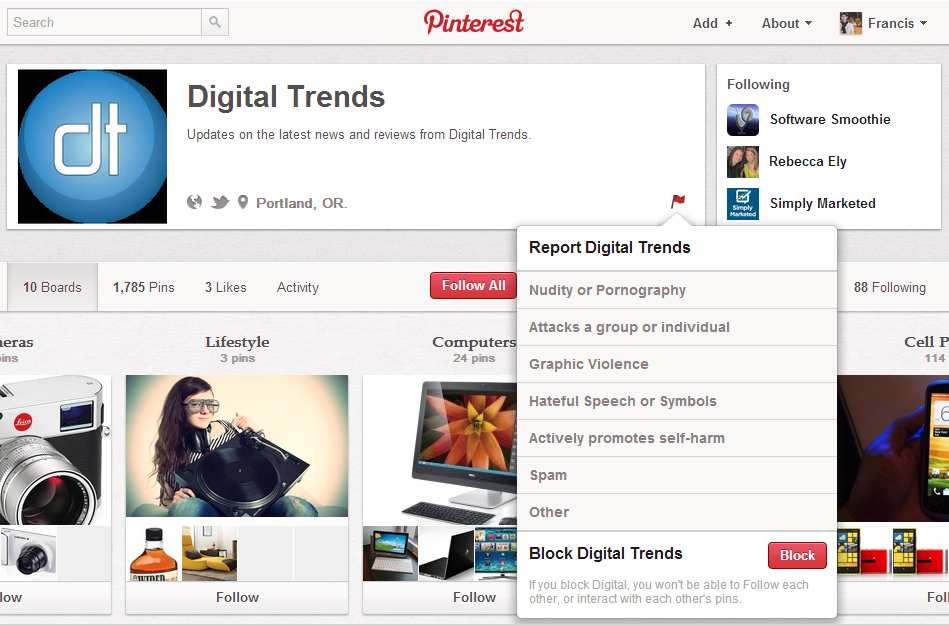
To block a user, you just need to hover over the flag icon on the bottom right corner of a user’s profile. At the very bottom of the box that pops up, you’ll see a bright red button for “Block [username].” According to Pinterest, you might not yet see the flag icon on its desktop app but it’s going to be rolling out shortly to all users. As for its mobile app, the block and report a user will appear in the next mobile update.

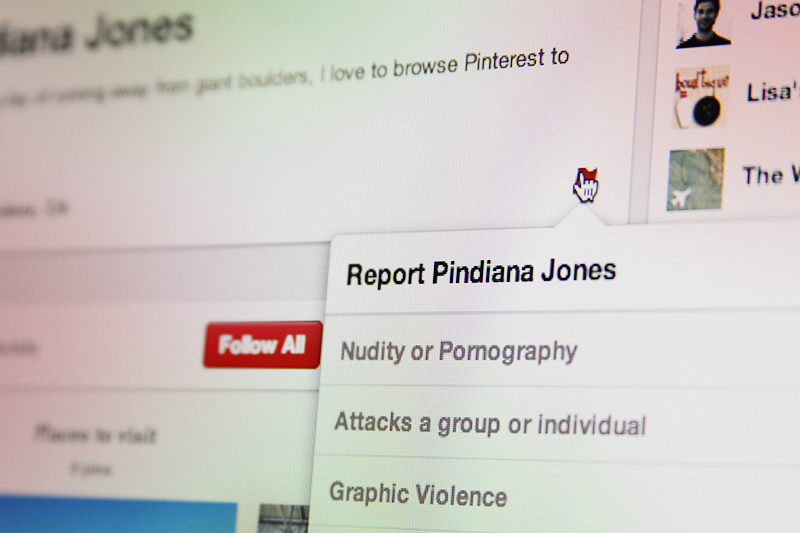
In addition to blocking, the team has launched a feature that will now enable you to report users, and not only individual pins. The report feature comes with a selection of types of reports you can file from “nudity or pornography” to “spam.” The “report user” feature was the eighth most popular feature requested by users and in fact hasn’t been taken down from the request page as of press time. It’s surely a tool that will help Pinterest and graphic artists fight copyright issues that plague that site; if a user is a repeat offender, now their account status and not just guilty pins will be punished. 

The last new update enables users to have greater control over settings to let you further filter the types of emails that you receive from Pinterest.


Source : digitaltrends[dot]com

Oct 16, 2012

U.S. smartphone owners pay 3-10 times more for 4G LTE data, says study

4G LTE

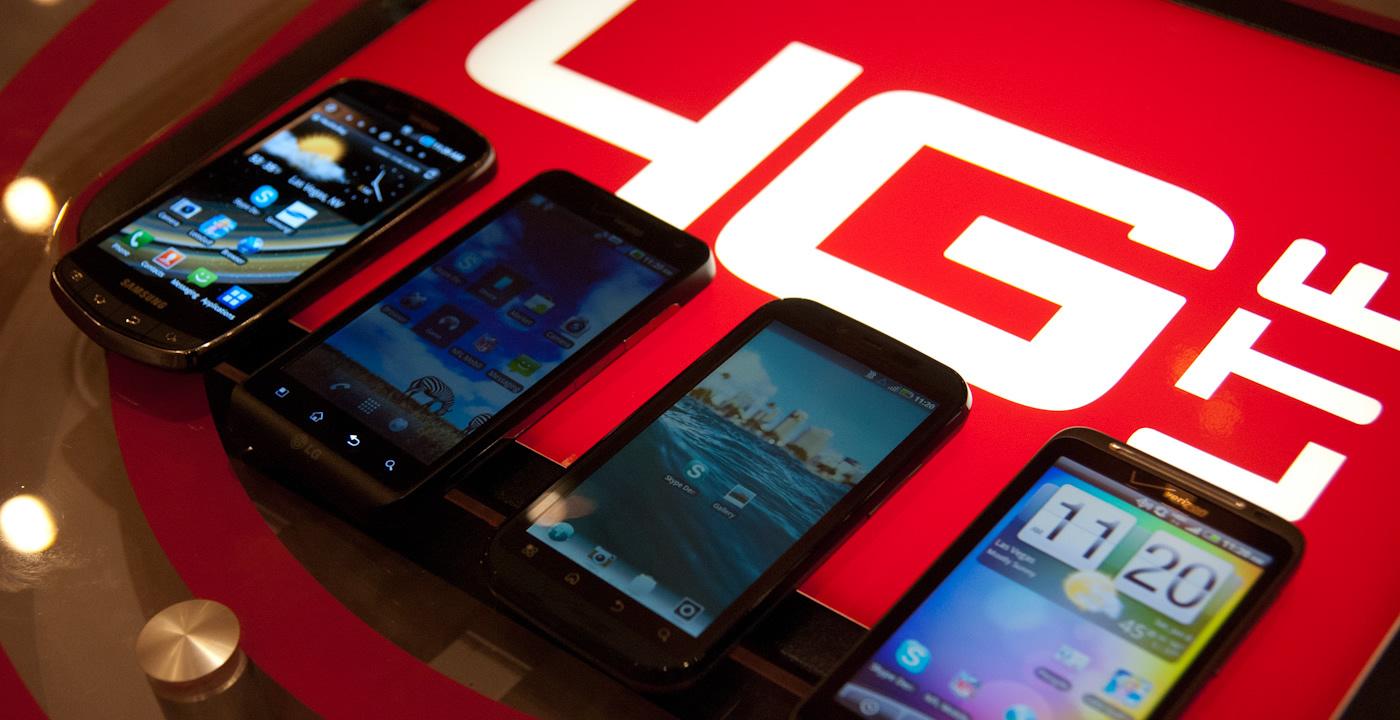
According to a recent study, Americans pay three times as much for their LTE network service than most Europeans -- and nearly ten times more than what Swedish citizens pay.

We can now add 4G LTE service to the list of things Americans pay significantly more to have than the rest of the world — right next to education and health care. According to a GSM Association study reported by the New York Times, Americans pay three times more per gigabyte of data than the average European consumers — and ten times more than Sweden. But at least we can get a large pizza for just $5, right America?

The study revealed that America’s leading LTE provider, Verizon Wireless, charges its subscribers $7.50 for every gigabyte of data downloaded over its network. In comparison, the average cost of a gig in Europe is $2.50. Sweden leads the way in inexpensive service, with data only ringing up at $0.63 per gigabyte.

Verizon spokeswomen Brenda Raney did counter this information by pointing out the Verizon plan that is being compared is from its Share Everything plan, which includes unlimited call and text minutes and allows data to be shared among ten devices. If a person was to purchase a data only plan, similar to how the European providers offer service, they would only pay over twice the European average with a cost of $5.50 per gigabyte. Of course, Europeans separate talk and data plans, though. Verizon, on the other hand, is forcing all new users to sign up for Share Everything plans. And though you can connect up to 10 devices to an account, there is a monthly fee per device, which ranges from $10 to $40. 

Verizon was the first company to roll out 4G LTE in the United States, followed by AT&T. Verizon still owns the market with 11.6 million LTE subscribers (AT&T reports just short of a million), or about 43 percent of the world’s 27 million LTE users. The lone country to beat Verizon to market just happens to be the cheapest: Sweden. The cost gap seems to have everything to do with competition, though. Europe has 38 of the world’s 88 LTE providers fighting for subscribers. Austria and Finland have three within their borders alone. Meanwhile, the world’s largest market for mobile, the United States, is still playing catch up in this regard.

This has actually been a trend with phone service in the United States. The average cost of a 3G contract runs an American citizen $115 a month. In comparison, citizens of the Netherlands pay $51 and those in Britain pay $59. The higher costs keep the adoption rate at a slow climb, which in turn keeps the cost up on those that have jumped on board because the provider has to recoup costs from building  the network. It’s a self-perpetuating cycle that is very American: Pay more, consume more, and get less.


Source : digitaltrends[dot]com

How Facebook will track your offline life with Datalogix

facebook datalogix partnerIn the eight years that Facebook has been providing users with a platform to share their personal data, the social network has time and time again been criticized for violating privacy in its quest to be an ad platform. Facebook’s recent partnership with Datalogix—a service that tracks whether people who view ads on the site end up buying the advertised products in stores—has again raised fears among users about how the social media giant is turning their personal data (both on-and-offline) into a revenue-generating strategy. To understand what exactly this means and how we got to this point, we have to go back to when it all began.

A short history of Facebook and its fight for revenue

Facebook launched in 2004, received its Series A shortly after, and was valued at $98 million dollars by the time it received its Series B in 2005. A year later Facebook opened up to the general public, closed its Series C with a valuation of $500 million, and then its Series D with a valuation of $15 billion—but the company was still far from profitability.

While Facebook’s worth continued to grow, investors began to question the company’s earnings capabilities. In 2008, after passing its 100 million user mark, Facebook began focusing on its monetization strategy and reached profitability in 2009 largely through advertising. Since then, however, while the company’s user-base and revenues have been increasing, the rate of advertising as a percentage of the company’s revenue has been steadily dropping.

As Facebook began focusing on monetization and leveraging the power of its personal information database, alarm bells began sounding for privacy advocates and concerned users who were starting to wonder what the company was doing with this data. Despite these privacy worries, Facebook continued its high user growth rate and passed 500 million users in 2010.

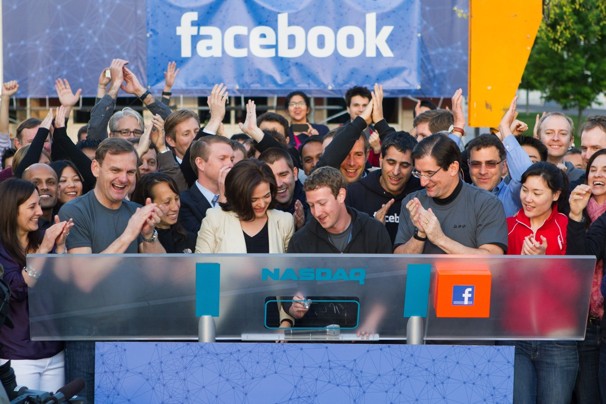
facebook ipo nasdaqThis past February, Facebook went through a highly-anticipated, controversial IPO—opening at $38 per share at a valuation of $100 billion and then dropping below $19 a share just a few weeks later. Investors began to worry and marketers questioned the effectiveness of advertising on Facebook—with big names like GM completely pulling their ad dollars and concluding Facebook ads were “ineffective.”

Facebook, which was competing with heavy weights like Google—the world’s largest display advertising network—for ad dollars, needed to find a way to prove the efficacy of its platform. It opened up its real-time bidding ad–exchange (FBX) in September, and this month, reported hitting the one billion-user mark.

Try as it might, Facebook can’t compete with Google

Last year, Facebook’s advertising revenue grew 69 percent from the year prior, to hit $3.1 billion. In contrast, competitor Google’s total advertising revenue grew nearly 30 percent to reach $36.5 billion. But while advertising rates on Facebook are increasing, click through rates (CTRs) aren’t keeping up.

The average CTR for banner ads in the US is .1 percent, but a Webtrends report found that Facebook’s 2010 CTR was only .051 percent while Google’s was .04 percent—almost 10 times as high. And while advertising rates of Facebook ads in the first quarter of 2012 rose by 40 percent, CTRs reportedly fell by eight percent. Not only that, but while the average CTR for Facebook ads decline by half just two days after being released, advertisers on Google reportedly drive 20 percent of conversions through the search engine’s display network.

And in terms of what the two companies offer in the way of targeting, Facebook is still far from catching up to Google. While Facebook offers targeting by education, workplace, Likes, location and demographics, Google lets you target based on topics and interests, contextual keywords, location, demographics, and also offers the ability for advertisers to extend their audience by retargeting.

To persuade marketers to spend an increasing share of their ad dollars on Facebook despite the not yet promising numbers, the social network needs to find different metrics to prove that their ads are equally or more effective at producing conversions. Unable to challenge Google in terms of display ads, Facebook has turned to new methods to try to prove that it can compete in terms of offline conversions.

When the times get tough… the tough get invasive

All of this is why Facebook is getting creative. To prove the value of its ads, the company turned to Datalogix to help it gather information around the offline activities of users to show that even if CTRs weren’t high, conversions were.

“As marketers look to build digital campaigns to connect with and influence consumers, many are asking how best to measure success and optimize the impact of their ad campaigns,” the Facebook blog post announcing the partnership explained. “Since the early days of digital advertising, online marketing has been focused on optimizing ad campaigns for the click. But while clicks are an effective way to measure campaigns designed to drive traffic and fulfill direct response goals, increasingly, research from firms like Nielsen suggest that clicks aren’t the right metric for the broader set of marketing objectives beyond direct response.”

But Facebook’s new partnership with Datalogix has consumers deservedly worried that for the first time, their private, offline purchasing data—from information on personal doctor’s prescriptions to data on dietary choices—can be combined with their activity online and then sold to advertisers. It’s a whole new level of invasiveness, and brands stand to profit far more than users even hypothetically could.

What is Datalogix and how will it work with Facebook?

Datalogix has purchasing data from a reported 70 million U.S. households covering a $1 trillion in consumer transactions; the data is largely drawn from loyalty cards and programs at more than 1,000 stores.  For each of these users, Datalogix creates a Datalogix ID number that is then matched to Facebook users, who by default are opted into the program. By matching personal data like contact information associated with both the loyalty cards and Facebook accounts, Datalogix can track whether people bought a product in a store after seeing an ad on Facebook.

logoDatalogix says users’ personal information is made anonymous and collected into different groups of people who saw or did not see an ad, arguing that since data was aggregated by group, it doesn’t pose any privacy violations. Once Facebook turns over data on which group was served a specific ad and which group wasn’t, Datalogix generates a report showing the contrast between the two groups in terms of who actually went out and made purchases of the advertised product or service. This data will help Facebook—and in turn, advertisers—understand how ads are performing.

To date, the two companies have measured 45 ad campaigns and reported that in 70 percent of cases, for every $1 spent on Facebook ads it earned an additional $3 in incremental sales.

Time to kiss your offline privacy goodbye

As you can imagine, this new partnership has caused many privacy advocates to speak up, noting an evolution of Facebook’s infringement on user privacy from collecting and owning user data on its own site, to indulging itself with information of users and non-users on pages outside of Facebook—so long as the site included a Facebook Like button. But with the new partnership, Facebook now has access to the offline data of its users. And unlike data users share on their social media profiles—data created with the intent to share and the knowledge that it might be passed along to third-parties—this offline data is private information that consumers probably don’t realize is being created in the first place, let alone being shared with third parties.

“The Datalogix/Facebook partnership isn’t surprising because data brokers are combining offline and online data much more often lately,” senior privacy strategist with Abine, Inc. Sarah Downey explains. “It’s a process called ‘data enhancement,’ where lots of companies who each know a little about you combine their information to get a much clearer and more detailed picture of who you are. They claim it’s only used for advertising, but the real, demonstrated harms of this data collection include identity theft, stalking, missed job opportunities, and lowered credit limits.

“The argument that data isn’t harmful because it’s aggregated or de-identified doesn’t always stand up. Plenty of so-called non-personally identifiable information has been tied to individuals and re-identified with ease. I’d hope that Facebook took extra precautions to prevent de-identification, but any data sharing runs the risk of being tied back to individuals,” Downey says.

grocery shoppingJeff Chester, executive director of the privacy group Center for Digital Democracy, echoes these concerns. “Individuals are being targeted through the Facebook Exchange. Facebook is working with many different data collection and targeting companies including Datalogix to track and market to individual Facebook users. This is not disclosed by Facebook and users have no control over this.”

Consumers who participate in loyalty programs don’t realize the data gathered about their purchasing history will be shared with third parties and those who are aware that their data might be sold, aren’t necessarily happy about it. An academic study titled Americans Reject Tailored Advertising and Three Activities that Enable It found that 86 percent of those surveyed did not want online advertisers to tailor ads based on their offline activities.

Facebook’s priority: Profit at all costs

Facebook isn’t the only company using offline data to target online viewers. Earlier this year, for example, Yahoo announced it was partnering with ad company CampaignGrid. Through the partnership, Yahoo could tap offline data to target millions of registered voters based on things like party affiliation, voting history, age, location, and more.

But Downey noted that Facebook is unlike any other company when it comes to the amount and depth of information it has about its users.

“The difference here is that Facebook isn’t just another company: It knows more about its one billion users than any other company in history.  It was just a matter of time before Facebook started doing data enhancement, given that they have a duty to shareholders to live up to their valuation, and proving that Facebook ads work in brick and mortar stores is an important part of demonstrating their value,” Downey says.

“This Datalogix partnership, combined with their ad network development (currently called Facebook Exchange), shows they’re aiming to track you everywhere you go, both online and off,” Downey adds. “What they’re doing is completely against consumers’ expectation and desires, but it follows Facebook’s historical trend of gradually eroding its members’ privacy. Facebook is the master of small changes that make the most of your personal information, even if you aren’t comfortable with them.”


Source : digitaltrends[dot]com

Oct 10, 2012

Hands-free video phone prototype demoed, makes you look a bit like an android

Docomo Video Phone

Japanese mobile network NTT Docomo has demonstrated a protoype hands-free video call device, which uses a combination of real and CG images.

Japanese mobile network NTT Docomo has given the world a preview of what it thinks is the future of video calling, which instead of being conducted by holding a device in front of your face, will be made while wearing a headset that works like Google’s Project Glass, only in reverse.

The handsfree video phone has a total of six fisheye cameras built into the frames, providing a 180-degree field of view, plus another around the back of your head. They shoot real-time, 720p video that’s beamed to whoever you’re calling. Clever software stitches together the images to accurately show your facial expressions during the conversation, something which has the unfortunate side-effect of adding a disconcerting android-like sheen to your face.

Docomo Video Phone GlassesRather than rely on one camera like video calls made today, NTT Docomo’s video phone combines both real footage with a computer generated, 3D model of your head.

The reason for this is down to the camera’s limited resolution, but according to the promo video you can see below, if the camera resolution is increased to either 4K or 8K, more actual camera footage will be able to be used.

If you’re wondering why it also needs another camera on the back of the headset, it’s for filming the background, which helps to make the call more immersive.

A camera hasn’t been added for capturing the movement of your mouth yet, but the software listens to your voice and tries to recreate it the best it can. Finally, a six-axis motion sensor tracks the movement of your head, so the final result is as life-like as possible, despite it being built around a CG image.

At the moment, the video phone only sends images and doesn’t have a display to show the person you’re calling, but this is being worked on for a future prototype. Of course, the early version we’re seeing here is gigantic, and we’d expect the size to be reduced dramatically before it ever goes on sale too.


Source : digitaltrends[dot]com

The QWERTY is back with the LG Mach

LG Mach

Sprint has announced the LG Mach, a new QWERTY slider Android smartphone that sits just below the Motorola Photon Q in the network's range.

The QWERTY slider form factor still has its fans, and Sprint wants to make sure they’re well catered for on its network, so it has introduced the new LG Mach. Now, with a name like that, you’re probably expecting incredible performance, but while the Mach isn’t a basic phone, it’s not quite up there with the range-toppers of today.

What we’ve got is a 4-inch touchscreen with an 800 x 480 pixel resolution, which slides to the side to reveal a big QWERTY keyboard, providing users with the best of both worlds. You’ll have to be prepared to compromise on size and weight when comparing it to its touch-only peers though, as the LG Mach is a chunky beast at 12mm thick and 168 grams.

Deep inside the phone is a 1.2GHz, dual-core processor and 1GB of RAM, while the operating system is Android 4.0 Ice Cream Sandwich. Although LG doesn’t talk about it in the press release, CNet.com says the Mach will be upgradeable to Android 4.1 Jelly Bean, but doesn’t offer any timescale.

There is a 5-megapixel camera on the rear of the phone, which can also shoot 1080p video, plus a basic 0.3 megapixel forward-facing video call lens above the screen. LG makes a point of highlighting the Mach’s eco-friendliness, saying it’s 56-percent recyclable, and has been given the seal of approval by a couple of environmental foundations too.
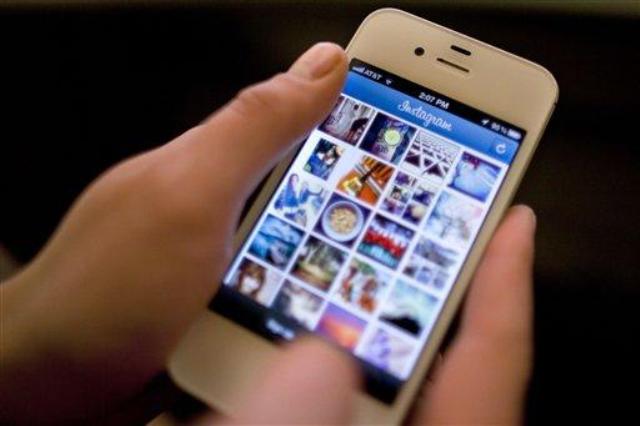
The Mach will connect to Sprint’s 4G LTE network and other features include Bluetooth 4.0, a 1700mAh battery, 8GB of internal storage memory, GPS, a microSD card slot and NFC.

As unusual as the LG Mach’s form factor may be these days, it’s not alone on the market, and one of its closest rivals is also offered through Sprint. The Motorola Photon Q has a slightly larger screen at 4.3-inches, an 8-megapixel camera and a 1.5GHz, dual-core processor, so the LG Mach will likely come in at a slightly lower price. It does win over in one key area though, as the Mach is ever-so slightly lighter and slimmer than the Photon Q.

Sprint hasn’t provided any release information or pricing structure at all, so if you’re interested in the phone, you’ll need a little patience.


Source : digitaltrends[dot]com