Pages

Showing posts with label masses. Show all posts

Oct 19, 2012

Startup Six3 hits the video market with a new take on the messaging app

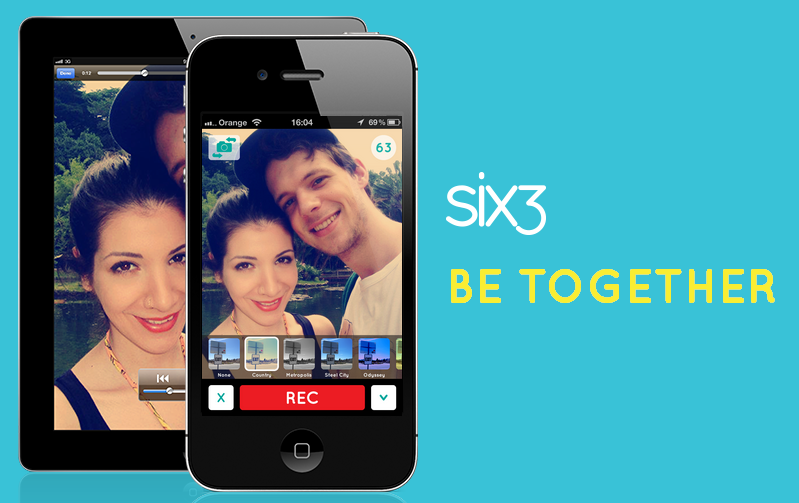
six3 be together

Telefonica-backed startup Six3 wants to bring video messaging to the masses with its new app -- which lies somewhere between Skype and Viddy.

UK-based, 14-month-old startup Six3 wants to shake up the messaging platform by adding video the mix, and with a backer like Telefonica, the largest telecommunications companies in the world, it might just be able to. There isn’t a direct competitor with any existing mobile app out there, so Six3 describes itself as a hybrid between Whatsapp and Viddy and hopes to be a game changer that opens up a market of users communicating strictly through short video messages.

There are undoubtedly countless messaging and video sharing apps out there, which Six3’s CEO and co-founder Tim Grimsditch categorizes into three buckets. First there are one-to-one video chatting services, but Grimsditch says that the growth for those companies is slow since users “tend to stick to very tight circles using that service.”

In bucket two are the Instagram-for-video apps. The most well known in this market are services like Viddy or Mobli. Those apps, however, are about producing quality content. Six3 is about bite-sized messages and quick communication.

The third bucket is filled by the all-in-one communication services like Whatsapp and Skype. These apps tend to “focus all of their energy behind a piece of their service that they’re famous for,” says Grimsditch. The video part of a messaging service like Whatsapp, he explains, is weak. “We’re a tiny team with small resources, yet our video messages are twice as fast as Whatsapp.”

Internationally, particularly in Asia, there’s been a lot of experimentation with new types of chat apps — a popular one being WeChat. Its users are so accustomed to its unique voice messaging feature that I was told few WeChat users in China even send text messages anymore. Six3 wants to do something similar by targeting an untapped niche. “[We're] a platform to communicate with video messages in a way that’s easy, mobile, lets people decide on private or public messaging, and lets people use it within their existing network,” says Grimsditch.

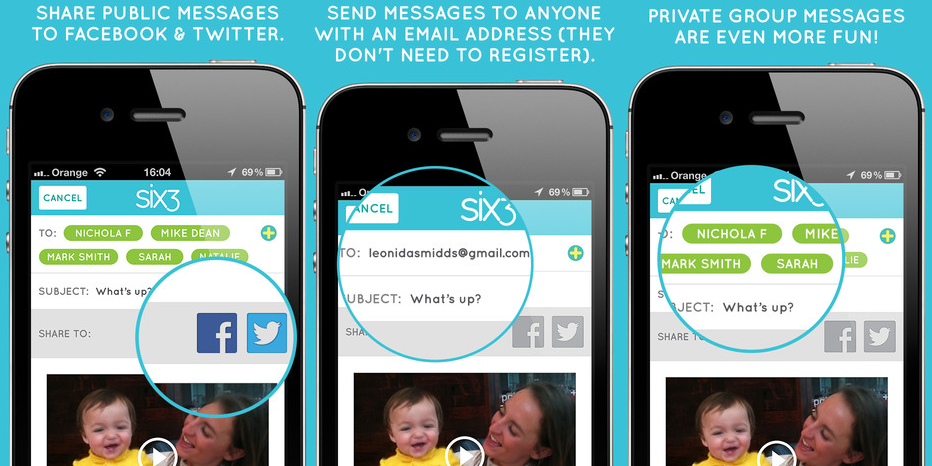
Using the app is as simple. You can select a colored filter, record your video for a maximum of 63 seconds (which is where Six3’s name comes from), select the video’s recipients (via email, address book contacts, Twitter, Facebook, or other Six3 users), and press “Send.”
six3 messaging to

To take social a step further, Six3 announced a deeper Facebook integration yesterday at the Dublin Web Summit’s START conference, where the company was recognized as one of the “world’s 100 most promising early stage startups.” The update adds the ability for users to send private Six3 video messages to individual Facebook friends or share them publicly to your Facebook Timeline, while offering a faster and more seamless user experience. “It makes it incredibly easy to create good looking 63 second long video, share it through Six3, Twitter or Facebook, and respond to the video,” explains Grimditch.

The app will remain free for as long as it exists and you can find it in the App Store (the Android version is in the works), but Six3 will be experimenting with a few revenue models. The ones that Grimsditch was comfortable describing include charging users to archive messages for those important clips that you might have an emotional attachment to as well as the possibility of creating sell premium options like color filters or other visual effects as in-app purchases.

To many developers’ benefit, smartphone owners aren’t particularly app-loyal. Grimsditch is well aware of this and hopes to jostle competitors and become not jut a trend, but a staple app in the sea of 700 million smartphones. “The reality is that we’re just getting started and the dust isn’t going to settle in this market for years and years. So I think you’re going to see many years of explosive innovation, and we’re absolutely planning to be at the forefront of that.”


Source : digitaltrends[dot]com

Sep 10, 2012

Minority Report alert: FBI launching $1 billion face recognition project

fbi face scanning minority report

The FBI is creating its own photo database. And you thought Facebook's face scanning system was scary.

A little over a year ago, Facebook introduced face recognition software to the masses when it included the feature in its photo uploading process. And the masses, as you may assume, didn’t react all that well. There was plenty of conspiracy theory and privacy-concerned backlash, which died down as soon as everyone started talking about how the service was opt-in only. Since then, the feature has faded into the background and taken its rightful place among other Facebook-announcements-that-cause-us-to-wield-pitchforks-for-a-week-but-then-everyone’s-over-it.

But now, concerns over consumers’ image privacy have been resurrected by a billion dollar FBI project. According to New Scientist, the Federal Bureau of Investigation is launching a $1 billion effort called the Next Generation Identification (NGI) program, which will use face detection as well as “biometrics such as iris scans, DNA analysis, and voice identification to the toolkit.” The system is already being ushered in, as some states have started uploaded images (currently it sounds as if this is limited to mugshots); it’s expected to be implemented nationwide by 2014.

As all things start, intentions are good: Such highly accurate identification systems would be used to focus on criminals faster, result in quicker arrests, and potentially stop illegal activity before it happens. Of course, all of that sounds incredibly Minority Report-ish – including this example use:

“Images of a person of interest from security cameras or publics photos uploaded onto the Internet could be compared against a national repository of images held by the FBI. An algorithm would perform an automatic search and return a list of potential hits for an office to sort through and use as possible leads for an investigation.”

While current states that have participated in the pilot program have been uploading mugshots for the NGI, it’s uncertain whether this will eventually extend to include all of our images. In fact, New Scientist pointedly asked the FBI this question and no response was given.

In case it isn’t clear enough, what we very possibly have in the works here is a national civilian photograph database. Right now, the FBI hasn’t reached that far, but it’s very easy to assume it will – and it’s all legal under the US Privacy Act.

Before you start pointing fingers at Facebook and user-facing (pun intended) face recognition software companies out there (think Face.com – now Facebook-owned – and Lambda Labs), consider the amount of state and federal operations that have your images. Your license, your passport, your public transportation ID… it goes on and on. If the government wants to harness image identification, it can and it will, and it won’t have to rely on social networks for help. That said, our increasing comfort with putting our likenesses all over the Internet is only making it easier for this type of system to be enacted. 


Source : digitaltrends[dot]com

Sep 6, 2012

Obama’s DNC speech sets new political record on Twitter

Obama Reddit AMA question conspiracy

President Obama helped set a new Twitter record Thursday night, with his DNC speech provoking the most tweets ever for a "political moment."

Twitter went into overdrive Thursday night as masses of its users fired off a ton of tweets during President Obama’s acceptance speech at the Democratic National Convention in Charlotte, North Carolina.

According to the official Twitter blog, the speech set a new record for “political moments” on the microblogging site, with 52,756 tweets-per-minute being posted at the end of the president’s address.

Adam Sharp, Twitter’s head of government, news, and social innovation, wrote in the post: “The Democratic National Convention has driven an incredible amount of Twitter conversation since the very first day. [At] the close of the official proceedings, we have seen more than 9.5 million tweets sent about the events in Charlotte.”

He added that Thursday alone saw 4 million tweets relating to the convention, a figure equal to the total number sent during the entire duration of last week’s Republican National Convention.

Sharp singled out the moments during Obama’s speech which really got Twitter users going:

- 43,646 tweets for “I’m no longer just the candidate, I’m the President.”

- 39,002 tweets for “I will never turn Medicare into a voucher.”

- 38,597 tweets during a discussion of Medicare

- 37,694 tweets for “We don’t think government can solve all our problems…”

- 34,572 tweets for quips about the Olympics and “Cold War mind warp.”

Sharp assured its users the Twitter blog would be following events closely between now and Election Day in November. “With the conversation about the 2012 election happening on Twitter, the road to Election Day 2012 will be paved in tweets,” he wrote.

It seems that wherever Obama goes, the connected world goes with him. Last week he did a 30-minute ‘Ask Me Anything’ session on Reddit, setting a new record for visitors to the site in the process. In fact, so many people logged on to view Obama’s AMA that the site buckled under the weight of demand, causing it to crash several times over the course of the session.


Source : digitaltrends[dot]com