Pages

Showing posts with label twitter. Show all posts

Nov 14, 2012

Twitter War Erupts Between Israel and Hamas During Gaza Strikes

ht idf twitter 2 tk 121114 wblog Twitter War Erupts Between Israel and Hamas During Gaza Strikes

                                                      (Image Credit: IDFSpokesperson/Twitter)

As the Israeli Defense Forces waged a military campaign on Hamas targets in  Gaza today, a different kind of war unfolded on Twitter between the two groups.

“We recommend that no Hamas operatives, whether low level or senior leaders, show their faces above ground in the days ahead,” said a tweet from the @IDFspokesperson account today. The tweet followed news that the Israeli attack had taken out Ahmed Jabari, the chief of staff of the Ezzedeen al-Qassam Brigades and leader of the military wing of Hamas.

Read More: Israel Assassinates Hamas Commander

Hamas launched mortars in retaliation,  but also fired back on Twitter.

“Our blessed hands will reach your leaders and soldiers wherever they are (You Opened Hell Gates on Yourselves),” said a tweet from the @AlqassamBrigade handle that was directed to the Israeli Defense Forces Twitter.

Throughout the day, the warring groups used their Twitter accounts to provide real-time updates about the military action. The IDF account even broke the news of Jabari’s death on Twitter and quickly posted a video of the strike that was said to have killed him.

“Hamas continues to try to kill Israeli civilians. So far today, the Iron Dome has intercepted 17 rockets fired from #Gaza,” another update said, referring to the missile defense system installed with the help of the U.S.

Meanwhile, the militant unit of Hamas said it had shelled numerous Israeli bases.

“Al Qassam hit Isnad Sofa base with 6 mortars in response on assassination of its leader,” a recent update said, as the Twitter war continued well into the evening.


Source : abcnews[dot]go[dot]com

Nov 8, 2012

Twitter Asks Users to #Reset Passwords, Citing Hacking Issues

ht twitter logo jef 120321 wblog Twitter Asks Users to #Reset Passwords, Citing Hacking Issues

Twitter Logo (Twitter)

Twitter may have had a record 20 million tweets about the election on Tuesday, but there are some problems in paradise today for the social media service.

Many Twitter users received an email notification from Twitter asking them to reset their passwords after an unknown website or online service compromised the accounts of many users. A few high-profiled accounts, including TechCrunch’s, were affected.

Once users reset their passwords, naturally, they took to the Twitterverse to complain about having to do it.

“We’re committed to keeping Twitter a safe and open community. As part of that commitment, in instances when we believe an account may have been compromised, we reset the password and send an email letting the account owner know this has happened along with information about creating a new password. This is a routine part of our processes to protect our users,” Twitter said in a statement on its blog.

Twitter, however, admitted that it reset more passwords than it should have. “In this case, we unintentionally reset passwords of a larger number of accounts, beyond those that we believed to have been compromised. We apologize for any inconvenience or confusion this may have caused,” the company said.

Twitter also encouraged users to read about how to protect their accounts and make their passwords secure. To reset your password, Twitter recommends users type in the link into your browser to reset your password. Often, hackers can access your password by tracing the original link from the notification.

Many argue that Twitter, like Google, should implement stronger security, including two-factor authentication, which, if enabled, forces users to type in two passwords.  ”We’ve certainly explored two-factor authentication among other security measures, and we continue to introduce features, such as https, to help users keep their accounts secure,” Twitter told TechCrunch.


Source : abcnews[dot]go[dot]com

With Twitter accounts hacked, users urged through email to change passwords

Twitter usernames and passwords leaked — but you don't have to worry

This morning Twitter sent out a network-wide email to its users whose accounts were compromised, and urged them to change their passwords.

Users have been calling out Twitter for its vulnerable account authentication for some time now, but the social network still remains mum about the apparent holes in its security. Today Twitter was finally subject to its largest attack, which due to its scale, forced the company to send user-wide alerts via email notifying its users that their accounts have been compromised.

In an email sent this early this morning, Twitter had acknowledged that accounts had been compromised by a third-party site, and urged its users to change their passwords. We checked Twitter and noticed that many compromised accounts were used to tweet spam, but the original users have been able to regain access to them.

Here’s what Twitter said in the email:

“Twitter believes that your account may have been compromised by a website or service not associated with Twitter. We’ve reset your password to prevent others from accessing your account.

You’ll need to create a new password for your Twitter account. You can select a new password at this link: https://twitter.com/pw_rst/…

As always, you can also request a new password from our password-resend page: https://twitter.com/account/resend_password

Please don’t reuse your old password and be sure to choose a strong password (such as one with a combination of letters, numbers, and symbols).

In general, be sure to:

Always check that your browser’s address bar is on a https://twitter.com website before entering your password. Phishing sites often look just like Twitter, so check the URL before entering your login information!

Avoid using websites or services that promise to get you lots of followers. These sites have been known to send spam updates and damage user accounts.

Review your approved connections on your Applications page at https://twitter.com/settings/applications. If you see any applications that you don’t recognize, click the Revoke Access button.

For more information, visit our help page for hacked or compromised accounts.

-The Twitter Team”

Earlier last month, Dennis Jones and his Twitter handle @blanket was hacked, which lead him to discover a mature black market for hacked Twitter, Minecraft, and YouTube accounts. Each account can sell for as little as $60. Digging deeper, we discovered that hacking Twitter accounts as basically become child’s play. Many “hackers” are simply teenagers who browse forums like hackforums.net. These communities are full of tutorials that can guide anyone step-by-step through taking over coveted Twitter handles. These forums are also a proliferating marketplace for selling or trading programs used in malicious virtual attacks, including cracking passwords.

We reached out to Twitter and inquired about how many accounts have been compromised, and who was responsible for the attack. We’ll update you once a spokesperson gets back to us.


Source : digitaltrends[dot]com

Nov 6, 2012

Barack Obama Announces ‘Four More Years’ With Tweet

ht obama wins tweet wy 121106 wblog Barack Obama Announces Four More Years With Tweet

Image credit: @BarackObama/Twitter

It wasn’t in a speech or a statement that Barack Obama announced that he was going to be re-elected as the president of the United States. It was through Twitter.

At 11:14 p.m. ET, @BarackObama tweeted, “This happened because of you. Thank you.”

A few minutes later: “We’re all in this together. That’s how we campaigned, and that’s who we are. Thank you. – bo.”

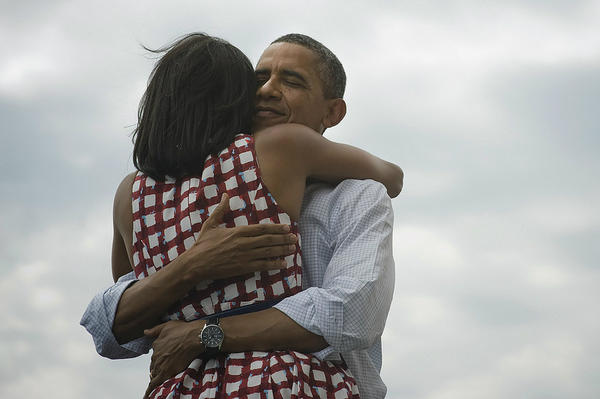
And finally along with a photo of him and Michelle Obama: “Four more years.” That last tweet is now his most retweeted tweet and one of the most retweeted tweets ever. Twitter would not confirm if it was the most retweeted tweet ever. Just 40 minutes after posting it, it had 308,705 retweets.

According to Twitter, after a network call of the presidential race at 11:19 p.m., there were 327,453 tweets per minute. On Election Day itself there were over 20 million election related tweets. For more on the social media reaction to Election Day, check out our guide.

Check out our full article on Barack Obama’s win. 


Source : abcnews[dot]go[dot]com

Obama tweets his most retweeted tweet ever as news networks call election for Democrats

President Obama looking stoic

Barack Obama and his campaign team took to Twitter Tuesday night to thank supporters for turning out to vote, with Obama tweeting his most retweeted tweet ever in the process.

Barack Obama has taken to Twitter to thank his supporters for turning out to vote and returning him (almost certainly) to office for another four years.

At the time of writing, all the major American news networks are calling the presidential election for Obama, with a number of key swing states projected to fall to the Democrats.

At around 11.15pm ET, Obama’s campaign team tweeted, “This happened because of you. Thank you.”

Another came a minute later: “We’re all in this together. That’s how we campaigned, and that’s who we are. Thank you. -bo” The inclusion of “-bo” The inclusion of -bo apparently indicates a personal tweet from Obama himself.

The campaign team then tweeted a photo (below) of Obama hugging wife Michelle, accompanied by the words, “Four more years.” Twitter has just reported that this has already become @BarackObama’s most tweeted retweet ever – at the time of writing this stands at 314,000 – not bad for a tweet posted 40 minutes ago. The account has 22.1 million followers.

However, Mitt Romney’s Twitter account has so far stayed silent, with the last tweet posted around 3pm ET. “With your help, we will turn our country around and get America back on the path to prosperity. Please vote today,” it said.

Earlier in the evening, Twitter announced that Election Day had already become the most tweeted about event in US political history.


Source : digitaltrends[dot]com

Twitter: Over 20 Million Election Related Tweets Today

ht barack obama tweet wy 121106 wblog Twitter: Over 20 Million Election Related Tweets Today

Image credit: @BarackObama/Twitter

Twitter has called its own race. At 10:01 p.m. ET, Twitter announced that it had hit 20 million election-related tweets, making Election Day 2012 the most tweeted-about event in U.S. political history.

As a reference, there were close to 20 million tweets about Hurricane Sandy over the span of last week and 10 million tweets during the first presidential debate. Twitter has not released the exact details on the peaks — it will likely do that tomorrow when all is said and done — but at 9:26 p.m. when the Pennsylvania results were announced there was a peak of 66,019 tweets per minute (TPM) and at around 10:45 p.m. there was a spike of 69,000 TPM.

Throughout the day voting topics have trended on the service, including #stayinline, referring to those standing in the voting lines or urging those to tough out the wait. The impact was also showing on the candidates’ Twitter feeds. As of 10:45 @barackobama had a 123,782 retweets on the following tweet “RT it you’re on #TeamObama tonight.”


Source : abcnews[dot]go[dot]com

The problem with your socially-sourced election predictions

social media and election predictions

As the 2012 presidential election comes to a close, our interest is being held captive by early results sourced by the likes of Twitter and Facebook. But for all of the infographics created from this data, is there really enough here to offer election predictions?

Finally, November 6 is here. Election Day has come and that means the campaigns we’ve watched unfold over what feels like a lifetime are coming to an end. And this has been an election season the likes of which we’ve never seen: It’s infiltrated every last pore of our existence thanks to the deluge of social media outreach and coverage.

And it’s not over yet. While the votes have yet to be counted, we apparently already have an outcome: Obama will be our president for another four years.

How do we know this? Social media. Statistically, candidates who have more Facebook Likes and Twitter followers tend to win. Three recent gubernatorial races went to the candidate with largest Twitter follower counts.

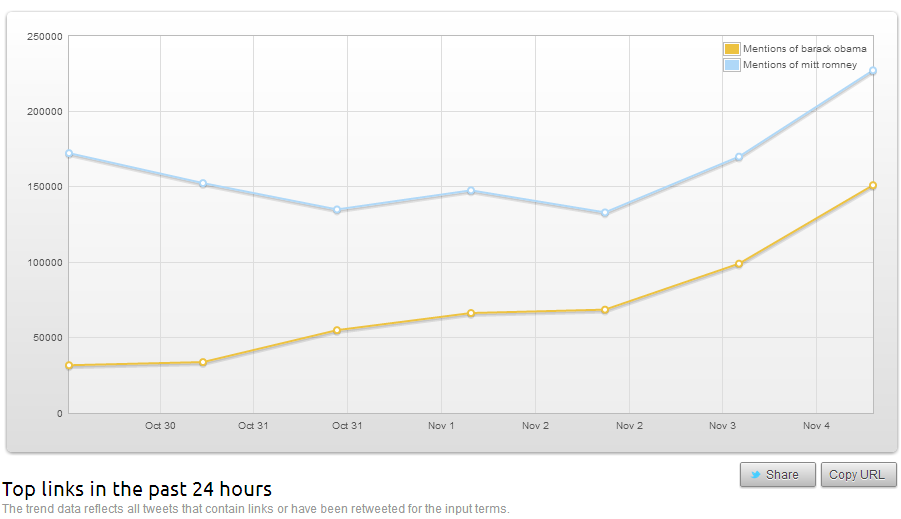
But wait – there’s also an argument that @mentions indicate who our winner is going to be. The candidate everyone’s talking about will be the next president. In that case, Mitt Romney takes the lead.

topsy election

And if you think Web buzz in general is going to predict our next president, then once again it’s Romney for the win.

google trends election

Social network-sourced election predictions are everywhere, but whether they mean anything is unclear. There’s no shortage of infographics using eye-catching visuals to colorfully chart out how we’re using Facebook, Twitter, and Instagram to talk about our candidates, but not enough analysis about whether this content is signal or noise.

What we do know is this:

  • People increasingly use social networks; as of May, eight percent of online adults were using Twitter on a typical day.
  • People increasingly get their news from social media and digital outlets; according to a Pew Research Center Report, “the percentage of Americans saying they saw news or news headlines on a social networking site [from the day before] has doubled from nine percent to 19 percent – since 2010.”
  • 88 percent of social media users are registered voters.

election infographicsThe big picture take-away from this is that social media and elections matters; politicians should be creating content here, because constituents react to it. But the data raises more questions than it answers. What about sarcasm, mood, and sentiment? Or spam accounts? Or malicious posts meant to manipulate a social network? We just saw how completely faked information can take over a platform as well as the news cycle, so what’s to keep us safe from similar effects with election predictions?

For all the revealing bite-sized data we can squeeze out of Facebook posts and followers and Twitter mentions and hashtags, there are plenty of glaring inaccuracies as well. According to Twitter, Ron Paul should have been the Republican nominee, and the Iowa primary would have ended quite differently.

For every insightful social media analysis, there are 10 terribly shallow ones. Countless news outlets launch tools or republish infographics that count “buzz” – and if that’s all we we’re looking for, Herman Cain would probably be our next president.

What’s missing, of course, is context. So many of the endlessly-circulated infographics and charts we’ve seen this year are heavy on data and pie charts and graphs and lack anything to put those numbers into perspective.

As a rule, these prediction tools aren’t able to determine if tweets or Facebook posts are coming from people who are even eligible to vote. According to a recent study, 73.7 percent of Twitter users are between the ages of 15 and 25, so there’s plenty of opportunity here for users who can’t vote to be sharing their opinions. To further complicate things, only 0.45 percent of Twitter users disclose their ages. 46 percent of Facebook users are 45 or older, but given how large Facebook is, this number is sort of insignificant; it means that there are plenty of under-aged users on the site who could very well be endorsing candidates they can’t vote for.

Demographics in general are rather ignored – the most notable of them being that the people who use social networks to talk about politics are already politically motivated. This means that those who keep their political ideals to themselves or don’t have strong enough beliefs to broadcast them – but will still vote – aren’t being counted. In traditional prediction methods, pollsters specifically reached out to this subset in order to create more accurate views of the elections, but since the data being pulled from social networks is all self-motivated, these data simply get left out.

German researchers recently looked at Twitter’s predictive abilities, saying: “While we find evidence of a lively political debate on Twitter, this discussion is still dominated by a small number of users: Only four percent of all users accounted for more than 40 percent of the messages.” This was back in 2009, but surely the scale still speaks to a notable discrepancy.

“So long as you understand the data and the demographics of social users, you can measure sentiment in perspective and target relevant messages to those groups,” says 140Proof founder and CTO John Manoogian III says. “The problem comes when pundits and analysts mistakenly assume that social media aggregates the tastes and preferences of all voters — it does not. Sites like Facebook and Twitter have political leanings. But social media does pretty strongly indicate what young, educated, and/or professional voters are saying.”

A much bigger factor is the failure of sentiment and mood analysis. The mechanisms we use to measure social media talk aren’t sophisticated enough to know if you’re slamming Obama or endorsing him. Some people can barely read sarcasm, so don’t expect applications pulling in tweets and posts to consistently do so. If you write “Oh sure, I totally believe Romney has women’s interests at heart,” in a Facebook post, it will likely be interpreted as a pro-Mitt statement.  

There’s also the fact that we want this to work; we want to be able to use social media to tell us how we all really feel. “This is the so-called file-drawer effect: researchers do not publish negative results, hence, only positive results are known and it seems that something is possible most of the time when it could be due to pure chance,” says researcher Daniel Gayo-Avello. “A paper [I wrote with] Eni Mustafaraj and Takis Metaxas showed that, in fact, results could be guessed roughly half of the time; that is not an impressive predictive ability, isn’t it?”

“Thus, by not knowing (because they are seldom published) about negative results, everybody assumes that simple methods simply work; and, indeed, they ‘work’ but half of the time, akin to a broken watch which ‘works’ twice a day.”

This doesn’t mean all this information isn’t valuable – it absolutely is, and interesting to boot. There’s no argument that politicians shouldn’t be using social networks, and this type of outreach is only going to become more common and more sophisticated.

The big lesson is social networking can be used as an indicator of opinion, but not necessarily decision. There are just too many loose ends involved, and until they can be tied up, you’re just going to have to learn who will win our elections the old fashioned way: by waiting up all night for some guy or gal on TV to announce it. 


Source : digitaltrends[dot]com

Nov 5, 2012

Copyright infringing tweets now withheld, not removed

troll wannabe

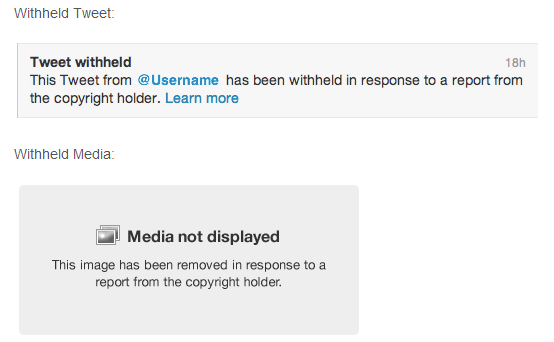
Twitter changed its legal policy, citing transparency, for tweets taken down by DMCA complains. Twitter now withholds suspected tweets instead of removing them altogether.

Twitter has begun handling DMCA copyright notices in a new way. In a tweet, Twitter announced that the practice of outright removing tweets has been shelved. Instead, the site will notify the offending tweeters with a notice indicating that the tweet has been marked for a DMCA takedown.

We now offer more #transparency in processing copyright reports by withholding Tweets, not removing. Learn more: support.twitter.com/articles/15795.

— Jeremy K. (@jer) November 3, 2012

In the past, Twitter would completely remove the infringing tweet, and retweets and responses would disappear along with it. The new tactic will replace the tweet with a reason explaining its removal, while keeping everything else intact.

To recap the type of content that Twitter will remove, Twitter’s tweet linked to its Copyright and DMCA Policy page which outlines what’s considered copyright infringement:

“Twitter will respond to reports of alleged copyright infringement, such as allegations concerning the unauthorized use of a copyrighted image as a profile photo, header photo, or background, allegations concerning the unauthorized use of a copyrighted image uploaded through our photo hosting service, or Tweets containing links to allegedly infringing materials.”

The way Twitter is handling DMCA takedowns parallel’s Google’s DMCA notifications that show up at the bottom of search results. Results removed from Google results are replaced with an explanation, the number of results removed, and a link to the report from the party responsible for filing the complaint.

To give you an idea of what the tweets will look like Twitter will replace the infringing content with the following explanation:

withheld tweets

“This Tweet from [@username] has been withheld in response to a report from the copyright holder. Learn more: support.twitter.com/articles/15795#”

In the past, infringing tweets would be removed and clicking on a URL of where the tweet used to live, would instead open up a 404 page indicating that the content has been removed altogether.

The change helps to manage the transparency that Twitter wishes to maintain with its content moderating practices, as explained in its policy page:

“In an effort to be as transparent as possible regarding the removal or restriction of access to user-posted content, we clearly mark withheld Tweets and media to indicate to viewers when content has been withheld.”

As a company that’s steadily evolving into a content hub for publishing the latest news, there’s a delicate balance between users and complaining publishers that needs to be maintained to keep both parties relatively happy. Removing content outright discourages users from using Twitter as a content distribution platform, while of course failing to acknowledge and comply with DMCA complaints subjects Twitter to lawsuits. This is one strategy that provides transparency for DMCA takedown notices for all parties involved, including the readers and retweeters of the tweets. It’s also a strategy that can help identify baseless complaints, which has in fact been a common practice on Google.


Source : digitaltrends[dot]com

Oct 25, 2012

Letterpress, a new game for iOS from the creator of Tweetie

If you’ve used the Twitter client Tweetie or the official Twitter apps for iOS, Android and OS X, you have one person to thank for them: Loren Brichter. Brichter rose to fame with his excellent Twitter app, Tweetie, for iOS and Android. These apps were so good that Twitter acquired him and his apps and since then he made the Twitter apps for iPhone, iPad, Android and OS X.

Last year, Brichter left Twitter to continue working for his own company, Atebits. He has been secretly working on his own app since then and yesterday it was finally released on iOS. Say hello to Letterpress.

Letterpress is a two player, online multiplayer game similar to Scrabble, where you have a grid of 5×5 tiles consisting of letters. Your goal is to form words using these letters. The word should have at least two characters and you cannot repeat words. Once you select your letters, they get assigned by your team color. The opponent then has to do the same.

If you choose from the white tiles, that is those that have not been used, you get one point per tile. If you steal tiles from your opponent, you get one point and the opponent loses one point per tile. Once stolen, the tiles turn the color of your side. If you use your own previously used tiles, you don’t get any points. Eventually, you have to use up all the tiles on the board and the one with the highest score wins.

The premise is pretty simple but despite that the game is fun to play. What I really like about this game is how well made it is. From the UI design to the slick animations, everything is top-notch and shows that a great deal of care went into making the game.

Now here’s the best part: Letterpress is completely free for download. There is an upgrade option for which you have to pay $0.99. which lets you use various themes for the board and you can also play multiple games at the same time but even without upgrading the game feels complete.

Click here to download the game on your iPhone, iPad or iPod touch. You’ll need a Game Center ID to play the game.


Source : blog[dot]gsmarena[dot]com

Oct 19, 2012

Liberal Democrats More Likely to Hit ‘Like’ Than Conservative Republicans, Says Pew Report

ht obama facebook jef 121019 wblog Liberal Democrats More Likely to Hit Like Than Conservative Republicans, Says Pew Report

Image credit: Twitter

Does your political leaning say anything about how you use Facebook‘s “Like” button or social media in general? It could. The Pew Internet & American Life Project has found, among other things, that liberal Democrats are more likely to hit the “Like” button than conservative Republicans.

Specifically, 52 percent of liberal Democrats have “liked” a post to promote material related to politics, while 42 percent of conservative Republicans have done so. Pew also found that 38 percent of the social media-using population has used the “like” function to promote political issues.

Democrats are also more likely to encourage people to vote on social media. Forty-two percent have done so, compared to the 36 percent of Republicans.

In other areas of social media use, though, it appears that Democrats and Republicans aren’t all that different. For instance, Pew said 42 percent of liberal Democrats and 41 percent of conservative Republicans who use social media have posted their own thoughts or comments on social media sites.

Pew said 39 percent of Republican social media users repost political content from others, while 34 percent of Democrat social media users do so.

“There is a mixed picture along party lines. One party doesn’t have an obvious social media edge. The biggest driver here is whether you are interested in politics in the first place. If you talk about it with friends, you are going to use the social tools to talk politics,” Lee Rainie, director of the Pew Research Center, told ABC News.

Kay Lehman Schlozman, a professor of political science at Boston College and co-author of the survey, said, “I would not hyper-analyze the differences. What is clear is that the liberal Democrats and conservative Republicans are more active than moderates or independents because they care so much more about politics.”

Beyond partisanship, the rise in usage is certainly the major takeaway. The report found that 66 percent of the social media users use services like Twitter or Facebook to engage in some form of political discussion. According to Pew, that amounts to 39 percent of all American adults.

The results of the report were based on a survey of a national sample of 2,253 adults (18 or older). It is important to note that the survey was conducted between July and August and that some of these patterns may have changed as the election season has progressed.


Source : abcnews[dot]go[dot]com

Oct 18, 2012

Tweetbot for Mac is finally here… but it costs $20 and is in limited supply thanks to Twitter’s API restrictions

tweetbot for mac

Tweetbot for Mac launched today, but Twitter's new API guidelines has left Tapbot with no choice but to sell a limited number of copies for $20.

Tweetbot’s Mac app finally launched in the Mac App Store today, but there’s a catch: Tweetbot for Mac will cost you $20, which is actually a reasonable price considering the circumstances.

The circumstances are these: Mark Jardine of Tweetbot developer Tapbots explains that Tweetbot for Mac will cost $20 “because of Twitter’s recent enforcement of token limits.” Tweetbot only has a limited number of user tokens it can implement and is therefore limited to hosting a small number of users — and because that potential pool of users will be restrained, the company has to charge a higher price. “These tokens dictate how many users Tweetbot for Mac can have,” Jardine says. While initially Tweetbot said it was working closely with Twitter as a result of the API restrictions, collaboration seems to have fallen to the wayside as alpha testing was squeezed out and later the Tapbots developers headed to App.net to try their luck there

Despite the bumpy road, the Mac client is finally  here, although there are some strings attached. One thing to note is that the number of Mac tokens available to Tweetbot are independent of the tokens available for Tweetbot for iOS users, which should be a relief to all the Tweetbot iPhone users out there who want the app for their desktop too. Once the number of tokens available for Tweetbot on Mac are used up, however, Tapbots will discontinue further sales — so you may want to act fast. 

An estimated fewer than 100,000 individual user tokens will be made available to Tweetbot based on Twitter’s API guideline Version 1.1. Existing third-party Twitter apps will be offered an additional 200 percent of the app’s current user token, but since Tweetbot for Mac is launching today without an existing user base, this unfortunately won’t apply.

To expand the number of tokens available Twitter explains that it reviews requests on a case-by-case basis. Jardine is aware of this and at the end of his announcement points to Twitter’s support account saying, “feel free to let Twitter know how you feel about it.”

If you were an early participant in the alpha or beta trial of the Tweetbot Mac app but have no intention of purchasing an account, Tapbots is kindly asking these testers to “please do us a huge favor and Revoke access.” With limited tokens available on Tweetbot for Mac, it frees up more space immediately for buyers.

With new stipulations attached to distributing this (and once-free) software, we have to wonder what may  happen to buyers that stop using Tweetbot for Mac. We reached out to Tapbots to find out if the company would possibly consider buying back accounts from inactive users. We will update you with their response.


Source : digitaltrends[dot]com

Oct 11, 2012

Twitter silently rolled out a user directory to boost search engine efforts – but is it helping?

twitter directory

Twitter quietly launched a directory listing the majority of its users in an effort to boost its search engine presence. It's the latest effort by the company to establish itself as a media network driven by the hunger for ad revenue.

This week, the Internet noticed that Twitter had quietly rolled out a directory of its users, though a Twitter spokesperson tells us it was actually introduced a “few weeks ago.” While this might seem like a rather small and inconsequential feature, it’s yet another sign that Twitter is hell bent on evolving into a media company and pushing its ad revenue strategy; it’s one more way to get eyeballs on the propriety Twitter site, and instead of just competing with third party developers, this time Twitter is trying to work its way around Google. 

Back in January 2012, Google came under fire for favoring Google+ results in its social search feature and cutting out data from Twitter and Facebook. The effort that users had put into surfacing their Twitter and Facebook accounts — inarguably the most important social profiles there are — was immediately buried when Google flipped the switch. 

Right away, Twitter voiced its disapproval. “For years, people have relied on Google to deliver the most relevant results anytime they wanted to find something on the Internet… We’re concerned that as a result of Google’s changes, finding this information will be much harder for everyone. We think that’s bad for people, publishers, news organizations and Twitter users.”

Regardless of the history between Google and Twitter, it’s in Google’s best interest to its users as “a search engine’s ultimate goal is to give people what they want,” says Dan Eng, Senior SEO Strategist for Red Bricks Media

Now, since it appears the Google isn’t doing Twitter any favors, Twitter is doing what it can to get its content better Page Rank. For instance, Twitter recently changed its robots.txt file to enable search engines to crawl content within tweets and hashtags. Eng offered us his two cents about how Twitter was positioning its directory for search engines to index. “It’s mostly likely taking users from top to bottom in authority. Logic will say that the most popular and active users should get preference in content creation for indexation while inactive or spammy profiles hold less weight.”

What this means is that you can now search for general topics like “fashion” or “presidential debate” in a search engine, and you may find tweets from relevant and preferential Twitter users showing up in the search results. Or if news breaks, Twitter hopes that search results will offer relevant tweets. 

And in addition, of course, is the full user directory Twitter has published that should help index many Twitter accounts with all search engines.

“If successful, Twitter would have expanded their reach by presenting their well-received content through a new source for their existing audience as well as providing a new channel for first time users and users that have dropped off over time,” Eng pointed out. “If Twitter’s audience responds well to this information, search engines will have no choice but to recognize it as valuable content that is helpful and in demand from their searchers.”

Twitter confirmed as much when we asked about the new directory. A spokesperson told us it was released, “to help people find the accounts they’re looking for with various search engines. Public and protected accounts are included.” The spokesperson emphasized that protected tweets will remain private to the user and accepted followers.

If you’re logged out of Twitter, you can access its directory from the bottom of its homepage, to the left of Twitter’s copyright mark. Opening up the page will present to you an index of Twitter accounts listed in Latin and non-Latin character names listed by the name that you’ve signed up on Twitter with (not your Twitter handle).

Interestingly enough we’ve found that the directory limits the number of pages you can visit (or calls you can make) within a restrictive time frame. When we opened up more than five pages within the directory in a span of a few seconds (not links to individual Twitter accounts), we were greeted with a blank page on the sixth page. The rest of the site work was working as intended.

From the directory, I was able to find my own Twitter account, @francisybea under “Francis Bea,” as well as my colleague Molly McHugh, @iammollymchugh. We’re skeptical that every single Twitter account appears in the directory, but it could be close to listing the full 500 million users. We’ve estimated that under “A,” there are 18 million user names alone.

Twitter’s spokesperson cryptically hinted that not every account may appear in the directory. “Similar to search results, we have methods to filter for quality accounts.” The spokesperson then directed me to Twitter’s Help Center to read the requirements for a user to show up in Twitter’s search results. Basically, it says the directory will only list what Twitter deems “quality accounts”  – a determination that’s reminiscent of how Twitter hands over Verified Account badges. Accounts that don’t meet Twitter’s expectations per “Twitter’s Search Rules and Restrictions” could be penalized by being excluded from the directory.

 google twitter directory

While how Twitter decides who gets to be in the directory is interesting, what really matters here is how effective its efforts at getting indexed by search engines are. When we conducted a Google search to find out how many accounts were indexed from Twitter’s directory using the query site:twitter.com/i/directory/profiles, as SearchEngineLand (which noticed the directory roll out) had done, we found that just a mere 618,000 Twitter accounts had been indexed (fewer than SearchEngineLand found earlier this week). At last check, this number had risen to 644,000 results, which indicates Google is continuing to index them. 

bing twitter directory results

Bing on the other hand has yet to index Twitter’s directory and returns just one result. DuckDuckGo offers just two results.

Is Twitter’s directory necessarily helping to crawl more Twitter accounts? Not yet at least; the directory doesn’t appear to make much of a dent on Google’s search algorithm when accounting for the fact that just 0.0012 percent of Twitter’s directory of 500 million accounts are being indexed by Google — although that number appears to be rising, albeit very minimally. 

Neil Patel, co-founder of KISSmetrics and marketing blog Quick Sprout, agrees. “Percentage wise, I don’t think it will cause a huge lift. I would be shocked if it causes their overall traffic to jump by more than 10 or 15 percent,” he says. “When you have millions of Twitter profiles, naturally not all of them will be indexed as good portion of their user profile pages aren’t popular, contain very few tweets, and aren’t linked to from other websites,” Patel explained. Still even a five percent increase would result in millions more visitors, Patel adds, the idea being this respectively boosts Twitter’s ad revenue.

As Twitter tightens its grip on its ecosystem, motivated by its renewed focus on advertising, the directory should improve Twitter’s search visibility — even if just by fractions. The better the company’s search presence on Google, Bing, or any other search engine, the more traffic it will bring in. And of course higher traffic means more ad revenue. So even if that increase is minute, it’s existent. 

“Just like any business out there, Twitter has to keep on growing. And a good way for Twitter to do that is to leverage the number one site on the web, Google, to gain more traffic,” says Patel. “Through their directory initiative, move people will find Twitter when they Google names or use any other search engine.”

So what does this mean for everyday users of Google, Bing or other search engines? Twitter has consistently been a source for the freshest information, so “now by making this information available to search engines, Twitter provides helpful on the spot data whereas a page that needs to gain organic rankings would never be able to reach,” say Eng.


Source : digitaltrends[dot]com

Oct 10, 2012

TweetDeck cleans up its act with design overhaul

TweetDeck redesign

TweetDeck has received a major redesign, with font size choices, and a new all-white look. All its missing is a single-column view.

Popular Twitter client TweetDeck received a major design overhaul today, which gives users more options to tweak the look and feel to their liking.

The most obvious new design aspect you’ll notice is the font change, which is far easier on the eyes than in the previous version. Moreover, users can now choose between three different font sizes: small (13pt), medium (14pt), and large (15pt). While this might not seem like that big of a switch, it is an instantly noticeable improvement over the previous design, which now seems almost unreadable by comparison.

An arguably bigger design change is the addition of a white theme, which can be turned on with the click of a toggle switch located on near the top-left corner of the app. The classic dark theme is still available, of course, for those of you who dislike the brightness of the new look.

Tweetdeck-redesign

To update to the new version, just follow these instructions, via TweetDeck:

The update is live now on web.tweetdeck.com. If you use the Windows app, just restart to trigger an auto-update. Chrome app users should restart Chrome to update the app and the updated Mac app is available now in the Mac App Store.

While TweetDeck, which is owned by Twitter, does not explicitly say so, the update appears to have fixed some of the window re-sizing issues that plagued the previous version — at least, re-sizing works far better for me now than it did before the update. As a TweetDeck user, my only remaining complaint is that the application no longer has a single-column view, as it did before Twitter scooped up the client and made it its own. In fact, you still cannot adjust the size of the app’s window to make it smaller than three-columns wide.

Why this is the case, I’ve yet to find an answer. But if you’re listening, TweetDeck, please, for the love of the microblogging gods, bring back the single-column view. Your heavy users will thank you. And if you don’t, we may be forced to switch over to Tweetbot, which does a great single-column view. That is, if Twitter doesn’t kill it off before we have a chance.


Source : digitaltrends[dot]com

Stealth mode video app Vine acquired by Twitter for its rumored in-house video hosting service

twitter vine

Twitter has reportedly acquired Vine to develop a video sharing service in-house. It's the latest development in reports that Twitter will stop supporting third-party video sharing services.

After yesterday’s report about Twitter developing an in-house video client, there’s now some solid evidence that Twitter has invested in developing a video service. AllThingsD has reported that Twitter recently acquired three-person New York City-based video sharing startup Vine.

The same report indicates that the deal was motivated by the acquisition of the team rather than the product itself, although an update by AllThingsD suggests that Vine could remain a standalone service. We reached out to Twitter, but the company declined to comment on the matter.

If you take a look at Vine’s site, you’ll notice the service has yet to launched and is simply taking user signups. But the splash page currently describes it as, “the best way to capture and share video on your iPhone. No editing. No rendering. No post-production. Video has never been this fun.”

Vine could be in its beta testing stage with some early adopters — primarily investors and other entrepreneurs using the service — which gave us a look at how Vine works. It’s apparently focused on short form clips that last just a matter of seconds, but the platform stitches together these short clips into a longer video. It then loops back to the beginning of the clip automatically, kind of like a GIF but with sound.

We did a Google search for site: http://vine.co/v/, which appears to be the site’s root URL for user submissions, and found that vine videos were in fact being indexed by Google with approximately 104 results. We were able to check out the submissions from people like MG Siegler and Vine co-founder Dom Hofmann and David Lee, managing partner of SV Angel.

Here are just a few examples that you can check out:

Davidlee

Parislemon

Kevin

CarterKev

Dom 

Whether Vine would continue to exist in its current form or have its technology use to support whatever video service Twitter has up its sleeve remains to be seen. Still, the acquisition absolutely points to the platform’s interest in bringing video in-house. 


Source : digitaltrends[dot]com

Oct 3, 2012

Squeezed out by Twitter, Tweetbot makers introduce the App.net-friendly version, Netbot

netbot from tweetbot

After Twitter's API restrictions hurt its alpha testing, Tweetbot makers went the developer-friendly route with Netbot, the App.net iPhone and iPad apps.

Fan-favorite iOS Twitter client Tweetbot recently announced it would be shutting down its alpha testing as a result of Twitter’s recent API restrictions. Initially, Tweetbot developer Tapbots reassured us all that the application would be just fine, and the team was working closely with Twitter on the project. Unfortunately that was not the case, as user tokens became limited and so did Tweetbot’s ability to functionally test its app.

So while Tweetbot for Mac waits in the proverbial wings, Tapbots decided to take action where it could – over at App.net. The anti-Twitter, microblogging platform has been developer-friendly from the get-go, launching in reaction to tide of API restrictions Twitter began whispering about early last summer. App.net recently announced it would be incentivizing — allowing developers to build for its platform by offering them a crack at a $20k pool.

App.net also recently dropped its user fees from $50 a year to $36 a year, or $5 a month. The quick assumption there is that the platform is trolling for new users as its initial hype begins to fade, but App.net is spinning this as good news, saying it’s nearing 20,000 users, easily surpassing its 10,000 paying members goal.

Of course, it’s still no Twitter – which, this summer, was estimated to have more than 300 million registered users. But given the platform’s distancing from developers, it’s only natural that app builders are starting to look elsewhere, Tapbots included.

netbot for iphoneWhich is what brings us Netbot. “If you love Tweetbot and are on App.net, you’ll want Netbot,” co-founder Paul Haddad wrote in a blog post introducing the new client. “We’ve been working very closely with App.net. Their goals of always putting users first resonates with what we believe at Tapbots. Even though App.net is currently a small network, we expect big things from them and are proud to be a part of the community.”

Haddad says App.net is also working on bringing expected features like push notifications and private messaging to the platform, and once available, they will be integrated into Netbot as well.

netbot for ipadNetbot for iPhone and iPad is available today (both cost $4.99 — Tweetbot for iPhone is $2.99, for the record), and the app is incredibly reminiscent of what we all fell in love with in Tweetbot for iPhone (the long-awaited iPad version was in the works when the Twitter hammer fell). App.net iOS users will absolutely want to turn to this client for their mobile use. Getting Tapbots – a very respected and creative team – on board with the platform speaks well of where mobile development for App.net is going and the kind of talent it’s attracting. But it’s important to remember that App.net is not a Twitter-as-we-know-it-now killer – it’s just trying to resurrect what Twitter was and could have been. 


Source : digitaltrends[dot]com

Sep 28, 2012

Twitter is under-reporting mentions on iPhone and third-party apps

twitter on mac

You may want to rely on Twitter's desktop app if you want an accurate measurement of how many replies you're receiving.

If you’ve been primarily using the Twitter iPhone app, you may have been missing out on mentions, retweets, and replies. Twitter application Favstar noticed some inconsistencies when its users were unable to see notification Tweets from the company’s accounts, only to later realize upon investigation that viewing mentions on Twitter for the iPhone and other third party clients was unreliable. If you take a close look and compare the desktop app and iPhone app, some mentions are just plain nowhere to be found. Other mentions have been replaced, unusually enough, with older Tweets.

twitter not showing tweets

For example, as Favstar shows in the above screenshots taken from its own Twitter account on the Mac and the iPhone, the Tweets from @BauDaLayla and @PaulShipper have been replaced entirely by older posts.

It should go without saying that it’s incredibly important the Twitter iPhone app display content correctly; mobile usage is only on the up and it’s where the platform is making its money. TheNextWeb found that third-party Twitter clients for the iPhone were also incorrectly displaying mentions. That could suggest the bug is originating from Twitter’s API, and you have to hope a quick fix is on the horizon. 

For now, we’d recommend that you double check your mentions and do a side by side comparison to see if you’re missing anything of significance.


Source : digitaltrends[dot]com

Sep 23, 2012

Sharing is not caring: How social networks ruin amazing secrets

social media sharing header oversharing

Social networks encourage spreading everything you encounter far and wide, but sharing can actually destroy the very things you want to promote.

With Twitter, Facebook and even LinkedIn “share” buttons plastered on every website, any online experience can become a social one with the click of a link. The ubiquity of social networks encourages the thinking that sharing is an unquestionably good thing, especially on the Internet when there’s no limited resource to deplete. The more people that know about something cool, the better, right?

Wrong. I’m here to tell you: People ruin everything. The next time you discover something secret and amazing, you should let it stay that way. Here’s why.

John Peel Archive

Earlier this month, something wonderful was discovered. Unfortunately, that discovery assured its destruction.

On September 10, the Liverpool-based culture blog Seven Streets wrote that an archive of 458 radio shows hosted by legendary DJ John Peel had “turned up on Soundcloud.” On September 12, The Verge picked up the story. By the time I attempted to access the Soundcloud archive eight hours later, it had disappeared. Soon after, “+dB,” the user account which had created this resource had disappeared as well. As Seven Streets wrote in an update to the original post, “Sadly, it looks like the Web police have struck as the channel is currently down.”

Sad indeed. A unique and invaluable cultural resource was destroyed by the publicity The Verge and other outlets brought it, and a passionate patron of the arts was hounded (further) into hiding.

This is far from an isolated case. Public attention destroys great things all the time, even in a digital world that’s supposed to foster sharing.

The Awful Forums

The private forums for the comedy website Something Awful make another ready example — only the Awful Forums didn’t need public news stories to be destroyed by the public.

Launched in 2001, the SA Forums were for years very close-knit communities of like-minded nerds. The success of The Forums could be attributed to two factors: a $9.95 sign-up fee (which kept less-determined users away), and curation by SA’s forum admins, who were never afraid to drop the banhammer to ensure the forums stayed the forums.

Unfortunately, the Awful Forums were irrevocably changed by explosive growth in 2004. It wasn’t just that there were massive amounts of new users. It was that most were joining for the wrong reason: to access the short-lived “BitTorrent Barnyard” — a family of subforums which hosted BitTorrent files when the legality of this activity was more of a grey area.

somethingawful forums social media overshareTens of thousands of new users flooded in to the forums. Most weren’t up to the standards of the previous guard, and many were ignorant of the codes of conduct for the community. When the Barnyard was shut down on January 1st, 2005, this unwanted influx of new user accounts was cited as the reason. As one forum user wrote in SomethingAwful’s own SAClopedia in late-November 2004,

Fight club will be no more on January 1, 2005. This is because [SA Founder Rich "Lowtax" Kyanka] is tired of the newbies, and he thinks that it’s just bringing retarded people to the forums (which it is.)

Unfortunately, this change may not have come soon enough. After dilution by hordes of new users that arrived during this period, the forums and would never be the same. The public had ruined them.

Apple

I’m sure veterans of sites like Reddit, 4chan, and Digg pine for “the good old days” in a way similar to senior Awful Forums users. Long-time Apple fans may soon join these groups. This will be due to the unfortunate side effects of Apple’s ascent to hardware dominance: increased vulnerability by viruses and other exploits, and decreased coolness implied by ownership of the Apple device.

OS X has long-enjoyed (and promoted) a reputation for being more secure than competing operating systems. Apple’s engineering skill is one reason for this advantage. A bigger reason may be that hackers target Apple devices less often because Apple’s market share is significantly smaller than that for Windows. As Apple’s market share grows, this may change — causing, I’m sure, great dissatisfaction for millions of Apple fans.

os x secure apple mountain lionFurther, in the months following iPhone’s and iPad’s release, the novelty of each was so great that mere ownership of the device made for a solid 10 minutes of conversation with any non-owner. Fast forward a few years, and Apple now sells 2 million iPhones in its first day of preorders.

Moving from exclusivity to ubiquity has made Apple billions, but it’s also made its devices less interesting to own and maybe even less secure. We may have been better off had the excellence of Apple experiences remained a secret.

Not a new problem

The harm that a crowd brings to anything noteworthy can extend outside the digital world, too. See the reason shows at many of Portland’s best house venues are now secret. See the effect that many fear Portlandia and The New York Times’ affections will have on our fair city (which, incidentally, is a terrible place to which you should never consider moving). In each case, greater knowledge by the public threatens the very existence of the thing being celebrated.

The scientists who study the world’s most-exceptional trees understand this. The locations of trees like the 379-foot Hyperion, the tallest known tree, and the Del Norte Titan, one of the most-massive, are closely-guarded secrets. So too is the exact location of Methuselah, one of the oldest.

They learned their lesson from the tragic story of Prometheus, a ~5,000-year-old tree which was chopped down by a graduate student in 1964. This and other conservation fails have taught ecologists a valuable lesson: even if 99 percent of people will behave themselves appropriately, there remains that one person in one hundred who will not. That person may even have great intentions, but those intentions don’t make their actions any less destructive. Hence, secrecy — something more of us should consider when dealing with things both wonderful and fragile.

Conclusion

I think we could all take a cue from ecology and learn that cool, secret things deserve to remain cool, secret things. Even on the Internet.

Some things will be destroyed immediately, simply due to greater knowledge of them. Some communities are great in large part due to their exclusivity, and thus should remain exclusive. Some products are cool because few have access to them, and some are secure for the same reason. Some things are so rare and so fragile that secrecy is the only way that they can continue to be.

Yes, people might think (for a moment, at least) you are cool for sharing some secret. Yes, you may get some page views for your “discovery” of an amazing thing. But, if you really care about the preservation of that secret thing you’d best shut up about it.

Welcome to the antisocial.


Source : digitaltrends[dot]com

Sep 22, 2012

Twitter’s new Lifeline feature helps users in Japan access emergency information

twitter-logo-black

Twitter launched a new feature today called Lifeline to help users in Japan access relevant information during an emergency.

Twitter’s new Lifeline feature lets users find and follow local accounts that upload important information during emergencies. All that’s needed is a postal code, typed into the service, and Twitter will create a list of resources for you. As of right now the feature is only available to Twitter users in Japan, but there are plans to expand Lifeline into other countries. Presumably this expansion will rely on government cooperation and will probably focus first on countries prone to natural disasters.

The new feature generates a list of Twitter accounts actively posting emergency information. This curated list could include city, district, or national government accounts being updated with official announcements important to the public. It won’t be restricted to government, however, and will likely bring attention to local media and utility companies so people in Japan will be informed of service disruptions and breaking news surrounding the event.

Twitter isn’t the first social media site to venture into this field either. Facebook introduced a similar service to Japan earlier in the year, called “Disaster Message Board”, that allows users to indicate whether they are safe during a natural disaster or other emergency situation. Friends and family can then check Facebook to see the status of their loved one, rather than waiting for a phone call or some other form of communication.

These social media features seem to be responding to the announcement from the Department of Homeland Security in the US after last year’s earthquake in Virginia. At the time, it was recommended the public use text messaging, email, Facebook, or Twitter to check up on friends and family, rather than voice calls. The department claimed this would help clear up phone lines crucial to emergency personnel’s response to the disaster.

“Since Twitter often becomes a de facto lifeline during crises everywhere, we hope to eventually expand this functionality to more locations around the world,” Jinen Kamdar, Twitter product manager, told The Next Web.

According to Kamdar, Twitter has entered a partnership with the Prime Minister’s Lifeline Commission, as well as regional governments in Japan. The Lifeline feature hasn’t been used yet, and hopefully it won’t have to be for a very long time, but it seems like a very important addition to Twitter’s growing platform. What do you think of the new feature? How quickly do you think it will spread around the world?


Source : digitaltrends[dot]com

Sep 21, 2012

CBS introduces ‘Tweet Week’ to launch fall shows

CBS is getting social with its new Fall line-up, launching a week of interactivity through Twitter and Facebook with the stars and creators of such shows as The Big Bang Theory, CSI and Made in Jersey. And, no, you probably haven't heard of that last one; it's new.

Imagine, for a second, that you’re a broadcast television network in the United States, and you’re wondering what would be the best way to launch your new fall line-up at the same time as the other broadcast networks, without getting lost in the sheer volume of new and returning shows vying for people’s attention. How, exactly, could you make your shows stand out and grab the eyeballs and all-important Nielsen ratings numbers of viewers in this landscape? Why, the answer is obvious, isn’t it? It doesn’t take 140 characters to spell out the need for social media in this situation.

The Hollywood Reporter has the exclusive on CBS Tweet Week 2012, during which both casts and crews of shows like The Big Bang Theory, Person of Interest and Vegas will be online during the East Coast timezone premieres of their new seasons, answering questions from fans and offering additional insight – or, at least amusing anecdotes – about the shows and their upcoming episodes. Despite the title of the promotion, this interactivity isn’t limited to Twitter, with Facebook also being used during the period.

The shows that will be included during the event will be:

  • How I Met Your Mother, Partners, 2 Broke Girls, Mike and Molly and Hawaii Five-O on Monday, September 24
  • NCIS, NCIS: Los Angeles and Vegas on Tuesday, September 25
  • Survivor, Criminal Mindsand CSI on Wednesday, September 26
  • Big Bang Theory, Two and A Half Man, Person of Interest and Elementary on Thursday, September 27
  • CSI: NY, Made in Jersey and Blue Bloods on Friday, September 28.

That’s not the only online promotion CBS is giving its new fall line-up; a web-series called Fall Premiere Show launched this week, offering viewers “a sneak peak at each night’s line-up,” as well as interviews with those involved in making the shows and, perhaps most importantly for returning shows, recaps of what happened during previous episodes. The show is hosted by Taryn Southern, and makes a point of pushing CBS Connect – “the place where fans and stars get social,” according to Southern – which just so happens to be the department responsible for Tweet Week. Suddenly, everything falls into place.

It’s interesting to see CBS pushing social media promotion of its new shows so heavily, considering it has traditionally been seen as the oldest-skewing of all the broadcast networks with its steady diet of procedurals and “safe” comedies. The combination of this network and Twitter can either be looked at as a case of CBS trying to get in touch with a younger demographic – or, alternatively, a sign that Twitter and Facebook are now firmly mainstream enough that their own demographics are shifting upwards in age.


Source : digitaltrends[dot]com