Pages

Showing posts with label social. Show all posts

Nov 14, 2012

Facebook partners with job search Web veterans to unveil its Social Jobs application

When you spend all your time on Facebook anyway, why not give the job market a quick look for new opportunities? The Social Jobs app aims to bring them straight to socially-apt job seekers.

The elections have come and gone but the high unemployment rate remains. You could either wait for the government to create more jobs, or you can try tapping the power of your social circles and hop on Facebook’s latest job searching app powered by employment websites BranchOut, Us.jobs, Work4Labs, Jobvite, and Monster.com.

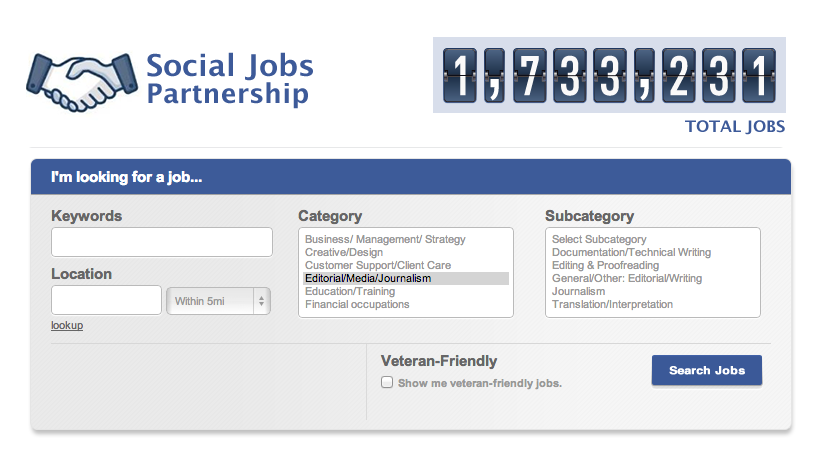
As part of the Social Jobs Partnership – an initiative backed by the U.S. Department of Labor, the National Association of Colleges and Employers (NACE), DirectEmployers Association, the National Association of State Workforce Agencies – the collaborative effort aims to direct job listings to where they can get the biggest limelight. The simply-titled Social Jobs app, which does not require you to give permissions or add any third-party software, allows you search for jobs in a variety of industries and outputs listings from the combined opportunities posted on Monster, Jobvite, and the like. You can also narrow your searches by zip code or check the veteran-friendly box to consolidate local, applicable opportunities. At launch, the app hosts more more than 1.7 million jobs with additions on the way.

“Facebook is all about connecting people and we’re thrilled to see developers leveraging our platform to connect job seekers and prospective employers,” said Marne Levine, Facebooks’ Vice President for Global Public Policy. “By allowing job seekers to view and share job openings based on personalized criteria, like location and industry, the Social Jobs Application builds on our broader effort to help people use social media to find jobs in the U.S.”

The condensed location of job searches on Facebook makes perfect sense, given how potential employers are likely already searching for you on Facebook when you apply for a position. Much like the purposes of LinkedIn, Facebook also provides a window for networking opportunities – if users feel compelled to combine their personal social network profile with their professional life. Of course, there are no promises that you’ll find a perfect fit using the app but it sure is nice to have a single bookmark to give the job market a quick sift.

There’s no word on whether the app aims to extend to international markets, but for the moment, Social Jobs is a good start to bring you some potential opportunities stateside.


Source : digitaltrends[dot]com

Nov 7, 2012

Social media election reactions that made us laugh, cry, and proud to be Americans

Best social media election day presidential election 2012

Social media played a huge role in garnering raw reactions from American citizens, and here's how you guys made us feel after an eventful 24 hours.

Decision 2012 is officially made and President Barack Obama will serve four more years as our nation’s leader. If you were like any of us here at Digital Trends, you were probably glued to Twitter, apps, and various news sources for the latest election updates. And like most current events as told by social media, there was a lot of information to sift through that made us laugh, cry, and even proud to be Americans — and for taking the opportunity to exercise our freedom of speech.

Laugh

Fools clinging to relevance

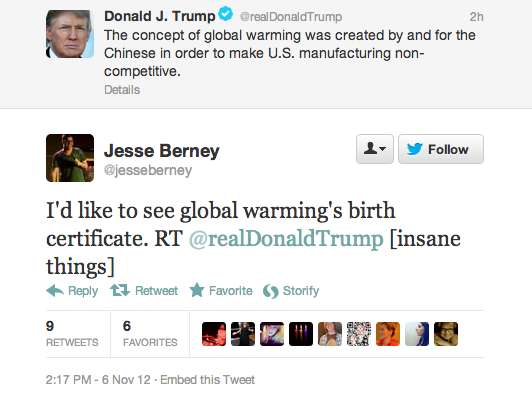
The amount of incoherent tweets from absent-minded people could not have made our office laugh any louder. The superstar troll this season, and maybe every political season, easily goes  to Donald Trump, who tweeted: “The concept of global warming was created by and for the Chinese in order to make U.S. manufacturing non-competitive.” Wait, is that supposed to be radical? Global warming isn’t a scientific issue, and Hurricane Sandy was just a random and devastating fart from the clouds?

Then, after Barack Obama was declared re-elected, good ol’ Don had the nerve to call the poll results BS and say America is not a democracy… even though the president won by a significant popular vote as well. Try harder, Mr. Trump.

Sarah Palin’s hair disaster

Via citylightsanddrunkhighfives

We swear this isn’t a way to be sexist because we’d absolutely point out if John McCain appeared on television with a horrible toupee, but our jaws dropped when Sarah Palin appeared on Fox News last night looking… well, different. During the 2008 campaigns, we remembered her as a relatively put-together woman with her hair neatly held back and a possible Bumpit hidden under that volumized poof. Last night, Palin proved that the recently released photo of her in big 80s hair, off-shoulder cropped top, and wedge heels while shopping at Kmart in Los Angeles isn’t just a phase. She’s officially lost it.

Arnold Schwarzenegger’s patriotism

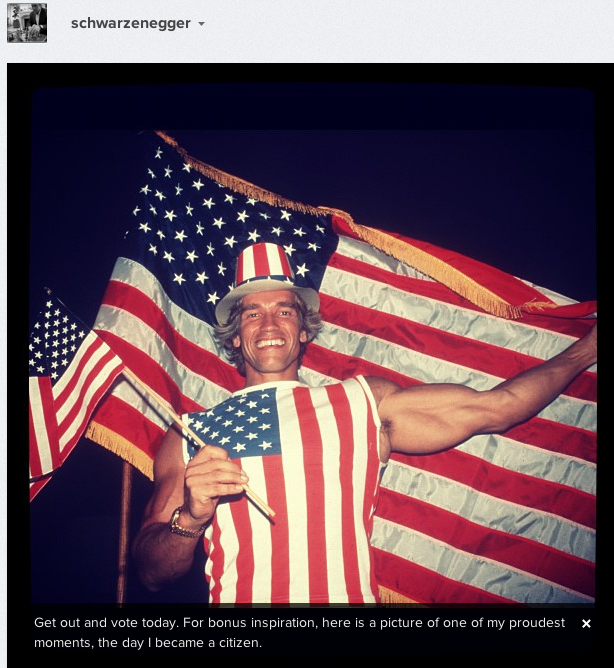
This was a hard call — does this gem belong under the Laugh or the Proud sections? We’re pretty happy for Arnold Schwarzenegger on his road to citizenship, but we don’t think we’ve ever seen anyone go this all out when they first received their United States passport. It’s adorable, sweet, personable, but let’s face it: It’s also hilarious. Were you inspired to go out and vote after this photo? And for the green card holders, are you aspiring for the same kind of celebration one day? Oh, sweet, sweet Arnold.

Proud 

Inventive ways to follow the elections

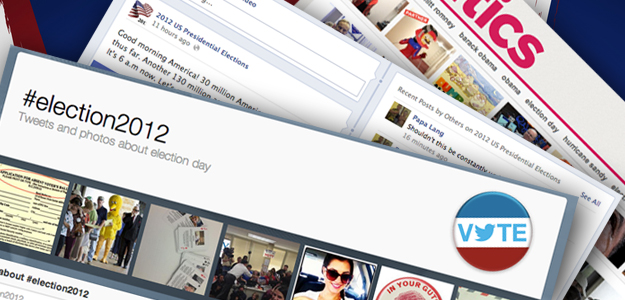
Back in the day (and by that we mean two elections ago) people used to sit around and actually watch television to keep up with state tallies and news analytics. These days, we have apps, widgets, even an HTML5-infused comic strip to help illustrate the journey of how we got to Election Day 2012. Following the elections has never been so interactive, creative, and dare we say, fun, to keep up with … in an effortless manner, no less. We are continually stunned by how app developers, Web designers, and graphic artists manage to find ways to make all this information digestible and approachable depending on your personal interests and styles.

Obama hits Reddit one last time

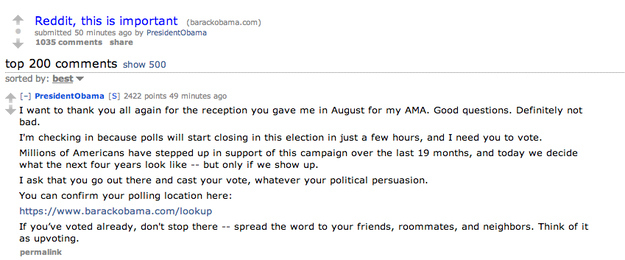
In the late afternoon of Election Day 2012, the POTUS decided that since he already had an account on Reddit, he might as well put it to good use to garner some last-minute Internet followers’ votes. “Think of it as upvoting,” he writes in a completely relevant and connected way to target his Reddit audience. He even referenced the viral Not Bad rage face. If there’s anything we learned this political season, it’s that the Web should also be considered a campaign stop, and probably the most cost-efficient one as well.

Amazing political discourse on Quora

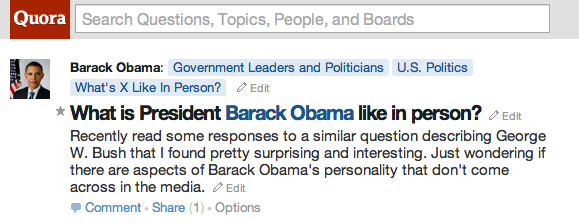
Quora is a great place to hit up when you’ve got questions you’re dying to find a logical, reasonable answer to, and the open-minded discussions on that site made us truly proud of our fellow American Netizens. Especially when the question was as simple as “What is President Barack Obama like in person?” It’s hard to envision any politician as a regular guy, but Peter Marquez, a former White House director for Space Policy (who’s also a republican), managed to do it in a completely unbiased manner. The discussion adds a sense of familiarity and a new personable level that reveals a different side to the president. Whether or not this had to do with your voting decision is another story, but we’re proud of the Internet nonetheless for using resources in a respectful and insightful way.

Social media trends soar

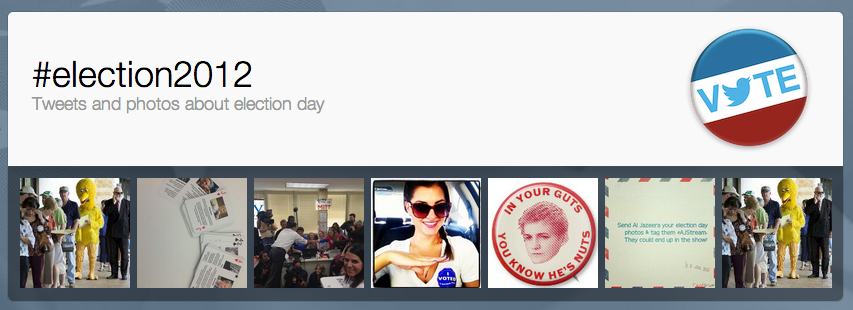
Twitter is one of the biggest go-to sources for real-time reactions to current events, from the Super Bowl to Hurricane Sandy updates. Decision 2012 was no different. Members of the social media world took to Twitter and Facebook to encourage friends to vote and make their voices heard, noting that you can’t complain about losing if you don’t vote. According to the latest Twitter update, about 31 million tweets were shared yesterday, hitting a peak of 327,452 Tweets per minute – right around when the president was declared re-elected.

Pepsi commercials and celebrity endorsements might be cool for most social issues, but Twitter takes the cake on spreading the word this election season (on top of the president himself on Reddit). It was also nice to see politicians offer congratulatory remarks to the president, and thanking voters for their support.

But of course, social media’s power did not come without hiccups, which brings us to our next segment…

Cry 

Instagramming your ballots

We get it, Instagram is everywhere. It’s in your local restaurant, bus stop, park, airport, and it’s an overall visual way to chronicle your life. But do explain to us what is so awesome about a piece of paper that shows you’ve voted? Are we going to start encouraging high school students to Instagram their SAT scores now? We know you mean well by proving your civic engagement, but we’re pretty sure no one would lie about taking part in democracy at a crucial time. Consider your voice heard, and keep those ballot photos to yourself. After all, it actually is illegal to photograph your voting booth in several states.

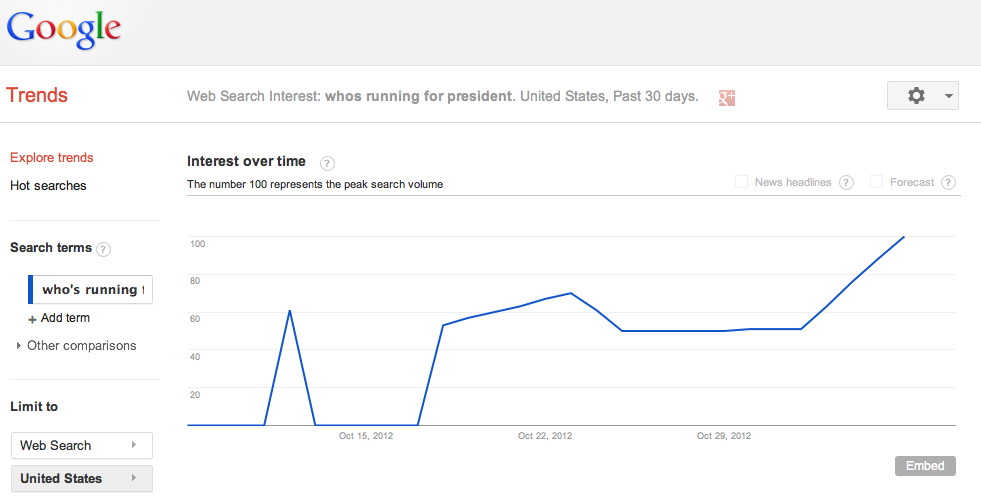
Google searches for “Who’s running for president” spike

Really, America? You waited until the last possible moment to figure out who the presidential nominees are this year or when election day is? It’s one thing to be undecided till the last minute, but completely clueless is unforgivable. This misguided, uninformed, careless inactiveness is everything that’s wrong with America. If you had to search on the day of the elections, we have to cry over the fact that people like you have the power to vote.

#VoteBlack and #VoteWhite hashtags remind us racism still exists

Let’s just get one thing straight in America: Barack Obama is not the first African American man to ever run for president. Turning this election into a race-based decision is as good as Donald Trump’s repeated taunts and challenges to bully Obama for his birth certificate and college transcript: Degrading, tasteless, and offensive. Worse, some of the offending tweets with the hashtag offered completely inappropriate remarks, showing just how vile people can be.

We had to blur out some horrible vernacular, but you can use your imagination as to what these words might have been. Thankfully, plenty of other tweets with the same hashtags shared our sense of disgust. Guess what, haters?


Technology is the clear loser in the elections

We obviously love, live, and breathe technology here at Digital Trends, but we have to admit: Real world instances of tech did not fare well during the elections whatsoever. A touchscreen voting machine in Pennsylvania seems to have spazzed out and auto-changed Obama votes to Romney. New Jersey’s email voting option backfired on residents because county email inboxes couldn’t handle the requests. Even if we can vote online, the opportunity opens e-voters to fraud and will make it that much harder to accurately tally the polls. Although we’re in this to help society advance, it seems the ol’ paper ballot is still the trustworthy method.


Source : digitaltrends[dot]com

Oct 26, 2012

Hackers break into South Carolina gov’t database, release 3.6 million SSNs

More than 3 million Social Security Numbers - as well as more than 300,000 credit card numbers and potentially a number of tax returns - have been breached as the result of hackers working their way into the South Carolina Department of Revenue's database.

Approximately 3,600,000 Social Security Numbers and an additional 387,000 credit- and debit-card numbers have been made public as a result of a cyber attack on the South Carolina state Department of Revenue, it has been announced, with roughly 16,000 of the credit card numbers revealed to be unencrypted.

According to a statement released by the Department of Revenue, the hacks – at least four separate attempts have been identified to date – occurred in September following an earlier attempt the previous month, with the data stolen on the latter two of the break-ins. The Department of Revenue only became aware of the hacks the following month, according to its director, James Etter: “On October 10, the S.C. Division of Information Technology informed the S.C. Department of Revenue of a potential cyber attack involving the personal information of taxpayers,” he is quoted as saying in the official statement. “We worked with them throughout that day to determine what may have happened and what steps to take to address the situation. We also immediately began consultations with state and federal law enforcement agencies and briefed the governor’s office.”

Following the initial consultation with law enforcement agencies, the Department called in an outside security company, Mandiant, to consult on the investigation. In the days following, it was discovered that the system had been breached four times in September, and once in August; by October 20, the vulnerable pathway had been identified and the system secured – but by that time, it was too late.

An Associated Press report suggests that Tax Returns are also amongst the data that was breached during the hacks, but that has not been confirmed by the South Carolina authorities at this time.

“The number of records breached requires an unprecedented, large-scale response by the Department of Revenue, the State of South Carolina and all our citizens,” Governor Nikki Haley said, when commenting on the situation. “We are taking immediate steps to protect the taxpayers of South Carolina, including providing one year of credit monitoring and identity protection to those affected.”

For those in South Carolina who are concerned that their Social Security Number or credit- or debit-card details have been released as part of this hack, there’re both a website – protectmyid.com/scdor – and a phone number (1-866-578-5422) to call to find out if they have been affected by the break-in. Those who have been affected will be able to receive one year of credit monitoring and identify theft protection from Experian as a result. “From the first moment we learned of this, our top priority has been to protect the taxpayers and the citizens of South Carolina, and every action we’ve taken has been consistent with that priority,” DOR director Etter said. “We have an obligation to protect the personal information entrusted to us, and we are redoubling our efforts to meet that obligation.”


Source : digitaltrends[dot]com

Oct 4, 2012

Oracle Unveils Oracle Social Relationship Management Suite at Oracle OpenWorld

New Service Enables Companies to Listen, Engage, Create, Market and Analyze Interactions across Multiple Social Platforms in Real-Time

During his keynote presentation, Oracle CEO Larry Ellison announced the Oracle Social Relationship Management (SRM) Suite.

Oracle Social Relationship Management Suite is an integrated enterprise service that enables companies to listen, engage, create, market, and analyze interactions across multiple social platforms in real-time providing a holistic view of the consumer.

Oracle Social Relationship Management Suite is integrated with Oracle’s enterprise applications, including Oracle Fusion Marketing, Oracle Fusion Sales Catalog, Oracle ATG Web Commerce, and Oracle Enterprise Resource Planning (ERP), allowing organizations to use social to transform their corporate business processes and systems.

Additionally, Oracle Social Relationship Management Suite is integrated with Oracle Platform Services, including Oracle Java Cloud Service and Oracle Database Cloud Service, enabling marketing teams to integrate social with their custom Web pages, landing pages and marketing tools.

Providing a holistic view of consumer interactions, Oracle Social Relationship Management Suite includes:

Oracle Social Network (OSN): Provides a secure collaboration platform that supports real-time collaboration and networking for users inside and outside the organization.

Oracle Social Marketing: Enables marketers to centrally create, publish, moderate, manage, measure and report across multiple social campaigns and platforms. It also helps marketers publish social content, engage fans and customize their brand’s look and feel.

Oracle Social Engagement & Monitoring Cloud Service: Enables organizations to analyze social media interactions while also empowering customer service and sales teams to effectively engage with customers and prospects. It gives organizations the tools they need to understand customers and take the appropriate actions by monitoring, listening, learning, and responding to signals and trends across the social web.

Oracle Social Sites: provides brands and agencies a powerful and rich editing experience that end users can leverage to dynamically develop and launch social sites.

Oracle Data and Insights. A service that caters to a growing enterprise need for externally information by providing information, directory and insights about common business entities.

“By fundamentally changing the way organizations connect with their different stakeholders, social is changing the rules of business,” said Thomas Kurian, executive vice president, Oracle Product Development. “With the Oracle Social Relationship Management Suite we are empowering our customers to embrace this change by integrating the tools required to listen, engage, create, market and analyze social interactions into existing applications and services.”

Tags: Oracle ATG Web Commerce, Oracle CEO Larry Ellison, Oracle Database Cloud Service, Oracle Enterprise Resource Planning (ERP), Oracle Fusion Marketing, Oracle Fusion Sales Catalog, Oracle Java Cloud Service, Oracle Platform Services, Oracle Social Relationship Management Suite

Source : techtalkafrica[dot]com

Sep 23, 2012

Sharing is not caring: How social networks ruin amazing secrets

social media sharing header oversharing

Social networks encourage spreading everything you encounter far and wide, but sharing can actually destroy the very things you want to promote.

With Twitter, Facebook and even LinkedIn “share” buttons plastered on every website, any online experience can become a social one with the click of a link. The ubiquity of social networks encourages the thinking that sharing is an unquestionably good thing, especially on the Internet when there’s no limited resource to deplete. The more people that know about something cool, the better, right?

Wrong. I’m here to tell you: People ruin everything. The next time you discover something secret and amazing, you should let it stay that way. Here’s why.

John Peel Archive

Earlier this month, something wonderful was discovered. Unfortunately, that discovery assured its destruction.

On September 10, the Liverpool-based culture blog Seven Streets wrote that an archive of 458 radio shows hosted by legendary DJ John Peel had “turned up on Soundcloud.” On September 12, The Verge picked up the story. By the time I attempted to access the Soundcloud archive eight hours later, it had disappeared. Soon after, “+dB,” the user account which had created this resource had disappeared as well. As Seven Streets wrote in an update to the original post, “Sadly, it looks like the Web police have struck as the channel is currently down.”

Sad indeed. A unique and invaluable cultural resource was destroyed by the publicity The Verge and other outlets brought it, and a passionate patron of the arts was hounded (further) into hiding.

This is far from an isolated case. Public attention destroys great things all the time, even in a digital world that’s supposed to foster sharing.

The Awful Forums

The private forums for the comedy website Something Awful make another ready example — only the Awful Forums didn’t need public news stories to be destroyed by the public.

Launched in 2001, the SA Forums were for years very close-knit communities of like-minded nerds. The success of The Forums could be attributed to two factors: a $9.95 sign-up fee (which kept less-determined users away), and curation by SA’s forum admins, who were never afraid to drop the banhammer to ensure the forums stayed the forums.

Unfortunately, the Awful Forums were irrevocably changed by explosive growth in 2004. It wasn’t just that there were massive amounts of new users. It was that most were joining for the wrong reason: to access the short-lived “BitTorrent Barnyard” — a family of subforums which hosted BitTorrent files when the legality of this activity was more of a grey area.

somethingawful forums social media overshareTens of thousands of new users flooded in to the forums. Most weren’t up to the standards of the previous guard, and many were ignorant of the codes of conduct for the community. When the Barnyard was shut down on January 1st, 2005, this unwanted influx of new user accounts was cited as the reason. As one forum user wrote in SomethingAwful’s own SAClopedia in late-November 2004,

Fight club will be no more on January 1, 2005. This is because [SA Founder Rich "Lowtax" Kyanka] is tired of the newbies, and he thinks that it’s just bringing retarded people to the forums (which it is.)

Unfortunately, this change may not have come soon enough. After dilution by hordes of new users that arrived during this period, the forums and would never be the same. The public had ruined them.

Apple

I’m sure veterans of sites like Reddit, 4chan, and Digg pine for “the good old days” in a way similar to senior Awful Forums users. Long-time Apple fans may soon join these groups. This will be due to the unfortunate side effects of Apple’s ascent to hardware dominance: increased vulnerability by viruses and other exploits, and decreased coolness implied by ownership of the Apple device.

OS X has long-enjoyed (and promoted) a reputation for being more secure than competing operating systems. Apple’s engineering skill is one reason for this advantage. A bigger reason may be that hackers target Apple devices less often because Apple’s market share is significantly smaller than that for Windows. As Apple’s market share grows, this may change — causing, I’m sure, great dissatisfaction for millions of Apple fans.

os x secure apple mountain lionFurther, in the months following iPhone’s and iPad’s release, the novelty of each was so great that mere ownership of the device made for a solid 10 minutes of conversation with any non-owner. Fast forward a few years, and Apple now sells 2 million iPhones in its first day of preorders.

Moving from exclusivity to ubiquity has made Apple billions, but it’s also made its devices less interesting to own and maybe even less secure. We may have been better off had the excellence of Apple experiences remained a secret.

Not a new problem

The harm that a crowd brings to anything noteworthy can extend outside the digital world, too. See the reason shows at many of Portland’s best house venues are now secret. See the effect that many fear Portlandia and The New York Times’ affections will have on our fair city (which, incidentally, is a terrible place to which you should never consider moving). In each case, greater knowledge by the public threatens the very existence of the thing being celebrated.

The scientists who study the world’s most-exceptional trees understand this. The locations of trees like the 379-foot Hyperion, the tallest known tree, and the Del Norte Titan, one of the most-massive, are closely-guarded secrets. So too is the exact location of Methuselah, one of the oldest.

They learned their lesson from the tragic story of Prometheus, a ~5,000-year-old tree which was chopped down by a graduate student in 1964. This and other conservation fails have taught ecologists a valuable lesson: even if 99 percent of people will behave themselves appropriately, there remains that one person in one hundred who will not. That person may even have great intentions, but those intentions don’t make their actions any less destructive. Hence, secrecy — something more of us should consider when dealing with things both wonderful and fragile.

Conclusion

I think we could all take a cue from ecology and learn that cool, secret things deserve to remain cool, secret things. Even on the Internet.

Some things will be destroyed immediately, simply due to greater knowledge of them. Some communities are great in large part due to their exclusivity, and thus should remain exclusive. Some products are cool because few have access to them, and some are secure for the same reason. Some things are so rare and so fragile that secrecy is the only way that they can continue to be.

Yes, people might think (for a moment, at least) you are cool for sharing some secret. Yes, you may get some page views for your “discovery” of an amazing thing. But, if you really care about the preservation of that secret thing you’d best shut up about it.

Welcome to the antisocial.

Source : digitaltrends[dot]com

Aug 21, 2012

Social chat client ooVoo unveils four-way mobile video chat

oovoo on android

As the market keeps experimenting with social video, ooVoo continues to build its social chat app.

Social video call application ooVoo continues to build, and today is announcing it’s now enabled four-way video mobile chats. The Web application, which boasts 54 million users, already offers 12-way video chat sessions, but the mobile version will now be able to handle up to four different users in one call, on one screen. The feature is available for Android and iOS, and is operable between users on different operating systems.

Video has become a hot social commodity – and for skeptics, a big question mark. Various startups are attempting to understand where social and video intersect; will its practical possibilities or its creative potential resonate most with users? There’s a ton of experimentation going on here.

OoVoo is clearly trying to exploit both. The application deeply integrates with Facebook but also uses a familiar Skype-like set up for launching and holding calls. In a demo and call with ooVoo execs Jay Samit and Larry Lieberman, they made it clear how important a priority social is to them. “It’s the marriage of communication and social,” Samit tells me. “Facebook is there so you can stay in touch with what your friends did; this is how you can show your friends what you’re actually doing and not miss those spontaneous moments.”

Despite this emphasis, there’s plenty below ooVoo’s surface that makes it a compelling service. During my hands on time with the service, video and audio feedback were spot on. That terribly distracting delay between video and audio that even the most popular chat and call apps are subject to was nowhere to be seen. This lack of reliability makes it rather impressive that ooVoo’s able to stream four videos to individual handsets at once. “How well our video calling works it a testament to our engineers’ hard work and witchcraft,” Leiberman tells me. OoVoo analyzes the various devices’ signals it’s working with, and will drop video for the weakest signal if need be, keeping audio running and keeping both operating for the devices with bandwidth that are able to handle it. “If you can’t handle video up and video down, we keep the audio going for you, and both going [for the other people on the call] so no one loses the experience,” says Leiberman. Competitor services, largely, just drop calls entirely once one of the participant’s bandwidth is unable to support it.

oovoo on desktopIn addition to enabling four-way video chat, the ooVoo update always always you to text during the call — so if you have a private message for one of the participants, you are able to contact them via SMS one-on-one.

“Mobile is taking place on social,” Samit tells me, emphasizing that more social elements is the number one requested feature from ooVoo’s users. This new push means ooVoo’s bent on exploring and exploiting that intersection.


Source : digitaltrends[dot]com

Aug 15, 2012

All give and no take: Why should we use check-in apps, again?

Why should we use check in apps

Social networks at least provide some utility for the privacy they take, but check-in apps like Foursquare and Saga get an intimate glimpse at your life without much in return.

A very dear friend of mine, who is not the most prolific of Facebook users, posted the following message on his feed over the weekend:

“I just unlocked the “Newbie” badge on @foursquare for checking in for the first time!”

He checked in at the local grocery store, and hasn’t checked in anywhere since.

The fact that he’s about two years late on the Foursquare fad notwithstanding, I’m only left to assume that after everyone on his feed found out that he was at the grocery store, he realized just how creepy check-in apps are. It’s certainly not because he’s worried about being caught in a compromising place. He’s the least likely person in my circle of friends to do that sort of thing, mainly because I know what his wife would do to him if he accidently checked in at Tassels Adult Entertainment Complex.

I recently tried the new Saga app myself. It tries to make life a game, like Foursquare does. It gives you experience points for going to cool, new places based on its suggestions. It knows when you go to these places because it’s constantly tracking you. But it sounded like an interesting idea for me because I don’t get out as much as I used to (thanks, three-year-old daughter), so when I do get out I would like to maximize the experience. I also do some travel writing on the side, so finding some cool new places around town is a professional responsibility.

It lasted about two minutes before I deleted it.

That’s how long it took me to realize that all of these apps are thinly veiled marketing schemes and might also be serving to undo the community that they bill themselves as creating.

Before you fit me for a tin-foil hat, let me defend myself as a rational person. I barely read Terms of Service before clicking the “Agree” button. I have all of my usernames and passwords saved in both my browser and my phone. In other words, I tend to think the best of both people and companies.

And I don’t have anything to hide, location-wise. If my wife had somehow gotten access to my Saga data, the only thing she would find out about me is that I go to Target, Best Buy, and Barnes & Noble entirely too much. She already knows how lame I am, so this won’t be news. It won’t divulge my mistress’ address, mainly because we always meet in public places like Target, Best Buy, and Barnes & Noble. Just kidding, honey.

The first thing I worried about was becoming a sheep to the app, blindly following it wherever it led me, even if I had already heard from various sources that a certain BBQ truck was substandard to the one I already frequent. Good marketing can manipulate even the strongest of minds.

In other words, with these apps some people can lose the freedom of choice.

foursquare mayor

The second aspect that troubles me applies more for Foursquare than Saga. As we know, the gamification of Foursquare assigns “Mayors” to various locales. I’m a very competitive person and I like to think of certain places as “my places,” even though rationally I know these places are visited by hundreds of other people per day.

For example, say there is a place I like to frequent for lunch at least once a week. I’ve been going to this place since college. In my will, it requests that my favorite wrap from this establishment be placed in my coffin with my decaying corpse. I check in on Foursquare and find out that there’s someone out there who goes to this place two or three times per week. They are obviously the Mayor.

I will immediately hate this person, even though he or she is probably a nice person and obviously has exquisite taste. In any other situation we could probably be good friends, which is theoretically the point of all social apps, including check-in apps. But Foursquare has pitted us against each other.

Usage statistics for Foursquare show that the app isn’t growing at the rate it was a year ago, but still shows a user base that numbers over 20 million. That’s 20 million people who run the risk of being blocked from their friends’ Facebook feeds, unfollowed on Twitter, and serving as a conduit for the marketing activities of corporations. As I’ve written before, Facebook and numerous other online entities serve the purpose of marketers, but I concluded that Facebook provides its users enough to make the exchange worth it.

I don’t know if having an outside chance at being the fake Mayor of the gas station across the street has the same value.


Source : digitaltrends[dot]com