Pages

Showing posts with label privacy. Show all posts

Oct 16, 2012

How Facebook will track your offline life with Datalogix

facebook datalogix partnerIn the eight years that Facebook has been providing users with a platform to share their personal data, the social network has time and time again been criticized for violating privacy in its quest to be an ad platform. Facebook’s recent partnership with Datalogix—a service that tracks whether people who view ads on the site end up buying the advertised products in stores—has again raised fears among users about how the social media giant is turning their personal data (both on-and-offline) into a revenue-generating strategy. To understand what exactly this means and how we got to this point, we have to go back to when it all began.

A short history of Facebook and its fight for revenue

Facebook launched in 2004, received its Series A shortly after, and was valued at $98 million dollars by the time it received its Series B in 2005. A year later Facebook opened up to the general public, closed its Series C with a valuation of $500 million, and then its Series D with a valuation of $15 billion—but the company was still far from profitability.

While Facebook’s worth continued to grow, investors began to question the company’s earnings capabilities. In 2008, after passing its 100 million user mark, Facebook began focusing on its monetization strategy and reached profitability in 2009 largely through advertising. Since then, however, while the company’s user-base and revenues have been increasing, the rate of advertising as a percentage of the company’s revenue has been steadily dropping.

As Facebook began focusing on monetization and leveraging the power of its personal information database, alarm bells began sounding for privacy advocates and concerned users who were starting to wonder what the company was doing with this data. Despite these privacy worries, Facebook continued its high user growth rate and passed 500 million users in 2010.
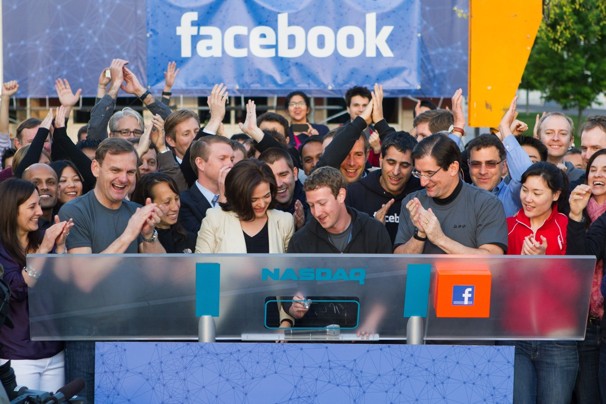
facebook ipo nasdaqThis past February, Facebook went through a highly-anticipated, controversial IPO—opening at $38 per share at a valuation of $100 billion and then dropping below $19 a share just a few weeks later. Investors began to worry and marketers questioned the effectiveness of advertising on Facebook—with big names like GM completely pulling their ad dollars and concluding Facebook ads were “ineffective.”

Facebook, which was competing with heavy weights like Google—the world’s largest display advertising network—for ad dollars, needed to find a way to prove the efficacy of its platform. It opened up its real-time bidding ad–exchange (FBX) in September, and this month, reported hitting the one billion-user mark.

Try as it might, Facebook can’t compete with Google

Last year, Facebook’s advertising revenue grew 69 percent from the year prior, to hit $3.1 billion. In contrast, competitor Google’s total advertising revenue grew nearly 30 percent to reach $36.5 billion. But while advertising rates on Facebook are increasing, click through rates (CTRs) aren’t keeping up.

The average CTR for banner ads in the US is .1 percent, but a Webtrends report found that Facebook’s 2010 CTR was only .051 percent while Google’s was .04 percent—almost 10 times as high. And while advertising rates of Facebook ads in the first quarter of 2012 rose by 40 percent, CTRs reportedly fell by eight percent. Not only that, but while the average CTR for Facebook ads decline by half just two days after being released, advertisers on Google reportedly drive 20 percent of conversions through the search engine’s display network.

And in terms of what the two companies offer in the way of targeting, Facebook is still far from catching up to Google. While Facebook offers targeting by education, workplace, Likes, location and demographics, Google lets you target based on topics and interests, contextual keywords, location, demographics, and also offers the ability for advertisers to extend their audience by retargeting.

To persuade marketers to spend an increasing share of their ad dollars on Facebook despite the not yet promising numbers, the social network needs to find different metrics to prove that their ads are equally or more effective at producing conversions. Unable to challenge Google in terms of display ads, Facebook has turned to new methods to try to prove that it can compete in terms of offline conversions.

When the times get tough… the tough get invasive

All of this is why Facebook is getting creative. To prove the value of its ads, the company turned to Datalogix to help it gather information around the offline activities of users to show that even if CTRs weren’t high, conversions were.

“As marketers look to build digital campaigns to connect with and influence consumers, many are asking how best to measure success and optimize the impact of their ad campaigns,” the Facebook blog post announcing the partnership explained. “Since the early days of digital advertising, online marketing has been focused on optimizing ad campaigns for the click. But while clicks are an effective way to measure campaigns designed to drive traffic and fulfill direct response goals, increasingly, research from firms like Nielsen suggest that clicks aren’t the right metric for the broader set of marketing objectives beyond direct response.”

But Facebook’s new partnership with Datalogix has consumers deservedly worried that for the first time, their private, offline purchasing data—from information on personal doctor’s prescriptions to data on dietary choices—can be combined with their activity online and then sold to advertisers. It’s a whole new level of invasiveness, and brands stand to profit far more than users even hypothetically could.

What is Datalogix and how will it work with Facebook?

Datalogix has purchasing data from a reported 70 million U.S. households covering a $1 trillion in consumer transactions; the data is largely drawn from loyalty cards and programs at more than 1,000 stores.  For each of these users, Datalogix creates a Datalogix ID number that is then matched to Facebook users, who by default are opted into the program. By matching personal data like contact information associated with both the loyalty cards and Facebook accounts, Datalogix can track whether people bought a product in a store after seeing an ad on Facebook.

logoDatalogix says users’ personal information is made anonymous and collected into different groups of people who saw or did not see an ad, arguing that since data was aggregated by group, it doesn’t pose any privacy violations. Once Facebook turns over data on which group was served a specific ad and which group wasn’t, Datalogix generates a report showing the contrast between the two groups in terms of who actually went out and made purchases of the advertised product or service. This data will help Facebook—and in turn, advertisers—understand how ads are performing.

To date, the two companies have measured 45 ad campaigns and reported that in 70 percent of cases, for every $1 spent on Facebook ads it earned an additional $3 in incremental sales.

Time to kiss your offline privacy goodbye

As you can imagine, this new partnership has caused many privacy advocates to speak up, noting an evolution of Facebook’s infringement on user privacy from collecting and owning user data on its own site, to indulging itself with information of users and non-users on pages outside of Facebook—so long as the site included a Facebook Like button. But with the new partnership, Facebook now has access to the offline data of its users. And unlike data users share on their social media profiles—data created with the intent to share and the knowledge that it might be passed along to third-parties—this offline data is private information that consumers probably don’t realize is being created in the first place, let alone being shared with third parties.

“The Datalogix/Facebook partnership isn’t surprising because data brokers are combining offline and online data much more often lately,” senior privacy strategist with Abine, Inc. Sarah Downey explains. “It’s a process called ‘data enhancement,’ where lots of companies who each know a little about you combine their information to get a much clearer and more detailed picture of who you are. They claim it’s only used for advertising, but the real, demonstrated harms of this data collection include identity theft, stalking, missed job opportunities, and lowered credit limits.

“The argument that data isn’t harmful because it’s aggregated or de-identified doesn’t always stand up. Plenty of so-called non-personally identifiable information has been tied to individuals and re-identified with ease. I’d hope that Facebook took extra precautions to prevent de-identification, but any data sharing runs the risk of being tied back to individuals,” Downey says.

grocery shoppingJeff Chester, executive director of the privacy group Center for Digital Democracy, echoes these concerns. “Individuals are being targeted through the Facebook Exchange. Facebook is working with many different data collection and targeting companies including Datalogix to track and market to individual Facebook users. This is not disclosed by Facebook and users have no control over this.”

Consumers who participate in loyalty programs don’t realize the data gathered about their purchasing history will be shared with third parties and those who are aware that their data might be sold, aren’t necessarily happy about it. An academic study titled Americans Reject Tailored Advertising and Three Activities that Enable It found that 86 percent of those surveyed did not want online advertisers to tailor ads based on their offline activities.

Facebook’s priority: Profit at all costs

Facebook isn’t the only company using offline data to target online viewers. Earlier this year, for example, Yahoo announced it was partnering with ad company CampaignGrid. Through the partnership, Yahoo could tap offline data to target millions of registered voters based on things like party affiliation, voting history, age, location, and more.

But Downey noted that Facebook is unlike any other company when it comes to the amount and depth of information it has about its users.

“The difference here is that Facebook isn’t just another company: It knows more about its one billion users than any other company in history.  It was just a matter of time before Facebook started doing data enhancement, given that they have a duty to shareholders to live up to their valuation, and proving that Facebook ads work in brick and mortar stores is an important part of demonstrating their value,” Downey says.

“This Datalogix partnership, combined with their ad network development (currently called Facebook Exchange), shows they’re aiming to track you everywhere you go, both online and off,” Downey adds. “What they’re doing is completely against consumers’ expectation and desires, but it follows Facebook’s historical trend of gradually eroding its members’ privacy. Facebook is the master of small changes that make the most of your personal information, even if you aren’t comfortable with them.”


Source : digitaltrends[dot]com

Sep 30, 2012

Terms & Conditions: Skype’s limits on ‘unlimited,’ blocked countries, forbidden uses and more

terms & conditions skype voip

Skype manages to keep its terms of use and privacy policy as slimmed down as possible -- but they're still beasts.

Check out the full Terms & Conditions archive.

When you think of online video calls, the first thing you probably think of is Skype. And now, thanks to being purchased by Microsoft, the service is in front of more eyes than ever. But because Skype’s business is international by nature — cheap calls to other countries are a main reason to use the service — its terms of service are a bit more complication than many other companies. Fortunately, Microsoft has given Skype’s terms and privacy policy a total revamp to make them easier for users to digest. But since we all know you’re probably not going to look at them anyway, let’s break down the most important bits.

Terms of Use

The Skype Terms of Use is a behemoth, so we’re going to keep this limited to only the most crucial aspects of the service.

Emergency calls

Right at the start of the terms, Skype explains that it does not provide access to most emergency services, like 911 here in the U.S. Because of this, the company makes very clear that Skype software is “not a replacement for your primary telephone service,” and that “it is your responsibility to purchase… traditional wireless (mobile) or fixed line telephone services that offer access to emergency services.”

The only counties where Skype users can access emergency services are the U.K. and Australia. Still, Skype warns that trying to make an emergency call through a computer is probably a bad idea, so do it some other way, if at all possible.

Careful what you say

Skype explains that, basically, you can say and do whatever you want over a Skype call. However, just for safety’s sake, the company technically forbids users from doing the following while using Skype:

  • Transmitting copyrighted content
  • Saying anything obscene, libellous, threatening, or otherwise criminal
  • No porn
  • No advertising
  • No spamming
  • No hurting children
  • No denial of service (DoS) or distributed denial of service (DDoS) attacks

If you do any of these things, and Skype finds out about it (through a user report, or it ending up on YouTube, etc.), your account will probably be blocked.

Pay up

Call rates: While calls made with Skype are often less expensive than those made using a mobile phone or a landline, it still costs money. Unless you pay for a Skype subscription, you will be charged a connection fee, as well as the per-minute rate for your call. (See those rates here.)

Skype Credits: To pay for Skype calls, you have to purchase Skype Credits. However, if you don’t use those credits for 180 days, they will go into “inactive” status. To reactivate your Credits, log in to your account, and click here.

Refunds: If you buy Skype Credits, you can get a refund for unused Credits within 15 days. After that, you can only get a refund if you’ve purchased a Skype subscription.

Wrong number

If the no emergency services access thing wasn’t enough to make you realize that Skype shouldn’t be your only phone, there’s also this: Your Skype phone number (either an Online Number or Skype to Go Number) are not yours. You may not transfer them to another phone — in fact, you’re forbidden from even trying to do that. So don’t.

Unlimited (kind of)

If you’ve purchased a Skype unlimited subscription, beware that your calls are not actually “unlimited” — after two hours of gabbing away, you’ll have to hang up and redial.

No Skype for you

A number of countries or Internet service providers (ISPs) have blocked VoIP services like Skype altogether. These countries include places like Ethiopia, a number of countries in the Middle East, some Mexican ISPs, and a number of Asian countries.

Fortunately, here in the U.S., we have the Federal Communications Commission’s Net neutrality rules, which prohibit ISPs from blocking VoIP. But if you live in a place without such rules, it’s your responsibility to find out whether Skype is legal or allowed. Annoyingly, Skype does not provide a definitive list of which countries and ISPs block VoIP services.

Privacy Policy

Skype has done a fine job of making its privacy police nice and clear. But like the terms of use, it’s a massive document that could be distilled down even further.

What Skype knows

The company says simply says that it “may gather and use information about you,” and has outlined quite a few examples. However, it says that it might collect more information about you than what it details here, which is just slightly disturbing. Still, I suggest you take a look at the full list. But here’s a brief rundown:

  • Identification info (name, address, email, telephone number)
  • Credit card info
  • All profile data (age, gender, country of residence, etc.) 
  • Content of instant messaging communications, voicemails, and videomails
  • Location data from your smartphone or mobile carrier
  • URLs that appear in your mood message
  • IP address
  • List of contacts

Why it needs to know

Skype explains that it only collects your data to provide its services to you, or improve its services. But that’s not the whole story here.

Skype’s business itself is not based primarily on advertising, which means that the company will never “sell, rent, trade or otherwise transfer any personal and/or traffic data or communications content.” However, because Skype is owned my Microsoft, you are effectively handing over that data to the Big M and its subsidiaries. This also means your non-personally identifying data (age, country of residence, etc.) might be used to serve up target ads through Microsoft Advertising and a list of other ad networks.

In short, if you use Skype, you are entering into the vast Microsoft business ecosystem, which reaches far and wide. To opt out of receiving targeted Microsoft Advertising, click here. To opt out of Skype-specific ads, click here.

Taking charge

If you want to edit or delete your personal information, you may do so through your Skype profile. Any IMs or voicemails through Skype will be deleted after a period of 30 to 90 days, unless a the government or court has properly requested that Skype retain the data, or Skype needs it to fulfill some aspect of its service.

Conclusion

Overall, Skype’s terms and privacy policy are fairly straight forward, especially considering its many functionalities and the vast geographical spread of its users. Considering the number of countries that have banned VoIP service, however, it would be helpful if Skype made it easy to find out which countries are on the list, especially for the many travelers that presumably use Skype to keep in touch while abroad.


Source : digitaltrends[dot]com

Sep 25, 2012

Outrage over Facebook’s private message scandal should send us running for our privacy settings

facebook reading

A supposed leak of old private messages turned out to just be resurfaced old Wall Posts - but the resulting outrage should be an indication you need to head to your privacy settings.

Yesterday a new Facebook privacy scare hit the Web when users began complaining that old private messages from 2009 were being publicly posted to their Timelines. Facebook quickly came back, defending itself and saying that these were Wall Posts from 2009, things that people had put on friends’ Walls in ’09 intentionally.

Here’s a sample of what most of the resurrected moments looked like (via BetaBeat):

betabeat example one

example two betabeat

There’s no definitive way to tell, but these seem to read like privately shared messages, although it’s worth mentioning that some users who’d seen this also went through their Messages inbox to see if they could find the reproduced notes and were not able to – meaning that these could have very well been publicly posted. Also, we all used to speak very differently — read, candidly — on Facebook. 

Facebook, for its part, says that they’ve checked the complaints and none of them have been private messages exposed. “A small number of users raised concerns after what they mistakenly believed to be private messages appeared on their Timeline,” a Facebook rep tells me. “Our engineers investigated these reports and found that the messages were older wall posts that had always been visible on the users’ profile pages.”

 “A lot of the confusion is because before 2008 there were no likes and no comments on wall posts. People went back and forth with wall posts instead of having a conversation [via comments].”

Remember those days? If you don’t, and you have Timeline, take a walk down memory lane and just look: Pre-2010, your Wall (as it was then known) is full of single statements that you assumedly responded to over on your friends’ respective profiles.

old facebook posts

There also weren’t as many privacy concerns, and to that end, privacy controls. It was a simpler time. The Timeline changed all that – and then some. I’ve said it before but it bears repeated: By putting the year toggle on the sidebar of your profile, it’s become incredibly, incredibly easy and quick to scan to all the dumb stuff you did when Facebook was college-kids only, before you parents and brands and employers and everyone was using the platform. Obviously, this only applies to a certain generation, but those of us in that bracket were raised online. Much of our young adult and adult lives are catalogued here, for better or worse, and the Timeline means everyone we give permissions to can go right ahead and see what we’ve done and said for themselves.

So if you haven’t already, you immediately should head over to your privacy settings and use the Limit Past Post feature. This takes everything you publicly posted or shared with friends of friends limited to your friends only. Of course this doesn’t take care of things people posted on your Wall – unfortunately that’s out of your hands, and can be just as damning.  

limit pasts posts feature

It’s clear that something went wrong here, though. Maybe those weren’t private messages that suddenly showed up on users’ Timelines, but it certainly doesn’t make sense to see content from three years ago suddenly front and center on your page. I reached out to Facebook for clarification but didn’t get an answer to this question.

Be it system glitch or user error, it’s a harsh reminder that the Internet is an elephant: It forgets nothing. 


Source : digitaltrends[dot]com

Sep 23, 2012

Terms & Conditions: Evernote puts you in charge

Terms & Conditions evernote privacy

Evernote uses its terms of service and privacy policy to put users in charge of their data and information security.

Check out the full Terms & Conditions archive.

Launched in 2008, Evernote started as a “productivity tool.” But it has since grown into something much more — a virtual extension of your brain. For those of you not yet in the know, Evernote allows you to store nearly anything you want to remember — photos, receipts, Web pages, recipes, voice recordings, you-name-it — and access those “memories” through a mobile app or on the Web. You can also share “notebooks” with whomever you like. It’s quite handy, especially if you live a busy, active life, with plenty of stuff you want to remember.

But using a service that literally mimics your memory means putting a lot of trust in Evernote not to misuse or abuse the vast amounts of inherently personal data users upload to its servers. And to do that properly, you’re going to need to understand Evernote’s sweeping terms of service and privacy policy. Let’s boil things down to the most important bits.

Terms of Service

Evernote has already done the job of summarizing its terms of service into three main bullet points, which is extremely helpful. These points are:

  • Your Data is Yours
  • Your Data is Protected
  • Your Data is Portable

To learn more about what exactly Evernote means about all this, you can read this extremely explicit, clear, and downright encouraging blog post from Evernote CEO Phil Libin.

While helpful, these points don’t quite tell the whole story. Here’s the rest of what you should know about Evernote’s ToS.

Intruder alert!

Evernote kicks off its ToS with a “Use of Service” section, a dense paragraph that basically says that if you discover any “unauthorized use” of your account, you have to tell Evernote about it. And if you don’t, the company is not responsible if someone steals or deletes your data.

Legal shmeagle

One curious portion of the “Use” section is that you must be “of legal age to form a binding contract” to use Evernote, which in the U.S. means you technically have to be 18-years-old to sign up. Google also has this provision in its terms, meaning anyone under 18 can’t use any Google products. In reality, of course, no company pays much attention to this rule. And Evernote later explains that you can use the service if you’re over 13-years-old. So don’t fret, teens. You may be breaking the law by using Evernote, but nobody cares.

Own it

Evernote has the fantastic policy that you own the rights to everything you upload to its service, and the company promises not to use your stuff to make money. Further, if you decided to ditch Evernote, you can take all of your data with you.

That said, you are on your own if you upload (and share) copyrighted content and get served with a lawsuit — Evernote will not help you in any way.

Contact at your own risk

If you contact Evernote with some ingenious way to improve the product, Evernote may (or may not) use the information you provide however it sees fit, be it for marketing material, or to tell the world about what dumb ideas you have. (Kidding!) It also automatically owns that idea. So if you come up with something brilliant, don’t just email it to the company willy nilly.

Avoid the following

Evernote lists a bunch of stuff you can’t do, but nothing that surprising. All of it simmers down to these forbidden activities. Don’t use Evernote to:

  • Make money
  • Scam people
  • Spam people
  • Abuse, stalk, or harass people
  • Share copyrighted content that you don’t own
  • Spread viruses
  • Do anything else that’s illegal
  • Spread naked pictures or porn (even homemade stuff) publicly, though you can upload whatever you want to your private notebooks

If you find anyone doing any of these activities listed above, you can rat them out to Evernote.

Nuts & bolts

Most of the second half of Evernote’s ToS include a bunch of basic explanations of things that don’t really need explaining. So let’s just sum up the potentially important bits:

  • Evernote uses some other third-party institutions to do business (like server providers, banks, etc), and your account information may be passed on for general business purposes.
  • Evernote may make changes to its services at anytime, so don’t freak out like a Facebook user if that happens.
  • Evernote may serve you ads sometimes. If you click them, any data you provide is between you and the advertiser.

Evernote might send you marketing material or other emails from time to time. If you want to opt-out of marketing emails, visit Evernote.com and click: Settings > Personal Settings > Contact Preferences, uncheck all the boxes, and click “Save Changes.”

Evernote marketing

Privacy policy

Privacy and security are of the utmost importance to Evernote, as is evidenced by their privacy policy and other corporate explanations of their practices. As such, there’s not much here you need to worry about, so I’ll keep this short and sweet.

Collect yo’self

Like all digital services, some personal information is collected by Evernote. But it’s really just the bare minimum to provide the service. Here’s what you can expect Evernote to know about you, either because you provided the information by signing up, or through cookies and tracking pixels:

  • Name
  • Email address
  • Billing information (if you pay for a premium account)
  • IP address
  • Demographic data (like occupation)
  • Location information
  • Device data (whether you’re using a mobile phone, Mac, PC, etc, to access Evernote)
  • What stuff you click on while visiting Evernote’s website
  • Whether or not you’ve opened an email from Evernote

Feeling used

Of course, the information above is collected for a reason. The company may use or share it in a number of ways, which include:

  • To contact you about offers (unless you opt-out)
  • To obey the law (e.g. if served a judicial subpoena for your data by a U.S. court)
  • To investigate possible illegal activity from your account
  • If you sign up for Evernote through the website of a third-party affiliate

Maximum security

Seeing as Evernote can be (and often is) used to store things like passwords, financial data, and credit card numbers, the company’s security practices are probably the most important part of the whole business. (After all, we wouldn’t use Evernote if we thought it be easy for our personal stuff to get into the hands of hackers.) Here’s what Evernote does to protect your info:

  • All passwords are encrypted, and are not directly stored on Evernote’s servers
  • All the stuff you upload is encrypted over SSL (the Internet’s standard)
  • Servers are physically protected, and only a select number of approved employees have access to those servers (a very important part of data security that many average Web users fail to take into consideration)
  • Your data is never observed by Evernote, or used for data mining, or to provide targeted advertising, which limits the possibility of a security breach
  • Evernote’s PC and Mac desktop clients allow you to further encrypt your extra-sensitive notebooks and protect them with a password that is never transmitted to Evernote (further limited the chance of a hacker snagging it)

Here’s a video about how that last bit works:

Conclusion

Overall, Evernote’s terms of service and privacy policy are straightforward, and provide little surprises. However, despite the helpful bullet points listed at the top, the terms of service is particularly long and dense. So I doubt many (read: any) users have actually read them. (I certainly wouldn’t if it weren’t my job.) As the company’s user base grows, however, I would love to see Evernote move in the direct of companies like Tumblr and Microsoft, both of which have made a serious effort to dumb-down their legalese for us non-attorney types.

I reached out to Evernote for comment on this story, but they were not able to get back to me straight away. I will update this space as soon as I hear back. 


Source : digitaltrends[dot]com

Sep 21, 2012

Ostrich Pillow is the strangest thing you can get a college student

Here's a super non-stealthy way to sneak a nap in your day: the Ostrich Pillow will provide an illusion of privacy as you catch up on rest.

It’s been about a month since college began, meaning midterm season is nearly approaching for our young students. This could spell all-nighters, cram sessions, and never seeing your roommate for the week until your exams are over. Lucky for you (or your scholarly loved ones) no one has to disturb you while you attempt to catch a beauty rest. Just slip on the Ostrich Pillow and it’s like no one is even there.

Ostrich Pillow airportCreated by design duo Kawamura-Ganjavian of Studio Banana Things, Ostrich Pillow is like a combination of a face mash, pillow, and hand rest. You wear the pillow over your face and pass out as you please, wherever you want: airport gates during flight delays, college libraries, your home office desk. If you want to lean over and face down, side pockets around your hand make for a cushy place to rest your hands. The Ostrich clearly shows when you want to not be disturbed, though the looks you will probably get from wearing it may say otherwise. Currently a project on Kickstarter, the pillow is machine-washable and will come in three color options. 

“Did you know that a power naps of around 20 minutes increases productivity by more than 30 percent?” the duo writes on the Kickstarter page. “Seeing as we all spend more and more time at work/in front of a computer screen or in transit, we thought why not create a device that helps you disconnect and dream for short periods of time. That’s how the Ostrich Pillow came to life.”

Ostrich Pillow close upWith a mouth hole specifically designed to help you breathe comfortably while you rest, we can only wonder how the pillow holds up on sweat and heat retention. The last thing we need is a terrible bedhead after attempting to sneak a nap in the middle of the work day. You’ll also have to take extra risks on not having eyes set on your belongings, since anyone can steal your possessions while you’re off in a remote world.

The Ostrich Pillow is a strange product, to say the least, but it’s got good intentions in mind and the pillow reminds us of a real-life take on Katamari Damacy characters meet space suit. You will need to fork up quite a bit at $75 a pillow plus shipping to support the project, and you’ll have until October 18 to do it. Is nap time and crazy design worth the extra cash? You be the judge. 


Source : digitaltrends[dot]com

Sep 12, 2012

Drones: 13 things you need to know from Congress’s new report

Congress drones report privacy spying technology

A new Congressional report lays out in vivid detail the danger drones could pose for personal privacy. Here's everything you need to know.

Starting in 2015, the skies above the United States will become infiltrated by a rare creature: drones. Also known as unmanned aerial vehicles (UAVs), drones are currently forbidden from flying in U.S. airspace above 400 feet, unless the Federal Aviation Administration (FAA) provides a license. But thanks to a bill passed by Congress early this year to make these licenses easier to get, drones will likely become a part of everyday life for Americans. 

While fun and futuristic, this coming reality unearths serious questions about privacy and personal liberty in the 21st century. A report published last week by the Congressional Research Service (CRS) shows that our laws are currently unprepared to deal with the privacy implications posed by the use of drones. The report (pdf) is an excellent read — at least if you’re a wonk like me. But if you don’t have time to peruse a 20-page CRS report, here are the 13 things you must know about the looming drone privacy apocalypse.

1. There will be 30,000 drones in the sky in less than 20 years

drone swarm

The FAA estimates (pdf) that within the next 15 years, more than 20,000 drones will take to the skies in the U.S., including drones operated by police, military, public health and safety agencies, corporations, and the public in general. That number is expected to jump to 30,000 within 20 years from today — a number the FAA refers to as “relatively small.” Currently, the FAA has only given out about 300 licenses to fly drones capable of cruising at more than 400 feet in the air.

2. Matters of privacy are all about “reasonableness”

reasonable

The Fourth Amendment to the U.S. Constitution guarantees our right against “unreasonable searches and seizures.” The key word here is “unreasonable” — and thanks to our rapidly changing technologies, its definition is in near-constant flux.

CRS researcher and legislative attorney Richard M. Thompson II, who authored the report on drones, explains in the report that “the reasonableness of drone surveillance [as considered by the courts] would likely be informed by location of the search, the sophistication of the technology used, and society’s conception of privacy in an age of rapid technological advancement.”

It’s this last part — “society’s conception of privacy” — that you should worry about on a daily basis, as it applies to the use of information gathered by everything from drones flying over our back yards to GPS capabilities in our smartphones to our Facebook profiles. Once society becomes generally “OK” with certain information becoming public, or becoming public in a certain way — once we think of these things as “reasonable — the Fourth Amendment protects us less. 

3. The Fourth Amendment: It depends what the definition of “search” is

surveillance-camera-shutterstock

As with what can be considered “reasonable,” the definition of what constitutes a “search” under the Fourth Amendment is a slippery beast. The Fourth Amendment provides for little wiggle room when it comes to activities performed in your home, behind closed doors and curtained windows. (No searches without a warrant there — most of the time, anyway.) But as soon as you leave the confines of your house, things start getting more complicated — and things get even worse when you consider surveillance that uses planes and helicopters. Throw drones in the mix and, well, the fine line across which surveillance by the state becomes “search” gets downright knotty.

Thompson’s CRS report explains that a court reviewing the use of drones under the Fourth Amendment will have to consider past cases that involved “privacy in the home, privacy in public spaces, location tracking, manned aerial surveillance, those involving the national border,” and instances when warrants aren’t needed to perform a “routine” search (like searching a car at a U.S. border), to determine the definition of a “search.”

4. Drones will have the ability to see through walls and ceilings

x-ray vision

Thanks to technology like the Xaver 800 from Camero, which uses electromagnetic radar to construct 3D images of hidden objects, law enforcement and military personnel can now “see” through walls. Combine this with laser radar and thermal imaging techniques, and our homes practically have glass walls, as far as the police are concerned. Thompson estimates that similar technology will eventually be outfitted on drones, allowing them to see through ceilings and walls. The question before the courts will be: Without a warrant, is that reasonable?

5. Drones could be outfitted with face recognition technology

face recognition

In addition to seeing through our walls, Thompson writes that law enforcement organizations “might seek to outfit drones with facial recognition or soft biometric recognition, which can recognize and track individuals based on attributes such as height, age, gender, and skin color.”

Considering that the FBI is currently undertaking a $1 billion project to build out its face recognition capabilities, this one seems all but inevitable. However, as Thompson explains, the sophisticated nature of such technology may determine whether the use of face recognition technology on drones “is lawful under the Fourth Amendment.”

6. Aerial searches in manned aircraft are not against the Fourth Amendment — but drone surveillance may be different

helicopter

While the Fourth Amendment provides strict protections for privacy inside the home, anywhere outside the home falls into other categories of protection. The first is “curtilage,” which is defined as the area surrounding a home (like a front or back yard). Areas outside of that are referred to as “open fields.” The Fourth Amendment protections apply differently for each of these categories; curtilage is often nearly as highly protected as inside the home, while open fields may not be protected at all.

That said, existing case law (precedent) determines that police may use airplanes and helicopters that fly within federal aviation guidelines to look in on citizens’ curtilage — even if it’s fenced in or otherwise hidden from public view — without a warrant. It is not yet clear whether drones would fall into the same category as planes and ‘copters, according to Thompson.

7. Long-term tracking is different from short-term tracking

Real_Time_GPS_Tracking_Device

In the recent Supreme Court case United States vs Jones, the Court ruled that the tracking of an individual using GPS for a long period of time (say, a month) constitutes a “search” under the Fourth Amendment due to how much information can be gathered about a person over an extended period, thus requiring a warrant to perform the tracking. But previous case law upheld law enforcement’s ability to track users outside their homes for a shorter period of time without the need for a warrant.

Now, because drones can stay in the sky for long periods of time — and, in the case of Lockheed Martin’s Stalker drone, possibly forever — they could be used to track people’s movements for extremely long periods of time. Because of this, the courts will have to decide whether the use of long-duration flight drones for surveillance purposes constitutes a search under the Fourth Amendment.

8. U.S. borders are a search free-for-all

US-border-drone

As you may have gathered, reasonable expectations of privacy have a lot to do with where a person is. But the one place you should have zero expectation of privacy is near a U.S. border. Border agents already have the ability to search things like your car, without a warrant, within 25 miles of a U.S. border.

Because of the looser restrictions near U.S. borders, the use of drones is, and will be, extremely prevalent. And since the surveillance using drones “may be considered more passive” than surveillance agents on the ground, or in planes and helicopters, by the courts, explains Thompson, drones “may be even less likely to run afoul of Fourth Amendment requirements.” (Emphasis mine.)

9. Technology sophistication matters

 thermal-imaging-camera

Under the Fourth Amendment, all technology is not created equal. The use of gadgets that anyone can get their hands on (like binoculars) for surveillance purposes are more permissible by the courts than technology that is extremely sophisticated (like radar that can see through walls).

With this in mind, the courts will likely have to decide what types of technology can be attached to drones for surveillance use. Is a low-powered camera allowed while a high-powered camera isn’t? Should drones be outfitted with face recognition systems? It’s not yet clear — and it’s something that the courts (or Congress) must establish.

10. The more common drones become, the less privacy protections you may have

privacy

As with the public definition of “reasonable” under the Fourth Amendment, the public’s expectations of privacy with regards to certain technology changes with time. The more a technology is used, the more acceptable (read: reasonable) it is. Thompson points out that as drones become increasingly commonplace, the more the public will accept the use of drones for surveillance purposes, potentially changing which types of surveillance practices are and are not protected under the Fourth Amendment.

11. Americans are worried about drones

drone camera

According to a study released in June by Monmouth University (pdf), 80 percent of Americans approve of using drones for search and rescue missions, while 67 percent believe drones should be used to “track down runaway criminals.” 

And yet, 42 percent of respondents said they would be “very concerned” about their own privacy if drones were used by law enforcement. Twenty two percent would be “somewhat concerned,” and 16 percent would be “just a little concerned.” A full 15 percent said they would not be concerned at all.

Oh, and only 23 percent said they would feel comfortable with using drones to catch speeding motorists.

12. There are ways to fight back against drone privacy invasion now

S 3287

The courts are not the only government body that can decide what is and is not allowed by drones. Congress can also take action, and it’s already begun to do that. Rep Austin Scott (R-GA) and Sen. Rand Paul (R-KY) recently introduced the Preserving Freedom from Unwarranted Surveillance Act of 2012 (H.R. 5925, S. 3287), which would require the federal government to gain a warrant based on probable cause before drones could be used for surveillance purposes. And Rep. Ted Poe’s (R-TX) Preserving American Privacy Act of 2012 (H.R. 6199) would also require law enforcement to obtain a warrant for drone surveillance, among other restrictions.

Thompson suggests that “Congress could also limit the admissibility of evidence in a criminal prosecution to situations where its acquisition was the purpose of the drone search.”

If you’re afraid of waiting to let the courts decide how drones can be used for surveillance — a decision that will come after the drones are already being used for that purpose — I suggest you look into vocally supporting some of these bills.

13. We’re just making this up as we go along

winging it

Valuable tidbits about the Fourth Amendment aside, the key takeaway from all this is that laws are nothing more than a man-made creation. In other words, they are made up. And as technology advances faster than our government can respond, those in charge of crafting the rules are forced to figure out all the implications on the fly — not just for drones, but for all emerging technologies. More important, our view of drone surveillance (or GPS tracking or Facebook data scraping) plays a major role in how the government will decide these issues for us. We would do well for ourselves to pay close attention.

Shutterstock images: camera via Sto; X-ray via jgl247; helicopter via Sofron;  gun/thermal imaging camera via Brent Wong; privacy via Thomas Skjaeveland; winging it via Yuri Arcurs


Source : digitaltrends[dot]com

Sep 1, 2012

Making Smartphone Spy Software Less Threatening

Smartphone spyware is here to stay, whether people like it or not. Even though there was, in fact, some kerfuffle over privacy issues, many still argue that many measures like it has some uses. To some, it’s a way to augment the abilities of phone service providers  to help users stay appraised of a situation – mothers can make sure their kids are okay, law enforcement officials and the like can track victims or suspects, and individuals can find their lost phones.

This isn’t to say that there isn’t a dark side to smartphone spy software use. Jealous or controlling romantic partners can leverage such programs that help them stalk their significant others. Bosses or employers can secretly use them in misguided attempts to manage workers more effectively. And no matter what the purpose of spying is, there is one other thing that makes this particular software type threatening – the fact that, no matter what, it STILL infringes privacy.

Given that there are some major pros and cons to spy app use, we need to establish some measures that will respect both the need to have the right information and one’s right to privacy. Here are some ideas:

Transparency policies on the part of the “spies”

This should be par for course, but it’s amazing how many agencies and individuals choose to not inform people that they’re being spied on. While it is true that telling a person about the monitoring software on their smartphones may seem like defeating the whole purpose of spying, we still have to consider the backlash one can get when the subject of surveillance finds out.

It’s especially important for individuals or private agencies to implement this – employers and parents should be upfront about the spy applications installed in smartphones. We should also all be clear on the purpose of the surveillance and the parameters involved.

Vigilance on the part of the smartphone owners

For those who are really uncomfortable with the idea of being spied on, the solution is to simply find ways to detect and avoid smartphone spyware. A Forbes article last month discusses how one can learn whether or not his phone has become a victim of spy software. Less technical approaches include observing the device’s behavior and battery life (if the phone behavior seems strange or you lose power quickly, you probably have it), as well as your data usage report. Once we have confirmed the spy app, we can perform a factory reset.

Even if we don’t find spy software, we still need to be vigilant – we need to make sure that our smartphones are with us at all times, we need to assign complex passwords to our phones, and we need to limit its network access if possible. Most importantly, we need to get anti-spy software from a REPUTABLE SOURCE.

Legislation concerning the capacity and use of spyware

As was mentioned before, there are people who use smartphone spy applications with malicious intent. As such, we need some very clear legislation with regard to what phone-based spy software should be allowed to do, and which entities can use them. Despite the fact that some places have made spy app use illegal, there is still the matter of its usefulness in the context of criminal surveillance and rescue operations. The only way to resolve this is to…

  • Require a license for high-level spy software use (only law enforcement and other sanctioned organizations can use software that listen in on calls, etc.)
  • Limit the abilities of commercially available spy software (private citizens will only be able to track the phone’s whereabouts, not the activity of the user)

To our knowledge, we currently only have blanket legislation governing spyware restrictions. But should these be implemented, more people can be less paranoid about being monitored by unsavory folk.


Source : techtalkafrica[dot]com

Aug 26, 2012

Terms & Conditions: Facebook’s ‘Data Use Policy’ explained

Facebook's privacy policy, known as the "Data Use Policy," explained in simple terms -- with some helpful links added in to let you better control your privacy.

Welcome to the first edition of Terms & Conditions, a weekly column where we break down the tangled mess of online sites’ and services’ terms of service, privacy policies, and other lawyerly mumbojumbo, into language anyone can understand. This week, we’re tackling a doosey: Facebook’s privacy policy, also known as the “Data Use Policy.”

Given its history of brushing aside users’ privacy concerns, Facebook has broken its Data Use Policy into multiple parts, in an apparent attempt to make it easier to understand. It has also excluded many of the enigmatic legal phrases often used in privacy policies. Still, at about 8,700 words, the document remains nearly impenetrable. Let’s simplify things a bit, shall we?

Part 1. Your privacy, information, and (vaguely) how it is used

What Facebook knows about you

This one is simple: Facebook can record and access all information you share on Facebook — all of it. (Though it cannot always share that information with advertisers or other third-parties — more on this later.) It can also access information other Facebook users share about you on Facebook. Lastly, it can access a variety of information from the websites you visit through its “Like” button — even if you’re not logged into Facebook at the time. In fact, you don’t even have to have a Facebook account at all for the social network to scoop up certain bits of data.

Here is a quick-as-possible list of the information Facebook is probably collecting on you:

  • Name
  • Age
  • Gender
  • Email address
  • Networks
  • Photos and videos
  • Tags and facial data (for Tag Suggestions)
  • Which profiles you look at
  • Who you chat with through Facebook Messenger
  • Relationship status
  • “Likes” (anytime you click the “Like” button on Facebook or a third-party website)
  • Lists of favorite things (movies, music, books, etc)
  • Political affiliation
  • Which websites you visit and when
  • Anything you purchase with Facebook Credits
  • Browser type
  • Operating system type
  • IP address
  • GPS location
  • User ID number
  • Username

Public vs. private

Your public data: Facebook allows you to make certain information private, or to make all of your information public. However, even if you adjust your privacy settings to make everything private, some information is public, no matter what you do. All public information can be seen by anyone, even if they do not have a Facebook account. And “anyone” includes other websites, games, and various Web applications. Always-public information – what Facebook refers to as your “basic info” — includes:

  • Name
  • Profile pictures 
  • Cover photos
  • Gender
  • Username
  • User ID
  • Comments made on public websites that use Facebook’s commenting plug-in
  • Comments made on public websites through Facebook’s commenting plug-in about you by other people

Aside from those details, the rest of the information you choose to share with Facebook can be made private to a greater or lesser degree. Facebook also does a fairly good job of explaining how information you share publicly may be used. From the Data Use Policy:

Choosing to make your information public also means that this information:

  • can be associated with you (i.e., your name, profile pictures, cover photos, timeline, User ID, username, etc.) even off Facebook;
  • can show up when someone does a search on Facebook or on a public search engine;
  • will be accessible to the Facebook-integrated games, applications, and websites you and your friends use; and
  • will be accessible to anyone who uses our APIs such as our Graph API.

Your private data: Facebook allows you to make most of the information you share private. What “private” means is up to you. You can either share with all your friends, or use the “customize” sharing option accessible on each status update box, which lets you share the status update or photo with certain people, but not others. To learn how to check or update your privacy settings, click here.

“How Facebook uses your data” (or something like that)

Facebook is, by all measures, an advertising company — that is how it makes money. The way it sells advertising is by collecting all of the aforementioned information about its users, then using that data to sell target ads — ads that you are more likely to click on than ads made for just anyone.

As part of its Data Use Policy, Facebook outlines the situations for which it reserves the right to use your information, and some examples of how that information may be used. Notice I said “outline” — not “explains,” “details,” or any other word that means Facebook actually tells you anything worthwhile here. Also, notice that I said “some examples” — Facebook does not tell us all of the ways it may use your data. Just some cute examples.

This is easily one of the most important parts of Facebook’s Data Use Policy — it has “data use” right in the name! It is also easily the most confusing, worthless part of the whole bloody document.

So, what does Facebook use your information for? This: “We use the information we receive about you in connection with the services and features we provide to you and other users like your friends, our partners, the advertisers that purchase ads on the site, and the developers that build the games, applications, and websites you use.”

What “in connection with” means here remains disturbingly vague. Facebook rattles off a few examples, but does not enumerate each and every way it may use your information.

It does, however, say that all of the information you provide to Facebook — i.e. everything you do on Facebook, or anything one of your friends do on Facebook that links with your data — is available to the company. Facebook also reserves the right to use your data, as long as it has either:

  • received your permission
  • told you it would do so (through the Data Use Policy) 
  • or removed any personally identifiable information, such as your name

In short, Facebook reserves the right to use your information however it sees fit, as long as it is “in connection with the services and features” it provides. What “services” or “features” mean, well, take a guess.

Bottom line: This section is extremely vague, and should make you wary about having a Facebook account at all.

Deactivate vs. Delete

Facebook allows for two levels of cutting ties with the social network: deactivation, which simply puts your account on pause; and deletion, which completely removes all of your data from Facebook and its servers.

Deactivate: If you simply deactivate your account, you will still appear in your friends’ “friends list,” which means that information can still be accessed by Facebook or any third-party website, game, or application that gain access to your friends’ contact lists. You can also easily reactivate your account at any time.

To deactivate your account, click here.

Delete: Deleting your account is permanent, and cannot be undone once you do so. MOST of you data will be deleted from Facebook’s servers — but the process takes up to 90 days to complete. (Why it takes so long, Facebook doesn’t say.) But beware: Even if you delete your account, certain information — like all of you conversations with other Facebook users, or group posts — will remain on the site, as they are not exclusively associated with your account. So keep that in mind.

To permanently delete your account, click here.

Part 2. Sharing

Facebook like button

This is one area where things get tricky. As mentioned above, you have the ability to choose how (most of) your information is shared. Problem is, your friends also have that ability — and some of the information they share includes data about you.

For example, even if you have your privacy settings marked to the tightest possible option, others can still see comments you leave on status updates, photos, links, or videos that they share; the person who posted it controls who sees the update and all related comments.

Also, even if you hide your friends list, you will appear on your friends’ lists, which may be publicly available.

In short, any content that is about you, but controlled by someone else, is out of your hands — so keep that in mind.

Facebook allows you to control the privacy setting for each status update. Here are the instructions Facebook gives, which explain how this works:

Whenever you post content (like a status update, photo or check-in), you can select a specific audience, or even customize your audience. To do this,

  • simply click on the sharing icon and choose who can see it. Choose this icon if you want to make something Public. Choosing to make something public is exactly what it sounds like. It means that anyone, including people off of Facebook, will be able to see or access it.
  •  Choose this icon if you want to share with your Facebook Friends.
  •  Choose this icon if you want to Customize your audience. You can also use this to hide your story from specific people.
If you tag someone, that person and their friends can see your story no matter what audience you selected. The same is true when you approve a tag someone else adds to your story.

Facebook also notes here that you should “always think before you post, especially because “information you share on Facebook can be copied or re-shared by anyone who can see it.” Sage advice indeed.

Contact infoFacebook lets you find people by searching an email address or phone number that has been associated with that user’s Facebook account. However, you can change your privacy settings so that only your current friends can find you this way (or friends of friends, or anyone who has that information). To change this, click on “How you connect” here, and choose your setting on the first option in the pop-up window.

Facebook also allows people to find you through their contact importer, which imports people you have connected with through, say, Gmail.

Mobile accessNot surprisingly, information you reveal to Facebook may be accessible through your friends’ mobile devices (either in an app, or through Facebook’s mobile website). This information can — as you should know by now — be re-shared by your friends through their mobile devices.

Friends sharing with you

Links and tags: Surprise! Your Facebook friends can share links with you. One way this is done is by “tagging” the link they share with your name. You can either choose to review each link a friend tags you in, automatically approve every link, or it up so that certain people can tag you automatically, while other’s have to have your approval first. To set this, choose the “Timeline and tagging” option in your privacy settings, and select your preference.

Tagging in either a message or a comment thread only allows those with permission to view that information can see the tag.

Groups: You have the choice whether or not to join a Facebook Group. Once you have, however, anyone in that group can invite you to subgroups. Your name will appear as “invited” to the subgroup until you opt in or out.

Pages: Just assume that everything you do that’s associated with a Facebook Page — which are public, and are often used by business and publications — is public. “Liking” a Page is a public endorsement of it, and your Facebook friends may see that you’ve “Liked” a particular page in their News Feed. Comments on Pages are also public — so be careful what you say on a Page.

Activity log: Facebook lets you see some of the activity associated with your Facebook account, such as websites or products you have “Liked,” or links you’ve shared. To view this, click on your “Activity Log,” which appears just below your cover image on your Timeline. From that page, you can “unlike” or delete each action.

Part 3. Websites and third-party apps

Facebook Platform: This is a service offered by Facebook that allows websites, games, and other third-party applications to access your Facebook information.

Apps and your info: A big way your personal Facebook information is spread around the Web is through apps — both those that you personally use, as well as those that your friends use.

Before you install an app, you must approve it. Each app requests to access (and store on its own servers) parts of your Facebook data. Some apps want little access; some want a lot. But remember: Apps can often access your information simply because a friend of yours approved the app. Facebook gives you the ability to restrict the types of data your friends’ apps may access — but you have to un-check each category of info individually under the “Apps, Games and Websites” part of your privacy settings. To do so, edit your settings under the “How people bring your info to apps they use” subsection.

Logging in with Facebook: When you choose to log in to a third-party website with your Facebook credentials, Facebook provides that website with your Facebook User ID, but does not give that site your email address. Some sites may automatically connect you with your Facebook account if you use the same email address to log in to both.

Social plug-ins: Facebook describes social plug-ins as a “little piece of Facebook” embedded on other websites. The most prevalent social plug-in is the “Like” button and the “Share” button. Anytime you visit a website with any Facebook social plug-in (i.e. most websites) while still logged into Facebook, Facebook receives information about your visit to that site (your name, browser, IP address, date and time of your visit, etc.) Some of this information is shared with Facebook even if you are not logged in, or don’t have a Facebook account.

Facebook gets this info by installing cookies on your computer (more on this below). These cookies are used to show you ads on and off of Facebook. Facebook says it does not use the information to make a “profile” on you or your browsing habits — but it may be used without your personally identifying details, or as part of a group of data “to improve ads generally and information we receive to study, develop or test new and existing products or services.” That data is kept for 90 days.

Instant personalization: Facebook has partnered with a number of websites, like Rotten Tomatoes, to provide “instant personalization.” This means that, if you’re logged into Facebook, one of these partner websites can access your “public information,” as well as your User ID and friends list. This gives you the ability to comment on the site, and see how your Facebook friends have used the site.

The sites Facebook have partnered with are:

  • Bing – Social Search
  • Pandora – Personalized Music
  • TripAdvisor – Social Travel
  • Yelp – Friends’ Local Reviews
  • Rotten Tomatoes – Friends’ Movie Reviews
  • Clicker – Personalized TV Recommendations
  • Scribd – Social Reading
  • Docs – Document Collaboration
  • Zynga – Social Games (The Ville, Zynga Slingo and 7 other games)
  • Kixeye – Social Games (War Commander and Battle Pirates)
  • EA – Social Games (SimCity Social)

To turn off instant personalization, click “edit settings” under the “Instant personalization” subsection in the Apps, Games and Websites portion of the privacy settings. (You may have to close a video about instant personalization before you can actually access the privacy setting.) Once you’ve closed the obnoxious pop-up video, uncheck the box at the bottom of the screen.

Note: If you have already visited an instant personalization-enabled site with the feature allowed, then that site (and Facebook) may still have your data from those visits stored.

Search engines: You can choose whether to have your Facebook profile show up in search engines, like Google. This option is enabled automatically. To turn it off, click here, and un-check the “enable public search” box at the bottom,

>> Next page: Advertising, Facebook tracking, and odds & ends


Source : digitaltrends[dot]com

Aug 15, 2012

All give and no take: Why should we use check-in apps, again?

Why should we use check in apps

Social networks at least provide some utility for the privacy they take, but check-in apps like Foursquare and Saga get an intimate glimpse at your life without much in return.

A very dear friend of mine, who is not the most prolific of Facebook users, posted the following message on his feed over the weekend:

“I just unlocked the “Newbie” badge on @foursquare for checking in for the first time!”

He checked in at the local grocery store, and hasn’t checked in anywhere since.

The fact that he’s about two years late on the Foursquare fad notwithstanding, I’m only left to assume that after everyone on his feed found out that he was at the grocery store, he realized just how creepy check-in apps are. It’s certainly not because he’s worried about being caught in a compromising place. He’s the least likely person in my circle of friends to do that sort of thing, mainly because I know what his wife would do to him if he accidently checked in at Tassels Adult Entertainment Complex.

I recently tried the new Saga app myself. It tries to make life a game, like Foursquare does. It gives you experience points for going to cool, new places based on its suggestions. It knows when you go to these places because it’s constantly tracking you. But it sounded like an interesting idea for me because I don’t get out as much as I used to (thanks, three-year-old daughter), so when I do get out I would like to maximize the experience. I also do some travel writing on the side, so finding some cool new places around town is a professional responsibility.

It lasted about two minutes before I deleted it.

That’s how long it took me to realize that all of these apps are thinly veiled marketing schemes and might also be serving to undo the community that they bill themselves as creating.

Before you fit me for a tin-foil hat, let me defend myself as a rational person. I barely read Terms of Service before clicking the “Agree” button. I have all of my usernames and passwords saved in both my browser and my phone. In other words, I tend to think the best of both people and companies.

And I don’t have anything to hide, location-wise. If my wife had somehow gotten access to my Saga data, the only thing she would find out about me is that I go to Target, Best Buy, and Barnes & Noble entirely too much. She already knows how lame I am, so this won’t be news. It won’t divulge my mistress’ address, mainly because we always meet in public places like Target, Best Buy, and Barnes & Noble. Just kidding, honey.

The first thing I worried about was becoming a sheep to the app, blindly following it wherever it led me, even if I had already heard from various sources that a certain BBQ truck was substandard to the one I already frequent. Good marketing can manipulate even the strongest of minds.

In other words, with these apps some people can lose the freedom of choice.

foursquare mayor

The second aspect that troubles me applies more for Foursquare than Saga. As we know, the gamification of Foursquare assigns “Mayors” to various locales. I’m a very competitive person and I like to think of certain places as “my places,” even though rationally I know these places are visited by hundreds of other people per day.

For example, say there is a place I like to frequent for lunch at least once a week. I’ve been going to this place since college. In my will, it requests that my favorite wrap from this establishment be placed in my coffin with my decaying corpse. I check in on Foursquare and find out that there’s someone out there who goes to this place two or three times per week. They are obviously the Mayor.

I will immediately hate this person, even though he or she is probably a nice person and obviously has exquisite taste. In any other situation we could probably be good friends, which is theoretically the point of all social apps, including check-in apps. But Foursquare has pitted us against each other.

Usage statistics for Foursquare show that the app isn’t growing at the rate it was a year ago, but still shows a user base that numbers over 20 million. That’s 20 million people who run the risk of being blocked from their friends’ Facebook feeds, unfollowed on Twitter, and serving as a conduit for the marketing activities of corporations. As I’ve written before, Facebook and numerous other online entities serve the purpose of marketers, but I concluded that Facebook provides its users enough to make the exchange worth it.

I don’t know if having an outside chance at being the fake Mayor of the gas station across the street has the same value.


Source : digitaltrends[dot]com