Pages

Showing posts with label share. Show all posts

Nov 14, 2012

Facebook rolls out the share button to mobile users

Designed to encourage mobile users to share more types of content with their friends, Facebook is rolling out a new share button for the mobile interface.

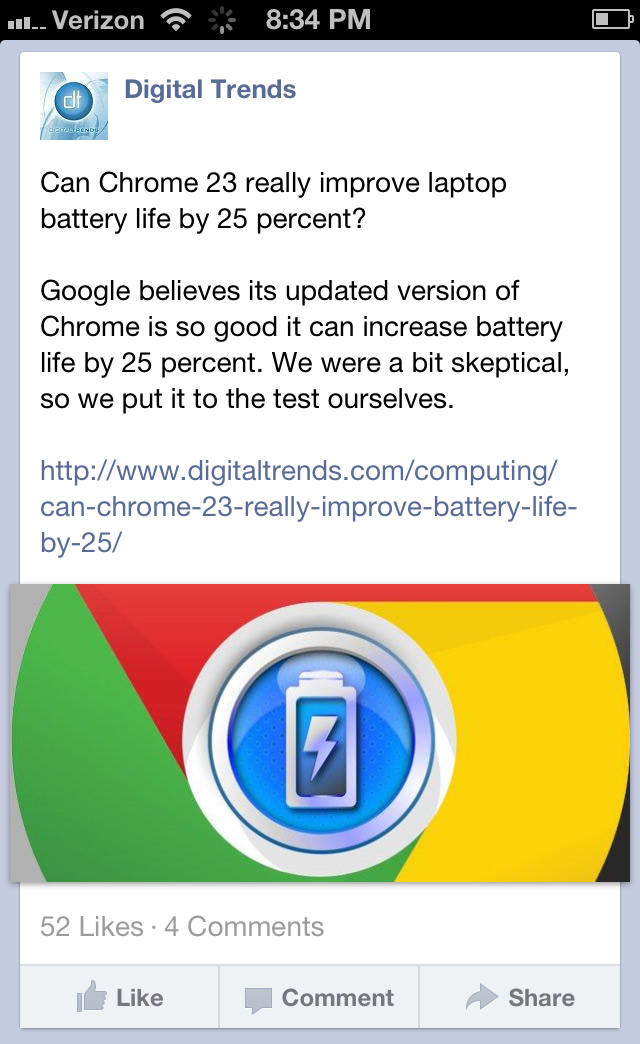
Detailed by Techcrunch earlier today, Facebook has launched a share button on the mobile version of the social network and is planning to add sharing capabilities to both the iOS and Android applications at a later date. While the ability to share a particular article, video or picture is commonplace on the Web version of Facebook, mobile users can simply tap on the new share link in order to pass along an interesting piece of content to their friends. When a user brings up the mobile version of the social network, they will notice a new Share button to the right of the Like and Comment buttons. 

Tapping the new share button brings up an interface that allows the user to write a comment that goes along with the shared content. In addition, the user can isolate the post to a specific subset of their friends through groups or post it publicly in order to reach all subscribers.

Once the user is satisfied with the post, they confirm the sharing action by tapping the Share button in the top right corner of the screen. Alternatively, cancelling the post returns the user to the news feed. The new share button is only appearing within the News feed at this point. When visiting a personal page of a friend or a brand, the share button hasn’t been incorporated within the design yet.

The launch of the new sharing feature marks a trend in Facebook’s strategic approach to mobile. While the inclusion of the sharing button isn’t a technical achievement by any means, the priority of improving Facebook’s mobile interface is evident. According to Facebook’s third quarter results, the social network has approximately 600 million active mobile users each month. In addition, about 120 million of those active users check Facebook exclusively through a mobile device. The addition of the share button on the mobile version of the site could result in a spike in the amount of articles, videos and pictures that are shared each day. 

With the addition of the share button for mobile users, this brings Facebook more in line with social network competitor Twitter. On the web version of Twitter, users are encouraged to retweet posts and share them with friends. It will be interesting to see if mobile users on Facebook transition from the Like action to the Share action. Potentially,  it could significantly increase the amount of shared content people find in their News feeds each day and possibly drown out other status updates from friends and family.

However, it could be extremely helpful to brands and advertisers since the share action is more valuable when attempting to spread a particular piece of content. In a related story noted by The Next Web, Facebook is also rolling out a new feed that allows a user to view posts from brands and other pages into a completely separate feed. While posts from those pages will still appear within the News feed, users can visit this page in order to view recent updates only from liked pages.


Source : digitaltrends[dot]com

Oct 26, 2012

Samsung tops the global smartphone market, as HTC, Nokia and RIM fall further behind

Samsung Logo Door Offices

Research published by market analysts IDC has put Samsung way out in front of its rivals in the global smartphone market share charts, where Nokia has disappeared from the top five for the first time, and HTC has dropped several spots too.

Market analyst company IDC has released the latest version of its Mobile Phone Tracker information chart, showing where it places the world’s major phone manufacturers regarding smartphone market share and sales. Samsung is the star of the show, a fact reflected in its own quarterly results, while Nokia, HTC and Research in Motion all show signs of suffering at both its, and Apple’s hands.

Samsung has retained its position at the top of the charts, with a 31.3-percent market share, up from 22.7-percent last year. It’s estimated to have shipped 56 million smartphones between July and September, a huge improvement over the already impressive 28 million from the same period last year.

The Korean company has also announced its financial report for the same period, posting $7.4 billion in profits, beating its previous record for the fourth consecutive time. A Reuters piece on the subject puts its smartphone shipments at 58 million, slightly higher than IDC’s figure, and says that between 18 and 20 million of that amount were Galaxy S3 handsets.

HTC drops behind RIM and ZTE

Apple comes second in IDC’s ranking, with 15-percent of the smartphone market, up from 13.8-percent this time last year, and we all know how it has been performing recently. Research in Motion is gamely holding on to third position with a market share of 4.3-percent, down from 9.6-percent last year, but ZTE is a mere 0.1-percent behind — making a position change likely in IDC’s next report.

Finally, the top five is rounded out by HTC. This time last year, it had a 10.3-percent market share, and was ahead of both RIM and ZTE, but now, with a dismal 4-percent, it trails both of them. It’s shown to have sold 7.3 million smartphones this quarter, highlighting the gulf that has opened up between it, Apple and particularly Samsung.

To try to drum up some business in Europe, HTC has today launched Best Deals, a variation on the popular daily deal system, where HTC owners can enter their own deal preferences and, based on location, the app will return relevant offers. There are 12 providers signed up to Best Deals, including iVoucher, Daily Deal, Qype and LivingSocial, but perhaps crucially, not Groupon. The Best Deals app looks to be part of HTC Sense, is compatible with the One X, One S, One X+, the 8X and 8S, and will be available in the UK, Italy, Germany, France and Spain in November.

Nokia leaves the top five for the first time

Finally, we come to Nokia, a company absent from IDC’s top five smartphone companies for the first time since it first began keeping records in 2004. It does still appear in the overall list of general phone manufacturers though, and in second position. It has shipped a massive 82 million phones during the third quarter, down from the 106 million it shipped during the same period last year, and it retains an 18.7-percent market share.

Samsung again tops this list, with a 23-percent market share and a grand total of 105.4 million phones leaving its warehouse.

There’s no sign of the global smartphone market slowing down either, as the 179 million smartphones sold this summer is 45.3-percent more than this time last year.


Source : digitaltrends[dot]com

Oct 3, 2012

Chinese manufacturer Hisense plays price limbo with its K26 HDTV

Hisense shows how low it can go with the hyper-affordable 42-inch K26 HDTV.

Hisense may be poised to stake out a market share here in the states, as its K26 television has made its way onto Costco’s website at an extremely low price, with other affordable models currently available at Costco, Walmart and HHGregg brick-and-mortar locations. Hisense hopes to challenge manufacturers like Vizio – which released its new Razor LED line yesterday- for buyers on a stricter budget.

Hisense’s 42-inch K26 television offers a 1080p Full HD picture, LED backlighting, and three HDMI inputs. The issue we’re having at this point is that any available literature is devoid of audio specs. Saying that the sound is “clear” and “crisp,” is as specific as Hisense gets. We won’t hold our breath, though, as on-board TV sound is almost universally terrible these days. 

On the plus side, Hisense is in the process of manufacturing its own Google TV set-top box, the Pulse, which is expected to retail for under $100. Since the K26 will not function as a Smart TV, the set-top box will be key for users that may want beefed up connectivity and app functionality in the future.

Whether Hisene has produced a viable, low-cost HDTV, or simply a low-quality low-cost HDTV, remains to be seen. But the price point is certainly intriguing. The K26 is currently available online at http://www.costco.com at the ultra-low price of $370.


Source : digitaltrends[dot]com

Sep 25, 2012

Redbox Instant to take on Netflix with pre-Christmas launch

redbox-instant

Redbox Instant could challenge Netflix for market share come Christmas.

With Netflix struggling, competing companies are beginning to smell blood in the water – and Coinstar Inc is one of the sharks hoping to capitalize. In partnership with Verizon, the company is eyeing a Christmas season release for its Redbox Instant, a streaming service that hopes to vie for some of the 24 million customers currently using Netflix. Bloomberg, among other outlets, is reporting that the service will be more focused on movies than TV shows, a move that may be an admission that Netflix has a hold on the small screen market.

The current model is in the process of internal alpha-testing, with plans for an abridged public test sometime late this fall. Ultimately, the goal is to have the service available for the Christmas season, but as of yet, we’ve been given no details on pricing.

Announced earlier this year, Redbox Instant plans to offer users rental credits for its Redbox kiosks as a supplement to its streaming service. In addition – a la Netflix – the service will debut with an associated app, allowing users to download titles onto their smartphones and gaming consoles.

The obvious game-changer here, is that the service provides a quicker way for users to obtain non-streaming titles, than does Netflix. Rather than waiting around for a DVD in the mail, Redbox Instant users will be able to rent certain non-streaming titles, simply by heading to the closest Redbox and redeeming their credits.

Going forward, Redbox Instant will hope to distinguish itself from its competitors, not just in terms of content delivery, but also through its business model. Bloomberg is reporting that – instead of paying its content providers at a flat, fixed rate (like Neflix does) – the company will instead marry their payment rate to the rate of their subscribership. The fewer subscribers the service has, the less it will pay for its content; the more it accrues, the more it will pay out to its providers.

For the interim, it appears that Redbox Instant’s business model is creating enthusiasm among investors. Bloomberg has also reported that Coinstar’s stock rose 1.3 percent this friday and is up just under two percent on the year.

For now, we’ll have to see whether Redbox instant is a contender or pretender. You can bet, however, that Netflix will be watching a little more closely than most.


Source : digitaltrends[dot]com

Sep 24, 2012

Apple Maps link redirect to Google Maps when you share them

Apple Maps in iOS 6 lets you drop a pin and share the location over email, SMS or social networks. The recipient can click on these links and open the point described in the URL. It seems for now, though, Apple is choosing to let people open these links in Google Maps.

This comes as no surprise considering the Apple Maps are only available on iOS 6 devices so it’s better to let people open the link in what is arguably the best and most popular mapping service in the world. If you do have an iOS 6 device, then it would open within the Apple Maps application.

There does seem to be an issue on iOS 6 devices at the moment, where certain apps tend to open the link within Google Maps in the browser whereas others open it correctly within the Maps application. This probably has more to do with those applications and an update should fix the issue.


Source : blog[dot]gsmarena[dot]com

Sep 23, 2012

Sharing is not caring: How social networks ruin amazing secrets

social media sharing header oversharing

Social networks encourage spreading everything you encounter far and wide, but sharing can actually destroy the very things you want to promote.

With Twitter, Facebook and even LinkedIn “share” buttons plastered on every website, any online experience can become a social one with the click of a link. The ubiquity of social networks encourages the thinking that sharing is an unquestionably good thing, especially on the Internet when there’s no limited resource to deplete. The more people that know about something cool, the better, right?

Wrong. I’m here to tell you: People ruin everything. The next time you discover something secret and amazing, you should let it stay that way. Here’s why.

John Peel Archive

Earlier this month, something wonderful was discovered. Unfortunately, that discovery assured its destruction.

On September 10, the Liverpool-based culture blog Seven Streets wrote that an archive of 458 radio shows hosted by legendary DJ John Peel had “turned up on Soundcloud.” On September 12, The Verge picked up the story. By the time I attempted to access the Soundcloud archive eight hours later, it had disappeared. Soon after, “+dB,” the user account which had created this resource had disappeared as well. As Seven Streets wrote in an update to the original post, “Sadly, it looks like the Web police have struck as the channel is currently down.”

Sad indeed. A unique and invaluable cultural resource was destroyed by the publicity The Verge and other outlets brought it, and a passionate patron of the arts was hounded (further) into hiding.

This is far from an isolated case. Public attention destroys great things all the time, even in a digital world that’s supposed to foster sharing.

The Awful Forums

The private forums for the comedy website Something Awful make another ready example — only the Awful Forums didn’t need public news stories to be destroyed by the public.

Launched in 2001, the SA Forums were for years very close-knit communities of like-minded nerds. The success of The Forums could be attributed to two factors: a $9.95 sign-up fee (which kept less-determined users away), and curation by SA’s forum admins, who were never afraid to drop the banhammer to ensure the forums stayed the forums.

Unfortunately, the Awful Forums were irrevocably changed by explosive growth in 2004. It wasn’t just that there were massive amounts of new users. It was that most were joining for the wrong reason: to access the short-lived “BitTorrent Barnyard” — a family of subforums which hosted BitTorrent files when the legality of this activity was more of a grey area.

somethingawful forums social media overshareTens of thousands of new users flooded in to the forums. Most weren’t up to the standards of the previous guard, and many were ignorant of the codes of conduct for the community. When the Barnyard was shut down on January 1st, 2005, this unwanted influx of new user accounts was cited as the reason. As one forum user wrote in SomethingAwful’s own SAClopedia in late-November 2004,

Fight club will be no more on January 1, 2005. This is because [SA Founder Rich "Lowtax" Kyanka] is tired of the newbies, and he thinks that it’s just bringing retarded people to the forums (which it is.)

Unfortunately, this change may not have come soon enough. After dilution by hordes of new users that arrived during this period, the forums and would never be the same. The public had ruined them.

Apple

I’m sure veterans of sites like Reddit, 4chan, and Digg pine for “the good old days” in a way similar to senior Awful Forums users. Long-time Apple fans may soon join these groups. This will be due to the unfortunate side effects of Apple’s ascent to hardware dominance: increased vulnerability by viruses and other exploits, and decreased coolness implied by ownership of the Apple device.

OS X has long-enjoyed (and promoted) a reputation for being more secure than competing operating systems. Apple’s engineering skill is one reason for this advantage. A bigger reason may be that hackers target Apple devices less often because Apple’s market share is significantly smaller than that for Windows. As Apple’s market share grows, this may change — causing, I’m sure, great dissatisfaction for millions of Apple fans.

os x secure apple mountain lionFurther, in the months following iPhone’s and iPad’s release, the novelty of each was so great that mere ownership of the device made for a solid 10 minutes of conversation with any non-owner. Fast forward a few years, and Apple now sells 2 million iPhones in its first day of preorders.

Moving from exclusivity to ubiquity has made Apple billions, but it’s also made its devices less interesting to own and maybe even less secure. We may have been better off had the excellence of Apple experiences remained a secret.

Not a new problem

The harm that a crowd brings to anything noteworthy can extend outside the digital world, too. See the reason shows at many of Portland’s best house venues are now secret. See the effect that many fear Portlandia and The New York Times’ affections will have on our fair city (which, incidentally, is a terrible place to which you should never consider moving). In each case, greater knowledge by the public threatens the very existence of the thing being celebrated.

The scientists who study the world’s most-exceptional trees understand this. The locations of trees like the 379-foot Hyperion, the tallest known tree, and the Del Norte Titan, one of the most-massive, are closely-guarded secrets. So too is the exact location of Methuselah, one of the oldest.

They learned their lesson from the tragic story of Prometheus, a ~5,000-year-old tree which was chopped down by a graduate student in 1964. This and other conservation fails have taught ecologists a valuable lesson: even if 99 percent of people will behave themselves appropriately, there remains that one person in one hundred who will not. That person may even have great intentions, but those intentions don’t make their actions any less destructive. Hence, secrecy — something more of us should consider when dealing with things both wonderful and fragile.

Conclusion

I think we could all take a cue from ecology and learn that cool, secret things deserve to remain cool, secret things. Even on the Internet.

Some things will be destroyed immediately, simply due to greater knowledge of them. Some communities are great in large part due to their exclusivity, and thus should remain exclusive. Some products are cool because few have access to them, and some are secure for the same reason. Some things are so rare and so fragile that secrecy is the only way that they can continue to be.

Yes, people might think (for a moment, at least) you are cool for sharing some secret. Yes, you may get some page views for your “discovery” of an amazing thing. But, if you really care about the preservation of that secret thing you’d best shut up about it.

Welcome to the antisocial.


Source : digitaltrends[dot]com

Sep 22, 2012

Want to install custom ROMs? Don’t buy Exynos phones.

Users may find the performance of Samsung’s Exynos processors exhilarating, but it seems the developers who work on custom ROMs for these devices don’t share the same enthusiasm.

Responding to a query on xda-developers forum, CyanogenMod developer who goes by the forum ID ‘codeworkx’ explained why he and other developers think that Exynos processors are bad for developers. It essentially boils down to lack of proper support from Samsung in terms of providing sources or documentation for their processors and when they do it’s either outdated or incompatible.

In comparison, he found Qualcomm and TI to be far better. He even gave an example where he compared two of Samsung’s phones, the I9100 Galaxy S II and the I9100G Galaxy S II, essentially the same phones but running on different SoCs, the former on Samsung’s Exynos and the latter on TI OMAP. The I9100 is still struggling with an unstable and poorly performing Jelly Bean ROM whereas the I9100G has a fully functional Jelly Bean ROM.

In the end, his advice is to avoid buying Exynos phones, that is, if you care about installing custom ROMs on your device.


Source : blog[dot]gsmarena[dot]com

Sep 1, 2012

Apple introduces Content Dispute system for the App Store

The App Store is not without its share of copycat apps. Often you will see developers trying to rip-off a successful app or game by having a similar name, icon or UI and try to benefit from someone else’s success.

For a long time, developers of popular apps could do little but watch copies of their app or game appear on the store. But now Apple has come up with a new Content Dispute system that might just put an end to this situation.

With the help of this new system, developers who feel their intellectual property has been infringed can now file a complaint with Apple by filling out a form. After that, Apple will put the developer in contact with the offending party and see if they can reach an agreement. If that doesn’t work, the developer can contact Apple’s legal team for further action.

This should hopefully reduce the number of copycat apps on the Store that confuse unknowing users and will also deter other developers from trying to create such apps that free ride on someone else’s success.


Source : blog[dot]gsmarena[dot]com

Aug 21, 2012

AT&T FaceTime restrictions may be at odds with FCC net neutrality rules

AT&T iPhone owners who want FaceTime will need to upgrade to a Mobile Share plan, but this new policy may be against the FCC's new net neutrality rules.

AT&T already announced that it would be rolling out shared data plans for their new mobile customers, but it looks like the separation between subscribers won’t just be how their data is distributed–application use may have limits as well.

We reported last month that AT&T may be planning on limiting access to FaceTime for iPhone owners based on their data service. Unfortunately for AT&T, it looks as though this may be in violation of FCC rules on net neutrality.

What we know about the limits

As of last week, AT&T made it known that using FaceTime over its 3G and 4G mobile network — a feature that will become available with iOS 6 in the fall — will be available only for shared data plan users. Users who are gripping tight to their tiered and unlimited plans will only be able to use the video chat app while connect to a Wi-Fi network. As wireless carriers are known to do, this limit in functionality is likely a push to get users to sign up for the new shared plans.

What we know about the law

According to Public Knowledge’s senior staff lawyer John Bergmayer (via NY Times), this attempt to prohibit use of a particular application puts AT&T in violation of the FCC’s rules on net neutrality. He refers to the Open Internet Rules, specifically one that states that mobile providers cannot “block applications that compete with the provider’s voice or telephony services.” The fact that the FCC used the term “telephony” aside, this raises a legitimate question as to the legality of AT&T’s app block. Mr. Bergmayer stated that there is “no technical reason why one data plan should be able to access FaceTime, and another not.”

While the FCC is currently not making a comment on this case, there is some precedent already set on the issue that may give us an indication as to how this will play out. Back in July, the FCC ruled that Verizon couldn’t block tethering applications in the Google Play store. Verizon tried to institute that blockage because apps made available a service that Verizon was charging for. Because of the FCC’s ruling, tethering apps are now available for Verizon customers.

What it means for other service providers

If AT&T is allowed to put up a firewall to prevent certain users from accessing an individual application, a somewhat startling statement will be made. Does this mean that other applications will see a similar block, like Skype on Windows Phones or other third party applications on any given service? It conjures up a somewhat frightening scenario in which app access becomes a tiered system. Only top data subscribers get access to top apps. If AT&T puts limits up on a game like Angry Birds, there could be riots in the street, but what about less popular texting apps or products like Google Voice, which directly conflict with AT&T’s services?

At the moment, this FaceTime debate only concerns AT&T users. Sprint has stated that it has no intention of charging extra for FaceTime access. Verizon has also not made any indication that it will put similar limits on iOS 6′s flagship video chat program. If nothing else, this may just give AT&T iPhone owners a reason to leave for another carrier. Then again, iPhone users have lived with Wi-Fi only FaceTime for this long. Maybe they don’t really need to video chat on 3G or 4G.


Source : digitaltrends[dot]com