Pages

Showing posts with label white. Show all posts

Nov 14, 2012

Turns out, the White House’s online petition tool is sort of unmonitored

Government jobs are hard, and people don't always have time to deal with your online silliness. Such is the case with this White House petition to legalize weed.

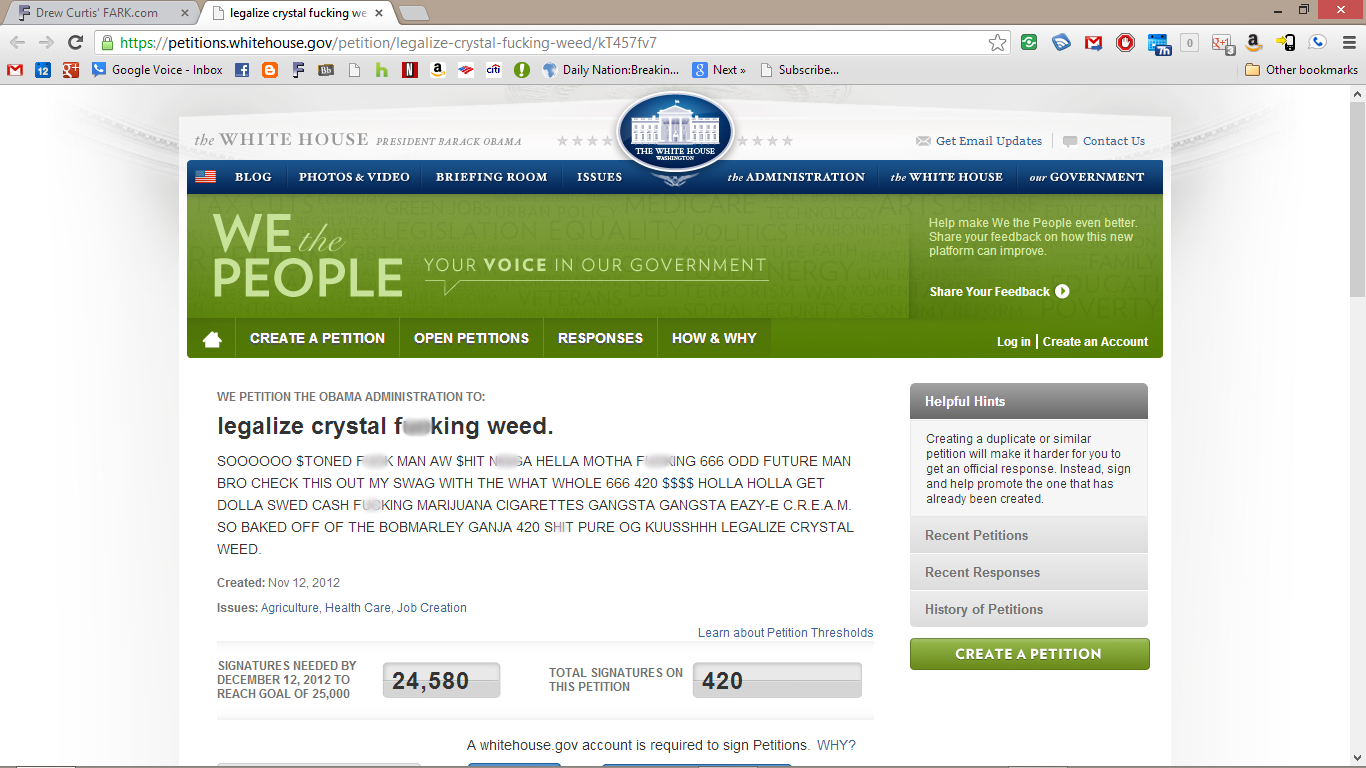
Freedom of speech is a powerful thing in the United States of America. Without it, you wouldn’t be able to protest, campaign, or get away with this gem that a community member on 4chan dug up. Thanks to this petition to “legalize crystal fucking weed,” we now know people who work in the White House are just like most of us: They’re very busy and do not have time to screen your online shinnanegans. 

Turns out, it’s not very hard to create a petition on Mr. President’s very own website. There’s a whole section of Whitehouse.gov that lets we the people announce what we would like to see the Decider In Chief do some deciding upon, and if the required signature threshold is achieved (25,000), according to the site, ” … it will be reviewed and the administration will issue a response.” So, somebody did their due diligence – save for, you know, any copy editing for grammar, structure, or coherence – and let their voice be heard about a sincere desire to … um … legalize some “crystal fucking weed.” Whatever that is. 

You would think the White House would have a systematic spell check to track cuss words at the very least, but this petition managed to stay online long enough to garner at least – wait for it – 420 votes before someone on Obama’s website staff got wise.

As of 9:38 a.m ET the petition has been removed, with the site claiming it was a violation of the terms of participation. Which is a shame, because we were just 20,000 or so votes shy of finding out what POTUS had to say on this crucial topic. After all, the petition is tagged under “Job Creations.” At least readers in Washington and Colorado can get nice and blazed while discussing it amongst themselves. 

[Image via]


Source : digitaltrends[dot]com

Nov 7, 2012

What Obama’s second term means for technology

Obama's second term for tech presidential election

Obama has four more years in the White House, but what will his policies mean for the future of the tech we use every day?

A couple of years ago, President Obama was having dinner with Silicon Valley movers and shakers, including an ailing Steve Jobs. Although no recording of the dinner has been made available, legend has it that the President asked Jobs what it would take for Apple’s manufacturing jobs to come back to America.

“Those jobs aren’t coming back,” replied Jobs.

Whether that is true or not, during the campaign both President Obama and Governor Romney focused a lot of their energies on plans to bring that kind of manufacturing back to American shores. Now that the president has won a second term, what does that mean for American technology and manufacturing?

Mr. Obama’s plan was built on education and training, investing in clean energy, and giving tax incentives to companies that bring jobs back to America.

Jobs’ grim reply was based on the fact that American workers are no longer trained for the needs of high-tech manufacturing. Obama believes that making college more accessible, both at the university and community college level, is part of the solution for closing that skills gap.

A major focus during Obama’s first term was keeping tuition rates down, doubling funding for Pell Grants, and trying to get community colleges to work together with local employers to better train outgoing students for jobs that already exist locally. There’s every reason to believe that push will continue.

Another creative idea from the campaign trail was the creation of “manufacturing innovation institutes,” where businesses and research institutions work together to make sure that American research and development produces corresponding high-tech manufacturing jobs. How the federal government can spur that idea remains to be seen, but it could be a key step in reshaping the American manufacturing sector and making sure the next Apple keeps its assembly lines here at home.

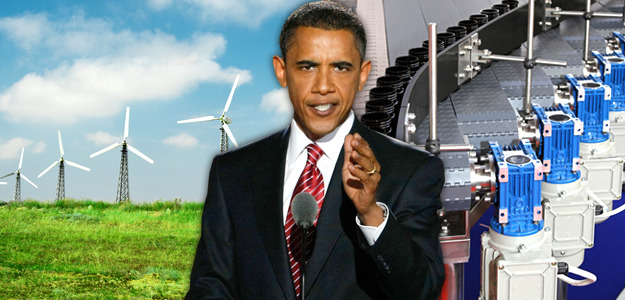
During the campaign, Obama predictably hit Governor Romney on the Republican Party’s close ties with the oil industry. In his first term, the president advocated an “all of the above” energy policy. He’s willing to explore any source, including oil, which can help America reach a majority of energy independence by 2035. It is now expected that investment in alternative energy technologies will only continue in the next four years.

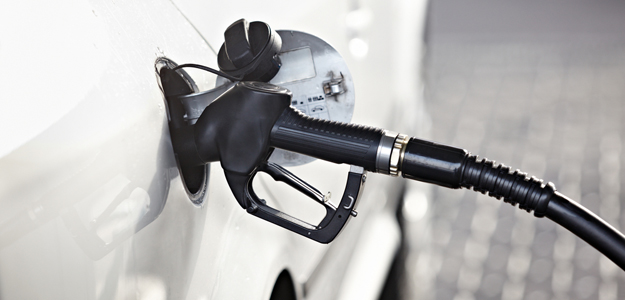
Gas pump car fuel efficiency obama technologyDuring his first term, President Obama pushed ahead with plans to double fuel economy standards for cars and light trucks by 2025, which is spurring the auto industry’s investments in hybrid and electric vehicles and has led to an American manufacturing boom of sorts in battery technology. Since these rules are now under no threat of repeal, cars and light trucks are expected to sip less and less gas in the next four years. Horsepower may be a different story.

One of the places where we heard repeats of 2008’s campaign pledges was in the area of corporate tax structure. The president promised to end tax breaks for companies that participate in outsourcing during his first term and promised to do the same in his second term (which you can assume to mean that the first effort didn’t go so well).

He also wants to provide tax incentives for companies to bring jobs back to the US. Considering Apple currently enjoys a 1.9 percent tax rate on its foreign earnings, I’m not sure how much of an incentive the US government can provide. Perhaps they will mandate that all federal employees will have to buy an iPad Mini. At least all of our forest rangers will have something to do while they’re stuck in those fire towers.

Any conversation about tax policy centers on Congress. In the coming days, it will be interesting to see if our Republican House makes any overtures of bipartisanship to the president now that they know they are stuck with him for another four years. If history is any indication, don’t hold your breath. There’s probably better chance of an impeachment investigation than bipartisan tax reform.

Whatever the case, many pundits believe that the president will be bolder in his second term, enacting whatever policies he can without congressional approval if Congress proves to be as intransigent as they have been in the past. A lot of the policies mentioned above came to pass through that same kind of executive maneuvering. Because of that, the next four years of America’s technology and education policy might be just as much decided in courtrooms as in the Oval Office.


Source : digitaltrends[dot]com

Sep 23, 2012

Changing Cities: Where Are the Solar Panels Mr. President?

gty the white house jt 120923 wblog Changing Cities: Where Are the Solar Panels Mr. President?

(KAREN BLEIER/AFP/GettyImages)

America is in the midst of something of a solar resurgence, but not at the White House.

On June 20, 1979 President Jimmy Carter installed 32 solar panels, used to heat water, on the White House roof.  In 1986 under the Reagan administration those panels were taken down for a routine roof resurfacing and never returned. However, in 2010, President Obama announced he was bringing solar panels back to the White House roof, which the administration said were slated for installation by the spring of 2011.

But as 2012 winds down, the panels — which the Department of Energy had said would likely produce 19,700 kilowatts of electricity a year, more than twice the electricity used by the average Washington home — have still not been installed, and many are asking where are they Mr. President?

In a bid to raise attention to the issue, author and climate activist Bill McKibben tried to hand deliver the Carter administration’s solar panels to the White House two years ago. McKibben had a sit-down with White House officials, and even appeared on the “Late Show With David Letterman” pleading his case for the panels to be returned.

When the Obama administration announced they were indeed installing new panels McKibben was excited, suggesting that as a national role model, solar panels on the White House could inspire people across the country to follow suit.

“If it has anything like the effect of the White House garden, it could be a trigger for a wave of solar installations across the country and around the world,” he wrote at the time.

But after two years and still no panels adorning the White House roof, McKibben’s excitement has morphed into disappointment.

When asked by ABC News about the status of the panels, the White House said “they are in the procurement phase.” The only solar panels currently on the White House grounds are ones President George W. Bush put on a maintenance building to warm the swimming pool.

“Somehow using 1970s technology, Jimmy Carter managed to get it up on the roof.  The administration promised it would be up by the last day of Spring 2011, but the last time I walked by there was no sign of anything,” McKibben told ABC News. “It’s a reminder of what a low priority global warming has been for the administration.”

In 1979, Carter predicted at the dedication ceremony of the White House solar system that by 2000 solar panels like the one on the roof would either be supplying cheap, efficient energy or “a museum piece, an example of a road not taken or it can be just a small part of one of the greatest and most exciting adventures ever undertaken by the American people.”

During his administration huge strides were taken in curbing the country’s dependence on foreign source of energy, including investing heavily in renewable power.  But with a shift of administrations and the new Reagan era, research and development budgets for renewable energy were slashed and the Department of Energy eliminated tax breaks for solar and wind projects.

Carter’s worries about his solar panels ending up in the museum proved prescient. Half the panels were taken by the Unity College cafeteria in Maine, but the other half did indeed end up as  museum pieces, now housed in the Smithsonian’s National Museum of American History, the Carter Library, and the Solar Science and  Technology Museum in Dezhou, China.

Yes, that’s right China, which seems a bit symbolic, since China now produces close to 80 percent of the world’s solar water heaters.

While solar at the White House may be a hot button issue in the wake of the scandal around the failure of Solyndra after it received a federal grant, it should be noted that the solar industry is actually expanding quickly in the United States, and under the Obama administration solar is having a real resurgence, helping lift the cloud that has surrounded the industry.

“As the costs of solar energy have continued to drop, the United States has seen tremendous growth in solar energy installations,” DOE spokeswoman Jen Stutsman told ABC News.  “Over the last four years, solar energy in the U.S. has more than doubled and the industry now employs 100,000 American workers — in design, construction, installation, manufacturing and more,”

Though the Solyndra affair has been a rallying cry for opponents of investing in alternative energy, the investment in the company represented less than 1 percent of the DOE portfolio.

Around the country the Obama administration is fast-tracking solar projects on public land.  Solar zones have been established in six states, helping to expedite permitting of solar on public land.

Before Obama took office, there were no solar projects on public land. Now 17 have been approved, with the potential to supply power for 7 million homes.  It’s what the administration calls a landscape approach.  Instead of letting the solar power industry grow organically, the administration has been carefully planning where to best zone the projects — generally choosing zones that have abundant sunshine and easy access to transmission lines to deliver power.

According to a recent report from the Solar Energy Industry Association 2012 has been a comeback year for solar. There has been a dramatic reduction in the cost of solar helping to fuel this solar resurgence, and solar installation has increased by 116 percent from Q1 to Q2 of this year.

Source : abcnews[dot]go[dot]com
Sep 5, 2012

Michael Jai White finally gets his own action movie franchise

Black Dynamite

After years of paying his dues, inarguably awesome action movie star Michael Jai White has been given his own franchise.

Officially speaking, we write these stories about the movie business to impart important news. All those stories we’ve written over the past few months about Joss Whedon’s blockbuster hit The Avengers were driven purely by your collective interest in that film. The movie pulled in nearly $1.5 billion worldwide, so it seems a pretty safe bet that our readers have some interest in hearing news related to the film and its possible future implications.

That said, we also have a bit of an ulterior motive in mind when we sit down to write one of these things. Ideally we’d like you to walk away from our work having learned something, or with a newfound desire to seek out entertainment that perhaps you had never heard of before.

Why the above disclaimer? Well, it’s great news for fans of Michael Jai White that the man will finally be given the sort of full-featured action movie franchise he has so obviously deserved for years, but it’s also an opportunity to expose White’s work to a larger audience. Many of you have likely never heard of the man, and that’s a shame given that he’s the closest living, youthful analogue we currently have to the larger-than-life badass action heroes of the late 1980s and early ’90s. Imagine a more athletic, martial arts-focused Sylvester Stallone, who can actually act quite well, and you’ve got a decent idea of what Michael Jai White brings to the table.

Alright, proselytizing is momentarily over. Let’s get right to the news. Courtesy Indiewire:

White has signed on to star in what is expected to be an action movie franchise from Moonstone Entertainment, titled Codename: Falcon. The franchise will revolve around a former marine named John ”Falcon” Chapman, described as a “dark anti-hero driven by guilt, who will destroy himself unless given something else to destroy,” making him “a useful weapon-of-last-resort for the foreign ministry.”

The first film in the franchise, titled Favela, is currently in pre-production.

As for the plot behind Favela, Moonstone Entertainment offers the following, PR-approved synopsis blurb:

… Favela sees Chapman traveling to Brazil to hunt down his sister’s killers, in the process discovering an underground world of drugs, prostitution, and police corruption ruled by the Japanese mafia.

That sounds like a pretty standard action movie plot. Something like a hybrid of Commando and any number of John Woo’s Hong Kong classics. Normally that wouldn’t reach out and grab our attention, but again, we’re big fans of Michael Jai White’s work, and his being given a franchise to lead is long overdue.

Listen, we don’t have all day to impress upon you the idea that Michael Jai White should be standing alongside Tony Jaa in your mental roster of our modern world’s most entertaining celluloid heroes, so instead we’ll do this the quick way. When you next fire up Netflix, stream the film Blood And Bone. Many will claim that Michael Jai White’s best work was in the 2009 blaxploitation spoof Black Dynamite, and they’d be absolutely correct, but Blood And Bone is a perfect depiction of the man’s acting talents alongside his inarguable skill at making on-screen violence look both spectacular and horrifically visceral. Blood And Bone fits neatly into the B-movie subgenre, but it’s amazing how many modern big-budget action movies are annihilated by comparison to this flick. If nothing else, it should offer ample evidence that Michael Jai White is a fellow to keep your eyes on.


Source : digitaltrends[dot]com