Pages

Showing posts with label house. Show all posts

Nov 19, 2012

The copyright study that Hollywood doesn’t want you to see

Copyright troll tactic tested

A report from the U.S. House's Republican Study Committee that criticizes the current copyright system was quickly removed from the organizations website after alleged complaints from Hollywood lobbyists. Here's everything you need to know, and why you should care.

Few issues rile up civic-minded Web users like copyright policy – and for good reason. U.S. copyright laws are ground zero in the fight between content creators – Hollywood movie studios, record companies, software creators, etc. – and us, the Web users, who “consume” that content. Copyright is the reason the largest Internet service providers in the U.S. are about to start bombarding subscribers with notices that say they may be breaking the law by clicking certain links. It is the force that has confused the idea of ownership in the digital era to the point that it is no longer recognizable. And it is for these reasons, and many others, that so many believe copyright reform is critical for both Web users, and the U.S. economy at large.

Which is why many an eyebrow raised on Friday after the influential Republican Study Committee (RSC) released a policy brief that called for a major overhaul of U.S. copyright policy. The findings and recommendations in the study, which is entitled “Three Myths About Copyright Law and Where to Start to Fix it,” were so “reasonable” that copyright reform evangelists in the technology community immediately jumped on the report as a sign that Washington may soon shed itself of the Hollywood lobbyist-imposed view of copyright, and begin fighting for consumer-focused change.

The elation was short-lived, however; less than 24 hours after the policy brief went up on the Web, the RSC pulled the study from its website. (We’ve reposted it below, in full.)

“Yesterday you received a Policy Brief on copyright law that was published without adequate review within the RSC and failed to meet that standard,” wrote RSC Executive Director Paul S. Teller in a mass email. “Copyright reform would have far-reaching impacts, so it is incredibly important that it be approached with all facts and viewpoints in hand.”

The “three myths” of copyright

The policy brief, authored by RSC staff member Derek Khanna, argues that current copyright policy is damaging to the U.S. economy because it “destroys entire markets,” flies in the face of free market capitalism, and imposes painful, “arbitrary” penalties on those who violate copyright law. In short: The policy brief argues exactly what critics of copyright have been saying for years. Only this time, it came from a source within U.S. House of Representatives – something that has never happened before.

Here is a summary of Khanna’s “three myths” of copyright, and why they are myths:

  1. Copyright was not created in order to guarantee that content creators get paid, as copyright reliant industries claim; it was created to “promote the progress of science and useful arts,” according to the U.S. Constitution. Khanna adds that the “purpose” of copyright “is to lead to maximum productivity and innovation.”
  2. Copyright is not, as some claim, “free market capitalism at work,” writes Khanna. It is the exact opposite: “a government-subsidized monopoly,” thanks to the massive, government-upheld penalties on those who violate copyright.
  3. Copyright does not lead to “innovation and productivity,” writes Khanna. He argues that, instead, copyright policy has created “a system that picks winners and losers, and the losers are new industries that could generate new wealth and added value.”

How to “fix” copyright

Khanna says these misconceptions and errant implementations of copyright policy have stifled a number of industries, including the DJ/remix industry (which he says has become “heavily retarded” in the U.S.); areas of scientific inquiry, due to the copyright of scientific papers from the 20th century; public libraries; journalism; and “added-value” industries, which are prohibited from transforming things like books and movies to include user-generated content such as “‘VH1 Pop-up video’ add-ons.”

To unbind these industries and others, Khanna suggests these reforms to copyright policy:

  1. Statutory damage reform: Limit the amount of money copyright violators can be charged from the current range of $750 to $150,000 per violation down to something more realistic.
  2. Expand fair use: Allow people to use copyrighted content to create their own content more freely. Khanna points to a paper entitled “Infringement Nation,” which “details how things you do every single day are infringing and leave every single person liable for billions in damages each year.”
  3. Punish false copyright claims: Copyright owners face “minimal or nearly non-existent punishment for bogus copyright claims today,” writes Khanna. He says this “often leads to de facto censorship,” something he says would be greatly diminished if there were penalties for copyright owners who falsely claim ownership.
  4. Heavily limit terms of copyright: Right now, copyright law says that individual copyright extends for the life of the author plus 70 years. For corporate copyright owners, the period is potentially even longer: 120 from the date of creation, or 95 years from first publication. Khanna recommends limiting this to an initial “free” 12 years of copyright protection, with the ability for copyright owners to renew the copyright for additional years at a cost.

A tipping point for copyright reform?

While the RSC has disowned Khanna’s report – for reasons officially unknown, but speculated to have something to do with “lobbyist pressure” on the organization, according to an anonymous source who spoke with Ars Technica – the ideas in the brief could represent a sea change for the GOP, which is currently seeking to draw in young voters for which copyright reform is a major issue. The Web-centric fight over the Stop Online Privacy Act (SOPA) and the PROTECT IP Act (PIPA) from earlier this year has also led Congress to reconsider its relationship with Hollywood studios and other heavy hitters in copyright-centric industries.

“It’s always hard to get legislation of any kind passed, but I think the chances have improved enormously since SOPA and PIPA were defeated earlier this year,” said Gigi Sohn, president and CEO of rights advocacy group Public Knowledge, in an email with Digital Trends.

Sohn says that a number of Khanna’s ideas – many of which have been long supported by Public Knowledge and other copyright reform advocates – could make their way through Congress in the coming months and years.

“Some of the possible provisions might include those that 1) expand fair use, including the ability to circumvent technological protection measures for lawful uses; 2) punish copyright holders who willfully and recklessly abuse copyright law and the takedown provisions of the [Digital Millennium Copyright Act]; 3) shorten copyright terms; 4) reduce statutory damages and 5) ensure that the ‘first sale’ doctrine is preserved in the digital age,” said Sohn.

In fact, some of these provisions are already floating around Washington. For example, earlier this month, Rep. Darrell Issa (R-CA) announced a proposal that seeks to allow consumers of movies and music to convert this content into digital formats.

Why you should care (if you don’t already)

Despite the passion surrounding the copyright debate, it is perfectly understandable why many Web users’ eyes glaze over at the mention of any type of policy reform. It’s complicated, even boring. But according to experts on both sides of the debate, copyright is something we should all pay attention to.

“Copyright affects every person’s ability to create, innovate, and express themselves freely,” said Sohn. “If copyright is too strong, it makes those abilities much harder for everyone but the biggest media companies.” She adds that citizens should “tell their Senators and Representatives that reforming our copyright system is important to them and that they want Congress to act in the upcoming term to make copyright law more balanced.”

PJ Kuyper, president of the Motion Picture Licensing Corporation (MPLC), agrees that copyright is important, but believes that it should be respected, not gutted.

“Copyright is not a conservative or liberal issue nor is it about more government or less government,” Kuyper said in an email to Digital Trends. “We should all be on the side of copyright because it is about property rights. No one has a monopoly to music or movies, just a monopoly on their song or their movie. It is no different than car keys giving you a monopoly on your own car.” (Emphasis his.)

What do you think? Should Congress adopt the ideas promoted by Khanna and Public Knowledge? Or should copyright be even stronger than it is today? Let us know your thoughts in the comments. And check out the full RSC policy brief below:

RSC policy brief: Three Myths about Copyright Law and Where to Start to Fix It


Source : digitaltrends[dot]com

Nov 14, 2012

Turns out, the White House’s online petition tool is sort of unmonitored

Government jobs are hard, and people don't always have time to deal with your online silliness. Such is the case with this White House petition to legalize weed.

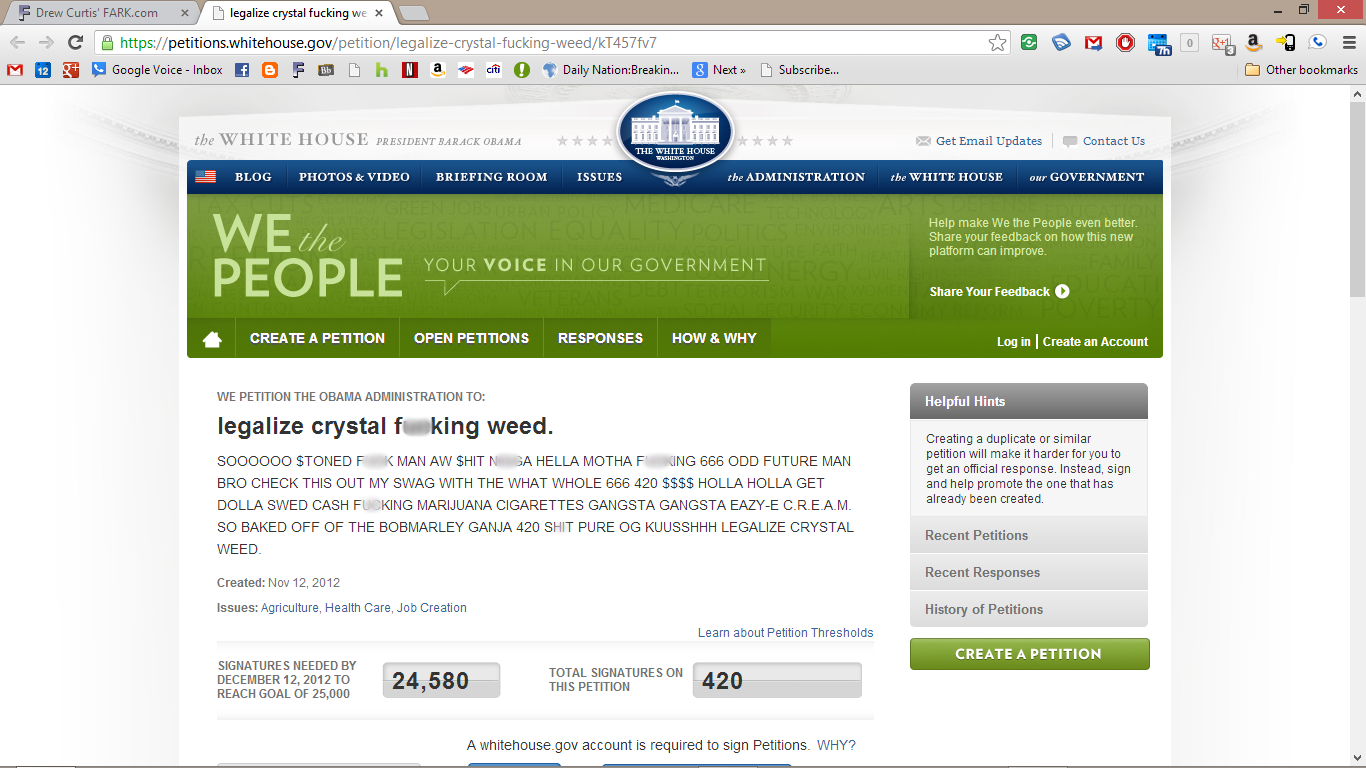
Freedom of speech is a powerful thing in the United States of America. Without it, you wouldn’t be able to protest, campaign, or get away with this gem that a community member on 4chan dug up. Thanks to this petition to “legalize crystal fucking weed,” we now know people who work in the White House are just like most of us: They’re very busy and do not have time to screen your online shinnanegans. 

Turns out, it’s not very hard to create a petition on Mr. President’s very own website. There’s a whole section of Whitehouse.gov that lets we the people announce what we would like to see the Decider In Chief do some deciding upon, and if the required signature threshold is achieved (25,000), according to the site, ” … it will be reviewed and the administration will issue a response.” So, somebody did their due diligence – save for, you know, any copy editing for grammar, structure, or coherence – and let their voice be heard about a sincere desire to … um … legalize some “crystal fucking weed.” Whatever that is. 

You would think the White House would have a systematic spell check to track cuss words at the very least, but this petition managed to stay online long enough to garner at least – wait for it – 420 votes before someone on Obama’s website staff got wise.

As of 9:38 a.m ET the petition has been removed, with the site claiming it was a violation of the terms of participation. Which is a shame, because we were just 20,000 or so votes shy of finding out what POTUS had to say on this crucial topic. After all, the petition is tagged under “Job Creations.” At least readers in Washington and Colorado can get nice and blazed while discussing it amongst themselves. 

[Image via]


Source : digitaltrends[dot]com

Nov 7, 2012

What Obama’s second term means for technology

Obama's second term for tech presidential election

Obama has four more years in the White House, but what will his policies mean for the future of the tech we use every day?

A couple of years ago, President Obama was having dinner with Silicon Valley movers and shakers, including an ailing Steve Jobs. Although no recording of the dinner has been made available, legend has it that the President asked Jobs what it would take for Apple’s manufacturing jobs to come back to America.

“Those jobs aren’t coming back,” replied Jobs.

Whether that is true or not, during the campaign both President Obama and Governor Romney focused a lot of their energies on plans to bring that kind of manufacturing back to American shores. Now that the president has won a second term, what does that mean for American technology and manufacturing?

Mr. Obama’s plan was built on education and training, investing in clean energy, and giving tax incentives to companies that bring jobs back to America.

Jobs’ grim reply was based on the fact that American workers are no longer trained for the needs of high-tech manufacturing. Obama believes that making college more accessible, both at the university and community college level, is part of the solution for closing that skills gap.

A major focus during Obama’s first term was keeping tuition rates down, doubling funding for Pell Grants, and trying to get community colleges to work together with local employers to better train outgoing students for jobs that already exist locally. There’s every reason to believe that push will continue.

Another creative idea from the campaign trail was the creation of “manufacturing innovation institutes,” where businesses and research institutions work together to make sure that American research and development produces corresponding high-tech manufacturing jobs. How the federal government can spur that idea remains to be seen, but it could be a key step in reshaping the American manufacturing sector and making sure the next Apple keeps its assembly lines here at home.

During the campaign, Obama predictably hit Governor Romney on the Republican Party’s close ties with the oil industry. In his first term, the president advocated an “all of the above” energy policy. He’s willing to explore any source, including oil, which can help America reach a majority of energy independence by 2035. It is now expected that investment in alternative energy technologies will only continue in the next four years.

Gas pump car fuel efficiency obama technologyDuring his first term, President Obama pushed ahead with plans to double fuel economy standards for cars and light trucks by 2025, which is spurring the auto industry’s investments in hybrid and electric vehicles and has led to an American manufacturing boom of sorts in battery technology. Since these rules are now under no threat of repeal, cars and light trucks are expected to sip less and less gas in the next four years. Horsepower may be a different story.

One of the places where we heard repeats of 2008’s campaign pledges was in the area of corporate tax structure. The president promised to end tax breaks for companies that participate in outsourcing during his first term and promised to do the same in his second term (which you can assume to mean that the first effort didn’t go so well).

He also wants to provide tax incentives for companies to bring jobs back to the US. Considering Apple currently enjoys a 1.9 percent tax rate on its foreign earnings, I’m not sure how much of an incentive the US government can provide. Perhaps they will mandate that all federal employees will have to buy an iPad Mini. At least all of our forest rangers will have something to do while they’re stuck in those fire towers.

Any conversation about tax policy centers on Congress. In the coming days, it will be interesting to see if our Republican House makes any overtures of bipartisanship to the president now that they know they are stuck with him for another four years. If history is any indication, don’t hold your breath. There’s probably better chance of an impeachment investigation than bipartisan tax reform.

Whatever the case, many pundits believe that the president will be bolder in his second term, enacting whatever policies he can without congressional approval if Congress proves to be as intransigent as they have been in the past. A lot of the policies mentioned above came to pass through that same kind of executive maneuvering. Because of that, the next four years of America’s technology and education policy might be just as much decided in courtrooms as in the Oval Office.


Source : digitaltrends[dot]com

Oct 12, 2012

UK government also probing Huawei, says it currently has no security concerns

Huawei Show Photograph: Reuters

Following the House of Representatives damaging report, the UK has revealed it has also been examining Huawei amid security concerns.

The story following the House of Representatives report that Huawei and ZTE pose a security threat to US national security continues, as international governments examine their involvement with the Chinese companies and look for their own evidence of security risks.

In the UK, it has been revealed that a parliamentary committee has also been examining Huawei’s presence in the country for a while, as it’s a major supplier of network equipment to British Telecom, Vodafone, O2 and most other network providers, plus it’s responsible for much of the infrastructure behind EE’s 4G network.

Should any discrepancies be identified, the continued rollout of both fiber and 4G broadband could be slowed or halted. Both projects, and the relationship with Huawei, are well established, and disruption would be costly. The report is due to be published at the end of the year.

Quite apart from the network disruptions, there’s a political aspect at work too, as Prime Minister David Cameron had a meeting with Huawei’s CEO Ren Zhengfei last month, where a £1.3 billion deal was reached. One of the first stages is for Huawei to move its UK workforce into a new 140,000 square foot office building in April next year.

A Cabinet Office spokesperson, Derek Smith, has been talking to the UK press about the government’s view on both Huawei and ZTE ahead of the final report, which is notably different to that of the US House of Representatives.

Cyber Security Evaluation Centre

Smith told TechRadar.com that “the Cabinet Office is confident that there are no security concerns,” and “comparisons with the US don’t hold up with what we’re doing here. We have a very strict evaluation process for products from any country, not just China, coming into the UK.”

He then referred to Huawei’s Cyber Security Evaluation Centre, which opened in 2010, where hardware and software are tested to, according to Huawei “ensure its ability to withstand growing cyber security threats.” The closest the blurb gets to admitting the centre is more about checking Huawei’s equipment is the admission that it’s there to “build mutual trust in the area of cyber security.”

A 2011 report covering the center’s opening from notorious scare-mongers The Daily Mail is far less subtle, starting with the headline “New cyber attack fears over the Chinese ‘Red Army Lab’ being used for BT tests.” The piece goes on to quote numerous security experts who warn against using Huawei’s services, plus it reveals that Huawei has an identical copy of BT’s computers and telecoms system back in its Shenzhen head office, so it can evaluate new hardware. Thankfully, the system isn’t connected to the UK network.

For now, it seems Huawei’s operations in the UK are safe, but things will take a turn for the serious — not to mention politically embarrassing — should the forthcoming report not back up the Cabinet Office’s statements, as Huawei is already sitting at the table with its slippers on in the UK, instead of only knocking on the door in the US.


Source : digitaltrends[dot]com

Oct 10, 2012

Stealth mode video app Vine acquired by Twitter for its rumored in-house video hosting service

twitter vine

Twitter has reportedly acquired Vine to develop a video sharing service in-house. It's the latest development in reports that Twitter will stop supporting third-party video sharing services.

After yesterday’s report about Twitter developing an in-house video client, there’s now some solid evidence that Twitter has invested in developing a video service. AllThingsD has reported that Twitter recently acquired three-person New York City-based video sharing startup Vine.

The same report indicates that the deal was motivated by the acquisition of the team rather than the product itself, although an update by AllThingsD suggests that Vine could remain a standalone service. We reached out to Twitter, but the company declined to comment on the matter.

If you take a look at Vine’s site, you’ll notice the service has yet to launched and is simply taking user signups. But the splash page currently describes it as, “the best way to capture and share video on your iPhone. No editing. No rendering. No post-production. Video has never been this fun.”

Vine could be in its beta testing stage with some early adopters — primarily investors and other entrepreneurs using the service — which gave us a look at how Vine works. It’s apparently focused on short form clips that last just a matter of seconds, but the platform stitches together these short clips into a longer video. It then loops back to the beginning of the clip automatically, kind of like a GIF but with sound.

We did a Google search for site: http://vine.co/v/, which appears to be the site’s root URL for user submissions, and found that vine videos were in fact being indexed by Google with approximately 104 results. We were able to check out the submissions from people like MG Siegler and Vine co-founder Dom Hofmann and David Lee, managing partner of SV Angel.

Here are just a few examples that you can check out:

Davidlee

Parislemon

Kevin

CarterKev

Dom 

Whether Vine would continue to exist in its current form or have its technology use to support whatever video service Twitter has up its sleeve remains to be seen. Still, the acquisition absolutely points to the platform’s interest in bringing video in-house. 


Source : digitaltrends[dot]com

Sep 25, 2012

Could Disney be the new Netflix?

Forget Apple and Amazon: The new Netflix might come from the House of Mouse, with one analyst suggesting that Disney is already well-placed to launch a streaming video-on-demand service to take the SVOD crown.

For years, a question on many people’s lips in the entertainment industry has been “Who is going to manage to take on Netflix and win?” The list of companies that many hoped would be able to manage to not only get a foothold in the increasingly-lucrative Video on Demand market, but manage to turn that foothold into something much more longterm and permanent, has been long throughout the years, from big names to Apple and Amazon to less obvious suggestions like Walmart and Blockbuster. According to one new report, however, we’ve all been overlooking a major media player who might even have the infrastructure in place to move into the market already: The Walt Disney Company.

Todd Juenger, a business analyst with Sanford C. Bernstein, believes that the only thing keeping Disney from being a major force in streaming content at this point is lack of desire. Describing the possibility for Disney to move into the area as a “hidden treasure,” Juenger wrote in a report to investors that “the time is ripe for Disney to re-imagine their sleepy SVOD service (Disney Family Movies) into a full-blown, premium Disney-branded SVOD service.”

For those unfamiliar with Disney Family Movies – I suspect that may be all of you who don’t have children – it’s a streaming video service that describes itself as “a subscription video on demand service for one very low monthly price: great feature movies, shorts, featurettes and bonus materials, at your fingertips.” In other words, the chance to see everything you’d get on a Disney DVD – including the special features, unusually for a streaming service offering – as an On-Demand offering from major television and cable providers (Instead of being available online, potential users are directed to contact their carriers to find out if the service is available for them).

The problem with Juenger’s prediction is that Disney’s offerings are currently tied up in a deal with Starz, which in turn makes their movies available to other VoD services, including Netflix. He has a simple solution to this problem: Break the Starz deal. “Full realization would likely require abandoning the Starz output deal,” he admitted in his report, adding that the potential earnings from a revitalized Disney Family Movies offering “would be easily superior” to the income the company sees from the current licensing deal. “At 12 million [subscriptions], DFM would add $475 million incremental operating income,” he explained.

The suggestion is a fascinating one, not least of all because it actually makes a fair amount of sense. Disney hasn’t made any noises about being concerned about this kind of plan in the past, but Disney Family Movies does provide an existing framework to build from, and with a bank of content that not only includes the animated Disney movies, but also ABC television content, Marvel Studios and Pixar, there’s a lot of reason for customers to sign up to such a service. Maybe it’s not such a crazy idea, after all.


Source : digitaltrends[dot]com

Sep 23, 2012

Changing Cities: Where Are the Solar Panels Mr. President?

gty the white house jt 120923 wblog Changing Cities: Where Are the Solar Panels Mr. President?

(KAREN BLEIER/AFP/GettyImages)

America is in the midst of something of a solar resurgence, but not at the White House.

On June 20, 1979 President Jimmy Carter installed 32 solar panels, used to heat water, on the White House roof.  In 1986 under the Reagan administration those panels were taken down for a routine roof resurfacing and never returned. However, in 2010, President Obama announced he was bringing solar panels back to the White House roof, which the administration said were slated for installation by the spring of 2011.

But as 2012 winds down, the panels — which the Department of Energy had said would likely produce 19,700 kilowatts of electricity a year, more than twice the electricity used by the average Washington home — have still not been installed, and many are asking where are they Mr. President?

In a bid to raise attention to the issue, author and climate activist Bill McKibben tried to hand deliver the Carter administration’s solar panels to the White House two years ago. McKibben had a sit-down with White House officials, and even appeared on the “Late Show With David Letterman” pleading his case for the panels to be returned.

When the Obama administration announced they were indeed installing new panels McKibben was excited, suggesting that as a national role model, solar panels on the White House could inspire people across the country to follow suit.

“If it has anything like the effect of the White House garden, it could be a trigger for a wave of solar installations across the country and around the world,” he wrote at the time.

But after two years and still no panels adorning the White House roof, McKibben’s excitement has morphed into disappointment.

When asked by ABC News about the status of the panels, the White House said “they are in the procurement phase.” The only solar panels currently on the White House grounds are ones President George W. Bush put on a maintenance building to warm the swimming pool.

“Somehow using 1970s technology, Jimmy Carter managed to get it up on the roof.  The administration promised it would be up by the last day of Spring 2011, but the last time I walked by there was no sign of anything,” McKibben told ABC News. “It’s a reminder of what a low priority global warming has been for the administration.”

In 1979, Carter predicted at the dedication ceremony of the White House solar system that by 2000 solar panels like the one on the roof would either be supplying cheap, efficient energy or “a museum piece, an example of a road not taken or it can be just a small part of one of the greatest and most exciting adventures ever undertaken by the American people.”

During his administration huge strides were taken in curbing the country’s dependence on foreign source of energy, including investing heavily in renewable power.  But with a shift of administrations and the new Reagan era, research and development budgets for renewable energy were slashed and the Department of Energy eliminated tax breaks for solar and wind projects.

Carter’s worries about his solar panels ending up in the museum proved prescient. Half the panels were taken by the Unity College cafeteria in Maine, but the other half did indeed end up as  museum pieces, now housed in the Smithsonian’s National Museum of American History, the Carter Library, and the Solar Science and  Technology Museum in Dezhou, China.

Yes, that’s right China, which seems a bit symbolic, since China now produces close to 80 percent of the world’s solar water heaters.

While solar at the White House may be a hot button issue in the wake of the scandal around the failure of Solyndra after it received a federal grant, it should be noted that the solar industry is actually expanding quickly in the United States, and under the Obama administration solar is having a real resurgence, helping lift the cloud that has surrounded the industry.

“As the costs of solar energy have continued to drop, the United States has seen tremendous growth in solar energy installations,” DOE spokeswoman Jen Stutsman told ABC News.  “Over the last four years, solar energy in the U.S. has more than doubled and the industry now employs 100,000 American workers — in design, construction, installation, manufacturing and more,”

Though the Solyndra affair has been a rallying cry for opponents of investing in alternative energy, the investment in the company represented less than 1 percent of the DOE portfolio.

Around the country the Obama administration is fast-tracking solar projects on public land.  Solar zones have been established in six states, helping to expedite permitting of solar on public land.

Before Obama took office, there were no solar projects on public land. Now 17 have been approved, with the potential to supply power for 7 million homes.  It’s what the administration calls a landscape approach.  Instead of letting the solar power industry grow organically, the administration has been carefully planning where to best zone the projects — generally choosing zones that have abundant sunshine and easy access to transmission lines to deliver power.

According to a recent report from the Solar Energy Industry Association 2012 has been a comeback year for solar. There has been a dramatic reduction in the cost of solar helping to fuel this solar resurgence, and solar installation has increased by 116 percent from Q1 to Q2 of this year.

Source : abcnews[dot]go[dot]com

Sep 5, 2012

Opinion: Sorry NFL, technology just makes football better on TV

Watching football on TV nfl game attendance

Anyone with a big-screen TV and a $50 cable package has the best seat in the house without getting out of the recliner. So why should we pay up to attend games, again?

For couch potatoes, fantasy junkies, and degenerate gamblers, this week is more important than Christmas. Another NFL season kicks off! I can hear my wife sighing already.

Lost in Olympics coverage over the summer was the fact that the NFL’s overall attendance for the 2011 season was the lowest it has been since the league expanded to 32 teams in 2002. Everyone has a theory. Most blame the overall state of the economy. Some blame expansion itself, diluting the product on the field to the point where we have the Colts, Dolphins, Rams, and Buccaneers of the world.

Yet some – myself included – have a different theory.

The product on TV is simply far, far better than what you can get in the stadium. Stadiums face the same problem as movie theaters: We’re so coddled by technology in our home theaters, it’s getting harder and harder to find an excuse to leave.

Although I have an NFL stadium 20 minutes from my house, I haven’t been to a Bucs game in about seven or eight years. Part of the reason is that I am an admitted fair-weather fan. I’m simply not interested in paying what I consider an exorbitant sum to watch a team lose. Just as if a restaurant started putting out an inferior product, I would stop patronizing that restaurant. And Chez Buccaneer has been an inferior restaurant for most of the last decade, not winning a playoff game since their Super Bowl run in 2002.

More importantly, the NFL shot themselves in the foot when it came to my prospective attendance when they invented NFL RedZone.

For those who aren’t familiar, RedZone is a channel broadcast by the NFL on most cable networks that shows only the most important plays from every game going on during Sunday afternoon. It simply skips around the league, staying at one game only if a team is in the “red zone.” The cost is around $50 for the season, less than one ticket to a live game.

No more rushing plays into the middle of the line, resulting in a 2-yard gain.

No more incomplete passes.

I only see what is important. I don’t even watch highlight shows anymore, because chances are I saw the highlight in real time, no matter the game. As a fantasy player, I see when my players (or the opponent’s) score before it even registers on the online fantasy tracker website. I’ve finished cursing by the time the score is updated.

I’ve heard the same refrain from the people who are lucky enough to subscribe to DirecTV’s Sunday Ticket, where they have access to every game broadcast. Or the people who would rather frequent the local sports bar, where they can also see every game and probably get better food than what would be available at the stadium.

So perhaps the cause of the NFL’s attendance woes (if you can call them that, considering more than 16 million people visited a game last year) is the NFL itself and its blinding madness to chase money wherever they may be able to find it.

stadium seating nfl sports football season viewershipThe question is: What can they do to get butts back in the seats?

I can’t say I’ll never go to another Bucs game, particularly if I have some friends going as well. But they need to provide a similar experience to what I have at home, which means letting me know what is happening in the other games. I may be a Bucs fan, but this season I’m also a fan of Tom Brady, Trent Richardson, and Jamaal Charles (until I trade them).

At Raymond James Stadium, there is one scrolling scoreboard in the whole building that shows scores from the other games around the league. Just scores. No stats. They don’t even show highlights of other games during halftime.

Meanwhile, during the innumerable stoppages of play to let the TV stations get their commercials in, the fans in the stadium are also treated to a bunch of commercials on the jumbotrons. I thought I paid you a lot of money for a ticket so I didn’t have to watch commercials?

So instead of the commercials between series, they need to show RedZone. Since it’s already an NFL product, there are no licensing issues. The people in the stadium can then get a much better idea of what’s going on around the league and won’t have the feeling that they’re missing something by opting to see the game in person.

Speaking of not missing anything, I need stadium-wide free Wi-Fi. Then I can bring my tablet to the game and keep up with my fantasy players. Or you can do some work during halftime, if you’re trying to offset the cost of the ticket.

Just as we started this conversation by bemoaning the slackening attendance at NFL games, we’re going to end it with another figure: $9.5 billion. That was the NFL’s total revenue last season. They can afford the bill for 65,000 people using Wi-Fi for three hours eight times a year, and to forgo the commercials in the stadium. And by doing that, maybe fewer games around the league will get blacked out, creating even more revenue.

Without changing the live game, the NFL risks losing a generation of fans to whom football might as well be played on a soundstage.


Source : digitaltrends[dot]com

Sep 4, 2012

LED lantern powered by water and salt, perfect for the crying camper

Water and salt powered LED lantern by Green House Co.

The lightweight LED lantern by Green House Co. runs on saline water so you can leave those rechargeable batteries behind on your next trip.

Remember those experiments you might have conducted in a high school science class where you attempt to light a bulb by sticking copper wires into a potato or lemon? This reaction is possible because the ions inside these fruits and vegetables help conduct voltage. The developers behind Green House Co., a Japanese gadgets company, has taken this notion to a more real-life level with its latest LED lantern that’s powered by just water and salt.

With no fancy name, the “GH-LED10WBW” does not require batteries or a dry cell. Users can simply fill it up with water and salt and the bulbs will light up upon sensing those ingredients. Green House recommends a ratio of 350 ml of saline water with at least 16 grams of salt — a combination that can last the lantern eight hours of glow before needing a refill.

The technology is possible by the electrolytes readily available inside lantern which contains a magnesium and carbon rod, each of which act as a negative and positive electrode, respectively. The resulting chemical reaction allows for a 55-lumen brightness, and the rods can both be used for 120 hours before requiring a replacement. The lantern also has a USB slot, allowing you to even charge some gadgets using the saline water concoction.

Because the LED lantern doesn’t need batteries, we can assume the device is relatively lightweight, and would make a great gear for campers and hikers. Of course, if you have a crybaby in your group, you can always experiment and see if tears are powerful enough to light up a whole gadget. When life hands you lemons, am I right?

Pricing information on the Green House Co. LED lantern is currently unavailable, but the item is reportedly scheduled for a release later this month.


Source : digitaltrends[dot]com

Aug 27, 2012

Seven profitable opportunities for sensors that could reshape our world

alderaban nao robot sensors

Sensors can make your house more efficient, cars safer, ads smarters, and they’ll make the next generation of entrepreneurs a tidy profit in the process.

Soon, there will be more sensors in the world than all the phones and computers combined. But there’s a problem: Many of the people who know sensors aren’t entrepreneurial (they’re engineers), and most of the people who are entrepreneurial haven’t yet realized the huge extent to which sensors will change the world.

Translation: This may be your big opportunity.

To illustrate what sensors can do, Michael Hinshaw and I included this intentionally very long paragraph in our recent book:

Today, digital sensors can:

  • monitor your tire pressure and avoid dangerous blowouts;
  • analyze the gait of elderly citizens and warn of falls before they occur;
  • follow the gaze of shoppers and identify which products they examine – but don’t buy – in a store;
  • monitor which pages readers of a magazine read or skip;
  • float in the air over a factory and independently monitor the plant’s emissions;
  • detect impacts in the helmet of an athlete and make it impossible for them to hide potential serious blows to their brains;
  • reveal when a dishwasher, refrigerator, computer, bridge, or dam is about to fail;
  • trigger a different promotion as a new customer walks by a message board;
  • analyze the duration and quality of your sleep;
  • warn drivers that they are about to fall asleep;
  • prevent intoxicated drivers from operating a motor vehicle;
  • warn a person before he or she has a heart attack;
  • detect wasted energy in both homes and commercial buildings;
  • warn a parent or boss when anger is creeping into their voice, to help prevent them from saying or doing things they will later regret;
  • tell waiting customers how far away the pizza delivery guy is from their house;
  • analyze the movements of employees through a factory to detect wasted time and efforts;
  • trigger product demonstrations or interactive manuals when a customer picks up or examines a product;
  • congratulate an athlete when she swings a tennis racquet properly or achieves an efficient stride while running. 

 The big question is: What will you do with them tomorrow? Here are seven ways you can personally profit from sensors:

1.) Add sensors to any dumb object, and give it the ability to act intelligently. Without a sensor, when the water filter in your refrigerator gets too old, you keep using it anyway. Add a sensor, and your refrigerator tells you to stop using it. Find something that bugs people with its stupidity, and make it smart.

2.) Learn to program a robot. Robots are moving collections of sensors, and some of the wisest folks among us are learning how to program the software that controls robots. This video from Aldebaran highlights the talents of an incredibly versatile robot with facial- and speech-recognition capabilities.

electricfoxy move wearable sensor clothing3.) Help people improve their athletic performance with sensors. The Move project at ElectricFoxy is studying ways to do this, and over at Sense of the Future we have identified over 200 health and fitness apps that use sensors.

4.) Make computers – and everything else – simpler to use. One way might be by incorporating gestural interfaces, like what Prime Sense is developing. We are getting very close to the day when our technology becomes so advanced that it disappears. Personally, I can’t wait to throw away all our remote controls.

5.) Build a new business around sensors. My friend likes to windsurf, so he uses a sensor on the buoy outside his favorite harbor to show him when the winds top 20 mph. He does this via a service called iWindsurf, which is basically a collection of sensors placed along the coastline. Where could you place sensors to deliver a valuable new service to a group of people with a strong interest? For example, I’d pay $5 to get a video of my son scoring a soccer goal, so someone might want to mount sensors and a camera in the crossbar of soccer goals and sell the videos to parents.

6.) Increase safety with sensors. Without a sensor, your car will run over the tricycle your son left behind your real wheel. With a sensor, your car will warn you not to back up. How can you use sensors to make the world safer, or at least your corner of it?

emotiv neuroheadset brain control sensors7.) Use your brain (better). Brain-Computer Interfaces (BCIs) are sensors for your brain. Right now they are mainly used in research labs, but a few companies like Emotiv have headsets you can buy today, and more are on the way. There are lots of overblown claims what these devices can do — most still require dorky, greasy caps — but anything that helps train your brain is a good thing.

I’ve just scratched the surface. For the next few days, imagine that everywhere you go everything has a sensor inside it. What would you want it to tell you, and when? Even better, what entrepreneurial opportunity can you create? There are millions of possibilities.

Bruce Kasanoff is a speaker, author and innovation strategist who tracks sensor-driven innovation at Sense of the Future. Kasanoff and co-author Michael Hinshaw teamed up to explore more of the opportunities unearthed by sensors in Smart Customers, Stupid Companies.


Source : digitaltrends[dot]com