Pages

Showing posts with label government. Show all posts

Nov 19, 2012

UK rethinks awful opt-in web porn filter, comes up with a marginally better idea

After giving consideration to an opt-in Internet content filter, where users would have to request access to adult material, the UK government may announce an active choice system instead before the end of this month.

The debate over whether Internet service providers should be automatically blocking adult content on the Web in the UK continues, however this weekend, news of a slightly tweaked plan has broken.

British Prime Minister David Cameron is said to be pushing forward with a new set of proposals, which veer away from the opt-in schemes from before — where the filter would be active unless you asked for it to be switched off — to a slightly more sensible opt-out system.

Referred to as active choice, the idea is that anyone who buys a new computer or signs-up with a new ISP will be asked whether children will have access to the computer. If the answer is yes, users will be guided through the installation of a filter, before answering a series of questions to set its sensitivity.

To stop cheeky under-18s from bypassing the filter before installation, unnamed measures will be implemented to confirm the person’s age from the start. The proposal may be announced before December.

Filters for the technically naive

Details on the new filter come from a report published by the Daily Mail, a UK newspaper with a poor reputation which has been pushing its own Block Online Porn campaign for a while, despite publishing questionable content itself on a regular basis.

It cites studies that say one in three children under the age of 10 have viewed pornographic material online, while four out of five aged between 14 and 16 do so on a regular basis.

While the new plans go against the blanket op-out schemes previously being considered, the Daily Mail is still claiming this as a victory, despite the system being nowhere near as restrictive as it wanted.

Internet filters appeal to the technically naive, but there’s no guarantee they’ll work. One of the reasons a filter is being considered is to assist parents with no knowledge of computers or the Internet (and obviously, no wish to learn) help stop their children accessing adult content. Except filters are easily avoidable by those with a modicum of know-how, i.e. the kids.

Filters are often ineffectual

There are also problems with filters not only blocking the wrong content, but failing to block that which it’s supposed to. For example, last year a well-known adult video website still appeared to users behind TalkTalk’s HomeSafe filter, as the message the site had been blocked only appeared in a box usually reserved for an advert.

TalkTalk is still the only major ISP in the UK to provide a cross-platform Internet filter, although Sky and Virgin Media have both agreed in principle to implement the government’s plans in the future, should they become mandatory. For now though, both let users choose what can be viewed online in the privacy of their own homes.

It’s becoming increasingly likely that a government enforced filter will be introduced in the UK in the future. While worrying, if one really must be introduced, this latest version is the least insidious discussed so far.


Source : digitaltrends[dot]com

Nov 14, 2012

Turns out, the White House’s online petition tool is sort of unmonitored

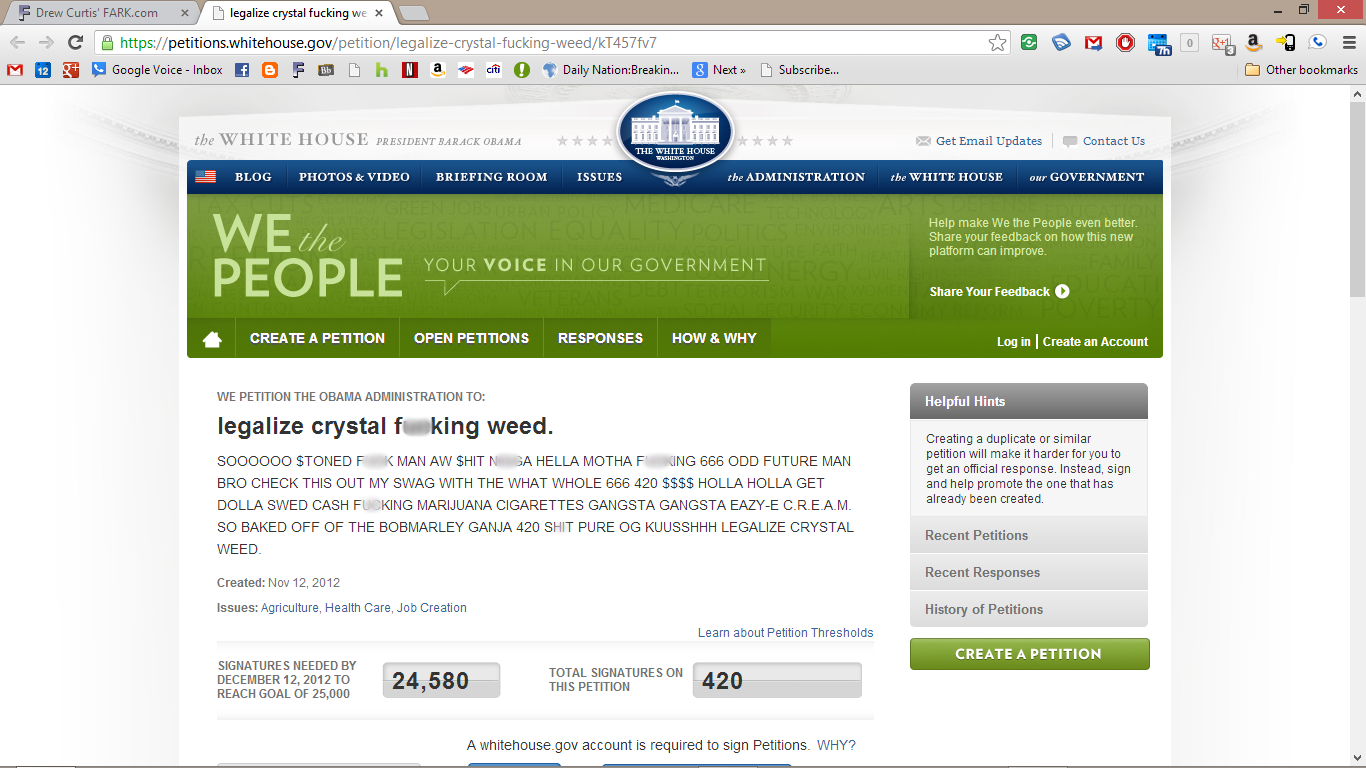
Government jobs are hard, and people don't always have time to deal with your online silliness. Such is the case with this White House petition to legalize weed.

Freedom of speech is a powerful thing in the United States of America. Without it, you wouldn’t be able to protest, campaign, or get away with this gem that a community member on 4chan dug up. Thanks to this petition to “legalize crystal fucking weed,” we now know people who work in the White House are just like most of us: They’re very busy and do not have time to screen your online shinnanegans. 

Turns out, it’s not very hard to create a petition on Mr. President’s very own website. There’s a whole section of Whitehouse.gov that lets we the people announce what we would like to see the Decider In Chief do some deciding upon, and if the required signature threshold is achieved (25,000), according to the site, ” … it will be reviewed and the administration will issue a response.” So, somebody did their due diligence – save for, you know, any copy editing for grammar, structure, or coherence – and let their voice be heard about a sincere desire to … um … legalize some “crystal fucking weed.” Whatever that is. 

You would think the White House would have a systematic spell check to track cuss words at the very least, but this petition managed to stay online long enough to garner at least – wait for it – 420 votes before someone on Obama’s website staff got wise.

As of 9:38 a.m ET the petition has been removed, with the site claiming it was a violation of the terms of participation. Which is a shame, because we were just 20,000 or so votes shy of finding out what POTUS had to say on this crucial topic. After all, the petition is tagged under “Job Creations.” At least readers in Washington and Colorado can get nice and blazed while discussing it amongst themselves. 

[Image via]


Source : digitaltrends[dot]com

Nov 8, 2012

Australia backs down on Internet porn filter plan, while Egypt pushes ahead

Australia has decided against introducing a mandatory, all-encompassing Internet porn filter, while in Egypt, the government has taken the opposite decision and will introduce just such a scheme soon.

Filtering the Internet to stop potentially harmful or illegal material from reaching the general population is a controversial subject, and one that has received considerable attention this year after the UK appeared to be edging ever closer to implementing such a scheme.

Other countries have been considering filtering Internet content too, and it so happens that today, Australia has decided not to go ahead with a mandatory filter, while Egypt has done the complete opposite.

We’ll start in Australia, where an all-encompassing Internet filter was put forward in 2007, but the plan stagnated for several years. Today, Australia’s Communications Minister has announced the government will no longer pursue its “mandatory filtering legislation,” but will instead use a list created by Interpol to block the worst offenders.

According to The Sydney Morning Herald, the major Internet providers have agreed to this, and it will see 90-percent of Internet subscribers without access to those sites featured by Interpol. Initially, the mandatory filter would have blocked sites with illegal sexual practices, sexual violence, drug use and those which “advocated terrorist activity.” The communications regulator would have also populated the list with sites about which it had received complaints.

Of course, not everyone is happy about the decision. A spokesperson for the Australian Christian Lobby said an Internet filter was needed to “protect our children from forming unhealthy attitudes towards women and sex.”

Egypt backs Web filter scheme

On that note, we’ll turn our attention to Egypt, where it’s a very different story. Following a series of demonstrations from a group by the name of Pure Net, the government has ordered a filter be introduced to ban pornographic websites. Like Australia, such a scheme had been proposed several years ago, but never enacted until now.

It’s estimated that introducing such a wide-ranging filter will cost $16.5 million, which according to one member of the Egyptian parliament is “worth the price,” as “no matter how much it costs, the moral value of this will be much more significant.” A strong supporter of the filter, he also says pornographic sites “deteriorate moral values and youth, promote a criminal culture and lead to unproductivity (sic), drugs and theft.”

The question of who will define what’s pornographic or obscene has yet to be answered, and many fear it will result in non-harmful sites also being blocked.

Other countries will no doubt be observing the response, and success, of both Australia and Egypt’s Web filtering plans. In the UK, nothing has been heard about the scheme since the end of a 10-week consultation in September.


Source : digitaltrends[dot]com

Nov 1, 2012

DT Daily: Facebook takes aim at Craigslist, Halo 4 reviews arrive

Facebook takes aim at Craigslist, Halo 4 reviews arrive, the U.S. government launches a stolen phone database, Kim Dotcom reveals more details about his new cloud storage service, and Walmart teams up with streaming video company Boxee.

Related Links:


Source : digitaltrends[dot]com

Oct 25, 2012

How Does The Navigation System On My Phone Know Where I Am?

The concept of a navigation system was first proposed around 50years ago. Around 20 years ago, only the Government had access to satellite technology so it amazing that in such a short space of time satellite based technology has made its way into navigation systems and even mobile Phones. You would be hard pressed to find a high or mid-tier phone without a built in navigation system and even some entry level phones (such as the entry level Android phones) come with a ready to use navigation system. Gone are the days when you need to stop and ask for directions but have you ever wondered how your phone determines where you are? Surely the navigation system doesn’t call its friend up and ask it for directions! Does it?

As you read this blog post, a network of GPS satellites are orbiting the Earth at an altitude of about 20,000 KM, making two full rotations around the Earth every day! A few Satellite systems have emerged but only two have made their way into mainstreams phones. At the moment, GPS is more widespread but GLONASS is said to be more accurate due to the way the satellites have been positioned. Many new devices such as the iPhone 4S, iPhone 5, Galaxy S3 as well as the new Sony Xperia phone make use of both GPS and GLONASS satellites to obtain greater accuracy and to shorten location finding times. GPS has 27 satellites and 3 of those are used for backup purposes. Like GPS, GLONASS has 3 for backup purposes as well but only has 24 satellites.

Google Maps on Android

Navigation system on IOS 6

How does it work? 

A random number is generated consisting of a long string of data and is continuously broadcasted by each satellite. The contents of the data being transmitted is not important but what is important is that the contents of the data being sent by the satellites and hat being received by the navigation systems is the same.

Your phone compares signals sent from a number of satellites in real-time. Phones use data from 4 satellites since GPS satellites have been positioned so that 4 satellites are able to communicate with a receiver at any given time. Comparing data from 3 satellites is considered to be sufficient but GPS makes use of 4 satellites for additional accuracy.

The phone now knows the distance between itself and the satellites tracking it but doesn’t know in which direction. To do this, it uses trilateration which compares the distance between you and three other locations although GPS uses 4 locations for additional accuracy.  If a satellite can see your phone known you must be somewhere in the radius of what that particular satellite can see. If a second satellite can see you then you know that you must also be within the radius of what that satellite can see. However, since two satellites can see you, you know that you must be somewhere where the radius of the two satellites intersects. The introduction of a third satellite can show you exactly where you are.

Now that your phone has your latitude, longitude and altitude it can now compare these coordinates with its own maps in order to determine the details of where you are.

BIO: This is a guest post on behalf of RAM tracking who specialise in vehicle tracking software. Vehicle tracking software uses a similar method to determine where the driver is.

Report an error

No tags for this post.
Source : techtalkafrica[dot]com

Sep 12, 2012

ArmA III developers arrested in Greece for spying on military base

bohemia interactive arrested in greece

Two Bohemia Interactive employees were accused of espionage on Sunday, but the Greek government has other issues with the ArmA III studio.

Czech developer Bohemia Interactive has had a solid 2012 so far. The runaway success of DayZ, the zombie apocalypse themed mod for its military simulators, brought massive mainstream attention to a line of games that has catered to a supportive but small audience. The company is hard at work on both the full version of that game as well as ArmA III, but the company’s smooth seas have grown choppy. Two developers from Bohemia’s ArmA team were arrested for “spying” in Greece.

The two unnamed employees, aged 28- and 33-years-old, were scouting locations for use in the next game on Lemnos, a small island in the Greek archipelago with a small population, some tourist trade, and one military air base. ArmA III’s primary setting, in addition to the Ai Stratis, is Lemnos and the developers were photographing that military base when they were arrested on Sunday under suspicion of espionage.

“We can confirm that two Bohemia Interactive employees, our colleagues and friends, were arrested during their holiday trip to Lemnos,” said Bohemia CEO Marek Spanel in a message on the developer’s forum, “They visited the island with the sole purpose of experiencing the island’s beautiful surroundings.”

“Since its establishment in 1999, Bohemia Interactive has created games based only upon publicly available information. We always respect the law and we’ve never instructed anybody to violate the laws of any country. The same is true for ArmA III. Currently, all our effort goes towards supporting the guys over there, as well as their friends and families affected by this difficult situation. We sincerely hope that this is an unfortunate misunderstanding of their passion as artists and creators of virtual worlds.”

The arrests may be more than just a misunderstanding. In 2011, the Greek government protested Bohemia’s use of Lemnos in ArmA III, claiming that its appearance in a war game might interest the tourist trade that keeps the island’s miniscule economy running. The game could also pose a security threat by realistically recreating the terrain.

 ArmA III definitely has the potential to reach a wider audience than past entries in the series. The popularity of DayZ drove sales of ArmA II, necessary for playing the mod version of the zombie game, up a purported 500 percent in May.

CTK reported on Tuesday that the men have been transported to the island of Lesbos where they will be interrogated by a Greek prosecutor. The Czech government’s Greek consul Blanka Kovacsova is working to help the developers.


Source : digitaltrends[dot]com

Aug 29, 2012

DT Daily: Sony debuts 84-inch 4K Bravia TV, LulzSec hacker gets arrested

Sony unveils a slew of new products including a massive 84-inch TV, the U.S. government boosts fuel efficiency standards, Americans misunderstand the cloud, Archos launches a game pad, and another hacker gets scooped up by law enforcement.

Related Links:


Source : digitaltrends[dot]com