Pages

Showing posts with label prototype. Show all posts

Nov 8, 2012

Vauxhall grabs three awards at RAC Future Car Challenge

GM, and its UK division of Vauxhall, took three awards from the RAC Future Car Challenge for green technology in both its production and prototype vehicles.

The Royal Automobile Club (RAC) Future Car Challenge is an annual event in which a fleet of vehicles are driven the 63 miles from Brighton to London in the UK, with the winner being the car which used the least energy to get there. This year’s winner was the Renault Zoe, a pure electric car which will be going on sale in Europe soon. But the big news for us in the US was the three awards grabbed by Vauxhall, GM’s UK division. Two of these were won by the Vauxhall Ampera, a rebadging of the Opel Ampera, basically a Chevy Volt with some slightly different styling.

The Ampera took the award for Most Efficient Regular Car (The Zoe being much smaller than the Ampera, the Most Efficient Small Car winner is generally the outright winner), as well as the title for Best Range Extender/Plug-In Hybrid. GM’s HydroGen4 (entered as a Vauxhall) hydrogen prototype took the prototype vehicle class title of Best Fuel Cell Vehicle. This is a nice feather in GM’s cap, especially at a time when they are losing huge amounts of money in the European market. But it is also important to us here. Although we may not get the Renault Zoe in the US, the Volt has become a very high-profile car.

It has been criticized over and over for having been built at a time when GM was in need of government assistance to stay afloat. But this award, among others, shows that the technology works, and that the car wasn’t some cobbled-together political tool for GM to pretend to be green. Add to this the fact that Consumer Reports recently named the Volt as the most reliable car that GM makes, and the criticism starts to look a bit hollow.

The awards from the RAC shouldn’t really come as too big a surprise. We know the Ampera to be an efficient vehicle, especially within this kind of distance. What is potentially more interesting is the prototype vehicles. There is a lot of guesswork out there about what the future of transportation holds, and there was an unfortunate lack of variety among even the prototypes. The HydroGen4 represents the biggest deviation among the award winners from the norm of plug-in electric vehicles. These vehicles have some significant drawbacks, and the potential is there for other alternative fuels to take the lead if a way can be found to make them viable. This might not be hydrogen, but it’s always good to see manufacturers exploring other avenues.


Source : digitaltrends[dot]com

Oct 27, 2012

The Nexus 4 was lost in a bar… Why is this so familiar?

Nexus 4 lost at bar

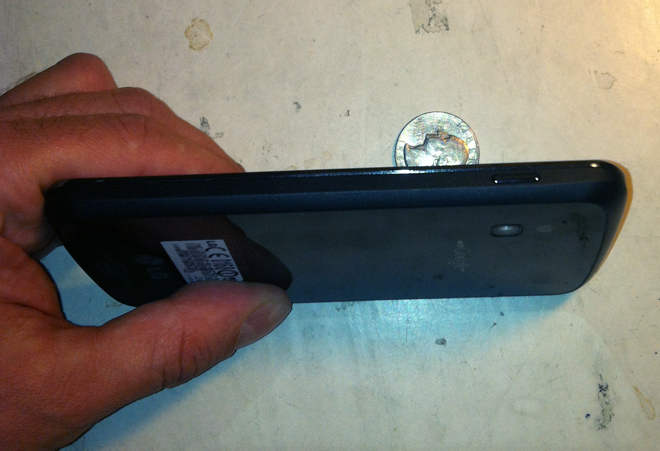
Following in the footsteps of Apple, one of its biggest competitors, a Google employee left a Nexus 4 prototype at a bar in San Francisco. Refusing a free phone, the man who found it decided to leak details of the device to media outlets.

Turns out Apple isn’t the only one who knows how to lose a smartphone in a bar because it looks like someone at Google did the same thing. To refresh your memory, a man named Brian Hogan found an iPhone 4 prototype in a bar left behind by an Apple engineer. Hogan ended up selling it to Gizmodo for $5,000 and consequently ended up in a lot of trouble. This story ends a little differently.

The bar this time around was the 500 Club in San Francisco. It happened on a Tuesday of last month. Jamin Barton, a bartender nicknamed “Sudsy”, found the phone while closing. At first, he didn’t think anything of it.

“We find about 20 a week,” Barton told Wired. ”Most people come back for them in 15 minutes.”

But this particular phone didn’t seem like the others. Nobody came to pick it up and Barton noticed quite a few peculiar features like a lack of SIM card and a “not for sale” sticker accompanying a Google logo on the rear panel. Once he showed it to fellow 500 Club employee, Dave, it was confirmed to be the upcoming Nexus 4.

The Nexus 4 is the smartphone Google was planning to unveil in New York on October 29, but that event has since been cancelled due to Hurricane Sandy. And, we might add, every detail about the Nexus 4 has already been leaked, including photos of the device. It will be manufactured by LG and have a 4.7 inch display, a quad-core processor, and ship with Android 4.2. If it was meant to be a secret then Google clearly dropped the ball.

Dave took over from there, offering to call Google HQ and explain what had happened. And much like Apple, Google blew the whole thing out of proportion. Brian Katz, Google’s global investigations and intelligence manager, was sent to the 500 Club almost immediately. Dave assured Google that Barton would hand over the phone as long as whoever picked it up confirmed their affiliation with Google.

Long story short, after some drama involving a riot and the local police station, Dave handed the phone over to Katz. In exchange, Katz offered Barton a free phone if he would agree to keep the incident under wraps and not discuss it with the pubic until after the official announcement. Obviously, Barton refused the offer and was paid a freelance fee by Wired for providing photos published alongside the article. Looks like isn’t the only one that’s lost control of its secrets. 


Source : digitaltrends[dot]com

Oct 19, 2012

Prototype E Ink Android phone puts your AMOLED screen to shame (but only in direct sunlight)

Onyx E Ink Smartphone

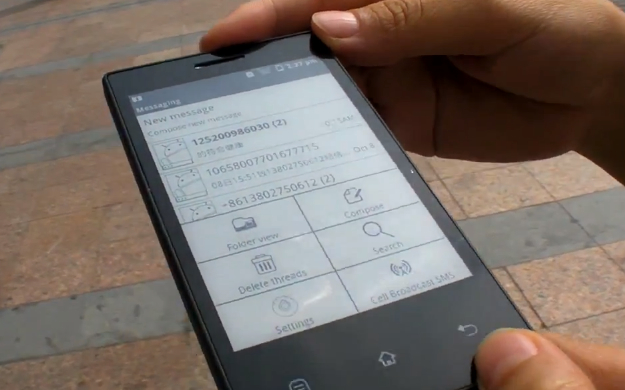
Onyx International, a company known for its range of e-readers, has shown off a prototype Android smartphone with an E Ink display. While the outdoor legibility and battery life are both excellent, the screen does let it down in other areas.

As every owner knows only too well, smartphone screens are difficult to view in direct sunlight, and while pushing the brightness up to maximum can help, it doesn’t do wonders for the battery life.

Here’s an interesting solution to the problem from a company named Onyx International, a smartphone with an E Ink screen. Onyx has plenty of experience in the world of E Ink screens, as it produces the Boox series of e-readers. The handset is only a prototype at the moment, but you can see a working version in the video below, where its screen is compared to a Galaxy Nexus.

The result is spectacular, as the Nexus device just looks like it’s turned off the entire time, while the Onyx phone’s display is crisp and sharp, despite being viewed outdoors. This probably won’t come as a surprise to anyone who has used an e-reader over the past few years, and the superior performance of an E Ink screen in sunlight formed the basis of a recent Amazon Kindle ad campaign.

Surprisingly, the Onyx phone runs Google Android, which has been extensively modified to run on a monochrome screen, but as you can see, the core functionality is still there. Because E Ink screens only take little sips of battery power, the standby time on the prototype is a week. Try that on any other smartphone.

There are, however, one or two little drawbacks. E Ink displays aren’t known for their speed, and sure enough the refresh rate is terribly slow, meaning any multimedia or gaming would be impossible. Viewing text webpages is good though.

While it’s an impressive technical feat and the use of an E Ink screen on a phone certainly has its benefits, the thought of enduring those long refresh times and not being able to do the things that almost all other smartphones can do, would probably make ownership too frustrating. After all, If I wanted a long standby time, a monochrome screen and little else, I’d buy a basic feature phone.

Take a look at the video showing the phone in action and see what you think.


Source : digitaltrends[dot]com

Oct 11, 2012

Bicymple strips design down to the core, removes bike chains

Bicymple in action

The prototype for the Bicymple tears it down to just a bar, handle, seat, and two wheels. And you didn't think bikes can get simpler.

When the weather is nice out, nothing is a better activity than getting your bike out of the garage and going for a beautiful ride. That is, unless you’re constantly interrupted with your pedaling when the bike chain falls out and you have to stop to fix and get your hands all oiled up. Bleh. Yes, I could get it fixed at a shop, but screw that noise. Peeves like those are why I’m particularly drawn to the Bicymple, a design that strips the chain component to make the entire vehicle more flexible.

Bicymple“By removing the chain, the number of moving parts and overall complexity is significantly reduced. A direct-drive, freewheeling hub joins the crank arm axis with the rear-wheel axis, shortening the wheelbase and minimizing the design,” describes Bicymple designer Josh Bechtel. “More than just a stylish concept bike, the bicymple is comfortable, easy to ride, and brilliantly simple to maintain … The optional rear-steer mode is reminiscent of custom ‘swing bikes’ and allows tighter turns and ‘crab-riding.’”

Basically, it’s two unicycles attached with a bar. Who knew such a concept could turn into an interesting, minimalist bike? 

From the looks of the demo video, the Bicymple sure looks like a fun ride, and maybe slightly more difficult than your average bike. We could only wonder about the physics and how much weight you have to put into the front and rear wheels to properly control the bike. Questions aside, the stylish and minimalist design is something that’s always trendy and appreciated in our eyes, and we hope you think it’s cool, too.


Source : digitaltrends[dot]com