Pages

Showing posts with label hundreds. Show all posts

Nov 9, 2012

Watching online porn is a good way to get yourself blackmailed by a hacker

Porn ransomware

Browsing online porn sites has become increasingly dangerous thanks to a precipitous rise in "ransomware" viruses, which lock down victims' computers, and demand they pay hundreds of dollars for the ability to regain control of their machines.

Watch online porn? Of course you do. Nothing wrong with that. You’re only human. But we have to warn you: Perusing the NSFW side of the Web could land you with a nasty computer virus that allows criminal hacker gangs to take control of you PC, and hold it hostage until you cough up cash.

Known as “ransomware,” this type of nefarious software is one of the most rapidly spreading threats on the Internet, according to a new report from cybersecurity company Semantic (PDF). The reason: It is an easy way from cybercriminals to make money.

“This malware is highly profitable, with as many as 2.9 percent of compromised users paying out,” the report says. “An investigation into one of the smaller players in this scam identified 68,000 compromised computers in just one month, which could have resulted in victims being defrauded of up to $400,000 USD.”

Semantic researchers Gavin O’Gorman and Geoff McDonald, who authored the ransomware report, say that hacker gangs are likely raking more than $5 million a year by extorting their victims. “The real number is, however, likely much higher,” wrote the researchers.

While about 16 different versions of ransomware viruses exist, says Semantic, they all work in relatively the same way. Hackers trick users into installing the virus on their computer by either installing malicious code on websites, or simply buying ad space on (usually porn) sites, and then running ads that link to a page infected with the ransomware. Once a user clicks the ad, it is secretly installed on their machine through the browser.
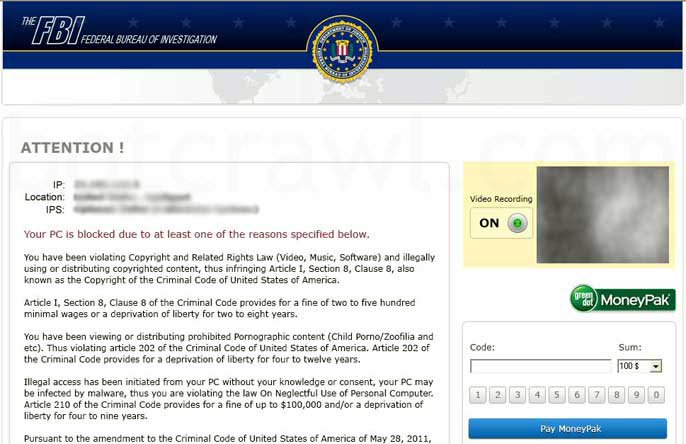
FBI ransomware

After the virus has successfully installed, things immediately go wrong. The ransomware automatically disables a number of key programs that render the computer inoperable by the user. An image will pop up on the screen that is made to look like it’s from a law enforcement agency, like the FBI. The image will tell the user that their computer has been blocked, and they must pay around $200 within 72 hours, or risk arrest for failing to pay a fine for “viewing or distributing prohibited pornographic content”

“Because the compromised individual may have indeed been browsing a pornographic website prior to infection, the message carries some more weight,” the report says. “In addition, the nature of the message may be embarrassing to some, encouraging them to get rid of it at any cost.”

Users tricked by the scheme will then purchase an electronic payment PIN, and enter the number into a box on their computer screen. The hackers can then retrieve the payment. Not surprisingly, however,  the hackers rarely uphold their end of the bargain, and victim’s computers remain locked.

According to Semantic, the number of ransomware infections in the U.S. has skyrocketed over the past few months, jumping from about 1-2 percent of total worldwide infections in March to 20-50 percent of infections, as of September.

Fortunately, there are a number of easy ways to avoid infection. First, don’t click any ads on porn sites. Second, make sure all your programs and plugins (like Flash and Java) are all up to date. And finally, install anti-virus software (this is a good free one), which will easily detect any ransomware and clean it off your machine.


Source : digitaltrends[dot]com

Oct 18, 2012

Meteor Lights Up the Sky Over Northern California

ht meteor shower jp 121018 wblog Meteor Lights Up the Sky Over Northern California

KRON

A meteor lit up the skies over the Bay Area in California in what experts say is debris from Halley’s Comet.

Hundreds of residents from Oakland, San Francisco and Santa Cruz called ABC News station KGO-TV, reporting a loud boom, explosions and streaks of light around 7:45 p.m. local time Wednesday.

NASA.com reported that the 2012 Orionid meteor shower is set to peak Saturday night into Sunday morning.

“Earth is passing through a stream of debris from Halley’s Comet, the source of the Orionids,” Bill Cooke of NASA’s Meteoroid Environment Office said in the NASA.com report.

Excited residents took to Twitter and YouTube to post photos and videos of the streaking comet.

“Happened to look over, saw like a crescent shaped object, reddish orange in color,” Edward Pierce told KGO. “As it went away it started getting larger. Kind of expanding.”

The National Weather Service says warm temperatures and cloudless skies are helping to make the bright lights more visible.

“Basically, you saw small car-sized pieces of rock and metal from the ashtray belt, crashing through layers of earth’s atmosphere, ionizing and setting the air on fire in its wake,” Jonathan Braidman, astronomer at the Chabot Space and Science Center, told KGO.

The Orionids are one of two annual meteor showers produced by icy pieces of Halley’s Comet. The other shower, called the Eta Aquarids, peaks each year in early May, according to NASA.

“Since 2006, the Orionids have been one of the best showers of the year, with counts in some years up to 60 or more meteors per hour,” NASA’s Cooke said.

Halley’s Comet might just be the most famous comet of all time, passing earth every 75 to 76 years. The last time it passed earth and was visible with the naked eye was in February 1986.


Source : abcnews[dot]go[dot]com

Sep 13, 2012

Apple iPhone 5 rumors roundup: what came true and what not

Naturally, prior to its announcement, the iPhone 5 was surrounded by hundreds of rumors. Somewhat unexpectedly though, this time round most of them turned out correct and we knew almost all there was to know about the latest Apple flagship, long before Tim Cook took the stage.

The amount of leaks of hardware parts and accessories as well as reports of iPhone 5′s features that turned out to be true was staggering. In fact we knew more about the iPhone 5 than we knew about the iPhone 4 and back then a real unit escaped the R&D center. There were still a few persistent rumors that turned out incorrect, so we thought we might do a quick round up and see if we’d actually miss any of them.

But first thing first – here’s the list of rumors that turned out correct.

Bigger 4″ screen

First off, the screen. An iPhone with a 4-inch screen was rumored ever since the iPhone 4 went official and we started waiting for the 4S. It didn’t happen last year, but the iPhone 5 finally got the hotly anticipated bump in screen size.

The numerous cases and part leaks also confirmed this multiple times so there were few raised eyebrows when Phil Schiller confirmed it on stage. We even knew that the screen resolution will be changed accordingly and the aspect will be changed. Even the fifth row of icons wasn’t a surprise thanks to the iOS 6 emulator.

Smaller dock connector, redesigned earbuds, two-tone body

The smaller dock connector appeared a few dozen times, along with the new-two tone design, all of which we witnessed at yesterday’s event. We even got to learn the new connector’s name and price prior to the press conference, which is hardly ever the case with Apple’s products.

Aluminum and glass combination. That’s what Apple is using for the new iPhone. It’s cool, but not shocking, and once again we have the leaked parts straight from the factory floors where the new iPhone 5 is made, to blame.

So if the design of the iPhone 5 couldn’t be kept under wraps, what was left for the earbuds that come in its package? Yes, they too shared the destiny of the Lightning dock connector and surfaced well in advance, complete with pricing info and name.

iOS 6, nano SIM and LTE

Those three didn’t even need leaks, really. Everybody knew that the iPhone 5 is going to run iOS 6, it was just a matter of making it official.

The same goes for the nano SIM, which the iPhone 5 uses . Apple fought hard for its version of the nano-SIM standard, so from the moment it was approved, we knew the iPhone 5 would utilize it.

Last year, Apple decided to skip on LTE for the iPhone 4S, but leaving it out of the iPhone 5 would be too risky. Not to mention that most of the latest mobile chipsets support native LTE radio – 4G is no longer eating batteries for breakfast.

It’s named the iPhone 5

Up until Apple sent out event invites to the press, it was hotly debated whether the next iPhone will use the iPad naming scheme and just be called the ‘new iPhone’ or stick to its roots and add a “5″. As the invite for the event confirmed, Apple chose to stick with the numbered iPhones.

Now, let’s review some of the rumors that came out false.

NFC

Slowly but surely, more and more Android and Windows Phone devices started featuring NFC capabilities, but Apple decided to skip it with the iPhone 5. Mind you, their Passbook feature for storing loyalty and gift cards as well as boarding passes and tickets is as ready as it’s ever going to be, but maybe it just isn’t the right time for Apple.

Probably, the guys over at Cupertino are leaving the NFC feature for the iPhone 5S. By then, the technology will be more widely spread and Apple will havemore time to attract more partners and enable NFC-sporting iPhones to do more cool things.

T-Mobile partnership

T-Mobile continues to be the only major US carrier that isn’t offering the iPhone. Although the company teased that people should be expecting exciting news in the near future, it turned out the news isn’t related to the iPhone 5. Bummer, really.

Fingerprint scanning Home button

A fingerprint scanning Home button sounds like something taken out of a spy movie, but some rumors suggested it’s a real possibility. No matter the wow-factor it would’ve brought, many people though its highly unlikely for Apple to go this far with security of the iPhone 5.

But who knows, maybe the iPhone 5S will allow you to not only look like James Bond, but actually feel like one as well?

Apple CEO Tim Cook made an announcement couple of months ago that the company is doubling the security around future products to keep leaks away. The first ever product to go under the umbrella of this promise was the iPhone 5, but ironically almost every part of the new iPhone was leaked.


Source : blog[dot]gsmarena[dot]com

Aug 13, 2012

Arrival Of Google Panda Marks The Beginning Of Content Revolution

The year 2012 has been extremely eventful for Google. With over four updates in the name of Google Panda  and Penguin, Google managed to filter hundreds and hundreds of websites through its advanced ranking factor. Each update was modified as per the results of the previous filter. In this article, I am going to highlight a few things that explain the nature of Google’s Panda in some light. Also, the article will talk about certain measures one can take to keep safe from the search engine ranking disaster.

The Objective

With its recent algorithm updates, Google has attempted to add a slight touch of “human” monitoring to its web relevance algorithms. The system has added factors such as content readability, site bounce rates, and genuine relevance to map the quality of a website. Fortunately, Google has achieved a healthy percentage of success in this attempt. Google Panda has managed to identify user-friendly websites than just web-crawler-friendly websites.

Websites’ Elements That Google Panda Dislikes

Google Panda works like cops. It is not responsible for honoring good quality content but for identifying and punishing poor-quality content. It does not allow low quality websites (having useless links, duplicate content etc), to rank. Unlike other Google algorithms, for Google Panda, keywords is not everything. Hence, if a website has poor quality content or duplicate content on most of its pages then it will definitely go down in the search engine rankings. Now what we need to focus here on, is what exactly defines low quality content.

  • Duplicate content : First of all, it is duplicate content. Google Panda hates plagiarism. It does not believe in providing same information again and again by changing a few words here and there to get a pass from plagiarism detectors.  It needs, fresh, informative and genuine content.
  • Quality of links : Secondly, Google Panda looks at quality of links, a website has received. Also, it will judge the content quality of the sites which are linked to the page. Hence, having safe links of genuine websites that do make sense to your website, is very crucial. Naturally, this is a major challenge for most SEO services providers and website owners.
  • Advertisements:  All SEO services experts and website owners must refer to the fact that the count of advertisements on your page can disturb your page rankings. It is quite surprising to note that Google Panda  may also hurt a high-quality content website’s ranking, if it has extensive Google AdWords program. The idea is to balance advertisements and content on each and every page of a website. This is why most experts suggest to seek assistance of professional Google Panda and Penguin compliant SEO services. 

Avoiding the Panda Slap

The search engine optimization industry calls Google Panda punishment- Panda slap. If you get hit by Panda slap, then not only your Google rankings go down but you also are forced to deal with the whopping loss of 50% of your regular traffic. This will definitely result in a major blow on your overall revenue. Hence, it is imperative to keep safe from low quality articles and weak links.

The conclusion

Google brought Panda algorithm to keep the Internet space free from the crowd of scraper sites. It does that by punishing the websites from which such content is scraped. So, every website owner looking forward to getting ranked must come up with healthy websites. Good quality content, ideal linking and balanced advertising are the initial stepping stones that one must cover.


Source : techtalkafrica[dot]com