Pages

Showing posts with label ultra. Show all posts

Oct 27, 2012

LG launches 84-inch, Ultra HD television at $19,999

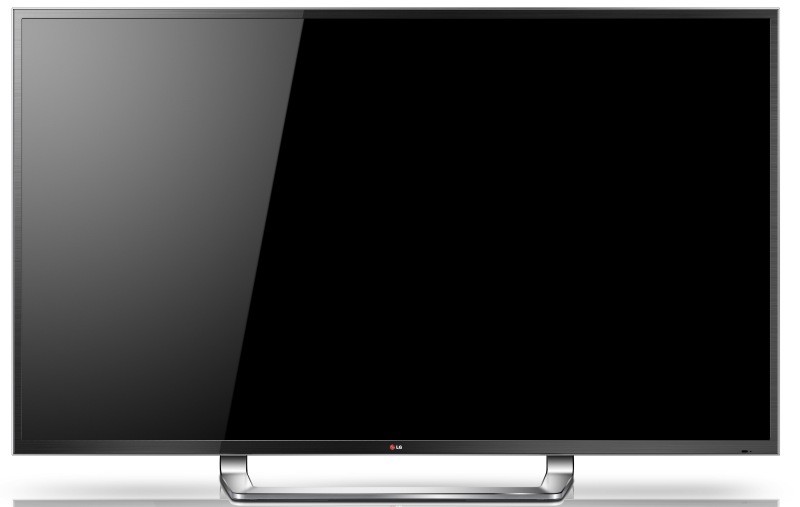
LG Ultra HD 84LM9600 front

Finally transitioning from simply showing off 4K technology at trade shows, LG is now selling an Ultra HD television around the same price as some cars.

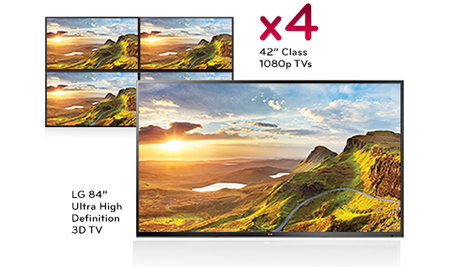
Earlier this week, LG held a launch event in Southern California to debut the company’s first Ultra HD (4K) television at a sizable list price of $19,999. The LG 84LM9600 has a native screen resolution of 3840 x 2160, four times the resolution of a typical 1080p television. While the amount of content available in Ultra HD resolution is incredibly scarce at the moment, the 84-inch LED Ultra HD panel also includes LG’s proprietary “Resolution Upscaler Plus” technology to up-convert 1080p content to the Ultra HD resolution. Regarding size, the 84-inch screen is the equivalent of four 42-inch, 1080p panels stacked in a rectangle shape. 
LG 84LM9600 sideWhile the television does include technology to allow consumers to watch 3D movies, an interesting feature directed at gaming consumers allows two players to play a multiplayer game without the need for split screen. Using glasses that are sold separately, the television is simultaneously displaying two video feeds and each pair of glasses is designed to pick up a specific feed.

In regards to 3D content, LG is including six pairs of flicker-free -glasses with the Ultra HD set. Flicker-free glasses are identical to glasses found within movie theaters, thus it’s inexpensive to add or replace glasses. Similar to other panels in the LG lineup, the company also includes a 2D-to 3D conversion feature with the set.

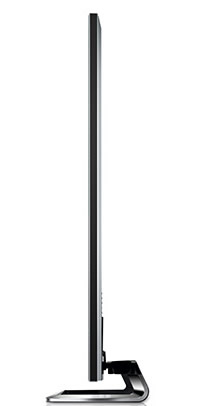
While the massive panel is just 1.57-inches thick, the television is over 150 pounds in weight plus another 25 pounds for the stand. Consumers will have to be careful when wall mounting the LG 84LM9600 which may require professional assistance for installation.

However, consumers won’t have to worry too much about a wired network connection near the home theater as the 84-inch television comes with built in Wi-Fi. The television ties into LG’s Smart TV ecosystem, so consumers will have access to plenty of applications like Netflix, Facebook, Vudu, Skype and Hulu Plus.
LG 84LM9600 sizeThe LG Ultra HD panel includes the gesture system and “Magic remote” found on other LG televisions. Consumers have to make gestures with the remote to interact with menus on the screen in addition to using voice commands. Specific to sound, the television includes a 10-speaker system rated at 50 watts.

The 84-inch panel also has a significant amount of audio and video inputs. Besides four HDMI inputs and three USB 2.0 inputs, the LG set includes an Ethernet port, antenna/cable input, composite audio / video input, component video input, RGB PC input and PC audio input. In addition, there is an optical digital audio output to send audio content to a receiver. 

While the list price on the television set nearly breaks $20,000, the sales price in stores will likely be around $16,999 according to LG management. However, it’s highly unlikely that an online retailer like Amazon will carry the massive television. According to LG’s site, there are currently no online retailers stocking the television yet and it can only be purchased at a handful of high-end home theater stores. To date, the only other Ultra HD television that will be available to consumers this year is Sony’s 84-inch XBR-84X900. However, the list price of Sony’s television is significantly higher. On the Sony store site, the price of the display is $24,999.99.


Source : digitaltrends[dot]com

Oct 26, 2012

Twizy as a fire truck? Renault Twizy EV to be used by Paris firefighters

Say-bonjour-to-Twizy-Renault's-stylish-EV-with-a-petite-price

The ultra-compact Twizy electric vehicle is set to be tested by the Paris fire department as a support vehicle. The specially adapted car will be equipped with emergency response equipment such as fire extinguishers and oxygen tanks.

While most of us are used to seeing firefighters responding to emergency calls in enormous great trucks roaring through the streets with sirens blaring, residents of Paris may be about to witness the tiny Twizy electric ultra-compact tootling out of a fire station on its way to tackle an inferno or some such incident.

Renault, maker of the ultra-small, ultra-light, ultra-short, ultra-cheap, ultra-pretty-much-everything vehicle, this week presented the Paris fire department with a specially adapted Twizy fitted with emergency response equipment such as fire extinguishers, oxygen tanks, a fire suit, a helmet and a first-aid kit. That’s a lot of stuff when you think about it – I hope they’ve left room for the driver.

Co-developed by Renault, Renault Tech and the Paris fire department, the diminutive doorless car – top speed 50mph (80km/h) – is set to be used as a support vehicle for “early interventions ahead of the arrival of more consequential lifesaving equipment,” Renault said in a press release. It will also be used when setting up temporary safety installations at major public events.

Tests will start in November and last for eight months, with the fire department considering the purchase of a fleet of adapted Twizy cars for use across the city.

“This initial prototype is real-life proof of the research and development work carried out together with the emergency services, demonstrating Renault’s ability and determination to innovate to meet the needs of firefighters,” Renault safety officer Claire Petit Boulanger said.

The Twizy was unveiled as a concept car at the Frankfurt Motor Show back in 2009, and went on sale in a number of European countries earlier this year for around $10,000.

How firefighters will feel about jumping into a Twizy after sliding down the firepole remains to be seen. A reviewer writing in the Telegraph recently said when she drove it around London she had “small boys pointing, mothers laughing, men staring.” And hers didn’t even have a siren on the top. Still, if it benefits the work of a firefighter, improves efficiency and is kinder to the environment, it has to be a good thing, right?


Source : digitaltrends[dot]com

Oct 23, 2012

Apple iPad mini enters the compact tablet battleground, faces the Nexus 7 and Kindle Fire HD

Apple just announced their 7.9-inch iPad mini and is now officially ready to enter the fight in the ultra portable tablet market.

iOS is the dominant platform in the large tablet class, but it’s a newbie in the compact segment. So does the Apple iPad mini have what it takes to successfully challenge the already established competition from Google (ASUS) with its Nexus 7 and Amazon with its 7-inch Kindle Fire HD.

We’ve prepared a quick comparison table for you, showing how the iPad mini stacks up against the competition.

 
Apple iPad Mini
Kindle Fire HD
Nexus 7
OS
Apple iOS 6
Android 2.3.3 Gingerbread
Android 4.1.2 Jelly Bean
Display
7.85-inch
IPS LCD
7.0-inch
IPS LCD
7.0-inch
IPS LCD
Resolution
1024 x 768
(163 ppi)
1280 x 800
(216 ppi)
1280 x 800
(216 ppi)
Height
Width
Thickness
200 mm
134.7 mm
7.2 mm
193 mm
137 mm
10.3 mm
198.5 mm
120 mm
10.45 mm
Weight
308 grams
395 grams
340 grams
Processor
1GHz dual-core
processor
A5
1.2GHz dual-core
processor
TI OMAP4460
1.3GHz quad-core
processor
NVIDIA Tegra 3
GPU
PowerVR SGX543MP2
PowerVR SGX540
GeForce ULP
RAM
512 MB
1GB
1GB
Storage
16GB / 32GB / 64GB
16GB / 32GB
8GB / 16GB
microSD card slot
No
No
No
Primary camera
5 MP, 2592×1944 pixels,
autofocus, 1080p video recording
No
No
Front camera
1.2MP Camera
“HD” Camera
1.2MP
Battery Life
10 Hours
11 Hours
10 Hours
Wi-Fi
Wi-Fi 802.11 a/b/g/n, dual-band, dual-antenna
Wi-Fi 802.11 b/g/n
Bluetooth
Yes
Yes
Yes
Network
2G Network GSM 850 / 900 / 1800 / 1900
3G Network HSDPA
4G Network LTE
No
No
NFC
No
No
Yes
Speakers
Mono
Stereo, with Dolby Audio
Mono
Availability
November 2, 2012
Currently available
Currently available
Price
$329 / $429 / $529
$199 / $249
$199 / $249

It’s way to early to be drawing any conclusions, but at first glance it seems that Apple isn’t really understanding what the compact tablet class is about. The way we see it – it’s about getting nicely performing and compact tablets at bargain prices.

Of course, no one was expecting Apple to pack their top-of-the-line A6 chip in the iPad Mini and start selling it for $199. But both the display and the pricing are disappointing. We were hoping to see a higher-res display or at least a more up-to-date CPU that could be relevantly put against the Nexus 7′s and the Kindle Fire HD’s.

Instead, the company that introduced Retina displays announced a 7.9-inch tablet featuring a display with just 162 ppi pixel density for the premium price (for the segment) of $329 (16GB).


Source : blog[dot]gsmarena[dot]com

The name less traveled by: Sony to stick with 4K while the industry turns to Ultra High Definition

Is Sony being stubborn by refusing to conform to the industry standard and use the Ultra High Definition denomination?

Just after news broke that the CEA had standardized the “Ultra High Definition” moniker for the products formerly known as 4K TVs, so too did the news that Sony would be sticking with the 4K title. It would be easy to dismiss this as Sony being obstinate, and to argue that 4K is now a misnomer, but many are sympathizing with the company’s position, which is that it doesn’t want to confuse its customers with the switcheroo.

Its not difficult to understand how Sony’s competitors could be worried about the prospect of their own customers improperly drawing a distinction between Ultra High Definition TVs and 4K TVs. Analysts, however, have also pointed out that, with 8K technology in the pipeline, the industry shouldn’t be using penultimate sobriquets for technologies that could eventually be usurped. It’s also clear that Sony has simply attached the 4K term to more products than virtually anyone else, and consequently, has more to lose by its being phased out. It has created 4K camera’s, a studio that delivers 4K movies, and a 4K-based post-production process, this in addition to a TV and projector that are labeled 4K. All-in-all, it’s clear the whole UHD decision presents a problem for Sony that an industrial-sized bottle of whiteout simply won’t fix.

Despite Sony’s uncomfortable position – rock on one side, hard place on the other – sometimes in business, you’re forced to bite the bullet. Microsoft’s Xbox made an enormous investment in HD-DVDs, as did its consumers - but Blu-Ray won out. A name change just isn’t that devastating to brand like Sony, and you have to wonder if it’s worth bad PR, or creating a lingering issue out of news story that should  have been one news-cycle long. Still, though the move may annoy those who initially called for the standardization, Sony says it must do what’s best for Sony; after all, you don’t become an industry leader by being afraid to go rogue once in awhile. For now, they will continue to market their existing products as 4K and they plan to attach the 4K UHD label to all future releases.


Source : digitaltrends[dot]com

Oct 18, 2012

‘Ultra High Definition’ officially replaces ’4K’ as name for next-gen TV standard

lg-4k

A board of industry leaders recently convened for a meeting in which it was decided that "Ultra High Definition" will replace "4K" as the name for the emerging, next-generation TV and projector technology. The decision was motivated not only by a need for a catchy, recognizable name, but also by the need to avoid potential legal issues.

If you thought the term “4K” referred to some sort of distance race, you aren’t alone. Though more and more TVs and projectors have started adopting the high-res format, most folks still had no idea that 4K was the name that had been adopted to describe what industry experts assert is the next stage in high-definition television. To end that confusion — and tackle legal and marketing issues as well — the consumer electronics industry has settled on a new name: Ultra High Definition.

On Wednesday, during a CEA-sponsored industry forum in San Francisco, a board of industry leaders convened to discuss and vote on a new name for what has been consistently referred to as “4K TV,” officially arriving at Ultra High Definition. 

You can read an in-depth report about the technology here, but here’s the crash course version: 4K refers to a television display capable of producing 4K HDTV relative sizesmore than 8 million pixels of resolution. It is doubles 1080p “Full HD” resolution in width and height, with at least 3,480 pixels running horizontally and at least 2,160 pixels running vertically. It could have been called a number of things. We could call it 2160p (1080p, doubled) or we could call it QFHD (an actual term for resolution, though it lacks a certain…zing) but, 4K has never been an accurate descriptor.

 But there are marketing concerns as well. 4K doesn’t mean anything to most people, and QFHD, what the heck is that? If the industry wants to make this new technology recognizable and understandable on its name alone, it needs its name to resonate with the public at large. If HD is good, then Ultra HD, that must be better, right?Why? The term 4K infers the number 4,000. And if you’re still awake after all those numbers we just threw down, then you may have noticed that 4,000 wasn’t among them. While this may seem trivial, it isn’t. Manufacturers have taken a lot of heat and some big financial hits via class-action lawsuits over misrepresenting the size of their screens. Some TV’s advertised as “40-inches” were actually measuring as little as 38.5-inches. That works out to almost 49 square inches of missing screen real estate. The last thing TV makers need is another reason to get sued. 

Also, this decision needed to take place now — in the technology’s infancy — and swiftly, too. The last thing we need is another Blu-ray vs. HD DVD kerfuffle.  Granted, that industry nightmare involved two different types of technology, not just a name. Still, the amount of confusion it generated among consumers and their resulting reluctance to jump on board resulted in a slowed adoption of high-definition disc-based media that has resulted in a rough road for Blu-ray.

It is the industry’s hope that a clear naming convention will lead to greater mind-share and, therefore, more rapid adoption of Ultra High Definition as the technology becomes more available and, eventually, more affordable. Of course, there’s plenty more work to do to make that happen. A delivery system for Ultra High Definition content needs to be settled on and then there’s the matter of creating content in Ultra HD as well. This is just the beginning, but Ultra High Definition is on the way and we can expect to see plenty of it at CES 2013. 


Source : digitaltrends[dot]com

Oct 12, 2012

SVS Ultra Series loudspeakers aim to redefine bang for your buck

SVS, an Internet-direct company best known for its high-performance subwoofers, has introduced a no-holds-barred loudspeaker family.

SVS has just announced its Ultra Series Loudspeakers, a line it says is built with value in mind. The company claims that the speakers are built to outperform competing brands that cost three, four, or even five times as much. That’s a bold claim indeed.

The SVS Ultra Series employs a small army of speakers that includes the Ultra Tower, the Ultra Bookshelf, the Ultra Center, and the Ultra Surround. We’ll be reviewing the line soon and if it blows our hair back like SVS says it will, we’ll be sure to let you know. 

SVS says its goal is no less than “pure acoustic perfection,” an end it hopes to accomplish through the Ultra Tower’s unique  trapezoidal construction and  its proprietary “ForceFactor” woofer array. The array features two side-firing 8-inch drivers at the base of the tower speakers, horizontally opposed to cancel out cabinet vibrations — a design that, in our experience, does offer cleaner, less distorted bass response with more even room coverage. The towers also feature two 6.5-inch composite glass-fiber midrange drivers and what appears to be a 1-inch tweeter with ring radiator.

The series will begin shipping November 20 — just in time for the holidays. Pricing details are as follows: SVS Ultra Tower $1999 pair; SVS Ultra Bookshelf $999 pair; SVS Ultra Center $699; SVS Ultra Surround $1199 pair. Those price points put the speakers at the pricier end of the Internet-direct speaker spectrum, but if the series can deliver on its promise of ultra performance, this could be the system to beat next year.


Source : digitaltrends[dot]com

Sep 28, 2012

Bass for your buck: SVS’ SB13-Ultra Subwoofer hopes to deliver foundation-shaking sound without breaking the bank

SVS packed all of its expertise into the attractive and value-priced SB-13 Ultra subwoofer

The recently announced SVS SB13-Ultra Subwoofer is all about delivering “extreme bass performance,” but the company says this is also the most “decor-friendly” subwoofer in its Ultra series. SVS is one of the best-reputed Internet-direct subwoofer brands, so when they release a new product, it’s always worth a look. We’ll be reviewing this one soon, but for now, let’s take a look at the specs. 

Added to this iteration of the Ultra series, are a high-powered aluminum voice coil and a custom gap extension plate. The sub also sports a tandem of linear-roll spiders and employs an integrated DSP “Sledge” amplifier. The company also touts the product’s room-size compensation control, which supposedly allows for seamless adjustment to any space, large or small.

The ultimate draw here is bass for your buck. At an suggested price of $1600, the SB13-Ultra offers specs and sound quality comparable to more expensive, high-end subs. It ships September 30, 2012  and – as is the case with all SVS subwoofers – it come with a 45-day in-home trial. If you give it a go, and are disappointed, you can return the product for a full refund, sans the shipping costs.


Source : digitaltrends[dot]com

Sep 26, 2012

Hands On: Fitbit Zip makes your workout adorable

Fitbit Zip

We spent a week with the new Fitbit Zip to see how the little gadget can motivate you to get moving.

When it first appeared on the consumer market, the Fitbit Ultra was one of the pioneer fitness gadgets that sparked the creation of a slew of social health gear, such as the Nike+ Fuelband and the now-defunct UP by Jawbone. Now, Fitbit’s got a more budget-friendly version of its premier device known as the Zip. It’s smaller, cuter, comes in various colors, all designed to make you more aware of everyday health.

Look and feel

Compared to the Ultra, and even the recently announced Fitbit One, the Zip is tiny. The downsizing makes the Zip almost as small as a quarter. And in its silicone, water-resistent case, the device comes out to be about half the length of a business card. The soft case allows you to clip the Zip onto your clothes in case you don’t prefer to throw it into your jeans like you would pocket change.

Fitbit Zip and dongleUnlike the more advanced One, the Zip uses an external rechargeable battery, which needs replacement approximately every six months. The screen also has a tap recognition feature that rotates between the items displayed in response to each tap received. For example, waking the Zip up from blank screen will display the last thing you looked on, which could be anything from Steps Taken, Calories Burned, Time, and Miles Traveled. The Zip also rotates with a strange emoticon that rates its satisfaction level of how much you’ve worked out today. When I first booted the Zip up, it stuck its pixelated tongue out at me, but after several hours of wear, the face changed to a grin and a wide smile. Okay, thanks, Zip.

Since the Fitbit Zip is so small, it is barely noticeable when worn. After a while, you forget it’s even there until someone makes a remark at the Tamagotchi-like creature you have pinned to your shirt. It’s a conversation-starter piece for sure, and the selection of bright colors help you coordinate it with your closet. 

Utility

Fitbit Zip setupAfter you clip it onto your outfit, just resume your day as normal. Later, check back with your Fitbit web dashboard to see how your day is going. When you first set up the device, you have to make sure the Zip is in range of the wireless USB dongle that comes with. A quick installation process syncs the dongle with the Zip, and all you have to do is enter the number that shows up on your device along with your height, weight, age, and gender. Each time you are within the dongle’s range, the Zip updates your activity information to your online account, and continues to do so every 15 minutes.

What’s surprising to me is how accurately the Zip was able to distinguish between walks and my ride on the train to work. Both include fairly physical shakes, but as I watched the Zip like a hawk during my bumpy train ride, the Zip did little to add an accidental step in my total walking count. Once I started walking again, it took a few seconds for the device to register the movement and the numbers sprang back up.

Fitbit Zip activity dashboardThe average person burns approximately 2,000 to 3,000 calories per day. An average New Yorker like myself probably burns more, thanks to the endless fast-paced walks we take daily. I’ve been wearing the Fitbit Zip for about a week, and my daily walks plus normal activities (meeting friends for dinner, cleaning, cooking) comes to a low of 7,400 steps on a regular day and 12,400 steps on a busy one. At this rate, I am walking an average of four miles a day — which isn’t too shabby at all. So how can I make the Zip help me get even fitter?

The Zip definitely works better used in conjunction with its web interface, which allows you set calorie burning goals. The site automatically sets your goal at 10,000 steps a day, but you can adjust this to suit your fitness level. Each time you reach a goal, you also receive a badge as a reward. This gamified process is cute and encouraging, and seeing all your daily activities in a graph helps you feel more motivated to keep things up. If you own the Fitbit Aria scale, the two gadgets are also clearly meant to complement each other to keep your activity level high and your weight low — or at least on track. 

Bottom line

Fitbit Zip 2

There are a few issues with the Fitbit Zip compared to other wearable fitness gadgets. For example, the device relies heavily on being clipped on your clothes or carried around. What abut the calories you burn in the shower, or other, ahem, activities where you’re not required to wear clothes? A gadget like the Nike+ Fuelband would be able to give you an estimate since it’s worn as a wristband, but the Zip is best for walkers and runners. Of course, at just $60, you have to accept the Zip’s lack of features and realize that’s what you get for skimping out an extra $90.

The Fitbit Zip is a great introductory gear for those who want to exercise more with minimal effort. When you wear a fitness gadget, your subconscious just becomes infinitely more aware of your daily activities. You want to please the tongue-sticking face on that little device, and if that means taking 2,000 more steps in a day, you’ll do it. I do believe the science is purely in your head, and a constant reminder that sits in your pocket is a nice way to start. The Zip is designed to keep you motivated to move, and will make a neat gadget to treat yourself with, or as a gift for those looking to have more fun with fitness.


Source : digitaltrends[dot]com

Sep 17, 2012

Fitbit announces two new fitness devices: One and Zip

Fitbit One

Welcoming the new season, Fitbit is releasing two new fitness activity tracker gadgets -- one to replace its famous Ultra and another for the budget-conscious.

Fitness gadget competitors may have to rethink their pricing strategies now that Fitbit has unveiled two new devices for the season. Following Fitbit’s premier gadget, the Fitbit Ultra, the company is now releasing the One and Zip — both updated to run with Bluetooth 4.0 support so you can wirelessly sync with the latest smartphone models such as the iPhone 4S/5 and Samsung Galaxy S3.

The Fitbit One, the more expensive of the two, is meant to be a major improvement and replacement over the Ultra. The One has a slightly curvier design and contains a clip that holds securely to your clothes to make sure you don’t misplace your pricey gear. It integrates a vibrating silence alarm to wake you up without disturbing your partner. Like the Ultra, the One not only follows the walk, steps, and calories burned in a day but also doubles as a sleep tracker to note the times you fall asleep and when you wake up. In a single charge, the One’s battery reportedly lasts between five to seven days with a battery indicator right on the LED screen. You can currently pre-order the device at $100 in your choice of Black or Burgundy colors, with a shipment date of around mid-October.

Fitbit OneIf $100 seems like to much to fork over at the moment, Fitbit will also offer a budget alternative. The Fitbit Zip is a $60 version that offers the basic fitness tracking functionalities as the One, just sans-sleep tracking and vibrating alarm. The tiny gadget (which looks a bit like a Tamagotchi toy — remember those?) also measures to just about the size of a quarter, and uses a replaceable battery so USB ports here. Fitbit estimates that the Zip’s battery will last approximately six months.

Fitbit Zip colors

The Fitbit Zip is available in five colors — magenta, lime, blue, charcoal, and white — and features a plastic, water-resistant body perfect for those wearing this during sweaty workouts. The device also connects to an online Fitbit account to keep track of your fitness activities online. When used in conjunction with the refreshed iOS and Android app, you can cheer on your Fitbit friends’ activities and view a leaderboard of who’s burning the most calories or losing the most weight. Like all previous Fitbit accessories, the accompanying online account offers gamified rewards such as badges for achieving certain weight loss goals. The Fitbit Zip is up for purchase today at the Fitbit official site.

Will the devices stack up to the likes of its competitors, such as the increasingly popular Nike+ Fuelband? Only time will tell.


Source : digitaltrends[dot]com

Aug 22, 2012

LG launches world’s first 84-inch, 4K 3D TV in Korea

LG has launched the world’s first 84-inch ‘Ultra Definition’ 4K 3D TV in Korea, with plans to release in international markets soon. This gigantic panel has a resolution of 3,840 x 2,160, which is basically four times the resolution of a 1080p display.

The TV, which is named 84LM9600, comes with LG’s Cinema 3D and a whole bunch of other features with 3D in the name. You also get a pair of passive 3D glasses for viewing the 3D content.

While on paper, this display sounds fantastic, but the reality is that there is very little 4K resolution content available at the moment, which means most of the time you’ll be looking at 1080p content quadrupled to its original size, on an 84-inch panel. This, along with the 25 million won (US$22,105) price tag, makes the whole thing hard to swallow. But if you’re someone who has loads of money to spend and want the absolute best TV to watch all the videos you shot using your RED Scarlet camera then this should make a great buy.

The LG 84LM9600 is out in South Korea right now and will be available in North America, Europe, Asia, and Latin America starting in September.


Source : blog[dot]gsmarena[dot]com