Pages

Showing posts with label source. Show all posts

Nov 9, 2012

7 Google Android Apps to Protect Your Phone from Virus

Google Android is one of the most popular operating systems in the mobile world. As an open source platform it allows others to modify the system files and develop applications. Unfortunately this can result in security threats to the very device that stores all your personal information. Protecting your personal data is easy with one of these free securities and antivirus applications offered for Android.


Antivirus Free
The Antivirus Free application will protect your phone from any malicious apps and viruses by discovering new apps installed on your system and cross-referencing them with a database. The app will request certain permissions which all for an easy installation and function.

Avast! Mobile Security
This application is a fully featured antivirus and anti-theft security application. The avast! application has an automatic virus scans and alerts for infected URL’s. In addition, if your phone is rooted you can add a firewall, control anti-theft features with remote SMS commands.

AVG Antivirus free

The AVG Antivirus is a free security application that protects your smartphones and tablets in real-time, from any viruses, malware and spyware or online corruption. In addition, this app has a task killer, phone locator, app lock and real-time scanner.

Dr.Web Antivirus Light 
This application will not effect your mobile phone operating system performance or reduce the batter life. Dr. Web Antivirus Light uses a distinctive process for discovering new virus families based on previous threats which reduce the size of the virus database.

Lookout Security & Antivirus
On a daily and weekly basis the Lookout application will scan your mobile phone for viruses. In addition, Lookout will scan the root folder of your mobile phone and solve any other problems relating to holes in security.


NetQin Mobile Security & Antivirus
The NetQin application identifies new applications installed and check a database for malicious apps. The functions and use are practical and user-friendly. In addition, there is an anti-theft feature which will allows you to track your robbed phone through Google Maps.

Zoner Antivirus Free
The Zoner Antivirus application provides protection against trojans, worms, spyware, adware, malware and viruses. In addition, the application offers theft protection which enables you to control remotely your device through SMS messages.

It could be devastating if your mobile phone is lost, stolen, or compromised by a virus. It is free and easy to protect all your information stored in your Google Android with one of these antivirus applications.

Tags: Anti-theft Security, Antivirus Free, Automatic Virus Scans, Avast! Mobile Security, Dr.Web Antivirus Light, Google Android Apps, Lookout Security & Antivirus, Mobile Phone Operating System Performance, NetQin Mobile Security & Antivirus, Security Holes, Trojan Worms, Zoner Antivirus Free

Source : techtalkafrica[dot]com

Oct 19, 2012

iPad mini mockup pictures leak from Vietnam, look almost like the real deal

A new iPad mockup has appeared in Vietnam courtesy of a China-based accessories company, which obviously uses the mockups to create various smart covers and cases.

According to the source, the iPad mini will feature a 7.85″ 4:3 aspect ratio display and two speakers at the bottom. The Lightning connector is naturally featured here too.


iPad mini model

Although we can’t really be sure if the mockups are credible they do give us a placeholder in our minds of what the iPad mini could be.

The display doesn’t seem all that realistic given the super-sized icons but it is just a model and not the real deal.

There’s a home button under the display (in portrait mode), a camera on the back, and a volume control key and volume rocker, all of which make the supposed iPad mini a classic-looking iPad.


iPad mini model

Not long time left until October 23 now. Excited?


Source : blog[dot]gsmarena[dot]com

Oct 17, 2012

Visual.ly plays matchmaker between infographic designers and data-hungry companies

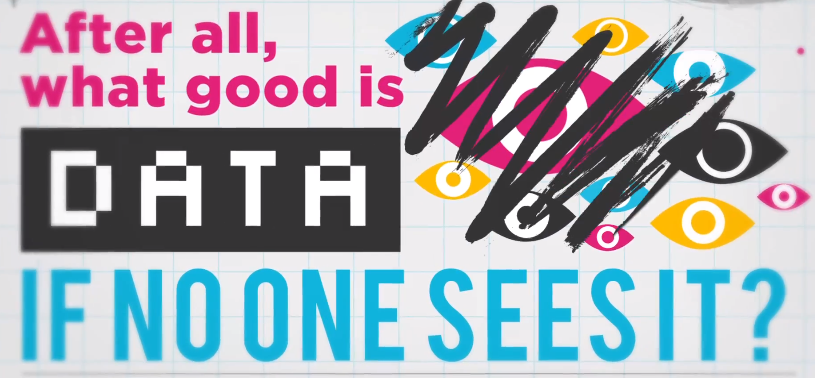
what good is dataThere’s no denying the grip infographics have on us. These bite-sized, data-packed, visual stimulants have become a news source in their own right. They’re easily shared, easily consumed – not to mention easy on the eyes.

One startup that’s been there since the beginning of this infographic heyday is Visual.ly. The company got its start with the help of design-heavy financial app Mint, where founders Lee Sherman and Stew Langille would translate money-related data (which, to put it kindly, it’s the most exciting stuff on earth) into colorful, fun, informative graphics. From there, Visual.ly was born, since positioning itself not only as a go-to for infographics but also as a hub for users – as well as talented designers – to flex their creative powers.

Now, Visual.ly, which sees about two million visitors a month, is taking the next step in its platform dreams by launching its Marketplace to match infographic creators with interested outlets. “This is the biggest launch we’ve had since originally launching the company,” says Langille, who serves as CEO. “It brings together the community we’ve carefully developed over the last year and a half.” Visual.ly has already become a place for designers to find new jobs, but now it’s refining the management and process behind all this.

Langille says Visual.ly has amassed some 50,000 designers, thousands of data journalists, and data analysts, and the site’s new marketplace will play matchmaker by connecting them with the clients who want what they’re selling. And the demand is high: Visual.ly says commissioners, generally brands and agencies (including the likes of The Economist, Pepsi, and CBS) are hungry for a piece of the infographic action.

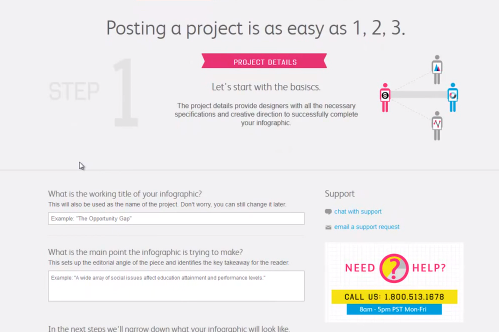
The marketplace isn’t just a one-stop infographic shop, either: Commissions and creators are connected based on Visual.ly’s algorithm, which reads design and graphic tastes to find the best match. “We get as much information as we can on the style that [commissioners] are looking for so we can match them with the designers and creators best suited to them,” Langille tells me. Clients can pull in whatever sort of documentation they want – Excel files, Google Docs – in order to get their project started.

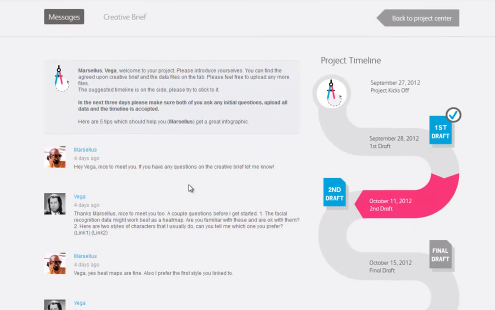
visually step 1From there, designers and commissioners are set up with the platform’s project management system and led through the creation process, where feedback and changes can be logged and tracked. Drafts can be uploaded and approved as well, all in real-time. It’s all presented in a timeline format, where both parties can set and use deadlines and adhere to budget and timing constraints. Visual.ly also handles payments through its system (part of the project will be paid up front to ensure creators get paid).

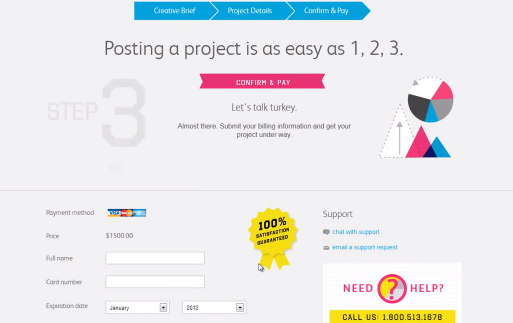
visually step 3What Visual.ly’s trying to do here is make the infographic smarter. While they’re inarguably popular, jury’s still out on its effectiveness. There’s some criticism that our love of these drive-by data visualizations means more and more poorly-sourced, ill-conceived, misleading, and downright false infographics are virally spreading around the Web.

And let’s face it, exclusivity can have its benefits. Infogr.am is one application that puts infographic creation into any and all users hands, and while that snappy premade template with your own supplied info might impress your coworkers or look real nice on a term paper, there’s something to be said for the research-hungry, data-happy journalists and analysts who make sourcing their livelihood and what they can do for the medium.

visually timeline

Of course, using these resources is optional: There will be different options, depending on a commissioner’s needs. You can supply data yourself, or bring in journalists and analysts to help you craft your story. Still, quality and originality are of the most important, and Visual.ly promises a 100 percent money-back guarantee – and with infographics starting at around $1,500, they’re wise to. “We’ll let the community dictate this price,” Langille says. “This is just the launch price, we’re trying to establish this but the market will determine where the price is set. We’re going to be very flexible, we just wanted some structure at launch.”

It might sound steep, but it makes Visual.ly a legitimate option for graphic artists and data types who need an outlet for their work. And given the design-hungry state our Web is currently in, following this trend isn’t a bad bet. The Visual.ly marketplace opens its public beta today, you can sign up to create or commission work here. 


Source : digitaltrends[dot]com

Oct 15, 2012

This cellphone makes a better use of a sugar rush than you ever will

A concept phone utilizes sugary drinks as the power source for a cellphone, making the battery biodegradable.

I’ve been trying to quit soda for the past few weeks thanks to too many hours on Reddit and constant streams of photos that displayed how much sugar was in a can of Coke. As a result, there are untouched cans of soda sitting my fridge with no one to claim them, but it felt irresponsible if I just gave them to the kids next door. If only this eco-friendly concept cellphone existed. The design, by China-based Daizi Zheng, claims that a Nokia phone could be powered solely on sugary drinks. Now there’s an interesting use of leftover Coke that’s much more excitable than cleaning the rust off my pennies.

According to Zheng’s thesis, the phone would contain a chemical board that can form a reaction to utilize sugar enzymes and carbohydrates and convert them into electric power. The phone would work with most sugary drinks; in fact, more sugar means longer battery life. When the sugar and carbs are all used up as battery, you’re left over with a liquid that’s biodegradable, and the phone can be cleaned, refilled, and reused once again.

“Bio-batteries are fully biodegradable and have, on a single charge, a potential life-span three to four times longer than conventional lithium batteries,” Zheng writes on his website. Keep in mind, however, this design would be used with a basic, barebone phone, so no sticky touchscreen and apps here.

Coke powered nokia phone leftover liquidSince the design aims to be environmentally-friendly, it’s probably better to use straight sugar water than Coke or other packaged sodas, considering how they tend come in plastic bottles or cans — both of which are already pretty expensive to recycle. Still, it would be cool if the phone doubled as a drink bottle so you can choose to either gulp your soda or conserve it for more phone battery. This rationale would force the user to pick between drinking an unhealthy beverage or forgo it for the sake of your gadget’s usability. However, since the sugar disappears as the phone uses up the battery, it is unlikely that the soda you do end up drinking from the phone would taste any good. We also have to wonder if the fizzy noise would interfere with your sugar high calls.

It’s an interesting approach at multi-purposing a notorious food item, and such a gadget would make a neat science experiment for kids to learn about the wonders (and potential harms) of what sugary drinks means to them, and the chemical world.


Source : digitaltrends[dot]com

Sep 28, 2012

More Americans read news online than anywhere else, new survey says

More than half of all Americans use the Internet as their primary news source, a new study has found, with one third of adult Americans getting their news from social networks more than any other outlet.

An increasing number of all Americans use the Internet as their primary news source, a new study has found, with one third of adult Americans getting their news from social networks more than any other outlet. Is this a victory for the power of social media, or a sad commentary on the ineptitude of “regular” news media?

The Pew Research Center released the study Trends in News Consumption: 1991-2012 yesterday, tracking the ways in which readers and viewers receive information about current affairs over the last twenty-one years. The report backs up the long-held belief that the rise of the Internet has been felt most dramatically in print media, and print newspapers in particular, and demonstrates that television news reporting looks set to be affected in a similar way very soon, with the first signs already visible.

According to the most recent survey of news sources, only 23 percent of Americans read newspapers today, down from 47 percent in the year 2000; this drop is reflected outside of newspapers, with print magazine consumption also dropping from the year 2000 (18 percent of respondents read news magazines today, down from 26 percent in 2000). In comparison, 46 percent of Americans now get their news from the Internet at least three days a week, with 34 percent having done so in the 24 hours prior to answering the survey (That figure grew to 39 percent when cell phones and other mobile devices are factored in). That 46 percent figure is up from 37 percent for the same question when asked just two years ago, and apparently made up of young people with higher education (65 percent of online news junkies are college graduates, with only 22 percent of them ages 65 or older).

Even more impressive is the rise of social media’s importance in the news landscape. “The percentage of Americans saying they saw news or news headlines on a social networking site yesterday has doubled – from 9% to 19% – since 2010,” the report points out, adding that “among adults younger than age 30, as many saw news on a social networking site the previous day (33 percent) as saw any television news (34 percent), with just 13 percent having read a newspaper either in print or digital form.” Facebook is by far the most successful of all social sites, with 41 percent of all adults using it regularly for news, compared with just 13 percent for Twitter.

Social networking sites have a far higher news penetration than other sites you may have thought would be more traditionally popular; compared with the 33 percent who get their news from social media, only 12 percent read news blogs on a regular basis, with just 5 percent listening to news podcasts. This may be considered a lesson for Huffington Post and other news sites: Perhaps it’s time to just start using Facebook and save yourself the costs of a website.


Source : digitaltrends[dot]com

Sep 16, 2012

The end of MP3? Opus Audio Codec promises better sound with less bandwidth

The open-source Opus Audio Codec could transform what we hear and how we hear it on the Web.

 Opus chart

Did you know there was such an Internet Engineering Task Force?  Turns out, there’s a “large open international community of network designers, vendors, and researchers,” whose mission is to organize, codify, research and document evolving standards for online applications.  And this week, they approved the Opus Interactive Audio Codec as a new standard for online audio, in a move that may improve the sound of everything from streaming radio to VoIP calls, even as it lowers prices.

The Opus codec was developed by a consortium of researchers from Mozilla, Xiph.org, Skype, Microsoft, and Broadcomm. Previous audio codecs have been optimized for specific uses – MP3 for music, SILK for voice, and so on –– but Opus promises better sound for everything, no matter how low your bitrate.  Opus switches between different codecs based on how much bandwidth it detects, so it can reduce latency and drop-outs on any connection.

Even more exciting than how Opus works is how it’s been developed.  Although plenty of patents have been filed around the technology, all the companies involved in Opus have committed to making the codec royalty-free, with an open-source code base. 

The commitment to an open-source implementation isn’t just hippie good vibes. While MP3 has made a lot of downloaders happy, it’s a patented codec, and anyone who uses it has to pay a licensing fee to the patent-holders.  That means anyone who wants to build an MP3 distributor, an MP3 player, or even a game that uses MP3 to stream its audio can’t make free software, because they’re in hock to the rights-holder as soon as their program is used. If you’ve ever wondered why Apple got into the audio-codec business with AAC, this is a big part of the answer; few companies hate seeing money leave the building like Apple. 

Christopher Blizzard, who’s worked in development at Mozilla, Red Hat, and Facebook, embraces the open-source ideal. “You can still build a Web browser, spider, client, Web server, image editor, a JS library, a CSS library, an HTML editor, a Web publishing system, commerce system – anything that is based on fundamental web technologies – without asking anyone for permission… This is why we’ve had billions of dollars of investment and a fundamental shift in the way that western society acts and communicates – all in the course of a very short period of time. The Web grew up on Royalty-Free.”  So the fact that the most popular audio and video codecs are licensed has a lot to do with the clumsy, thudding progress of online video and audio, including the fact that we still can’t have streaming video on a website without going through a host like YouTube.

Opus won’t solve that problem overnight, but it promises a way forward.  The codec’s slick rebuffering means its first implementation will be plugin-free voice and video chat directly through a Web browser. Firefox supports native playback of Opus files, and Google is working on implementing it in Chrome. And of course, Skype is enthusiastically rolling the codec into the next version of its software. Expect to hear better sound for less money in future browsers, phone apps, and desktop software as the codec freely gives itself to anyone who asks.


Source : digitaltrends[dot]com

Room to Grow: No More Room in Hell devs talk Steam Greenlight success

steam greenlight

NMRiH Dev Team talks Steam Greenlight and the future of Source Engine mods on Valve's Steam store.

No More Room in Hell is coming to Valve’s Steam. Why? Because you demanded it. At least, that is, if you’re one of the 54 million registered users on Steam and you also happened to participate in Steam Greenlight, Valve’s new community-based game selection process. One of the initial ten selections from the Greenlight program to be added to the Steam store, No More Room in Hell says a lot about what games will make it through the selection process. Digital Trends caught up with No More Room in Hell’s creators to discuss Steam Greenlight, its shaky launch, what opportunities the service offers independent developers, and how Steam will help the game reach an even bigger audience.

“We planned since the very second Greenlight was announced that we would try it if it was open to Source Engine mods,” says David Meade of the NMRiH Dev Team, “We didn’t know if sourcemods would be allowed on the platform. At QuakeCon2012 this year I knew a few names from Valve were attending and I wanted to know more about Greenlight. I ended up talking to Chet Faliszek [about Greenlight] in a little more detail. We exchanged emails, he told us to go for it, and it paid of quite well for us in the end here.”

Like every other developer on Greenlight though, Hell was buried beneath a wave of spam, prank, and offensive game submissions. It was rough, but Meade’s confident Valve will work out Greenlight’s kinks. “You saw the issues with spam and hiccups with percentages changing every time you refresh the page. It’s going to be some time before it’s perfect but overall we believe the service has real potential.” That isn’t to say there aren’t things that can be fixed though.

“As it is you can’t submit a game as a group, only as an individual. If you were able to say link it to a steam group or at least add moderators to manage the page it would have made things easier to manage on our end.”

Even with PC Magazine naming it mod of the year in 2011, there are still many people who never had the chance to play Hell. “The game is free, we just want people to play it and enjoy it so being on Steam will make that a much more achievable goal for us, says NMRiH Dev Team’s Matt ‘Maxx’ Kazan, “Greenlight will allow us to open up the game to a much wider audience of people who might not even know it exists.

It’s more than just a ready made audience though. As Steam has done for PC gaming in general, Greenlight will help make mods like Hell and other selectees like Black Mesa easier to run for less tech savvy players. “I don’t know if you’ve ever tried installing a sourcemod before but it can be quite confusing and frustrating for beginners,” says Meade, “We try our best to explain in detail where to download how to install etc. It’s never enough. Steam fixes all of that as it allows us to auto patch. One click download and install and you’re done.”

No More Room in Hell won’t be available on Steam right away, as the team is still trying to sort through a number of technical and legal issues to get the game available. Details on the road to reaching a broader audience. Congratulations again to the NMRiH DevTeam and the other initial Greenlight selectees.


Source : digitaltrends[dot]com

Sep 11, 2012

Digital publisher BlueToad claims to be unwitting source of leaked Apple UDIDs

BlueToad, a digital publishing company, has said it was the unwitting source of last week's leaked Apple UDID codes.

The story of the Apple Unique Device Identifiers, or UDID codes, leaked by hacking group Anonymous last week, has taken another turn. This time, rather than blanket denials, someone has owned up to being the unwitting source of the codes themselves. And it’s not the FBI.

NBC reports that the database of one million UDID codes came from BlueToad, a digital publishing company based in Orlando, Florida, that has a library of nearly 150 apps — primarily niche print magazines converted over for digital use — for both the iPhone and the iPad inside the iTunes App Store.

BlueToad’s attention was drawn to the missing UDID’s by security researcher David Schuetz, who documents his sterling work uncovering the source of the leak in a blog post.

He contacted BlueToad and told them of his suspicions, and the company launched an investigation, resulting in a 98-percent correlation between BlueToad’s database and that of the leaked UDIDs.

BlueToad’s CEO, Paul DeHart said “that’s 100-percent confidence level, it’s our data.”

Subsequently, DeHart published a statement on the company’s blog, saying that “a little more than a week ago, BlueToad was the victim of a criminal cyber attack, which resulted in the theft of Apple UDIDs from our systems. Shortly thereafter, an unknown group posted these UDIDs on the Internet.”

BlueToad is now working with law enforcement agencies in the ongoing investigation into the leak. To help put its business partners and the public’s minds at ease, it says it has fixed the vulnerability that allowed the UDIDs to be stolen, and has stopped storing them inside its database. BlueToad had already followed Apple’s directive to cease reporting UDIDs from its apps.

Case closed?

It would certainly seem so, as both the FBI and Apple have stated the leak didn’t come from them, and BlueToad seems convinced it’s the source. Taken at face value this way, the story now reads that hackers affiliated with Anonymous and working under the Operation AntiSec name, stole UDIDs from BlueToad’s computers, then published them saying they came from a larger file obtained from an FBI Agent’s laptop.

Agent Christopher Stangl was implicated due to his involvement with operations against Anonymous and LulzSec, as proven by his presence during a conference call that Anonymous claimed to have eavesdropped back in March.

After all, the easiest and most logical explanation is most likely true.

However, those who don’t like to connect the dots in this way will undoubtably have alternative theories. For example, the FBI could be working with BlueToad (although we can’t imagine for what reason), or the company is taking the fall — it is after all, completely innocuous — at their behest.

Even David Schuetz isn’t convinced this is the end of the story, and questions whether BlueToad is the original source, or a secondary leak.

A member of Anonymous, seemingly unfazed by the recent developments, took to Twitter to say simply “FBI-notebook – There is still no evidence. Stay tuned.”

For now at least, we’d say the file on this one needs to remain open, but on hold.


Source : digitaltrends[dot]com

Sep 7, 2012

How Online Games Affect Brain Development

Ever since the video game industry has become a multi-million dollar industry, it’s been targeted as a source of negativity. When they were off the radar, video games were just a simple form of entertainment, or a means of pushing technology to the next level, but once large amounts of money become involved, the world of gaming evolving into an industry just like any other. With all the negative attention, scientist have devoted studies to understanding the effect that video games can have on a person’s brain.

Online Games can have a Positive Influence 

Recent studies show that video games can affect a persons attitude in a positive manner, while influencing their behavior as well. These studies have created interest in what is known as serious games or games intended to affect the players health. Results have led researchers to believe that the understanding of the engaging elements of video games, might increase the chances of developers creating gaming experiences that influences positive and healthy behavior.

Many research results believe that the active participation in video games develop positive motivation in ways that looking and listening to information doesn’t. In turn this participation can affect various behavioral activities in the non-virtual world.

Online Games can teach Teamwork 

Online games that call for teamwork can help people to develop their communication skills for real world situations, which is obviously useful in busy work environments. The games that have social content in which players assist each other non-violently also affect a persons attitude when dealing with people.

Simply put, video games have an affect on the brain, depending on what games you choose to play. For people that indulge in a lot of violent video games, showing little emotion to violence can become a habit.

Creative Thinking and Problem-Solving 

Many video games, even violent ones, have players think of various ways to get out of certain situations efficiently. With almost every game out today, a person’s timing is enhanced, and in shooting games, the hand to eye coordination, and awareness of an area are also improved. Shooting games are also used for realistic military training, in order to learn procedures and strategic planning. Just like guns, this could be used for positive, safe military training.

Playing online video games has trained people to take in information quickly and use it to respond quickly in tense situations. This is noticeable in really elaborate and intense online role playing games that requires players to remember various locations, multiple actions and combinations in order to be successful in the game.

Social Responsibility

Some news that parents may appreciate is that a majority of the gaming industry has recognized the responsibility they have for the results that their work has on gamers. A lot video games now offer more challenging objectives and higher quality graphics to keep a players interest that helps to avoid focusing on any violence in the game. These type of games communicate valuable lessons about organizing, strategizing and taking responsibility, while providing an immersive form of entertainment.

Bio:  Marcela De Vivo writes about internet technology for ParkingGames, an online game that people can use to develop their parking skills.  She also loves meditation, hot yoga, and digital photography.

Tags: Gaming Online, Internet games, Online Games

Source : techtalkafrica[dot]com

Sep 2, 2012

HP keeps its promise, launches beta of Open webOS

Open webOS beta running in Ubuntu

HP finally does right by webOS, giving it a home as an open source platform.

Though it gave up on any plans to continue its Pre and TouchPad hardware collection, HP has managed to keep webOS alive. We’ve known for a while that HP wanted to introduce an open source version of webOS, but its recently made it official by finally releasing the beta version after keeping us waiting for eight months.

The news was released via a blog post on an Open webOS branded site. The website looks like it features the original webOS font (nice touch) and includes some documentation pertaining to the new software. If you’re interested in looking it over, the source code can be found on the site and on Github. An example of Open webOS beta can be seen above, running on a Ubuntu machine. The screenshot captures the trademark card view that made multitasking on webOS such a pleasure.

“It has taken a lot of hard work, long hours and weekend sacrifices by our engineering team to deliver on our promise and we have accomplished this goal,” the developers write in the post.

Open webOS comes with two different build environments: a desktop build and an OpenEmbedded build.

The desktop build provides a way for developers to play around with new features and technologies bundled with the OS on a Ubuntu PC. The OpenEmbedded build, on the other hand, allows webOS to be ported to “new and existing devices.” There are no specific devices named in the article, but hopefully this will be clarified sooner rather than later. However, it would make sense for Open webOS to play nice with Android — its open source peer — and perhaps even make it super simple to revamp Android apps to run on Open webOS. 

Although there is one piece of hardware that’s definitely able to run the beta software. The webOS-Ports team have come together to make Open webOS simple to install on the short-lived TouchPad using Preware software. If you’re still using a TouchPad and for some reason don’t want it to run Android, the update may be worth it you. Apparently the beta version includes a bunch of new features, gestures, and card-based functions.

According to the blog, the beta release of Open webOS comes with 54 components and totals over 450,000 lines of code. It all falls under the Apache 2.0 license, which the developers call “one of the most liberal and accepted in the open source community.”

All in all, Open webOS may breathe new life into the ailing platform. Just don’t expect to see it be picked up with the same ferocity as Android once was. Sadly, those days are well behind us.


Source : digitaltrends[dot]com

Sep 1, 2012

Online paywalls are becoming more popular with newspapers

New York Times Paywall

Definitely a flourishing revenue source for some print publications, using the online paywall is catching on among major newspapers.

According to a post on Media Life Magazine, three hundred newspapers around the United States has placed a paywall on the online version of the publication. With a bit under 1,400 daily newspapers left in the United Stated according to a Pew study, that means approximately one fifth have adopted a paywall to prevent free access to articles published online. While large organizations like The New York Times, Wall Street Journal and Los Angeles Times led the charge with the transition to the paywall structure, the majority of the newspapers adopting the revenue building format have been much smaller. Gannett Company, the parent company for eighty newspapers, announced plans to roll out a paywall on all properties accept for USA Today. Lee Enterprises and McClatchy, two other major parent companies for newspapers, have also announced plans to launch metered paywalls in various markets.

L.A. TimesAccording to Mashable, The New York Times had about half a million digital subscribers around July 2012 and have seen moderate growth in the subscriber base over the past fifteen months. With digital subscriptions priced between $15 to $35 each month, that means the Times is bringing in approximately $7.5 million to $17.5 million dollars each month off digital subscriptions. Over an entire year, the figure would be somewhere in between $90 million to $210 million. In addition, limiting online access is partly responsible for the eight percent increase in circulation revenue of the print version over the last quarter.

The structured paywall plans that The New York Times offers are focused on different types of mobile access. While the full $35 monthly fee provides access to the Times on all mobile devices, readers can also choose between a smartphone plan or a tablet plan. For instance, if a reader only wanted to read The New York Times on their iPad, they would have to pay for the $20 version of the paywall. Alternatively, smartphone users get a cheaper rate at $15 likely due to the smaller screen size.

Chicago TribuneThe Chicago Tribune has plans to roll out a new version of the site this year and will require users to register in order to “access premium features such as columnists, reviews, in-depth and investigative reporting and new content from outside news sources.” Anyone that hasn’t registered for the site will still be able to access breaking news and other basic content, but will be closed off from other portions of the site. 

One major major newspaper that’s continuing to resist a transition to the online paywall system is the Washington Post. According to GigaOm, the Post is extremely different from other newspapers. Rather than being able to encourage an increase in circulation revenue of the print version by limiting access to the site, the majority of the Posts’s online visitors are outside the Washington D.C. area.

Since the Post only circulates in print around Washington D.C., there’s no upside to limiting access to the site. Rather than invest in a technology that limits readership, management at the Post have been developing ways to increase Web readership through social channels. The Washington Post‘s Facebook social-reader app, for instance, is designed to bring more traffic from Facebook to the site.


Source : digitaltrends[dot]com

Aug 29, 2012

25 Best Websites of 2012

25 Best Websites of 2012

The Internet has become a major source of entertainment, social media, ideas and tools. This year, many new sites have blown up and become the big hit. Other sites have continue on to be some of the most visited sites for years. Here are the best websites of 2012:
1. Google:
With Gmail, google voice and google plus, everything from searching, communicating and sharing interesting ideas is available on one site.
2. Twitter:
Twitter’s popularity is growing, especially in 2012. Twitter is a place to share what;s up in your life quick and easy.

3.Facebook:
The number one social media site provides everything from sharing news, photos, and much more with your friends.

4.Youtube:
Youtube is still growing in popularity, and is taking place of the TV with awesome media.

5.Tumblr:
Tumblr is a major blogging site for teens and adults looking to share their interests.

6.Pintrest:
Pintrest blew up just this year. It allows you to “pin” your favorite pictures and things, and create your own portfolio of what you love.

6.Yahoo news:
People love to catch up on the latest news, and Yahoo is the place to do it this year.

7.Pandora:
Pandora is an interesting way to find new music. It gives you new songs to listen to based on your music taste.

8.Yahoo! Omg!:
The best site for gossip and news in the Hollywood lights!

9.Amazon:
Amazon is the perfect place to purchase all you want for a cheaper price. It’s the worlds largest e-commerce website.

10.Brotips:
Brotips is a fun and quirky site filled with tips for guys in a picture form. It’s entertaining and fun to read.

11.Dropbox:
A free service allowing you to share and save your photos, documents and more in one place.

12.Wikipedia:
Wikipeda is still a top website in 2012 for all of the information you could ever need.

13.Craigslist:
Craigslist is a way to shop in your area for used or new products, or even things such as homes and cars.

14.Flickr:
Love photography? Flckr is the best place to post your pictures and view others without copyright problems.

15.Metrolyrics:
Metrolyrics is a simple spot to find lyrics.

16.Hubpages:
An easy way to publish and earn money.

17.About:
About is a guide to all you need to know, whether you need information on ab workouts or the the top schools in the country.

18.Paypal:
Paypal is the safest place to store your money, send it and use it to purchase online.

19.Photobucket:
Store your photos and share with others on photobucket.

20.Groupon:
An easy website to find great deals and discounts on items, events and vacations.

21.Match.com:
Now you can search online and become compatible with someone nearby through match!

22.Allrecipes.com:
The best site for a wide selection of amazing recipes.

23.Hulu.com:
Watch your favorite TV shows and movies online, some even for free, with Hulu.

24.Etsy:
Etsy is a new site dedicated to selling and buying handmade goods.

25.Livestrong.com:
Find health and exercise tips for any sport!


Source : techtalkafrica[dot]com